Key Takeaways
- AI in K-12 education is already grading assignments, flagging learning gaps, and adjusting difficulty in real time. It’s not replacing teachers, it’s clearing space on their plates.
- Schools that start with one narrow use case, say automated grading or an adaptive practice app, tend to get further than schools that try to overhaul everything at once.
- Personalization is the real shift here. Thirty students used to get one lesson pace. Now the system can adjust for each of them individually.
- Governance and data protection matter just as much as the AI itself. Most pilots that stall didn’t fail because of bad technology, they failed because nobody set the ground rules first.
- AI tutors, multimodal classroom tools, predictive support, all of it matters less than whether a school actually knows what problem it’s trying to solve before adopting any of it.
Walk into a classroom today and there’s a decent chance software is quietly doing something a teacher used to do by hand. Flagging which kids are falling behind in fractions. Adjusting a reading passage’s difficulty mid-lesson. Drafting the first pass of feedback on thirty essays so the teacher can spend their evening on something other than red pen marks. That’s AI in K-12 schools in practice, and behind these applications is AI development focused on making learning more adaptive, personalized, and efficient. It’s a lot less flashy than the headlines make it sound.
The numbers back up how fast this is moving. Grand View Research puts the global AI in education market in the billions already, with strong compound annual growth projected through the rest of the decade, and K-12 institutions are a meaningful part of that growth alongside higher ed.
So what does this actually look like day to day, where’s it working, and how should a school that isn’t sure where to start actually begin? That’s what this piece walks through.
What Is AI in K-12 Education?
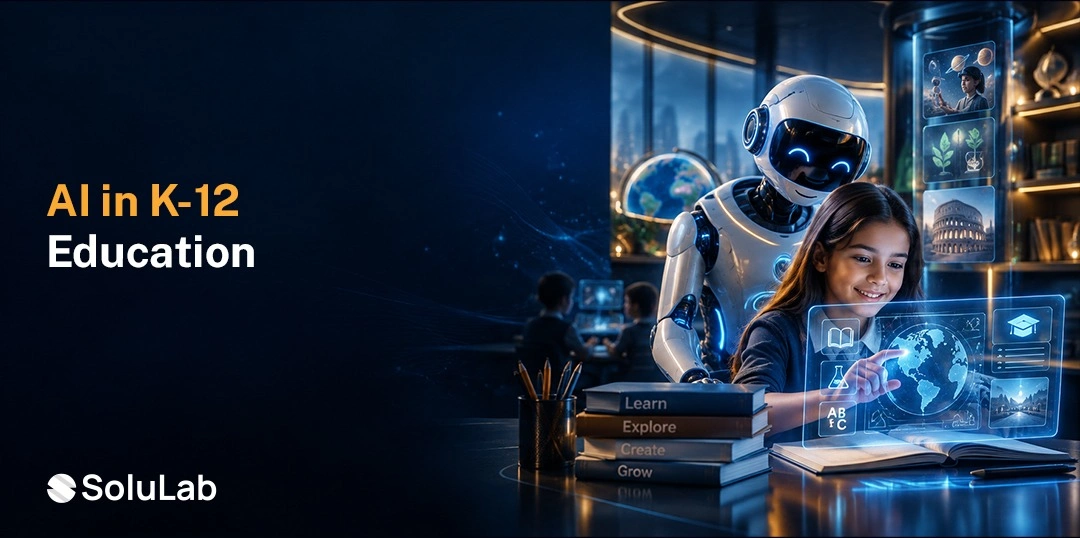
Here’s the short version: AI in K-12 education means software using machine learning, natural language processing, or predictive analytics to support teaching and learning for students roughly five through eighteen years old.
Broad on purpose, because the range is genuinely wide, everything from a chatbot answering a parent’s question about pickup times to a system quietly recalibrating a math worksheet based on yesterday’s results.
Two categories tend to get lumped together that really shouldn’t be. Instructional AI covers adaptive practice platforms, tutoring assistants, and tools that personalize what a student sees next.
Operational AI covers grading, attendance, scheduling, and administrative chatbots. Both fall under AI classroom applications, sure, but they’re solving different problems, and any school evaluating a vendor should know which one it’s actually trying to fix before signing anything.
In the 2024–25 school year, 6 out of 10 teachers used AI for their work. Teachers mostly used AI to:
- Prepare lessons – 37% used it every month.
- Create worksheets and activities – 33% used it.
- Adapt learning materials – 28% used it to better meet students’ needs.
How AI Personalizes Student Learning
This is where most of the excitement comes from, and honestly, it’s also where the artificial intelligence technology is furthest along.
1. Student Performance Data
Adaptive platforms track more than the final grade. They watch which question types trip a student up, how long they hesitate before answering, where they guess versus where they actually know the material. That data is the raw material everything else runs on.
2. Adaptive Difficulty Levels
Get five multiplication problems right in a row, and the sixth one steps up. Miss three in a row and the system eases off before frustration takes over. Simple concept, but doing it manually for thirty kids at once just isn’t realistic for one teacher.
3. Personalized Assignments
Instead of handing every student the same worksheet, the platform generates variations matched to where each one actually is. Stronger students get extension problems. Students who need reinforcement get scaffolding instead of being told to “try harder.”
4. Individual Feedback
Feedback lands immediately, not the next day, and it’s specific to the actual mistake rather than a generic “review chapter 4.”
5. Learning Pace Optimization
Some students finish a unit in two days. Others need two weeks. Adaptive systems let both happen without forcing the whole class onto one clock, something that’s basically impossible to manage by hand across a full classroom.
Benefits of AI in K-12 Education
Put the AI use cases above to work, and a few concrete benefits show up pretty quickly.
- More Personalized Learning: Each student gets a path that fits their actual level, not a lesson plan built for the “average” kid who doesn’t really exist.
- Faster Teacher Workflows: Grading, lesson planning, progress tracking- all of it takes a fraction of the time it used to.
- Better Identification of Learning Gaps: Patterns a teacher might not catch for weeks show up in a data dashboard within days.
- Improved Accessibility: Text-to-speech, live translation, adjustable pacing- these make a classroom usable for a lot more kids than a static lesson plan ever could.
- Data-Driven Decision-Making: Administrators get to see what’s actually working instead of relying on gut feeling or whichever teacher happens to speak up in a meeting.
- Greater Student Engagement: Interactive tools tend to hold attention longer than a worksheet, especially for kids who’ve already checked out of traditional formats.
Gartner’s work on ed-tech adoption has flagged something worth sitting with: the schools seeing real returns are the ones that changed how teachers actually work, not the ones that just bolted a new tool onto an unchanged process. The software matters less than what a school does with the time it frees up.
How Schools Can Implement AI Responsibly
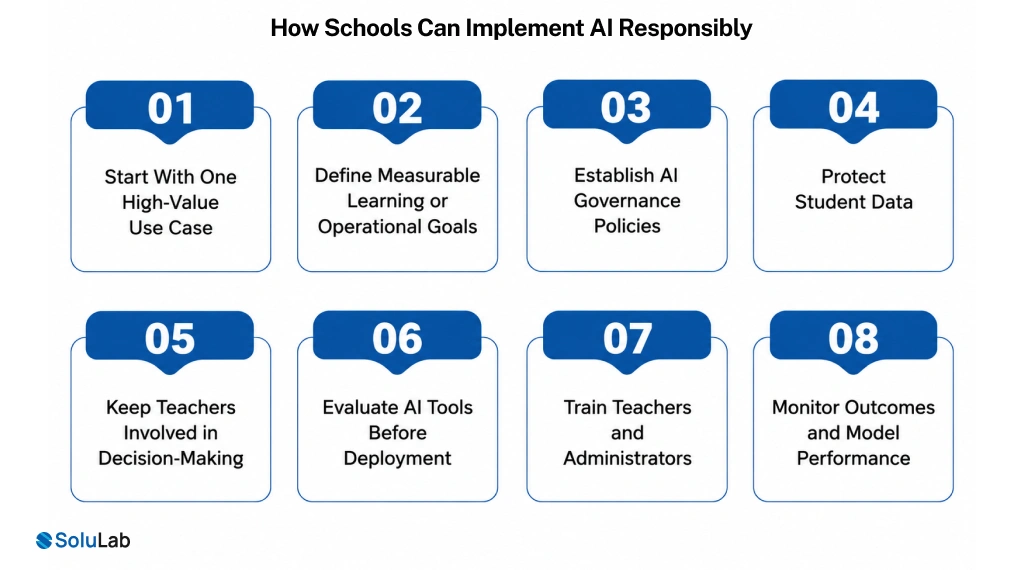
None of this works well if the groundwork gets skipped, and this is usually where things go sideways.
- Start With One High-Value Use Case: Pick whatever’s causing the most pain right now; grading load and intervention identification are common starting points, instead of trying to fix five things simultaneously.
- Define Measurable Learning or Operational Goals: Know what success actually looks like before you start. Hours saved, faster gap detection, higher engagement, whatever’s genuinely measurable.
- Establish AI Governance Policies: Set rules for what data the tool touches, who reviews what it produces, and how errors get corrected when (not if) they happen.
- Protect Student Data: FERPA and similar rules aren’t a checkbox. A vendor should be able to explain, in plain language, exactly how student data gets stored, used, and eventually deleted.
- Keep Teachers Involved in Decision-Making: Teachers know which classroom problems are real versus theoretical. Leave them out of the decision, and you’ll likely end up with a tool nobody actually uses by spring.
- Evaluate AI Tools Before Deployment: A slick vendor demo doesn’t tell you much. Pilot with a small group and see how it holds up against real classroom noise.
- Train Teachers and Administrators: Even a well-designed tool needs real training. A fifteen-minute webinar the week before launch is not training.
- Monitor Outcomes and Model Performance: AI systems drift over time. What worked in month one might need adjusting by month six, and somebody has to actually be watching for that.
Top Use Cases of AI in K-12 Education
his is the part that actually matters most: where AI shows up in a real school day, what it’s replacing, and what it’s not. Each of these is being used at real scale right now, not as a pilot in a single lab classroom.
1. Automated Grading and Assessment
AI grades multiple-choice and short-answer work instantly, and it can now handle a first pass on essays too, flagging structure, grammar, and argument coherence for teacher review rather than replacing that review entirely. This is probably the clearest example of AI grading and assessment already running at scale, and it’s usually the first use case a district tries, because the time savings are immediate and easy to measure.
What it actually changes day to day: a high school English teacher grading 150 essays a week can offload the mechanical pass spelling, grammar, structural completeness — to software, and spend their own grading time on the things a rubric can’t fully capture, like voice, argument quality, and whether a student actually understood the assignment. The software flags issues; the teacher still decides what the grade means.
For example, Newark’s public schools use Khanmigo (Khan Academy’s AI tool) to give students quick feedback on their writing. Teachers still hand out the final grade, but the first pass is faster.
2. Adaptive Learning Platforms
Software that adjusts pacing and difficulty per student, covered in more detail above, showing up mostly in math and reading right now, where skill progression is easiest to model algorithmically. A platform tracks correct and incorrect answers, response time, and hesitation patterns, then recalculates what the student should see next, in real time, without a teacher manually re-sorting the class into groups.
The clearest measurable impact shows up in intervention timing. Instead of a teacher noticing three weeks into a unit that a student never grasped fractions, the system flags the gap after the second or third missed problem, while there’s still time to intervene before it compounds into the next unit.
For example, DreamBox Math is now in over 4,000 school districts. And one of its new campuses became the top-ranked first-year school in California among high-poverty schools just two years later.
3. AI Tutoring and Homework Help
Chat-based AI tutors are available after school hours, walking a student through a problem step by step instead of just spitting out the answer. The better implementations are built to withhold the final answer and instead ask guiding questions, closer to how a good human tutor operates than to a search engine.
This use case leans heavily on the same underlying technology as conversational AI for education more broadly: natural language understanding that can interpret a student’s actual question, not just match keywords, and respond in a way that’s age-appropriate and pedagogically sound rather than just technically correct.
4. Administrative Automation
Scheduling, attendance, routine parent messages, all handled by AI so office staff can focus on things that actually need a human. This is the least glamorous use case on this list and also one of the highest-ROI ones, since it frees up hours that were previously spent on repetitive, low-judgment tasks.
More sophisticated versions of this are moving toward genuine AI agents for education systems that don’t just execute a fixed script but can reason through a multi-step task, like coordinating a schedule change across a student’s whole day when one class gets moved, or triaging an incoming parent question and routing it to the right staff member automatically.
For example, some New Mexico school districts now let an AI chatbot handle absence calls. When a kid misses school, it texts the parent and asks why, then requests a doctor’s note if needed. Parents actually respond to it, over 60% of the time, way more than they ever did to robocalls.
5. Early Intervention and Learning Gap Detection
Predictive models catch students at risk of falling behind well before a report card would ever show it, by watching patterns across attendance, assignment completion, and performance trends rather than waiting for a single bad test score to trigger concern.
This is arguably the highest-stakes use case on this list, because the entire value proposition depends on the model being right, and right early enough to matter. A false negative here means a student who needed help doesn’t get flagged; a poorly calibrated model that over-flags creates alert fatigue for the staff meant to act on it. Districts that get this right usually start with a narrow, well-validated indicator (chronic absenteeism, for instance) before expanding into broader academic risk scoring.
For example, A free tool from the American Enterprise Institute predicts which kids will become chronically absent before it actually happens. Tested on real data from Indiana and Rhode Island, it got it right nearly 9 times out of 10.
6. Accessibility Tools
Real-time captioning, text-to-speech, and live translation support students with disabilities and English language learners in ways that used to require a dedicated one-on-one aide for every lesson. This is one of the areas where the case for AI adoption is least controversial, since the technology is filling a genuine accessibility gap rather than replacing a judgment call a teacher used to make.
Elementary schools working with students who have IEPs are already using these tools to let kids access grade-level content at their own pace. In districts with a growing number of English language learners, real-time translation is cutting down the lag between a lesson being taught and a student actually understanding it, instead of waiting for a bilingual aide to become available.
Schools like USC and the United Nations International School use an AI tool called Wordly to translate IEP meetings and parent conferences live, no interpreter needed. Parents who don’t speak English can finally follow along in real time.
7. Student Engagement Tools
Gamified practice apps and interactive simulations that respond to how a student is doing in the moment, a growing corner of AI student engagement tools. These tend to work best as a supplement to core instruction rather than a replacement for it useful for practice and reinforcement, less useful for introducing genuinely new concepts.
A smaller but growing number of districts are experimenting with immersive learning with metaverse and AI for subjects like history or biology, where a 3D walkthrough of a cell structure or a historical site genuinely beats a flat diagram in a textbook. This is still early-stage compared to the other six use cases here, but the engagement data from initial pilots is promising enough that it’s worth watching over the next two or three years.
Some districts are pairing these with conversational AI for education, letting kids ask questions in plain language instead of hunting through a menu. A smaller number are experimenting with immersive learning with metaverse and AI for subjects like history or biology, where a 3D walkthrough genuinely beats a flat diagram in a textbook.
Challenges and Limitations to Watch For
None of this is without friction, and pretending otherwise would be dishonest.
Cost is real, especially for smaller or underfunded districts where even a modest per-student software license adds up fast across a whole school. Teacher buy-in is its own hurdle: a tool rolled out without proper training or without addressing legitimate concerns about job security tends to sit unused, no matter how good the underlying technology is. Data privacy is a live issue too, not a theoretical one, since these tools are often processing sensitive information about minors, which raises the compliance bar considerably compared to most enterprise software.
There’s also a quieter risk worth naming: over-reliance. If a student never struggles because the system always smooths the path, are they actually learning resilience, or just getting really good at a system that adapts to them? That’s a genuine open question in the research, not something with a clean answer yet, and it’s worth a school thinking through before rolling out adaptive tools everywhere at once.
AI in K-12 Education: What Comes Next?
The next few years will probably bring more sophistication rather than more disruption.
- AI Tutors and Agentic Learning Assistants: Tools that don’t just answer a question but track a student’s progress across weeks and proactively suggest what to review next.
- Multimodal AI for Classrooms: Systems processing text, voice, and images together, useful in subjects like science where a diagram carries as much weight as the explanation.
- AI-Powered Learning Ecosystems: Instead of five disconnected tools, schools are moving toward integrated AI-powered learning ecosystems for CBSE schools and similar curricula, where grading, personalization, and reporting all pull from the same underlying data.
- Predictive Student Support: Earlier, more accurate flagging of at-risk students, not just academically but around attendance and engagement too.
- More Personalized Curriculum Delivery: Curriculum adapting unit by unit based on how a student actually learns, not just problem by problem.
- Growing Focus on Responsible AI and Governance: Statista’s surveys on ed-tech adoption show a rising share of administrators naming data privacy and governance, not budget, as their top concern when evaluating new AI tools. That suggests procurement is about to get more rigorous, not less.
For schools building or customizing something rather than buying off the shelf, this is usually where custom AI development for schools and broader AI solutions for education enter the conversation, tailoring a system to a specific curriculum or student population instead of bending a generic platform to fit.

Conclusion
None of this replaces a good teacher, and the schools getting real value out of AI aren’t chasing every new tool that shows up in their inbox. They’re picking one actual problem, grading load, gap detection, accessibility, whatever it is, and solving it properly before moving to the next thing. AI agents for education and conversational tools are only worth adopting when they’re fixing something a teacher or administrator was already struggling with by hand.
If your school or district is trying to figure out where to start, SoluLab, an AI development company, can help your business scope a pilot that actually fits your curriculum and your students.
FAQs
Neha is a curious content writer with a knack for breaking down complex technologies into meaningful, reader-friendly insights. With experience in blockchain, digital assets, and enterprise tech, she focuses on creating content that informs, connects, and supports strategic decision-making.