Key Takeaways
- AI Agents for Education are autonomous, policy-aware systems that personalize learning, automate admin work, and support decision-making across schools, universities, and online platforms.
- Deloitte’s 2026 State of AI and Higher Education trends show institutions shifting from experimental AI tools to “agentic AI” that is embedded in core teaching, student services, and operations.
- Gartner’s 2026 higher education predictions highlight AI readiness, data governance, and architecture as critical prerequisites before scaling AI Education Agents across the institution.
- Major use cases for AI agents in educational organisations include tutoring, course planning, admissions triage, student success coaching, faculty assistants, and back-office automation.
- Well-designed educational AI agents can save teachers several hours per week on grading, lesson prep, and communication, freeing time for deeper student engagement and support.
- Custom AI agents for educational use cases require careful design around data privacy, ethics, academic integrity, and local regulations, especially in higher education and K–12.
- SoluLab, as a specialist AI Agent development company, delivers end-to-end AI Agent development solutions for schools, universities, and edtech platforms, from discovery and architecture to deployment and long-term optimization.
Artificial intelligence is beginning to reshape how students learn, educators teach, and institutions manage academic operations. Among the most impactful advancements are AI agents, intelligent systems that can understand goals, make decisions, automate tasks, and provide personalized support with minimal human intervention.
From serving as virtual tutors and learning assistants to automating administrative workflows and student engagement, AI agents are helping educational institutions address growing demands for personalization, accessibility, and efficiency. As schools, universities, and edtech companies explore new ways to improve learning outcomes, AI agent development is emerging as a practical tool for delivering more adaptive and responsive educational experiences.
In this blog, we’ll explore how AI agents are being used across the education sector, their key benefits, real-world applications, implementation challenges, and what the future of AI-powered learning could look like.
What Are AI Agents in Education?
AI agents in education are goal-driven systems that can perceive context (through data and interactions), reason about it, and then take actions or make recommendations within defined guardrails.
Unlike simple chatbots, these educational AI agents can chain together multiple steps, retrieving content, applying institutional rules, updating systems, and involving humans when needed.
How AI Agents for Education differ from basic AI tools?
- They are persistent “digital colleagues” that remember context across interactions.
- They act across systems (LMS, SIS, CRM, content repositories), not just within a single app.
- They follow institutional policies, grading rules, privacy policies, academic integrity rules encoded as guardrails.
- They can collaborate with humans: escalating issues, recommending actions, and capturing approvals.
Examples include:
- AI Education Agents that guide students through course selection and degree planning.
- AI Agents in Higher Education that support research administration, grant management, or compliance workflows.
- AI agents for educational institutions that coordinate between admissions, finance, and student success teams.
How Do AI Agents Work in Educational Environments?
At a high level, AI agents for educational organisations follow a simple loop:
- Perceive – Ingest signals from students, teachers, systems, and content (e.g., LMS data, assessments, attendance, helpdesk tickets).
- Reason – Use large language models and rules to interpret goals, constraints, and context.
- Act – Take steps such as answering questions, generating personalized learning paths, updating records, or prompting a human decision.
- Learn – Improve over time based on feedback, performance metrics, and institutional policy updates.
Core components of AI agent solutions in education
- LLM “brain” for natural language understanding and generation.
- Tooling layer to interact with LMS, SIS, CMS, HR, and analytics systems.
- Retrieval layer to access curriculum, policies, handbooks, and knowledge bases.
- Guardrails and policies to enforce academic integrity, privacy, and safety.
- Observation and feedback via logs, dashboards, and human review loops.
As an AI Agent development company, SoluLab typically designs an AI agent architecture that sits alongside existing LMS and SIS systems, layering intelligence over current platforms rather than forcing institutions to rip and replace.
AI Agents vs Traditional AI Tools in Education
Before 2024, most AI in education use cases were tool-centric: single-purpose apps for grading, quiz generation, or study help. By 2026, institutions are moving toward AI agent solutions that orchestrate multiple tools and workflows.
Comparison: AI Agents vs Traditional AI Tools
| Aspect | Traditional AI Tools | AI Agents in Education |
| Scope | Single task (e.g., generate quiz) | Multi-step workflows (e.g., diagnose gaps, recommend resources, notify teacher) |
| Context | Limited session memory | Persistent, multi-session context per learner or process |
| Integration | Often standalone apps | Deeply integrated with LMS, SIS, CRM, HR, and analytics |
| Autonomy | User-driven | Can proactively act, suggest, or escalate within guardrails |
| Governance | Basic settings | Policy-aware: data access, academic integrity, compliance rules |
| Value | Local efficiency gains | End-to-end process transformation and decision support |
Deloitte’s 2026 State of AI in the enterprise research notes that organisations seeing the biggest gains are those moving from “AI point tools” to agentic AI embedded in core processes, and education is no exception.
Major Use Cases and Applications of AI Agents for Education
AI Agents for Education can be deployed across the student lifecycle and institutional operations. Below are high-value AI use cases we see in our work with clients worldwide.
Student-facing educational AI agents
- Adaptive tutoring agents that explain concepts, generate examples, and provide practice tailored to student level and pace.
- Study companion agents that help students plan revision schedules, keep track of deadlines, and summarize key points from lectures.
- Admissions and advising agents that answer program questions, provide eligibility checks, and offer self-service guidance before routing to human advisors.
Teacher- and faculty-facing AI Education Agents
- Lesson planning assistants that align content with curriculum standards, student levels, and learning objectives.
- Assessment and grading agents that pre-score assignments (especially short answers and essays), highlight discrepancies, and surface patterns requiring intervention.
- Content re-authoring agents that adapt materials for different reading levels, languages, or accessibility needs.
SoluLab’s article on How AI in Education Helps Teachers Save Time illustrates how these agents can automate grading, lesson planning, and classroom management, giving teachers back hours each week to focus on high-value interactions.
Institutional and back-office AI agents
- Enrollment and financial aid agents who triage queries, gather required documents, and guide applicants through complex processes.
- Student success and retention agents that monitor risk signals (attendance, grades, engagement) and trigger timely outreach.
- Operations and procurement agents that streamline purchasing, contract review, and vendor management in educational organisations.
Deloitte’s higher education insights highlight that institutions that “reimagine” core processes with AI, rather than just digitizing them, see significantly higher ROI and agility.
Key Benefits for Teachers, Students, and Institutions
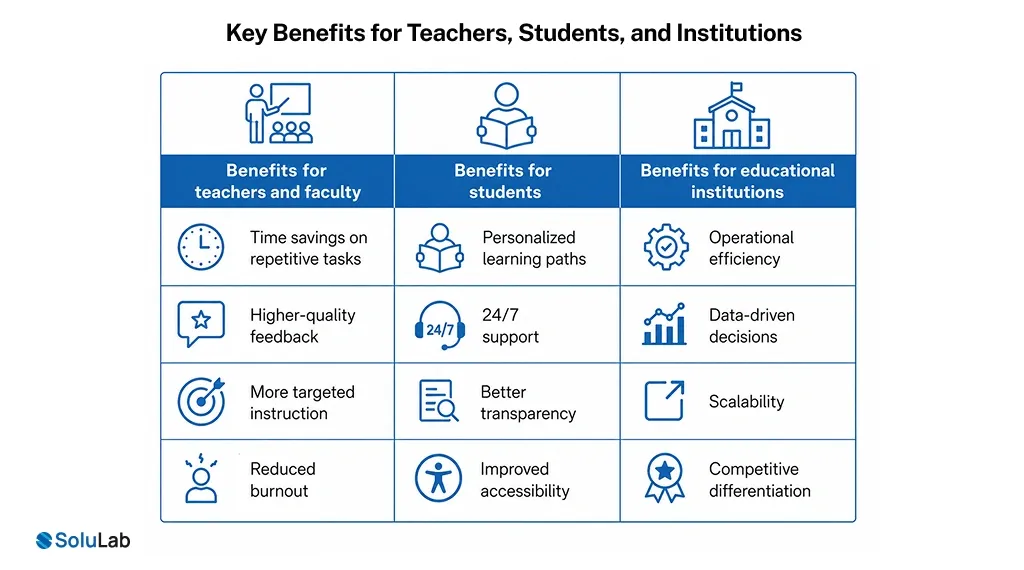
5.1 Benefits for teachers and faculty
- Time savings on repetitive tasks, such as grading, providing feedback drafts, and handling administrative communication.
- Higher-quality feedback through consistent rubric application and suggestions that teachers can refine instead of writing from scratch.
- More targeted instruction thanks to real-time insights into student performance and gaps.
- Reduced burnout as AI agents absorb low-value admin and coordination work.
According to SoluLab’s 2026 analysis of AI in classrooms, roughly half of surveyed educators already use AI to support lesson planning and materials creation, with a growing shift toward agent-based systems that integrate across tools.
5.2 Benefits for students
- Personalized learning paths tuned to pace, prior knowledge, and goals.
- 24/7 support via conversational educational AI agents, especially valuable for online learning and working students.
- Better transparency around progress, strengths, and areas for improvement.
- Improved accessibility through language support, reading-level adjustment, and multimodal content.
A 2026 global survey of AI in higher education found that students report higher engagement and clarity when AI agents help them navigate complex systems like course registration, degree audits, and financial aid.
5.3 Benefits for educational institutions
- Operational efficiency: automated triage, routing, and responses in admissions, student services, and IT helpdesks.
- Data-driven decisions: unified views of learner journeys and operational metrics driven by AI agent logs and analytics.
- Scalability: ability to support more students, programs, and modalities (hybrid, online, micro-credentials) without linear headcount growth.
- Competitive differentiation: modern, AI-augmented experiences that attract digital-native learners and international students.
AI Agents in Higher Education and Online Learning
Higher education institutions are under pressure from shifts in enrollment, changes in funding, and rising expectations for flexible learning. AI Agents in Higher Education are emerging as strategic assets rather than experimental pilots.
Where AI Agents in Higher Education Deliver Impact
- Program discovery and enrollment: AI agents that guide prospective students from initial interest to application submission.
- Advising and degree planning: AI agents that simulate “what-if” scenarios for course selection, prerequisites, and graduation timelines.
- Research and compliance support: AI agents that help faculty navigate grant requirements, ethics protocols, and reporting.
- Lifelong learning and alumni engagement: AI agents for online learning that support alumni in upskilling and career transitions.
Gartner’s 2026 predictions for higher education urge CIOs and provosts to focus on foundational data quality, governance, and architecture before scaling agentic AI across the institution, to avoid fragmented, hard-to-manage deployments.
AI agents for online learning providers
AI agents for online learning platforms can:
- Personalize course recommendations and learning paths.
- Offer always-on chat-based tutoring and troubleshooting.
- Automate assessment feedback at scale.
- Monitor engagement and trigger interventions when learners fall behind.
SoluLab’s work with online universities and MOOC platforms often combines AI Agents in Higher Education with AI agent development for universities’ continuing education and corporate training units, enabling unified learner experiences across multiple brands and programs.
Building Custom AI Agents for Educational Use Cases
Every institution has unique processes, policies, and student populations. That makes custom AI agents for educational use cases far more powerful than generic “one size fits all” bots.
Key design considerations
- Role clarity: Is this agent a tutor, an advisor, a back-office assistant, or a multi-role “hub”?
- Data scope: Which systems and content should the agent access (and which should it explicitly avoid)?
- Autonomy level: What can the agent do autonomously versus actions that must be suggested or escalated?
- Persona and tone: How should the agent speak to students vs faculty vs staff?
- Compliance and ethics: How will the agent respect academic integrity, regulatory boundaries, and cultural norms?
Why partner with an AI Agent development company?
A specialist AI Agent development company like SoluLab brings:
- Experience with LMS/SIS integrations, education data models, and consent regimes.
- Pre-built patterns for AI Agents in Educational Organisations (e.g., admissions, advising, teaching support).
- Knowledge of cross-jurisdictional privacy and compliance requirements in K–12 and higher education.
- Mature processes around evaluation, monitoring, and continuous improvement.
Step-by-Step Implementation Guide for Educational Organisations
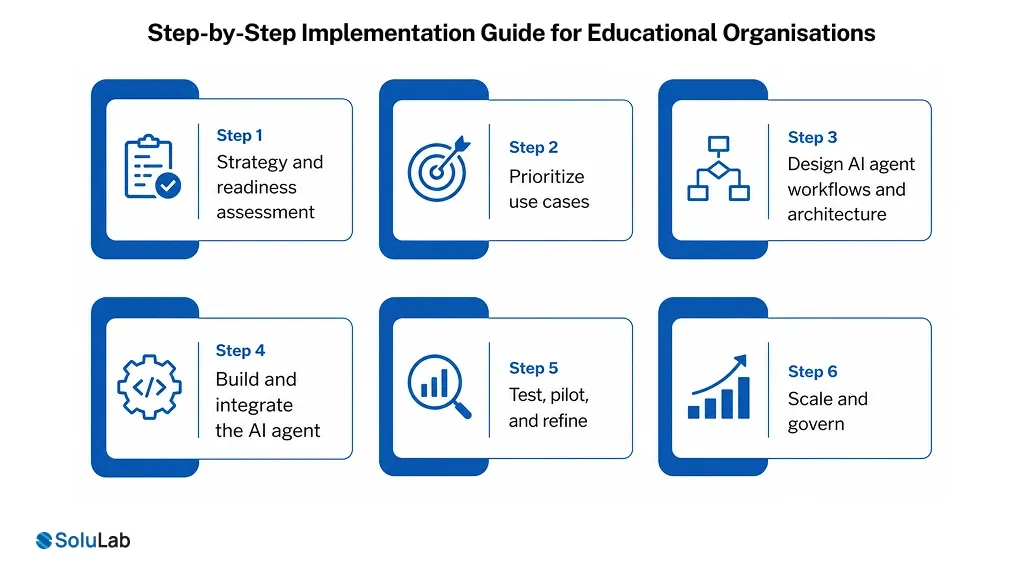
For schools, colleges, and universities, we recommend a phased approach to AI agent development for schools and universities.
Step 1: Strategy and readiness assessment
- Clarify objectives (e.g., reduce teacher workload, improve student retention, modernize online learning).
- Audit data quality and system landscape (LMS, SIS, CRM, HR, content systems).
- Identify policies and constraints (privacy laws, accreditation, union agreements).
- Align leadership stakeholders (academics, IT, operations, legal).
Deloitte and Gartner both emphasize that AI readiness, especially data governance and architecture is the single biggest predictor of value from agentic AI initiatives in 2026.
Step 2: Prioritize use cases
- Rank use cases by impact, feasibility, and risk.
- Start with “small, sharp wins” that are easy to measure, such as AI Education Agents for FAQ and triage, or teacher assistants that automate grading and planning.
- Balance student-facing and staff-facing pilots to build trust across the ecosystem.
For teacher productivity, SoluLab’s article on how AI in education helps teachers save time offers a strong starting point for use-case ideation.
Step 3: Design AI agent workflows and architecture
- Define user journeys and agent “jobs to be done.”
- Map data flows, integrations, and permissions.
- Decide on hosting model, model providers, and security requirements.
- Design governance: review processes, escalation rules, and logging.
Step 4: Build and integrate the AI agent
- Implement retrieval pipelines from LMS, content libraries, and policy documents.
- Integrate with systems of record (SIS, CRM, HR, ticketing).
- Encode institutional policies as guardrails and constraints.
- Build interfaces (chat widgets, portals, mobile, embedded widgets in LMS).
Step 5: Test, pilot, and refine
- Run sandbox tests with faculty and staff before student exposure.
- Track metrics like accuracy, response time, user satisfaction, and escalation rates.
- Collect qualitative feedback and refine prompts, tools, and policies.
Step 6: Scale and govern
- Roll out to more courses, departments, or campuses.
- Formalize governance committees and change-management processes.
- Treat AI agents as ongoing services, not one-time projects.
SoluLab’s AI Agent development services include ongoing evaluation and optimization, ensuring that AI agents for educational institutions evolve alongside policies, curricula, and learner needs.
Challenges, Risks, and Best Practices
Key challenges and risks
- Data privacy and security: Student records, health information, and behavioral data are highly sensitive.
- Bias and equity: AI agents may inadvertently reinforce historical inequities if trained on biased data.
- Academic integrity: Balancing AI assistance with genuine learning and preventing misuse.
- Change management: Fear among faculty and staff about being “replaced” by AI.
- Technical debt: Rushed, fragmented deployments leading to inconsistent experiences and security gaps.
Best practices for AI Agent development solutions in education
- Start with clear governance and ethics principles specific to your institution.
- Use human-in-the-loop patterns for high-stakes decisions (grading, progression, sanctions).
- Separate student-support agents from “command-and-control” agents that can change records or make financial commitments.
- Regularly audit agent behavior and outcomes for bias, accuracy, and policy compliance.
- Invest in AI literacy for teachers, administrators, and students.
Gartner’s 2026 strategic technology trends underscore that organizations treating AI as “economic infrastructure” invest heavily in trust, transparency, and governance before scaling agentic solutions.
The Future of AI Agents in Education
By 2026, we are still early in the AI agent journey, but trajectories are clear.
Emerging trends
- Multi-agent ecosystems: Coordinated AI agents for students, faculty, admin, and IT that share context and collaborate.
- Cross-institutional agents: Agents that support learners across multiple institutions and providers over their lifetime.
- Skill- and competency-based pathways: AI agents that navigate complex micro-credential and skills taxonomies to recommend personalized pathways.
- AI sovereignty: Local and national requirements around data residency and educational autonomy shaping AI architecture choices.
Deloitte’s 2026 higher education trends report suggests that institutions embracing AI agents strategically, aligned to mission, with strong governance will be far better positioned to weather demographic, financial, and technological shocks.
SoluLab’s perspective
From SoluLab’s vantage point as a global AI development company, we see AI Agents in Educational Organisations becoming as fundamental as LMS platforms were a decade ago. Institutions that:
- Build strong foundations (data, governance, architecture).
- Focus on human-centered design (student and teacher experience).
- Partner with experienced AI Agent development services providers.
will move fastest and safest into this new era of AI-Powered Solutions.
Conclusion
AI Agents in Education are shifting from interesting experiments to essential infrastructure for personalized learning, teacher support, and institutional efficiency. When designed well, AI Agents for Education:
- Give teachers back time to focus on human relationships and deep learning.
- Help students navigate complex educational journeys with personalized, 24/7 support.
- Enable educational organisations to operate more intelligently, transparently, and sustainably.
- Prepare institutions to thrive in a world where AI-powered skills and agility are central to success.
As a specialist AI development company in USA, SoluLab has helped schools, universities, and edtech providers around the world architect and deploy AI Agent development solutions that respect educational values while unlocking new possibilities.
FAQs
Shipra Garg is a tech-focused content strategist and copywriter specializing in Web3, blockchain, and artificial intelligence. She has worked with startups and enterprise teams to craft high-conversion content that bridges deep tech with business impact. Her work translates complex innovations into clear, credible, and engaging narratives that drive growth and build trust in emerging tech markets.