Key Takeaways
- Conversational AI provides proactive support, personalized guidance, and timely interventions that help reduce student drop-offs throughout the learning journey.
- AI-powered assistants deliver 24/7 support, instant responses, and personalized interactions without increasing administrative or faculty workload.
- Conversational AI analyzes student behavior and engagement patterns to detect potential drop-offs and enable targeted retention strategies.
If you’re responsible for student acquisition, retention, or digital learning initiatives, you’re likely facing a common challenge: keeping students engaged throughout their educational journey.
However, the answer lies in conversational AI for education.
These AI-powered assistants can answer student queries 24/7, send personalized reminders, provide academic guidance, support course enrollment, and identify at-risk learners before they disengage. All of this happens while reducing the workload on faculty and administrative teams.
As a result, more institutions are investing in AI solutions development to improve student engagement, retention, and learning outcomes at scale.
This guide explores how conversational AI is helping educational organizations reduce drop-offs and create more connected, student-centric learning experiences.
Let’s get started!
Why Traditional Educational Support Systems Are Falling Short?
Traditional educational support systems were designed for standardized learning. Today’s students need personalized, flexible, and real-time support, something many conventional systems struggle to provide.
1. One-Size-Fits-All Learning Approach
Traditional education often delivers the same content and pace to every student, regardless of their learning style, strengths, or challenges.
- Limited personalization in lesson delivery.
- Different learning speeds are rarely accommodated.
- Students may struggle to stay engaged or keep up.
2. Limited Access to Timely Academic Support
Students typically receive help only during classroom hours or scheduled tutoring sessions.
- Delayed responses to questions and doubts.
- Dependence on teacher availability.
- Learning gaps can grow before support is provided.
3. Inability to Scale Individual Attention
As class sizes grow, providing personalized guidance to every student becomes increasingly difficult.
- Teachers face heavy workloads.
- Student progress can be difficult to track individually.
- High-performing and struggling students may not receive the support they need.
How Conversational AI in Education Is Improving Student Experiences?
Using AI in education will help students get instant support, personalized learning, and 24/7 access to information. Here’s how conversational AI is improving student experiences.
- A 2025 study found students using AI-powered tutors learned more in less time and reported higher engagement and motivation than traditional classroom methods.
- Research on AI tutoring systems found students engaged in longer learning sessions and demonstrated a 39% improvement in performance scores when using conversational AI support.
- A survey of college students found 44% reported increased confidence in their problem-solving abilities after using an AI tutor.
- According The Guardian research shows 92% of university students now use generative AI tools to explain concepts, summarize content, and support their learning activities
Core Features of Modern Conversational AI Solutions for Education
Modern educational institutions are adopting conversational AI to deliver personalized learning, automate student support, and improve engagement. These advanced features help create more accessible, efficient, and student-centric learning experiences.
- Personalized learning pathways: AI-powered tutoring agents analyze student performance, learning patterns, and knowledge gaps to deliver customized lessons, recommendations, and study plans that improve learning outcomes.
- Content recommendations: AI systems suggest relevant learning materials, practice exercises, videos, and resources based on individual student progress and educational goals.
- Real-time question answering: Modern conversational AI solutions instantly respond to student questions, helping learners understand concepts faster and reducing dependence on instructor availability.
- Multilingual communication capabilities: Conversational AI learning assistants support multiple languages, enabling institutions to serve diverse student populations and improve accessibility for global learners.
- Progress tracking and performance insights: Generative AI in educational apps continuously monitors student engagement, assessment scores, and learning behavior to identify at-risk learners, predict potential drop-offs, and recommend timely interventions that improve retention and learning outcomes.
- Scalable learner engagement: Conversational AI learning assistants can simultaneously support thousands of students, ensuring consistent, personalized interactions without increasing faculty or support staff workloads.
Why Educational Institutions Are Investing in Conversational AI Development?
Educational institutions are leveraging AI to deliver personalized learning, streamline support services, enhance student engagement at scale, and improve outcomes through innovative applications such as AI in practical science learning.
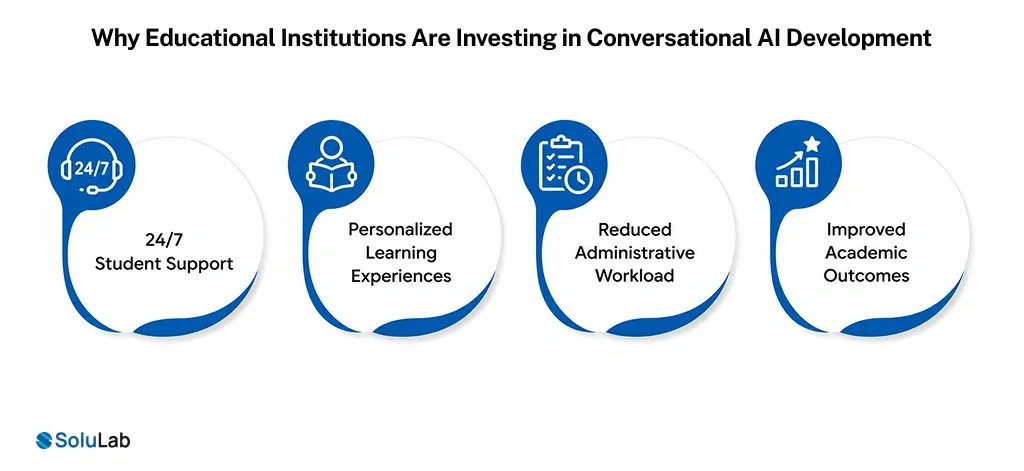
- 24/7 Student Support: Resolve queries instantly without staff availability constraints.
- Personalized Learning Experiences: Conversational AI in tutoring adapts to individual learning needs.
- Reduced Administrative Workload: Chatbots in Higher Education automate routine student requests and help teachers and faculty save time.
- Improved Academic Outcomes: Conversational AI Tutors provide personalized guidance and feedback.
How to Implement Conversational AI in Education Organizations?
Implementing AI solutions requires a structured approach that aligns technology with educational goals. Following the right steps helps institutions maximize adoption, improve learning outcomes, and deliver better student experiences.
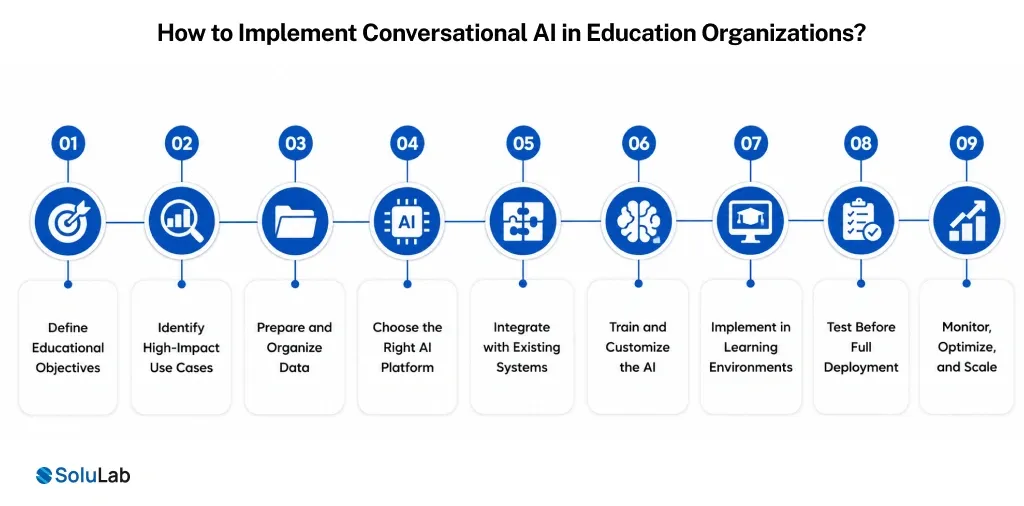
1. Define Educational Objectives
Start by identifying the specific challenges you want conversational AI to solve. Clear goals ensure the solution delivers measurable value for students, educators, and administrators.
- Identify key student pain points
- Set measurable success metrics
- Align AI with learning goals
2. Identify High-Impact Use Cases
Focus on areas where AI use cases can create immediate value, such as student support, admissions, tutoring, or conversational AI for student engagement.
- Prioritize frequent student inquiries
- Target repetitive administrative tasks
- Focus on high-volume interactions
3. Prepare and Organize Data
Conversational AI relies on accurate and well-structured data to provide relevant and reliable responses.
- Centralize educational data sources
- Clean outdated information
- Establish data governance policies
4. Choose the Right AI Platform
Select an AI platform that supports scalability, security, integrations, and future expansion requirements.
- Evaluate scalability requirements
- Review security capabilities
- Check integration flexibility
5. Integrate with Existing Systems
Connect AI solutions with student portals, CRMs, LMS platforms, and other educational technologies.
- Connect LMS and portals
- Integrate student information systems
- Enable seamless data sharing
6. Train and Customize the AI
Customize the AI using institution-specific content, academic resources, and support workflows to improve response quality.
- Use institution-specific knowledge
- Train academic support workflows
- Optimize response accuracy
7. Implement in Learning Environments
Deploy AI within websites, mobile apps, and conversational AI in e-learning platforms to maximize accessibility.
- Enable multi-channel access
- Support mobile learning experiences
- Expand student interaction points
8. Test Before Full Deployment
Conduct pilot programs to evaluate performance, identify gaps, and gather feedback from students and faculty.
- Run pilot implementations
- Collect user feedback
- Refine AI performance
9. Monitor, Optimize, and Scale
Continuously track performance, improve responses, and expand capabilities based on user needs and institutional goals.
- Monitor engagement metrics
- Improve conversational workflows
- Scale successful AI initiatives
What Is The Difference Between Educational Chatbots And Conversational AI?
Here’s a complete difference between a simple educational chatbot and conversational AI-powered learning solution:
| Aspect | Educational Chatbots | Conversational AI in Education |
|---|---|---|
| Core idea | Rule-based helper built for fixed tasks (quizzes, FAQs) | Adaptive tutor that can hold free-flow, human-like dialogue |
| How they talk | Predefined scripts, buttons, limited question types | Understands open-ended language and generates new responses |
| Personalization | Same path for most learners, light branching | Adjusts explanations, level, and pace to each learner in real time |
| Typical use cases | Quiz bots, course reminders, FAQ about classes/exams | Concept explanation, step-by-step coaching, feedback on answers |
| Flexibility & depth | Good for narrow workflows, struggles with “why?” questions | Handles “why/how/what if” and follows complex multi-step chats |
| Tech | Simple rules or decision trees | Uses NLP, machine learning, and context tracking |
How Much Does Educational Chatbot Development Cost?
Here’s a complete cost breakdown of custom education chatbot development and AI driven conversational tutor:
| Option / Scope | Typical Cost Range (USD) | What You Actually Get? |
|---|---|---|
| No‑code / SaaS education chatbot | $10,000 – $20,000 | Hosted bot, templates for FAQs & basic student support, limited customization, fast launch. |
| Basic custom chatbot for a school | $25,000 – $30,000 one‑time | Simple Q&A, student/parent support, basic LMS or website integration, standard UI. |
| Mid‑complexity AI tutor chatbot | $40,000 – $50,000 | Personalized learning flows, multi‑language, analytics, deeper LMS/SIS integration. |
| Enterprise‑grade EdTech chatbot | $50,000+ | Fully custom logic, advanced AI, multi‑tenant setup, complex integrations, SLAs, security. |
| Ongoing maintenance & updates | 15–25% of dev cost/year | Bug fixes, new features, content updates, model tuning, infra and compliance upkeep. |
Can Conversational AI Improve Student Retention?
Conversational AI can improve student retention by providing personalized academic support, proactive engagement, and instant assistance throughout the student journey. AI assistants help students stay informed about assignments, deadlines, course requirements, and available resources, reducing the likelihood of disengagement and dropout.
Research supports this impact. Additionally, studies on AI-driven learning support have shown improvements in student engagement and academic performance, with some AI tutoring programs increasing learning outcomes by over 30%.
By identifying at-risk students early and delivering timely interventions, conversational AI helps educational institutions improve retention rates while enhancing the overall student experience.
How Secure Are AI Solutions For Educational Institutions?
AI-powered solutions are built with security measures to protect student data, institutional information, and digital learning environments.
- Data Encryption: Protects sensitive information during storage and transmission.
- Access Control: Restricts system access to authorized users.
- Regulatory Compliance: Supports FERPA, GDPR, and education regulations.
- Threat Detection: Identifies suspicious activities and security risks.
- Secure Cloud Infrastructure: Ensures scalable and protected AI deployments.
How SoluLab Helps Build Conversational AI Solutions for Education?
SoluLab uses AI native approach to enhance learning experiences, automate support services, and improve engagement. SoluLab delivers customized conversational AI solutions tailored to modern education needs.
- Conversational AI Consulting and Strategy
- AI-Powered Tutoring Agent Development
- Educational Chatbot Development
- Conversational AI Learning Assistant Development
- Virtual Student Support Assistant Development
- Multilingual AI Chatbot Solutions
- AI-Powered Admissions & Enrollment Assistants
- LMS Integration Services
- Voice-Based Learning Assistant Development
- Custom Conversational AI Model Development
- Enterprise-Grade Education AI Platform Development
- AI Agent Development for Academic Institutions
- AI-Powered Assessment & Feedback Systems
Conclusion
Educational institutions must deliver timely support, personalized learning experiences, and proactive engagement throughout the student journey.
Conversational AI helps achieve these by providing instant assistance, identifying at-risk learners, automating routine interactions, and creating meaningful connections that keep students engaged.
If you’re looking to build student support systems, SoluLab, a leading AI development company in USA, can help your institution design and deploy custom conversational AI solutions. Book a free consultation call today!
FAQs
Neha is a curious content writer with a knack for breaking down complex technologies into meaningful, reader-friendly insights. With experience in blockchain, digital assets, and enterprise tech, she focuses on creating content that informs, connects, and supports strategic decision-making.