Key Takeaways
- AI grading tools are helping higher education institutions automate assessments, reduce faculty workload, and improve grading consistency at scale.
- Modern AI grading systems use machine learning, NLP, generative AI, and predictive analytics to evaluate assignments and generate feedback.
- AI-assisted grading offers greater flexibility and contextual understanding than traditional auto-grading systems.
- Institutions that invest in AI-powered assessment solutions today can improve operational efficiency, faculty productivity, and long-term academic scalability.
You manage a university or higher education institution, and faculty members are spending countless hours grading.
According to ResearchGate, professors spend an average of 12–15 hours every week grading assignments and providing feedback.
How do you maintain grading accuracy, provide timely feedback, and scale assessment processes without increasing faculty workload?
The answer lies in AI grading tools.
These AI-powered assessment systems can evaluate assignments, automate repetitive grading tasks, and generate personalized feedback. All while maintaining consistency and efficiency.
As a result, more universities are investing in AI-driven assessment technologies to automate evaluation workflows and improve academic outcomes.
This guide explores the rise of AI grading tools in higher education, the key trends driving adoption, and the opportunities they create for institutions looking to scale smarter.
Let’s get started.
What Are AI Grading Tools and How Do They Work?
AI grading tools are software solutions that use artificial intelligence, machine learning, and natural language processing (NLP) to automatically evaluate, score, and provide feedback on student assessments.
These tools help higher education institutions improve grading workflows, reduce faculty workload, and ensure more consistent evaluation standards across courses and departments.
The global AI in education market was valued at $8.3 billion in 2025 and is projected to reach $57.2 billion by 2033, growing at a CAGR of 25.9%.
AI grading tools automate the assessment process through a few simple steps:
1. Submission Collection: The system gathers assignments, quizzes, essays, or exams from the institution’s LMS.
2. Content Analysis: AI analyzes responses using machine learning and NLP to understand quality, relevance, and accuracy.
3. Rubric-Based Evaluation: Submissions are compared against predefined grading criteria and assessment standards.
4. Automated Scoring: The system assigns grades while identifying strengths and improvement areas.
5. Instant Feedback: AI generates personalized feedback and recommendations for learners.
6. Faculty Oversight: Educators can review, adjust, and validate AI-generated grades to ensure fairness and accuracy.
Why Are Institutions Adopting AI Grading Tools?
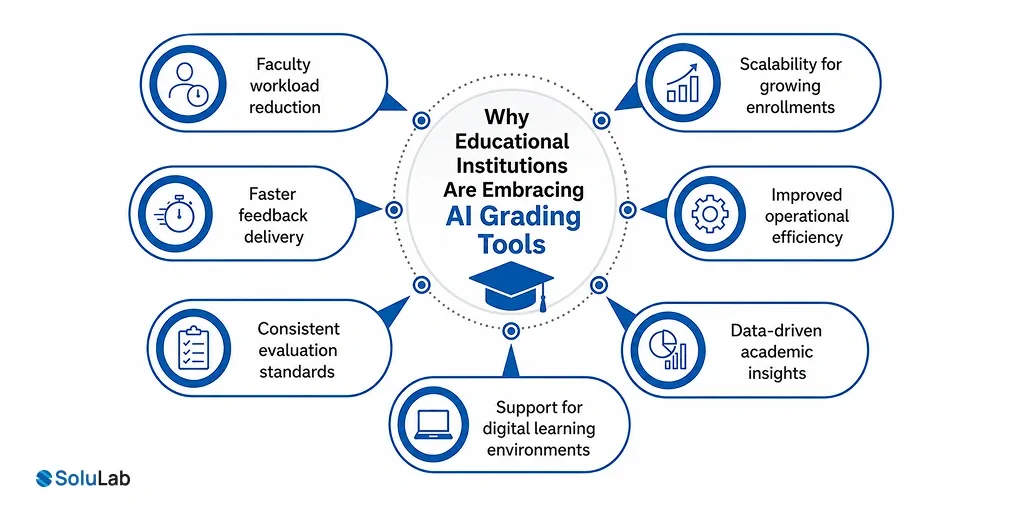
As student enrollments grow and assessment demands increase, higher education institutions are turning to AI-powered grading solutions to improve efficiency, maintain consistency, and support faculty productivity at scale.
- Faculty workload reduction: Grading hundreds of assignments each semester consumes significant faculty time. AI-assisted grading tools automate repetitive evaluation tasks, allowing educators to focus more on teaching, research, and student engagement.
- Faster feedback delivery: Traditional grading cycles can take days or weeks. AI grading tools accelerate assessment turnaround times, enabling institutions to provide timely feedback that supports continuous learning and academic improvement.
- Consistent evaluation standards: Manual grading can vary across instructors and departments. AI-assisted assessment tools apply predefined rubrics consistently, helping institutions maintain fairness and standardization across assessments.
- Scalability for growing enrollments: As class sizes increase, grading demands become more difficult to manage. AI for Teachers helps institutions assess large volumes of submissions efficiently without compromising quality.
- Improved operational efficiency: Universities can improve assessment workflows, reduce administrative overhead, and optimize academic resources by automating grading and feedback processes across multiple departments.
- Data-driven academic insights: AI grading platforms generate analytics on student performance, learning gaps, and assessment trends, helping institutions make informed decisions to improve educational outcomes.
- Support for digital learning environments: With the rise of online and hybrid education, institutions need scalable assessment solutions that integrate seamlessly with modern learning management systems and virtual classrooms.

Core Technologies Behind AI-powered Grading
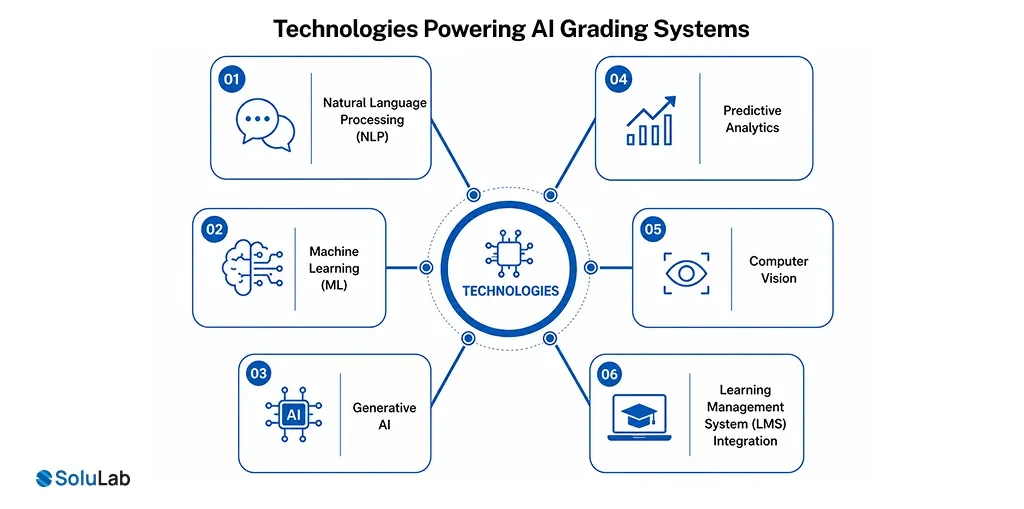
AI grading platforms combine multiple technologies to automate assessments, improve grading consistency, and deliver faster feedback. These innovations power today’s most advanced AI assessment tools across higher education institutions.
- Natural Language Processing (NLP): NLP enables AI systems to understand context, grammar, sentence structure, and meaning in written responses, making essay evaluation and short-answer assessment more accurate and scalable.
- Machine Learning (ML): Machine learning algorithms learn from historical grading patterns and institutional rubrics, helping AI Graders for Teachers deliver more consistent and reliable assessment outcomes over time.
- Generative AI: Generative AI creates personalized feedback, summarizes student performance, and provides actionable recommendations, enhancing the effectiveness of AI-Assisted Grading for higher education environments.
- Predictive Analytics: Predictive analytics identifies learning trends, performance gaps, and at-risk students by analyzing large assessment datasets, enabling institutions to make data-driven academic decisions.
- Computer Vision: Computer vision allows AI systems to process handwritten assignments, scanned exams, diagrams, and visual submissions, expanding grading capabilities beyond text-based assessments.
- Learning Management System (LMS) Integration: LMS integration connects grading tools with platforms like Moodle, Canvas, and Blackboard, automating assessment workflows and simplifying faculty operations.
How to Build an AI Grading Tool? Step by Step Guide
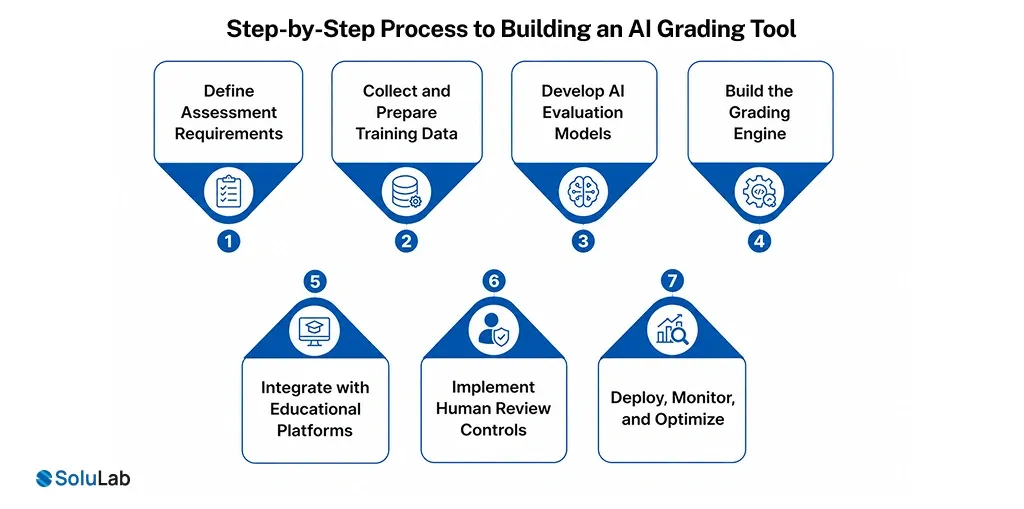
Building an AI grading tool requires a combination of educational expertise, AI technologies, and scalable infrastructure. The goal is to create a solution that delivers accurate assessments, consistent grading, and actionable feedback for institutions.
1. Define Assessment Requirements
Start by identifying the types of assignments, grading criteria, and educational outcomes the platform will support. This foundation ensures the tool aligns with institutional objectives.
- Assessment formats and use cases
- Grading rubrics and standards
- Faculty and student requirements
2. Collect and Prepare Training Data
High-quality datasets are essential for developing accurate grading models. Historical assessments and evaluation records help train the AI effectively.
- Historical grading records
- Annotated assessment datasets
- Data cleaning and labeling
3. Develop AI Evaluation Models
Build machine learning and NLP models capable of analyzing written responses, quizzes, coding assignments, and other assessment formats for AI student assessment.
- Natural language processing models
- Machine learning algorithms
- Automated scoring frameworks
4. Build the Grading Engine
Create the core system that compares submissions against grading criteria and generates scores, feedback, and performance insights.
- Rubric-based evaluation logic
- Automated scoring workflows
- Feedback generation mechanisms
5. Integrate with Educational Platforms
Integration improves adoption and assessment workflows. This step is critical for successful AI in education software development initiatives.
- LMS platform integration
- Student information systems
- Assessment workflow automation
6. Implement Human Review Controls
Faculty oversight helps maintain transparency, fairness, and academic integrity while allowing educators to validate AI-generated outcomes.
- Grade review capabilities
- Manual override options
- Quality assurance processes
7. Deploy, Monitor, and Optimize
Continuously monitor model performance and refine grading accuracy based on real-world usage. This ensures long-term success for AI solutions for education.
- Performance monitoring tools
- Continuous model improvement
- Security and compliance measures
Auto-Grading vs. AI-Assisted Grading
As educational institutions upgrade assessment processes, understanding the difference between auto-grading and AI-assisted grading is essential.
Both improve efficiency, but they offer different levels of flexibility and scalability for AI grading software development and enterprise AI education solutions.
| Feature | Auto-Grading | AI-Assisted Grading |
| Assessment Types | Multiple-choice, true/false, fill-in-the-blank. | Essays, short answers, projects, coding assignments, and objective assessments. |
| Decision-Making | Rule-based evaluation using fixed answer keys. | Context-aware evaluation using AI and machine learning models. |
| Feedback Quality | Limited to correct or incorrect responses. | Provides detailed feedback, recommendations, and performance insights. |
| Personalization | Offers little to no personalization. | Delivers personalized feedback based on student performance. |
| Accuracy for Complex Responses | Limited effectiveness for subjective answers. | Better suited for evaluating nuanced and open-ended responses. |
How Can Universities Balance AI Automation With Human Oversight?
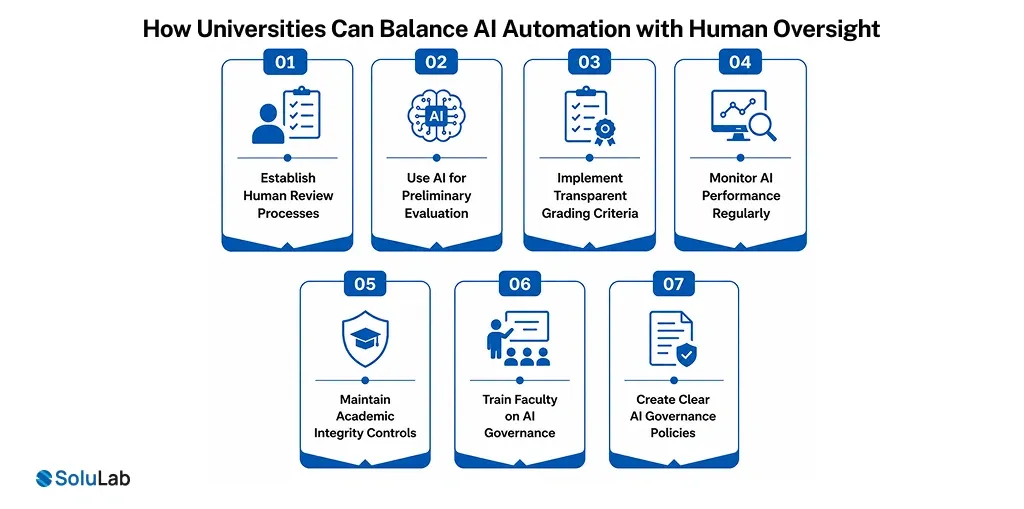
While AI can improve assessment workflows, universities must combine automation with human judgment to ensure fairness, transparency, academic integrity, and inclusive learning through AI solutions for students with disabilities. The most effective institutions use AI as a support tool rather than a complete replacement for educators.
1. Establish Human Review Processes
Faculty members should be able to review, validate, and adjust AI-generated grades, especially for subjective or high-stakes assessments.
- Review complex assessment outcomes
- Validate AI-generated scores
- Handle grading disputes effectively
2. Use AI for Preliminary Evaluation
AI can manage repetitive grading tasks while educators focus on nuanced assessments that require contextual understanding and professional judgment.
- Automate routine assessment tasks
- Prioritize educator decision-making
- Reduce faculty administrative workload
3. Implement Transparent Grading Criteria
Clearly defined rubrics help ensure both AI systems and faculty members follow consistent evaluation standards across departments. Many EdTech AI solutions prioritize transparency to improve trust and adoption.
- Standardize grading frameworks institution-wide
- Improve assessment consistency
- Support accreditation requirements
4. Monitor AI Performance Regularly
Continuous monitoring helps institutions identify inaccuracies, reduce bias, and maintain grading quality over time.
- Track grading accuracy metrics
- Identify algorithmic bias risks
- Improve model performance continuously
5. Maintain Academic Integrity Controls
Human oversight remains essential for plagiarism detection, ethical concerns, and exceptional cases that require manual intervention.
- Strengthen academic integrity measures
- Review flagged assessment cases
- Ensure ethical AI usage
6. Train Faculty on AI Governance
Educators should understand how AI systems operate, their limitations, and when human intervention is necessary.
- Build AI literacy programs
- Define oversight responsibilities
- Promote responsible AI adoption
7. Create Clear AI Governance Policies
Strong governance frameworks help institutions manage accountability, compliance, privacy, and grading transparency. This is a critical component of successful AI assessment platform development initiatives.
- Establish AI usage guidelines
- Define accountability standards
- Protect student data privacy
This placement looks more natural, improves readability, and avoids keyword stuffing.
Future of AI Grading Tools in Higher Education
As AI technologies continue to upgrade, grading tools will become more accurate, transparent, and integrated into academic ecosystems. Universities that adopt these innovations early can improve assessment efficiency, faculty productivity, and institutional scalability.
1. More Personalized and Adaptive Assessments
Future AI grading systems will evaluate not only performance but also individual learning patterns, enabling more tailored assessment experiences and feedback.
- Personalized feedback at scale
- Adaptive evaluation frameworks
- Improved learner performance insights
2. Greater Integration with Learning Ecosystems
AI grading tools will connect seamlessly with LMS software, student information systems, and analytics tools to create unified academic workflows.
- End-to-end assessment automation
- LMS platform integration
- Centralized academic data management
3. Enhanced Transparency and Explainability
Universities will demand AI systems that clearly explain grading decisions, helping build trust among faculty, administrators, and accreditation bodies.
- Explainable AI-driven evaluations
- Improved grading transparency
- Stronger institutional trust
4. Human-AI Collaborative Assessment Models
Rather than replacing educators, future AI grading tools will support humans in the loop for complex assessments.
- AI-assisted faculty decision-making
- Human validation of outcomes
- Balanced assessment governance
How SoluLab can Help you Build an AI Grading Tool?
Building an AI grading platform requires expertise in AI, education technology, and scalable software architecture. SoluLab, an AI native company, helps institutions develop secure and efficient grading solutions tailored to modern academic needs.
- Custom AI grading platform development
- AI-powered assessment automation systems
- AI feedback and recommendation systems
- Rubric-based automated grading solutions
- Secure cloud-based grading infrastructure
- AI governance and compliance frameworks
- Mobile and web assessment applications
Get our AI consulting services for assessment strategy, platform architecture, and integration with existing educational systems.
Conclusion
AI grading tools are changing higher education by helping institutions automate assessments, improve grading consistency, and deliver faster feedback at scale.
However, successful adoption requires balancing automation with human oversight, transparency, and ethical AI governance. Institutions that invest in assessment systems today will be better positioned to meet growing enrollment demands and future learning expectations.
Looking to build a custom AI grading platform? SoluLab, an AI software development company, can help your institution develop scalable, secure assessment solutions tailored to your academic goals.
FAQs
AI grading tools reduce faculty workload, improve assessment consistency, accelerate feedback delivery, and support broader AI-powered learning platform development initiatives across institutions.
Neha is a curious content writer with a knack for breaking down complex technologies into meaningful, reader-friendly insights. With experience in blockchain, digital assets, and enterprise tech, she focuses on creating content that informs, connects, and supports strategic decision-making.