
Key Takeaways
- AI in clinical trials is strongest in operations, where protocol design, site selection, recruitment and data cleaning consume most of the time and budget.
- Patient recruitment is the single biggest delay in most trials, and matching unstructured records against prose eligibility criteria is exactly what language models do well.
- Regulators now expect a documented credibility argument for any AI influencing a regulatory decision, scaled to how much that decision depends on the model.
- Validation is a deliverable, not a phase. A model that works but cannot show its work is unusable in a submission.
- Synthetic control arms are the most promising and most contested application, with acceptance varying by therapeutic area and agency.
- Roughly nine in ten drugs entering clinical trials still fail, and AI has not moved that number yet.
- Start with one operational workflow on historical data before anything touches a live study.
Clinical trials are where drug development gets expensive and slow. Recruitment stalls, protocols get amended, sites underperform, and data managers spend months chasing queries. AI in clinical trials targets exactly those bottlenecks: designing better protocols, finding eligible patients faster, monitoring sites by risk, and cleaning data as it arrives rather than at database lock.
The investment is following the problem. Grand View Research sizes the AI-based clinical trials solution provider market at around $3.5 billion in 2026, projecting $7.8 billion by 2030 at a 22.1% compound annual growth rate.
Most of the value sits in operations rather than in the science. This guide covers where AI genuinely helps across a trial, the use cases worth starting with, how to implement it without breaking validation requirements, what regulators now expect, and where the honest limits sit.

What Is AI in Clinical Trials?
AI in clinical trials means applying machine learning and language models to the design, conduct and analysis of studies. It supports investigators, data managers and medical monitors rather than making clinical or regulatory decisions on its own.
1. Where It Operates
Across the full study lifecycle: protocol design, feasibility and site selection, patient identification and recruitment, trial conduct and monitoring, data management, safety surveillance and regulatory writing. Operational applications are far more mature than anything touching efficacy analysis.
2. How It Differs From Discovery AI
Discovery AI proposes targets and molecules, which is a computational problem with fast feedback. Trials are an operational and regulatory problem with feedback measured in years. Our breakdown of generative AI in drug discovery covers the upstream half of the pipeline.
3. What It Does Not Replace
Investigator judgement, medical monitoring and regulatory accountability all stay with people. AI narrows the shortlist, drafts the document and flags the anomaly. A qualified human still decides, and the trail showing who decided is part of the record.
Why Do Clinical Trials Need AI?
Because trials consume most of the development timeline and budget, and the failure modes are operational as often as they are scientific. Three problems dominate.
1. Recruitment Is the Most Common Cause of Delay
A large share of trials miss enrolment timelines, and many sites enrol no patients at all. Eligibility criteria are written in prose while patient records are unstructured, so manual screening is slow and misses people who would have qualified.
2. Cost per Asset Keeps Rising
Deloitte’s analysis of pharmaceutical innovation puts average R&D cost per asset at roughly $2.23 billion, with trials accounting for the bulk of it. Every week saved in a Phase III study is worth real money.
3. Attrition Has Not Improved
Around nine in ten drugs entering clinical trials never reach approval, and most fail in Phase II on efficacy. AI can shorten the path to an answer. It has not yet changed how often the answer is no, which is worth stating plainly before any business case is written.
4. Data Volume Has Outgrown Manual Review
Wearables, imaging, electronic health records and decentralised trial platforms generate far more data than monitors can review by hand. Risk-based approaches are now expected, and they need analytics behind them to work.
Why Do Clinical Trials Need AI?
Because trials consume most of the development timeline and budget, and the failure modes are operational as often as they are scientific. Three problems dominate.
1. Recruitment Is the Most Common Cause of Delay
A large share of trials miss enrolment timelines, and many sites enrol no patients at all. Eligibility criteria are written in prose while patient records are unstructured, so manual screening is slow and misses people who would have qualified.
2. Cost per Asset Keeps Rising
Deloitte’s analysis of pharmaceutical innovation puts average R&D cost per asset at roughly $2.23 billion, with trials accounting for the bulk of it. Every week saved in a Phase III study is worth real money.
3. Attrition Has Not Improved
Around nine in ten drugs entering clinical trials never reach approval, and most fail in Phase II on efficacy. AI can shorten the path to an answer. It has not yet changed how often the answer is no, which is worth stating plainly before any business case is written.
4. Data Volume Has Outgrown Manual Review
Wearables, imaging, electronic health records and decentralised trial platforms generate far more data than monitors can review by hand. Risk-based approaches are now expected, and they need analytics behind them to work.
What Are the Top Use Cases of AI in Clinical Trials?
Eight use cases span the study lifecycle. The first five are operational and widely adopted. The last three carry more regulatory weight and more caution.
1. Protocol Design and Feasibility Simulation
Models trained on historical trial data estimate how a proposed protocol will perform: likely enrolment rate, screen failure rate, dropout risk and required sample size. Testing variations before the protocol locks avoids amendments, and amendments are among the most expensive events in a study.
2. Site Selection and Performance Forecasting
Predicting which investigator sites will actually enrol, based on past performance, local patient populations, competing trials and staffing. Poor site selection wastes startup cost on sites that never randomise a single patient.
3. Patient Identification and Trial Matching
Natural language processing reads clinical notes, pathology reports and discharge summaries against prose eligibility criteria, surfacing candidates manual screening would miss. This is the highest-value application in the category, and a RAG platform over health records is the usual architecture behind it.
4. Eligibility Pre-Screening and Referral
Ranking candidates by likelihood of qualifying so coordinators spend their time on the most promising records. Well-implemented, this reduces screen failure rates rather than simply increasing screening volume.
5. Risk-Based Monitoring and Data Quality
Anomaly detection across incoming site data flags protocol deviations, implausible values and sites drifting from the study mean, before those issues become findings. Deterministic parts of the workflow, such as query generation and reconciliation, often need no model at all and suit robotic process automation.
6. Safety Signal Detection and Pharmacovigilance
Scanning adverse event reports, narratives and literature for emerging safety signals faster than periodic review cycles allow. Case processing and coding are increasingly automated, with medical review retained.
7. Synthetic Control Arms and Digital Twins
Models built on historical patient data estimate how a participant would have progressed on standard of care, reducing how many people need randomising to control. The most promising and most contested application here, with acceptance varying considerably by therapeutic area and regulator.
8. Regulatory and Medical Writing
Drafting clinical study reports, patient narratives and submission documents from structured trial data. This sits squarely in intelligent document processing territory, and several large sponsors report their most concrete time savings here.
What Are the Benefits of AI in Clinical Trials?
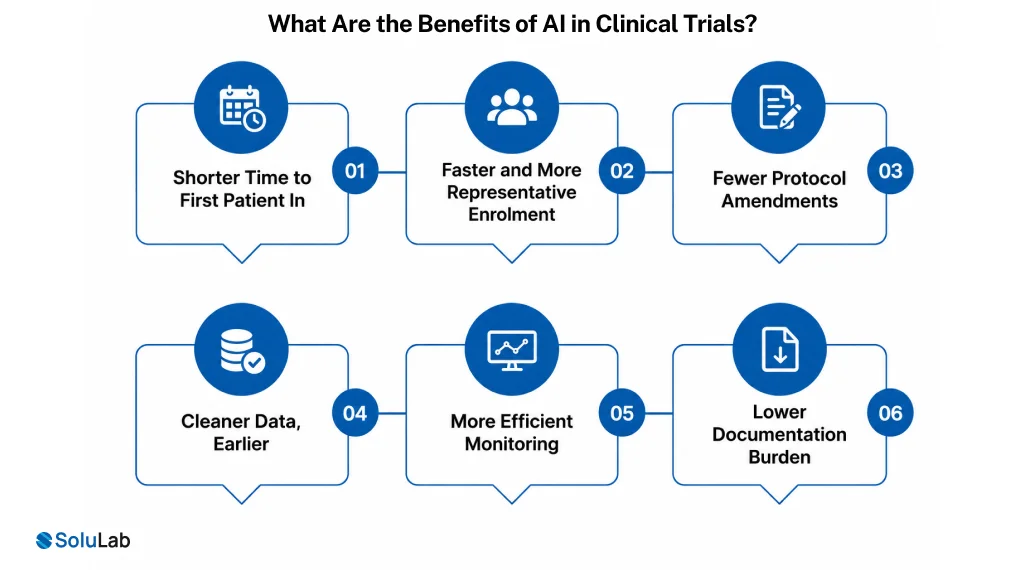
The benefits are operational: faster enrolment, cleaner data, fewer amendments and less manual review. Efficacy outcomes are a separate question that no software addresses.
1. Shorter Time to First Patient In
Better feasibility modelling and site selection compress the gap between protocol approval and the first randomisation. That period is pure cost with no data coming in.
2. Faster and More Representative Enrolment
Automated matching surfaces candidates human screening misses, including patients at sites nobody flagged as high potential. Broader identification also helps address the persistent under-representation problem in trial populations.
3. Fewer Protocol Amendments
Simulating protocol variations before lock reduces the chance of discovering mid-study that the criteria were too narrow. Each substantive amendment costs money, weeks and site goodwill.
4. Cleaner Data, Earlier
Catching implausible values and deviations as data arrives rather than at database lock shortens the path from last patient out to lock. Data cleaning is one of the least visible and most reliably slow parts of a trial.
5. More Efficient Monitoring
Directing monitoring effort at sites showing risk signals, rather than visiting everyone on a fixed schedule, is both cheaper and more effective at finding real problems.
6. Lower Documentation Burden
Automated drafting of reports and narratives frees medical writers for the judgement-heavy sections. The draft still needs review, but reviewing beats writing from nothing.
How Do You Implement AI in Clinical Trials?
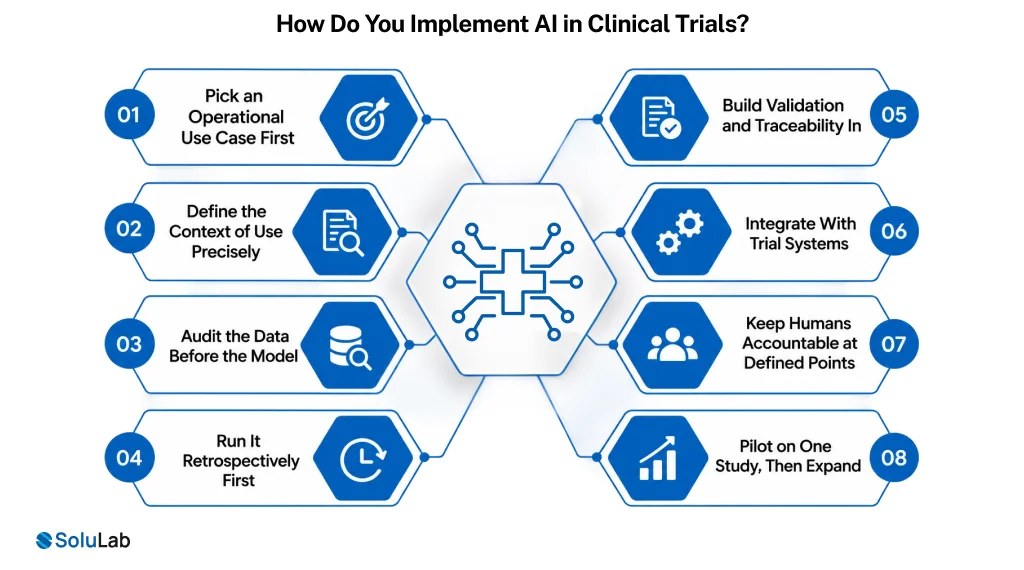
Implementation in a regulated environment follows a different sequence from ordinary software. Validation, traceability and human oversight shape the architecture from the first sprint rather than arriving at the end.
1. Pick an Operational Use Case First
Start where the output informs an internal decision rather than a regulatory one. Site selection, recruitment support and data quality all qualify. Anything feeding an efficacy conclusion carries a far heavier evidentiary burden.
2. Define the Context of Use Precisely
Write down exactly what question the model answers, what decision it influences and how much that decision depends on it. This framing now drives the regulatory conversation, so vague scope creates problems later.
3. Audit the Data Before the Model
Historical trial data, electronic health records and registry data all need harmonising, de-identifying and checking for bias in who is represented. Consent basis and data transfer rules need confirming early, not during validation.
4. Run It Retrospectively First
Test against studies already completed, where the outcome is known. This gives an honest accuracy baseline without putting a live study at risk, and it produces the evidence a validation package needs.
5. Build Validation and Traceability In
Version control, audit trails, reproducible outputs and documented performance characteristics belong in the build, not in a retrofit. Model monitoring in a validated environment follows the same discipline as MLOps, under stricter change control.
6. Integrate With Trial Systems
Connect to the electronic data capture system, clinical trial management system, safety database and site portals so outputs reach the people doing the work. This plumbing is usually the largest line item, and it is where AI integration services effort concentrates.
7. Keep Humans Accountable at Defined Points
Name who reviews model output and who signs off. An investigator confirms eligibility. A medical monitor reviews safety signals. A writer approves the narrative. Record those decisions.
8. Pilot on One Study, Then Expand
Run it alongside existing process on a single study, measure the difference, and only then extend to a programme. Sponsors who deploy across a portfolio at once cannot tell which part worked.
What Regulatory Requirements Apply?
AI used in a trial sits inside existing clinical research regulation, and regulators have begun publishing specific expectations for it. Four requirements matter most.
1. A Documented Credibility Argument
The FDA’s draft guidance on using artificial intelligence to support regulatory decision-making for drug and biological products sets out a risk-based framework: describe the question, define the context of use, assess how much the decision relies on the model, then establish and document credibility proportionate to that risk.
2. Good Clinical Practice Still Governs Conduct
The revised ICH E6(R3) guideline brought GCP up to date for modern trial designs, decentralised elements and data volume, with a stronger emphasis on risk-proportionate approaches and data governance. AI does not sit outside it.
3. Data Integrity and System Validation
Electronic systems handling trial data carry established requirements for audit trails, access control, record retention and validation. A model influencing data handling inherits those obligations.
4. Privacy and Cross-Border Data
Patient data feeding a model needs a lawful basis, appropriate de-identification and clarity on where processing happens. Multi-region trials compound this, and the answers need to be settled before development rather than during it.
5. High-Risk Classification in Europe
AI embedded in regulated medical products falls under high-risk obligations in the EU AI Act, layered on top of existing clinical and device regulation. Sponsors operating in Europe should map both sets of requirements together.
What Are the Risks and Limits?
Real, and mostly about evidence and equity rather than model performance. Five deserve planning before anything is built.
1. Bias in Historical Trial Data
Models trained on past trials inherit the under-representation in those trials. A recruitment model optimised on historical enrolment can quietly reproduce the same narrow patient population, which is both a scientific and an ethical problem.
2. The Industry-Level Evidence Is Not There Yet
Deloitte’s analysis notes that despite substantial investment, AI has not yet delivered lower R&D costs or faster development across the industry, and may be contributing to rising cost per asset. Programme-level wins are real. Portfolio-level proof is not, and business cases should reflect that.
3. Synthetic Controls Face Uneven Acceptance
Regulators have engaged with external and synthetic control arms, cautiously. Acceptance depends on therapeutic area, endpoint, data quality and agency. Do not design a pivotal study around one without early regulatory dialogue.
4. Validation Burden Is Often Underestimated
A model that performs well but cannot produce reproducible outputs, documented performance characteristics and a clear audit trail is unusable in a submission. Teams routinely budget for the model and not for the evidence package.
5. Site and Investigator Adoption
Tools that add clicks to an already stretched site workflow get abandoned. Anything touching site staff needs designing with them, and often needs delivering through the systems they already use, sometimes including healthcare app development for site-facing tools.
Conclusion
AI in clinical trials pays back fastest in operations. Better feasibility modelling, smarter site selection, automated patient matching and continuous data quality all shorten timelines without touching the scientific question the trial exists to answer. Those are the places to start, and they are where the evidence is strongest.
The disciplines that matter are unglamorous. Define the context of use precisely, test retrospectively before anything touches a live study, build validation and traceability into the architecture, and keep named humans accountable at defined points. Sponsors who treat the evidence package as a deliverable rather than paperwork get through review; the rest rebuild.
SoluLab, an AI development company, can help your business identify which trial workflows are ready, build models with validation designed in, and connect them to the trial systems you already run.
FAQs
Neha is a curious content writer with a knack for breaking down complex technologies into meaningful, reader-friendly insights. With experience in blockchain, digital assets, and enterprise tech, she focuses on creating content that informs, connects, and supports strategic decision-making.