Key Takeaways
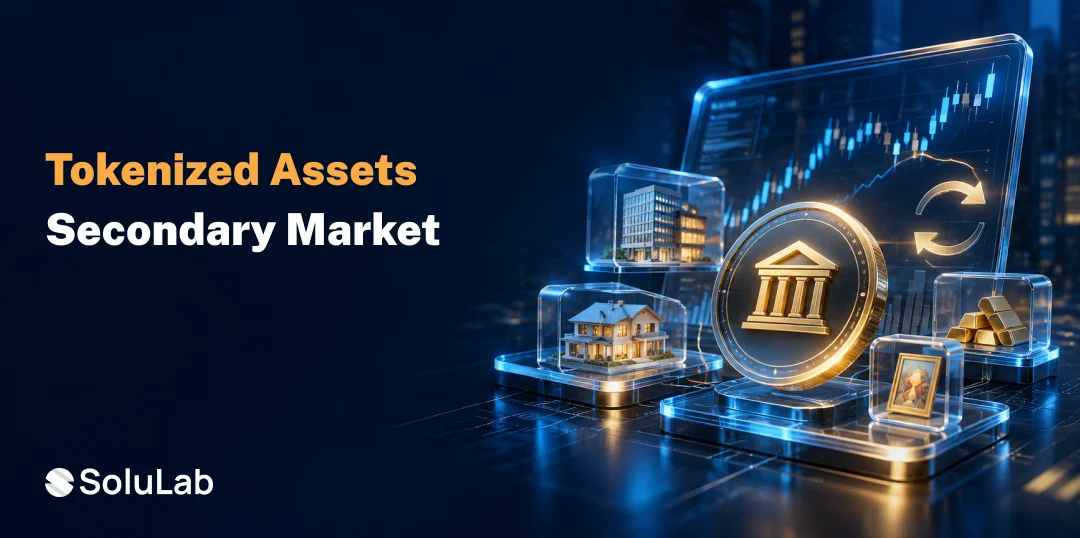
- The tokenized assets secondary market is where investors resell tokenized real-world assets, such as property, funds or bonds, after the first sale. Trading runs on an exchange, an alternative trading system or a permissioned pool, and blockchain-based settlement can finish in minutes. Compliance rules travel with the token, so only eligible buyers can trade.
Issuing a tokenized asset is the easy part. The harder question is what happens next: can an investor sell, to whom, how fast and at what price? That is the job of the secondary market. Tokenization promises faster settlement, smaller tickets and trading outside bank hours, but those promises only hold when the venue, the settlement design and the compliance rules are built together. This guide explains how the market works for real-world asset tokenization, from venues and trading models to settlement and marketplace design.
What Is the Tokenized Assets Secondary Market?
The tokenized assets secondary market is the set of venues and processes where investors resell tokenized assets after the issuer’s first sale. A tokenized asset is a digital token that represents ownership or economic rights in a real asset, such as property, a fund, a bond or a commodity. If you need the basics first, start with our asset tokenization guide.
The primary market is where the issuer first sells tokens and receives the money. The secondary market is every trade after that, between investors.
| Primary market | Secondary market | |
| Who sells | The issuer | An existing holder |
| Who gets paid | The issuer | The selling holder |
| How price is set | Offering terms or a fixed price | Bids and offers, quotes or a pool formula |
| Typical venue | Issuer portal or offering platform | Exchange, trading system, pool or OTC desk |
| Main risk | Whether the offering fills | Whether a buyer exists at a fair price |
Why Does the Secondary Market Decide Tokenized Asset Liquidity?
Liquidity is how quickly you can sell an asset at a fair price. Tokenization removes some barriers. Fractional units mean smaller tickets, and blockchain rails can run outside banking hours. But tokenizing an asset does not create buyers. A token with no market makers, no eligible buyer pool and no venue is as illiquid as the asset behind it. Early data suggests turnover is low compared with issuance.
Three things drive tokenized asset liquidity:
- The buyer pool. Only eligible investors can usually trade, so the pool is smaller than for a public token.
- Venue access. A token listed on one closed platform reaches only that platform’s users.
- Price discovery. Someone has to quote a price. Without market makers or regular auctions, spreads stay wide.
How Does Tokenized Securities Trading Work?
Tokenized securities trading runs through a small number of venue types. Which one you may use depends on the asset and the jurisdiction.
- Regulated venues. An exchange or alternative trading system in the US, or a multilateral trading facility or DLT trading venue in the EU. This gives the widest access and the strictest rules.
- Issuer or broker platforms. A closed marketplace where trades are matched inside one operator’s platform.
- OTC and request-for-quote desks. Large blocks are priced privately, then settled on-chain.
- Permissioned pools. On-chain liquidity pools open only to approved wallets.
- Peer-to-peer transfers. Direct transfers between two approved holders, with issuer approval.
Within a venue, the trading model matters as much as the venue.
| Trading model | How it works | Works best when | Watch out for |
| Order book | Buyers and sellers post bids and offers, and a matching engine pairs them | There are many active participants | Thin books give wide spreads |
| Request for quote | A buyer asks dealers for a price | Blocks are large and trades are infrequent | Depends on dealers staying engaged |
| Pool (AMM) | A formula prices trades against a pool of assets | You want always-on quotes | Pools need permissioning and can suffer price impact. See our guide to liquidity pools |
| Periodic auction | Orders collect over a window and clear at one price | Trading is thin and fairness matters | Investors cannot trade between auctions |
| Redemption or buyback window | The issuer or fund buys back tokens at net asset value on set dates | The asset is a fund or similar vehicle | Limited exit dates |
Many platforms combine them. A common pattern is an off-chain matching engine for speed with on-chain settlement for trust.
How Does Blockchain-Based Settlement Work?
Settlement is the moment ownership and payment actually change hands. In traditional markets it runs through clearing houses and custodians, and each party keeps its own record and reconciles later. US equities have settled on a T+1 cycle since May 2024.
Blockchain-based settlement works from a shared ledger instead. Its strongest feature is delivery versus payment (DvP): the asset and the payment move together, or neither moves. When both legs sit on-chain, DvP can be atomic, which means a single transaction completes both.
Here is the digital asset settlement flow most platforms follow:
- Match the trade. The order book, quote or pool pairs buyer and seller.
- Check eligibility. Both wallets are verified against the whitelist and transfer rules. Our guide to wallet whitelisting for tokenized securities explains how.
- Lock both legs. The token and the payment are held by the settlement contract.
- Swap in one transaction. Both legs move together. If either fails, nothing moves.
- Wait for finality. The platform treats the trade as final only after the chain confirms it.
- Update the registers. The on-chain record and the transfer agent record are brought into line.
- Report the trade. The venue sends reports to regulators and clients.
The payment leg decides how fast and how safe settlement really is.
| Payment leg | Atomic with the asset? | Strengths | Limits |
| Stablecoin | Yes, when on the same chain | Fast, works around the clock | Depends on the issuer’s reserves and rules. See our stablecoin development work |
| Tokenized deposit or central bank digital currency | Yes, if the network is connected | Regulated money, favoured by banks | Few live networks, still maturing |
| Bank transfer (off-chain) | No | Familiar, works with existing accounts | Settlement waits on the bank, so the speed gain shrinks. Handle it through escrow and our notes on on-chain vs off-chain tokenization |
Two cautions. First, “instant” only means instant when both legs are on-chain. Second, if the asset and the payment live on different chains, you need a secure messaging layer, as covered in our multichain tokenization platform guide. For the payment side, look at blockchain payment solutions built for settlement.
Which Compliance Rules Apply to Secondary Trading?
Rules follow the token, not just the venue. Each trade has two sides, and both usually have to pass before it settles.
- Eligibility. Only verified, approved wallets can hold or receive the token.
- Investor class and country. Some buyers are barred or capped by their status or location.
- Holding periods and holder caps. Lock-ups, resale limits and a maximum number of holders can all apply.
- KYC, AML and sanctions. Checked at onboarding and again on a schedule.
- Venue rules and reporting. Licensed venues must watch for abuse and report trades. In the EU, DLT trading venues sit under the DLT Pilot Regime.
The most dependable approach enforces these rules inside the token. Standards such as ERC-3643 check identity and rules on every transfer, so a trade that breaks a rule fails at settlement instead of being fixed afterwards. See the EIP-3643 specification and our comparison of ERC-3643, ERC-1400 and ERC-20. For cross-border trades, apply the rules of both the seller’s and the buyer’s jurisdictions.
How Is a Tokenized Asset Marketplace Designed?
A tokenized asset marketplace stacks seven layers. Skipping one usually shows up later as rework.
- Onboarding and identity. KYC, wallet linking and investor class.
- Token and registry. Token contracts, the whitelist and the link to the transfer agent record.
- Matching and liquidity. An order book, request for quote, auctions or a permissioned pool.
- Settlement. The delivery-versus-payment contract and the payment rails.
- Custody and wallets. Self-custody, a custodian or MPC wallets.
- Market data and pricing. Quotes, net asset value feeds and price history.
- Reporting and surveillance. Trade reports, audit logs and alerts.
Investors also expect basic digital asset management tools, such as holdings, valuations and statements in one view. And blockchain transaction processing capacity matters: choose a chain or layer 2 whose fees and finality suit how often your asset trades.
The main design choice is where matching happens.
| Centralized venue | Hybrid venue | Decentralized venue | |
| Matching | Operator’s off-chain engine | Off-chain matching, on-chain settlement | On-chain pool or order book |
| Control | The operator | Shared between operator and contract | Smart contracts |
| Best for | Regulated venues that need speed | Most regulated tokenized assets | Permissioned pools and DeFi-native assets |
| Trade-off | Trust in the operator | More moving parts | Lower throughput, harder compliance |
Most regulated platforms land on the hybrid model. For the wider trade-offs, see our explainer on CEX vs DEX.
How Do You Bootstrap Liquidity for a New Tokenized Asset?
No tool replaces investor demand, but these steps help.
- Build the buyer pool first. Onboard eligible investors before you list.
- Appoint market makers or dealers. Someone must quote a price.
- Start with auctions or quotes. Open a full order book only when there is enough activity.
- Pair with a stablecoin. It gives a simple, always-on payment leg.
- Offer redemption windows. For funds, scheduled buybacks at net asset value give holders a clear exit.
- List across more than one venue. Reach is a liquidity lever, and cross-chain support helps.
- Publish clear pricing and reporting. Transparent net asset value builds trust.
What Risks and Trade-offs Should You Plan For?
- Thin liquidity. Wide spreads and long waits to sell are common for niche assets.
- Price discovery. Illiquid assets are hard to value, so net asset value feeds must be accurate.
- Regulatory fragmentation. Venue and transfer rules differ by country.
- Smart contract risk. A bug in a settlement or pool contract can freeze or lose funds.
- Custody and key risk. Lost or compromised keys need a governed recovery path.
- Settlement finality. Chains finalize at different speeds, and cross-chain trades add risk.
- Front-running. Public pools can expose orders to reordering. Permissioned venues reduce this.
- Concentration. Relying on one venue, one market maker or one stablecoin creates a single point of failure.
How Do You Build a Tokenized Asset Trading Platform?
A venue combines token, compliance, matching and settlement layers. A typical build follows six steps:
- Choose the venue model and jurisdiction with counsel.
- Pick the token standard and compliance logic.
- Design matching and the liquidity model.
- Build the settlement contract and connect payment rails.
- Integrate custody, KYC and reporting.
- Audit, run a pilot, then launch.
SoluLab’s engineers cover each layer. That includes tokenized securities trading platform development, digital asset exchange development, crypto exchange platform development, and decentralized exchange development. Asset tokenization development services and RWA marketplace development can be scoped as one programme or in phases. For budgets and phasing, see our guide to the cost of an enterprise tokenization platform.
FAQs
Neha is a curious content writer with a knack for breaking down complex technologies into meaningful, reader-friendly insights. With experience in blockchain, digital assets, and enterprise tech, she focuses on creating content that informs, connects, and supports strategic decision-making.