
For a long time, trading systems operated on an implicit assumption: access was limited, liquidity was episodic, and execution followed structure.
That assumption no longer holds.
Markets today behave differently. Capital moves faster. Participants expect continuous access. And increasingly, trading systems are expected to operate without interruption.
Crypto exchanges emerged as one of the first environments where this expectation became the default. But early exchange models were not built with this in mind. They enabled access, but not always structure. They supported trading, but not always stability.
What we are seeing now is a shift.
Crypto exchange development is moving beyond enabling transactions. It is about designing systems that support continuous, structured liquidity without compromising control, compliance, or reliability.
Key Takeaways
- Crypto exchange development has evolved from enabling trades to building continuous trading infrastructure
- Liquidity is no longer episodic – it must be structured, predictable, and always available
- A modern exchange operates through coordinated layers: identity, compliance, trading engine, custody, and settlement
- Matching engines and liquidity design determine execution quality, not just speed
- Custody systems act as the foundation of trust, ensuring secure and accurate asset ownership
- Compliance must be embedded into transaction flow, not handled as a separate process
- Long-term success depends on infrastructure strength, not speed of launch or feature count
Why Continuous Trading Infrastructure Is No Longer Optional?
Traditional systems operate in cycles. Reports are periodic. Liquidity events are scheduled. Transfers require coordination. But user behavior has moved in the opposite direction.
Participants now expect:
- the ability to rebalance positions instantly
- execution without waiting for market windows
- visibility into pricing at any given moment
Crypto markets normalized this behavior early. Trading never closes. Liquidity is expected to exist across time zones. Execution is immediate. This creates a mismatch for systems that were not designed for continuity.
The question is no longer whether continuous trading should exist. It already does. The real question is how to support it without introducing instability.
Because continuous access without structure leads to:
- fragmented liquidity
- inconsistent pricing
- elevated risk
This is where infrastructure becomes critical.
A well-designed crypto exchange does not just allow 24/7 trading. It structures how that liquidity behaves.
What Crypto Exchange Development Actually Represents?
The term “exchange” often suggests a marketplace. But in practice, it is closer to a coordination system.
Every trade is not just a match between buyer and seller. It is a sequence of validations:
- Is the participant eligible?
- Is the asset available?
- Is the transaction compliant?
- Can ownership be updated correctly?
In traditional secondary markets, these processes were manual, slow, and opaque. Crypto exchanges compress all of this into real-time execution.
That compression is the real innovation.
Crypto exchange development is not about building a faster trading interface. It is about embedding:
- validation
- compliance
- settlement
- and reporting
directly into the transaction flow.
In that sense, exchanges are not just marketplaces. They are programmable liquidity systems. And that is exactly what makes them comparable to the evolution of secondary markets in private assets where liquidity moved from being occasional to being continuously accessible, but still governed.

Architecture of a Continuous Trading System
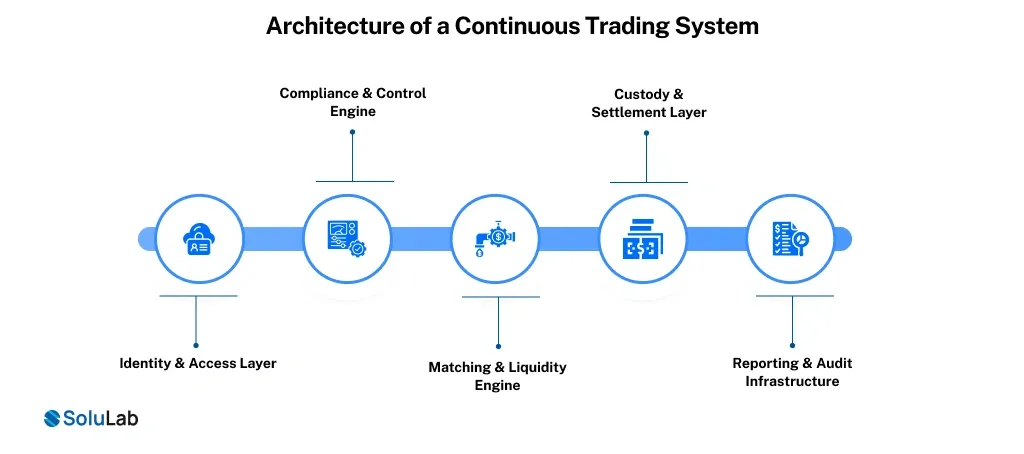
Liquidity at scale is not created by interfaces. It is created by infrastructure.
In traditional secondary markets, liquidity was constrained not by demand, but by coordination. Transfers required approvals. Ownership updates required manual intervention. Compliance checks slowed execution.
Centralized Crypto exchanges remove that friction but only when the underlying architecture is designed correctly. A functioning exchange is not a single system. It is a set of coordinated layers that operate continuously.
Identity & Access Layer
Before any transaction is allowed, the system establishes who is participating and under what conditions.
This includes:
- onboarding and verification
- jurisdiction tagging
- permissioning based on user type
Unlike static systems, this layer must remain dynamic. Eligibility is not fixed. It evolves with regulation, user status, and platform rules.
Compliance & Control Engine
In traditional systems, compliance sits outside execution. Here, it sits inside.
Every action, trade, withdrawal, transfer – passes through a control layer that enforces:
- KYC/AML validation
- trading restrictions
- jurisdictional rules
This is what allows continuous trading without losing regulatory control.
Matching & Liquidity Engine
This is where liquidity becomes operational.
Orders are received, matched, and executed in real time. But more importantly, this layer determines how liquidity behaves:
- whether spreads remain stable
- whether execution is predictable
- whether the market absorbs volatility
In that sense, the matching engine is not just processing trades. It is shaping the structure of liquidity itself.
Custody & Settlement Layer
In private markets, ownership changes required coordination across administrators and transfer agents.
In decentralized crypto exchanges, this is compressed into a single system.
This layer manages:
- asset custody
- balance updates
- settlement after execution
Ownership is updated continuously, not periodically. That shift from delayed reconciliation to real-time settlement is what enables continuous liquidity.
Reporting & Audit Infrastructure
Liquidity introduces visibility requirements.
Every transaction must be:
- recorded
- traceable
- auditable
This layer ensures that even though trading is continuous, accountability remains intact. When these layers are aligned, the exchange does not just enable trading. It sustains a continuous market environment without breaking control.
Liquidity Design and Matching Systems
Liquidity is often treated as an outcome. In reality, it is a design choice.
From Episodic to Continuous Liquidity
In traditional systems, liquidity events were scheduled. In crypto exchanges, liquidity is expected to exist at all times. But continuous availability introduces a new challenge:
How do you maintain structure when trading never stops?
Role of the Matching Engine
At a basic level, the matching engine connects buyers and sellers.
But in practice, it determines:
- how prices are formed
- how quickly markets react
- how stable execution remains
A poorly designed system creates:
- price fragmentation
- inconsistent fills
- unpredictable spreads
A well-designed system creates coherence in how the market behaves.
Liquidity Sources
Liquidity does not originate from a single place.
Most exchanges combine:
- internal order books
- external market makers
- aggregated liquidity feeds
Each source contributes differently:
- order books provide transparency
- market makers provide stability
- aggregation provides depth
The goal is not just volume. It is reliable execution across conditions.
Structuring Liquidity Behavior
Continuous trading without structure leads to instability.
That is why exchanges often introduce mechanisms such as:
- spread controls
- liquidity incentives
- execution prioritization
These are not optimizations. They are stabilizers.
They ensure that even when markets move rapidly, the system remains usable.
Liquidity, when designed correctly, becomes predictable. And predictability is what makes continuous trading sustainable.
Custody as the Foundation of Trust
In any trading system, ownership is the final truth.
Everything else, execution, pricing, liquidity, depends on whether ownership is correctly recorded and securely maintained.
From Registry to Wallet Infrastructure
In traditional markets, ownership is tracked through registries and intermediaries. In crypto exchanges, this responsibility shifts to crypto wallets and custody systems. But the principle remains the same:
Ownership must be:
- accurate
- verifiable
- and secure
Hot and Cold Environments
To balance accessibility and security, exchanges typically separate assets into:
Hot environments
- enable real-time transactions
- support active trading
Cold environments
- store assets offline
- reduce exposure to external threats
This separation allows the system to remain responsive without compromising security.
Distributed Control of Assets
Centralized control creates risk.
Modern custody systems reduce this risk through:
- multi-signature authorization
- distributed key management
- MPC-based systems
These approaches ensure that no single failure point can compromise the system.
Continuous Reconciliation
Unlike traditional systems that reconcile periodically, crypto exchanges must maintain alignment continuously.
That means:
- deposits are verified in real time
- balances update instantly
- internal ledgers match blockchain records
Any mismatch, even temporary, creates risk.
Why Custody Defines the System
Users may never see how custody works.
But they experience its reliability through:
- withdrawal speed
- balance accuracy
- system trustworthiness
If custody fails, everything else becomes irrelevant.
That is why, in continuous trading systems, custody is not just a component.
It is the foundation.

Compliance and Control in Continuous Trading Environments
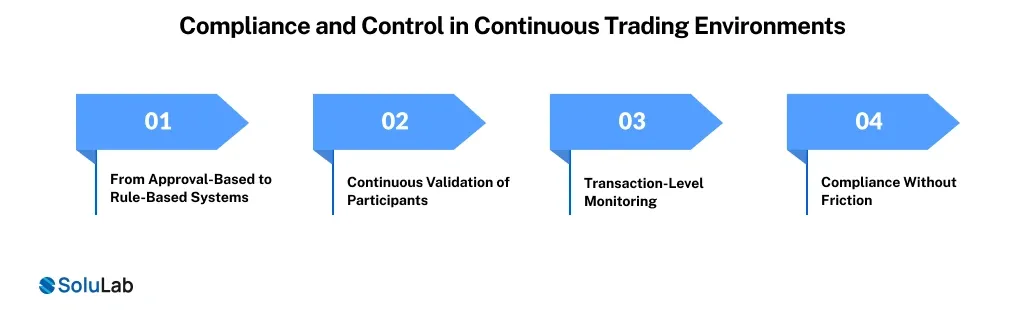
In traditional systems, compliance operates around the transaction. In continuous trading systems, it operates inside it. That shift is subtle, but it changes everything.
From Approval-Based to Rule-Based Systems
Earlier, transactions required coordination:
- approvals
- documentation
- manual checks
This created friction, but also control.
DEX Crypto exchange development cannot rely on this model. At scale, manual intervention breaks the system.
Instead, control is encoded into rules. Every transaction is evaluated in real time against:
- user eligibility
- jurisdictional restrictions
- transaction thresholds
- risk signals
If a rule fails, the transaction does not proceed. No escalation. No delay. Just enforcement.
Continuous Validation of Participants
Eligibility is not static. A participant who was compliant at onboarding may:
- change jurisdiction
- trigger risk flags
- fall under new regulatory conditions
Which means validation cannot happen once. It has to happen continuously.
Modern exchanges re-evaluate users dynamically, ensuring that every action reflects current compliance status, not historical approval.
Transaction-Level Monitoring
In secondary markets, oversight often happens after execution. In p2p crypto exchanges, monitoring is part of execution.
The system observes:
- transaction patterns
- asset movement behavior
- interactions across accounts
Not to block activity unnecessarily, but to detect inconsistencies early.
Compliance Without Friction
The challenge is not enforcing rules. It is doing so without disrupting flow.
If compliance slows down execution:
- users experience friction
- liquidity drops
- system efficiency declines
If compliance is too loose:
- risk increases
- regulatory exposure rises
The balance lies in embedding compliance so deeply into the system that it becomes invisible in normal conditions, but decisive when required.
Continuous trading only works when control is stronger than speed.
Security as a System-Wide Constraint
Security in exchanges is often reduced to tools and protocols. But in reality, it is a constraint that shapes every architectural decision.
Distributed Risk Surface
Unlike traditional systems, exchanges are exposed across multiple layers:
- user-facing interfaces
- APIs
- custody systems
- internal operations
Risk does not originate from one place. It emerges from interactions between these layers. Which means security cannot be centralized. It has to be distributed.
Layered Protection, Not Single Defenses
Strong systems do not rely on a single control.
They combine:
- access restrictions
- encryption across communication
- internal permission controls
- monitoring of system behavior
Each layer reduces exposure. Together, they create resilience.
Custody as a Security Core
Most critical failures in exchanges are not related to trading logic. They are related to asset control. That is why custody is treated as a security domain.
Approaches such as:
- multi-signature authorization
- hardware-secured key storage
- distributed key control
are not enhancements. They are requirements.
Operational Discipline
Even well-designed systems can fail under weak operational practices.
Security extends into:
- how withdrawals are processed
- how access is granted internally
- how anomalies are handled
Delays in large withdrawals, behavioral monitoring, and access logs are not user-facing features. They are protective mechanisms.
Binary Nature of Failure
Security failures do not degrade systems gradually. They break them. Which is why security must be treated as a constant boundary condition – something every system decision must respect, rather than something added later.
Building the System: In-House, White Label, or Infrastructure-Led
At a structural level, enabling continuous trading infrastructure requires a decision:
Do you build the system, adapt an existing one, or design it with a partner? This is often framed as a technical choice. In reality, it is strategic.
In-House Development
Building internally offers control.
The system can be tailored to:
- specific liquidity models
- custom compliance logic
- proprietary features
But control comes with responsibility.
- development cycles extend
- regulatory interpretation becomes internal
- system maintenance becomes continuous
This approach works when infrastructure capability already exists within the organization.
White Label Systems
White-label crypto exchanges reduce the time required to go live.
They provide:
- pre-built trading systems
- ready interfaces
- baseline functionality
This is useful for:
- testing market entry
- launching quickly
But these systems are designed for general use.
Over time, limitations appear:
- restricted customization
- dependency on vendor updates
- difficulty adapting to evolving requirements
Infrastructure-Led Approach
The third path focuses less on speed or control in isolation, and more on alignment.
Here, the system is designed around:
- business model
- regulatory environment
- liquidity strategy
Instead of building from zero or adapting a fixed template, the architecture is shaped with intent.
This is where DeFi exchange development firms like SoluLab typically operate – working at the infrastructure layer, where compliance, liquidity, and system design converge into a coherent trading environment.
Strategic Crypto Exchange Implementation Roadmap for Continuous Liquidity
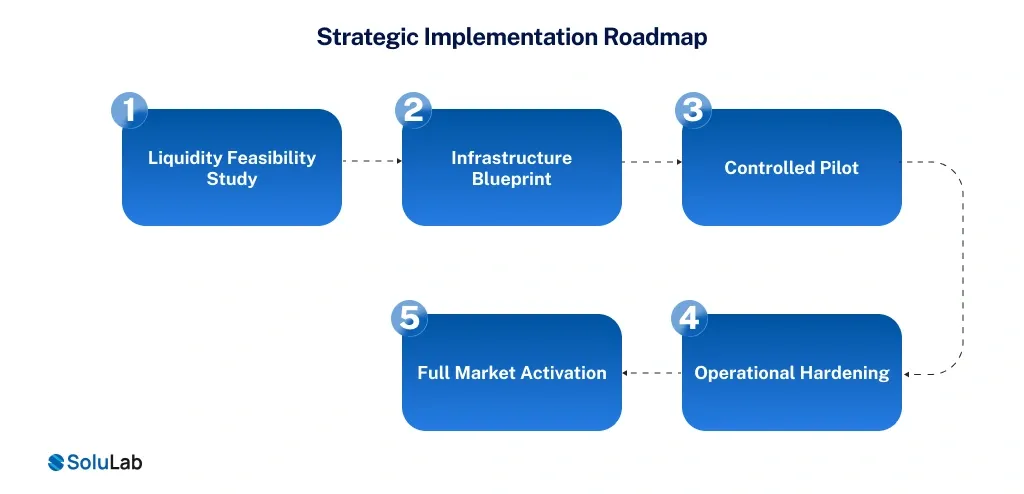
Institutions enabling secondary trading for existing portfolios must approach deployment methodically—especially when integrating blockchain infrastructure and crypto exchange capabilities.
Liquidity should be layered into infrastructure, not bolted onto it, particularly in tokenized and cryptocurrency-enabled ecosystems.
Phase 1: Liquidity Feasibility Study
- Analyze fund structure and transfer restrictions
- Assess investor appetite for tokenized assets and cryptocurrency-based trading
- Review regulatory constraints across jurisdictions
- Identify operational gaps in adopting blockchain-powered secondary markets
Not all portfolios require immediate 24/7 activation, even in crypto-enabled environments.
Phase 2: Infrastructure Blueprint
- Define compliance engine requirements for blockchain and crypto exchange integration
- Map integration with fund administrators and custodians
- Select trading model (windowed, continuous, auction) suitable for digital asset exchanges
- Establish real-time data synchronization across blockchain networks
A successful blockchain-based centralized exchange platform development effort begins with architecture clarity.
Phase 3: Controlled Pilot
- Activate limited liquidity windows via private crypto exchange environments
- Onboard select investors with secure cryptocurrency wallets
- Monitor automated compliance using smart contracts
- Validate reporting workflows across blockchain-led systems
This phase reduces risk before enabling full 24/7 trading in tokenized private markets.
Phase 4: Operational Hardening
- Implement monitoring dashboards for crypto exchange performance
- Stress-test settlement logic on blockchain infrastructure
- Strengthen audit and reporting layers using immutable ledgers
- Refine governance workflows for digital asset ecosystems
Continuous liquidity requires continuous resilience—especially in cryptocurrency markets.
Phase 5: Full Market Activation
- Expand investor participation across global crypto markets
- Introduce continuous order intake via AI integrated crypto exchange platforms
- Activate real-time compliance checks using blockchain automation
- Integrate advanced analytics for tokenized asset trading
By this stage, secondary markets for portfolio liquidity function as institutional-grade blockchain infrastructure, not experimental overlays.
The Future of Continuous Digital Trading Systems
Liquidity is no longer a feature. It is becoming a baseline expectation.
From Access to Efficiency
Early exchanges solved for access. They made digital assets tradeable. The next phase is about efficiency:
- how quickly capital moves
- how predictably trades execute
- how seamlessly systems interact
This is where infrastructure begins to matter more than interface.
Markets Without Boundaries
Crypto exchanges already operate without fixed hours. What is changing now is how they integrate with broader financial systems.
We are beginning to see:
- deeper integration with custody providers
- alignment with regulatory frameworks
- connections with traditional trading environments
Over time, the distinction between crypto exchanges and other trading systems will become less about asset type and more about how liquidity is structured and managed.
From Trading Platforms to Liquidity Infrastructure
Exchanges are gradually shifting roles. They are no longer just venues where trades happen. They are becoming systems that:
- coordinate capital
- manage liquidity across participants
- enforce rules without interrupting flow
This is a subtle transition, but an important one. Because once exchanges begin to operate as infrastructure, expectations change permanently.
What Will Define the Next Phase
The platforms that scale will not be the ones that launch fastest. They will be the ones that:
- maintain stability under pressure
- adapt to regulatory changes without disruption
- sustain liquidity across market conditions
In other words, the ones that treat continuous trading as a design problem, not just a feature.
Conclusion
Markets have always balanced two forces: control and liquidity.
For a long time, increasing one meant compromising the other. What we are seeing now is a shift in that balance.
With the right infrastructure, it is possible to enable continuous trading without losing structure. To allow liquidity without introducing instability. To scale access without weakening control.
Crypto exchanges sit at the center of this shift.
But building a crypto exchange is no longer about enabling trades. It is about designing a system where every layer — from identity to execution to settlement — works together without friction.
That is what turns a trading platform into infrastructure. And that is where long-term value is created.
FAQs
Shipra Garg is a tech-focused content strategist and copywriter specializing in Web3, blockchain, and artificial intelligence. She has worked with startups and enterprise teams to craft high-conversion content that bridges deep tech with business impact. Her work translates complex innovations into clear, credible, and engaging narratives that drive growth and build trust in emerging tech markets.