
Key Takeaways
- Obstacle: Businesses find it hard to combine the exchange tokenization, compliance, custody systems, and liquidity into a single platform. This results in a delay in launch, increased cost, and limited services.
- Solution: The crypto exchange with tokenization combines architecture and everything, and helps businesses launch a practical exchange product with a stronger market fit and lower execution risk.
- How SoluLab Can Help: SoluLab supports businesses with strategy, architecture, development, and compliance to combine into one scalable platform delivery.
Businesses entering digital assets are now trading and tokenizing as a single product. A platform that combines exchange infrastructure with issuance, custody, compliance, and tokenized asset trading can open wider paths. A crypto exchange with tokenization gives businesses a way to capture that demand with stronger revenue logic and broader market relevance across institutional segments.
For companies exploring crypto exchange development, this integrated approach is becoming a competitive necessity rather than an optional upgrade.
This guide explains how to create a crypto exchange with tokenization features in a way that is practical, secure, and built for business growth.
Why a Tokenization-Enabled Crypto Exchange Matters Now?
A tokenization-enabled crypto exchange can issue, distribute, trade, and manage tokenized products from one interface. This model suits businesses that want to support crypto pairs today and real asset products tomorrow.
The strongest demand is now shifting toward asset tokenization, where products are backed by tangible value—such as real estate, commodities, or financial instruments, bringing greater trust, liquidity, and long-term scalability to modern exchanges.
Coinbase Research said tokenized commodities tripled in total asset value in 2025, and Chainalysis noted that tokenized money market funds rose above $8 billion in December 2025. A crypto exchange with RWA tokenization capabilities sits directly in that growth lane.
A business that gets this model right is not only building a trading venue. It is building a market layer for issuance, transfer, settlement, and controlled distribution. That is what turns an exchange into a broader digital asset tokenization platform.
Benefits of a Crypto Exchange with Tokenization Features
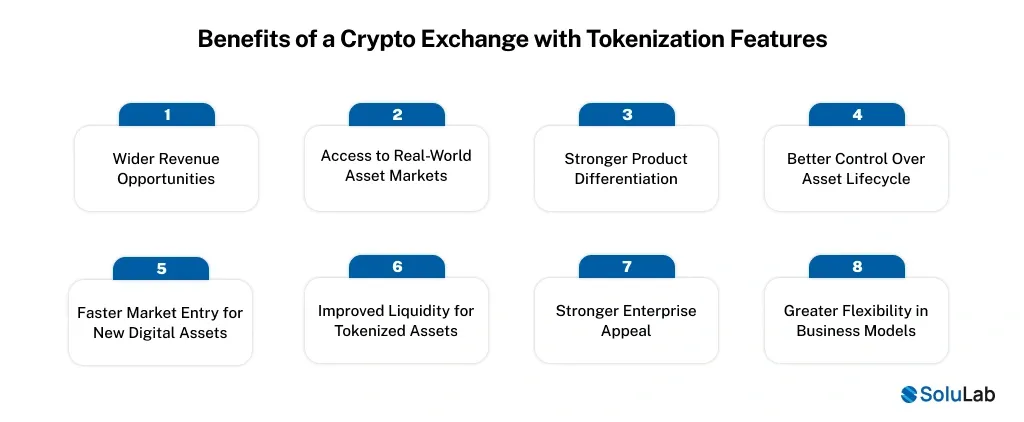
A crypto exchange integrated with tokenization capabilities is no longer just a trading platform; it becomes a multi-asset marketplace that supports both digital currencies and real-world assets. By combining crypto exchange development with asset tokenization development, businesses can unlock new revenue streams, improve liquidity, and future-proof their platforms.
Here are the key benefits:
1. Wider Revenue Opportunities
A crypto exchange with tokenization features creates more than one income stream. Along with trading fees, businesses can generate revenue from token issuance, listing services, asset management, custody support, and secondary market activity. This model gives the platform stronger commercial value and reduces dependence on standard exchange trading volumes alone.
2. Access to Real-World Asset Markets
Built-in tokenization allows the platform to support tokenized real-world assets. A crypto exchange with RWA tokenization can open access to markets such as real estate, commodities, private credit, and other asset classes. This enables businesses to attract a broader user base and a more diverse transaction flow.
3. Stronger Product Differentiation
A tokenization-enabled crypto exchange allows businesses to combine trading with asset creation, issuance, and transfer capabilities. This gives businesses a stronger market position and makes the platform more relevant for issuers, investors, and enterprise users.
4. Better Control Over Asset Lifecycle
By using decentralized exchanges with tokenization, businesses can manage the asset lifecycle from the platform. Trading, settlement, and reporting become a more complete operation under one environment. This improves efficiency and makes the platform easier to manage at scale over time.
5. Faster Market Entry for New Digital Assets
A platform with integrated tokenization tools can bring new digital assets to market more efficiently. This allows businesses to launch products within one environment and also shortens operational delays. It supports a smoother path from asset creation to active market participation.
6. Improved Liquidity for Tokenized Assets
A tokenized asset trading platform helps businesses create a more direct route to liquidity. When tokenized assets are listed and traded within the same ecosystem where they are issued, buyers and sellers can interact more easily. This helps to improve market activity and increases the practical value of tokenized offerings.
7. Stronger Enterprise Appeal
Businesses and institutional participants often look for platforms with clear controls, structured access, and broader asset support. The top digital asset tokenization platforms, combined with exchange capabilities, offer a more mature product environment. This makes the platform more attractive to enterprises seeking secure, scalable, and commercially viable digital asset infrastructure.
8. Greater Flexibility in Business Models
Built-in tokenization gives businesses more ways to shape their platform strategy. They can support asset-backed tokens, utility-based models, fractional ownership structures, and private market products within one exchange environment. This is a key differentiator for exchanges aiming to compete with top crypto exchanges globally.
Read more – Top 7 White-Label Tokenization Development Partners
How to Build a Crypto Exchange with Tokenization Features?
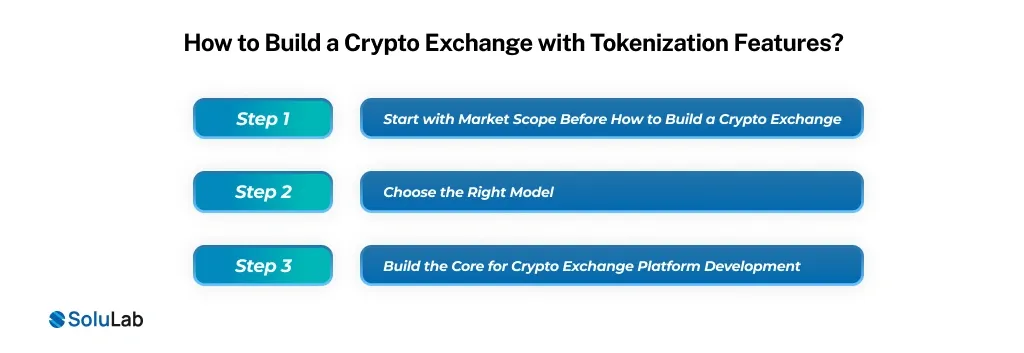
Starting a crypto exchange with tokenization features is no longer just about enabling trading—it’s about creating a multi-asset digital marketplace where cryptocurrencies and tokenized real-world assets can coexist.
Below is a step-by-step approach:
Step 1: Start with Market Scope Before How to Build a Crypto Exchange
Every platform build should begin with a market scope. The first decision is the target user group, whether retail traders, brokers, funds, issuers, or business users. Once that is clear, product structure, compliance needs, and trading workflows become easier to define.
Asset scope matters just as much. Some businesses may focus on crypto pairs and stablecoins, while others may want a real-world asset tokenization exchange. Early decisions around asset class, jurisdiction, custody, and settlement help prevent weak positioning and expensive corrections later. For best results, it’s good to hire an expert tokenization consulting company to understand the ins and outs deeply.
Step 2: Choose the Right Model
The exchange model shapes the entire product. Combining centralized and decentralized features to build a hybrid crypto exchange changes how the business operates and how users interact with the platform.
A centralized exchange offers tighter control over reviews, monitoring, and order execution. A decentralized model supports self-custody and greater flexibility. Businesses can go for the hybrid part with centralized governance, with decentralized settlement or tokenization layers where they add practical value.
Step 3: Build the Core for Crypto Exchange Platform Development
A reliable crypto exchange platform development includes the engine, wallets, custody controls, asset listing tools, fee systems, reporting, and compliance modules. These are core for the long-term infrastructure.
The platform should also support order books, deposits, withdrawals, token-related events, user permissions, and audit controls in one connected backend. For businesses targeting larger clients, governance, treasury controls, approval workflows, and API access should be planned early, not added later.
Step 4: Add Asset Tokenization Platform Development the Right Way
Tokenization should sit inside the platform as a business function. In a crypto exchange with tokenization, the platform must support issuance, listing, transfer rules, and secondary trading through a single operating flow that users can trust.
That means asset tokenization platform development should cover onboarding, legal structure, minting rules, investor access, redemption logic, and trading restrictions. A serious digital asset tokenization platform connects those controls directly to exchange infrastructure so businesses can issue and trade tokenized assets without fragmented systems.
Step 5: Treat Crypto Exchange Security Features as Core Infrastructure
Security and compliance shape whether the platform can attract serious users. Crypto exchange security features should include wallet segregation, key protection, withdrawal controls, access permissions, transaction monitoring, surveillance, and full audit trails. These are not optional layers for later phases.
This becomes even more important in tokenized markets. When a business supports asset-backed tokens or regulated products, the exchange must handle asset reviews, sanctions screening, KYC and KYB checks, suspicious activity controls, and issuance oversight with the same discipline as trade execution.
Step 6: Build Liquidity and Operations into End-to-End Crypto Exchange Development
A platform can launch with strong technology and still fail if liquidity is weak. Thin order books, poor spreads, and broken settlement processes reduce confidence quickly. That is why end-to-end crypto exchange development should include market operations and liquidity planning before launch.
Businesses need market-maker support, issuer servicing, treasury operations, custody workflows, and lifecycle management for events such as interest, redemption, or maturity. Strong reporting also matters, especially for tokenized assets, where ownership records and transaction visibility are part of the product value.
Step 7: Control Scope, Timeline, and Crypto Exchange Development Cost
Many exchange projects become expensive because they try to do too much at once. A better rollout starts with one asset category, one exchange model, and a limited tokenization scope. That approach keeps DEX development costs more manageable and improves execution discipline.
The roadmap should move in phases: discovery, architecture, compliance planning, core build, tokenization modules, testing, controlled release, and expansion. This gives the business a cleaner launch path and makes it easier to scale into more users, assets, and regions over time.
Conclusion
Creating an exchange with built-in tokenization features is a market-structure decision. Businesses that bring trading, issuance, compliance, and asset servicing into one platform can move closer to institutional demand and create more durable revenue. The right path starts with clear market selection, strong exchange architecture, a reliable tokenization layer, and disciplined security controls. It also requires a partner that understands trading systems and tokenized assets in the same build cycle.
A business does not need to launch every feature on day one. It needs a focused first version that solves a clear problem well. That is how a tokenization-enabled crypto exchange can earn trust, liquidity, and long-term relevance in a crowded market.
Looking for the Right Build Partner? Choose SoluLab!
At SoluLab, we help businesses to start their journey through planning, architecture, compliance-focused design, and delivery support. From crypto exchange platform development to tokenization workflows, our focus remains on building a platform that can help businesses combine exchange and tokenization features. For teams exploring a new market entry or a platform upgrade, our team of experts can help shape the roadmap, reduce execution risk, and move the product from concept to release with a path to adoption and revenue, safely and efficiently.
Book a free discovery call now!
FAQs
Shipra Garg is a tech-focused content strategist and copywriter specializing in Web3, blockchain, and artificial intelligence. She has worked with startups and enterprise teams to craft high-conversion content that bridges deep tech with business impact. Her work translates complex innovations into clear, credible, and engaging narratives that drive growth and build trust in emerging tech markets.