Key Takeaways
- XRP is emerging as a strong backbone for RWA tokenization due to its high speed, low transaction costs, and scalability.
- Real-world asset tokenization is moving mainstream, with businesses seeking efficient blockchain infrastructure to digitize assets.
- XRP Ledger enables faster settlement and global accessibility, making it ideal for financial-grade applications.
- Compared to traditional blockchains, XRP offers better cost-efficiency and performance for large-scale tokenization platforms.
- SoluLab helps businesses design and develop custom RWA tokenization platforms on XRP, ensuring scalability and compliance.
- With deep expertise in blockchain and tokenization, SoluLab enables end-to-end development—from strategy and architecture to deployment and optimization.
Unlike most blockchain ecosystems built around complex smart contracts, XRPL is designed as financial infrastructure first, not a developer playground first. That distinction matters when:
- Compliance is non-negotiable
- Settlement speed impacts revenue cycles
- A single exploit can cost millions
With over $40 billion worth of XRP held on Ripple’s balance sheet and growing institutional integrations globally, XRPL is positioning itself not just as a payments network but as a core layer for global asset movement.
The discussion for blockchain development is shifting fast,
from “Can blockchain work?” → to “Which blockchain can institutions trust?”
Why Financial Institutions Are Looking for Scalable Blockchain Infrastructure?
As of March 17, 2026, the validated on-chain RWA value (excluding stablecoins) is $27.05 billion.
Additionally, in 2025 alone, the tokenized RWA value increased by over 250%, indicating a clear shift from experimentation to institutional deployment. These numbers are changing the dynamics of how financial institutions are redesigning how assets move. This creates the demand for real-world asset tokenization on XRP and other networks.
1. The Breakdown of Traditional Financial Infrastructure
Today’s asset infrastructure is inefficient by design:
- Settlement cycles: 2-5 days (SWIFT, custodial transfers)
- Intermediaries involved: 4-7 entities per transaction
- Liquidity fragmentation: Assets locked in local markets
- Operational costs: Up to 2-4% per transaction in some asset classes
For large institutions managing billions, these inefficiencies directly impact:
- Capital efficiency
- Time-to-liquidity
- Cross-border scalability
Now compare that with tokenized infrastructure:
- Settlement: 3-5 seconds
- Global accessibility: 24/7 markets
- Fractional ownership: unlocked liquidity
- Operational cost: near-zero marginal cost
This is why institutions are actively evaluating XRP blockchain infrastructure for RWA.
2. What Institutions Actually Care About (Not Hype)
From recent projects like Project Agora, banks and asset managers are choosing blockchain technology to enhance automation and speed.
1. Can It Handle Compliance Without Workarounds?
Most blockchains require:
- Custom smart contracts
- External compliance layers
- Legal wrappers
This increases:
- Development cost
- Legal complexity
- Audit timelines
For regulated assets, this is a deal breaker.
2. Can It Eliminate Smart Contract Risk?
Smart contracts are powerful but risky.
In the last few years, billions have been lost due to:
- Contract vulnerabilities
- Poor audit coverage
- Exploits in DeFi protocols
For institutions, this translates to: Unacceptable operational risk
They don’t want flexibility. They want predictability and safety.
3. Can It Provide Instant, Low-Cost Settlement?
Liquidity is the backbone of financial markets.
If settlement:
- Takes days
- Costs unpredictably
- Requires intermediaries
Then, tokenization loses its advantage.
This is where XRP for real-world asset tokenization aligns with institutional priorities.
Read more – Blockchain-Powered Hotel Tokenization Is Changing Hospitality
Inside the XRP Ledger: Built-In Features That Enable Large-Scale Asset Tokenization
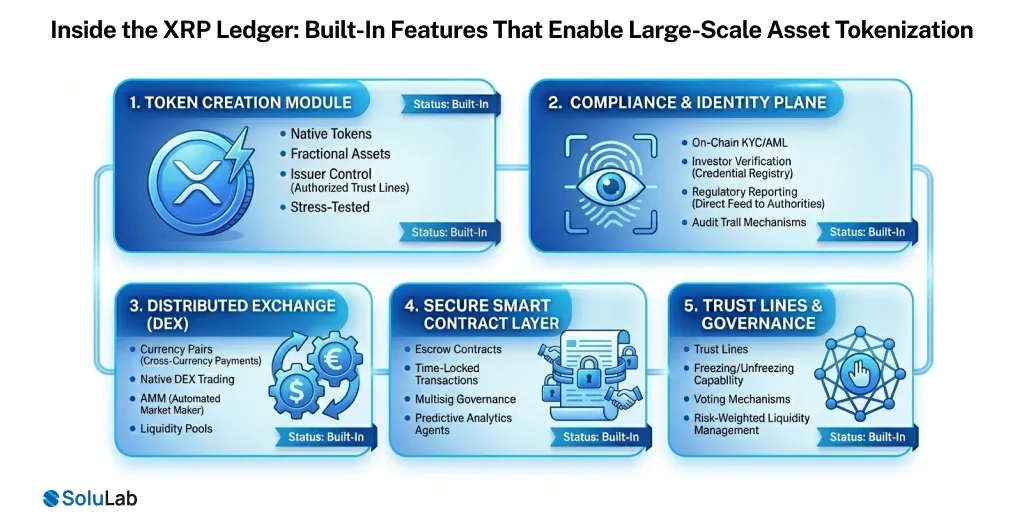
What makes XRP Ledger RWA tokenization different is simple: It removes complexity at the protocol level instead of pushing it to developers. But what features does this even include in the XRP ledger that make this complex task simple?
Fun Fact:
In 2026, the XRPL EVM Sidechain bridges the gap, allowing institutions to use familiar Solidity tools for complex logic while settling on the ultra-secure XRP mainnet.
1. The “No Smart Contract” Advantage (Security by Design)
Most blockchain ecosystems rely on:
- Custom-written smart contracts
- Third-party audits
- Continuous maintenance
XRPL takes a different approach.
Native Tokenization via Multi-Purpose Tokens (MPTs)
With MPTs, asset issuance happens directly at the ledger level.
This means:
- No custom contract deployment
- No repeated audit cycles
- No dependency on external logic layers
Business impact:
- Up to 40% reduction in development costs
- Faster time-to-market
- Lower long-term maintenance overhead
For enterprises evaluating XRP ledger tokenization, this is a major advantage.
Instead of building security on top, XRPL embeds it into the system.
2. Built-In Compliance: Clawback and Freeze Features
This is where XRPL becomes institution-ready. Most blockchains treat compliance as an add-on. XRPL treats it as a core requirement.
Clawback Function
Allows issuers to:
- Recover assets in case of fraud
- Comply with regulatory orders
- Handle lost key scenarios
Freeze Capability
Enables:
- Restricting suspicious accounts
- Enforcing jurisdictional rules
- Meeting AML/KYC obligations
These features directly address regulatory concerns from bodies like:
- SEC
- ASIC
- Global financial regulators
For XRP ledger asset tokenization, this reduces legal friction significantly.
3. RLUSD: The Missing Piece for Institutional Settlement
Tokenized assets need a stable settlement layer.
Without it:
- Pricing becomes volatile
- Transactions become complex
- Institutional adoption slows down
Enter RLUSD (Ripple USD)
A USD-pegged stablecoin designed for:
- Institutional-grade transactions
- Cross-border settlement
- On-chain liquidity
In the XRP token digital asset ecosystem, RLUSD acts as:
- Settlement currency
- Liquidity bridge between fiat and digital assets
- Treasury management layer for institutions
This is critical for XRP cross-border asset tokenization, especially in markets where currency volatility is high.
Read more – Tokenization in Finance
Throughput, Speed, and Settlement: Can XRPL Power Institutional-Grade Financial Systems?
There are many infrastructures, like tokenization on Solana, Ethereum, and Polygon. Of course, each of them has a different target. For example, Ethereum focuses on smart contracts (ERC-20, ERC-3643 for RWA) and a massive developer ecosystem.
Let’s see the table below to get a simple idea:
| Factor | XRP Ledger (XRPL) | Ethereum | Solana |
| Core Focus | Financial infrastructure | Programmable finance | High-speed applications |
| Settlement Finality | ~3–5 seconds | 12 sec-min (network dependent) | ~2–5 seconds |
| Transaction Cost | <$0.01 (stable) | $5–$50+ during peak usage | <$0.01 (low but variable) |
| Tokenization Method | Native (MPT, built-in) | Smart contracts (ERC standards) | Smart contracts |
| Compliance Controls | Built-in (freeze, clawback) | Custom implementation required | Limited native support |
| Performance Stability | High (predictable fees & speed) | Variable (gas spikes, congestion) | High speed but occasional outages |
| Best Fit Use Case | Banks, RWAs, regulated assets | DeFi + RWA hybrid models | Retail apps, high-frequency use cases |
Now see how this is even achieved.
1. Performance That Directly Impacts Capital Efficiency
XRPL delivers:
- Settlement time: ~3–5 seconds
- Transaction cost: typically <$0.01
- Energy usage: negligible compared to proof-of-work chains
- Throughput: ~1,500 transactions per second (with scaling improvements ongoing)
Now compare this with traditional systems:
- Cross-border wires (SWIFT): 2–5 business days
- Securities settlement: T+2 cycle still standard in many markets
- Real estate transactions: weeks to months
What this means for institutions:
- Faster capital rotation
- Reduced counterparty risk
- Real-time liquidity access
This is why the XRP blockchain for RWA is being evaluated as a settlement layer, not just a tokenization layer.
2. Interpreting the Real Advantage (Beyond Speed)
Speed alone is not the value. Predictability is.
Ethereum-based systems often face:
- Gas fee spikes during network congestion
- Variable confirmation times
- Dependency on external smart contracts
XRPL, on the other hand, offers:
- Stable fee environment (fractions of a cent)
- Deterministic settlement (no probabilistic finality delays)
- Minimal execution risk (no contract failures for basic tokenization)
For an institution moving $50M-$500M transactions, this predictability matters more than raw speed.
How Blockchain Development Partners Help Enterprises Launch XRPL-Based Tokenization Solutions?
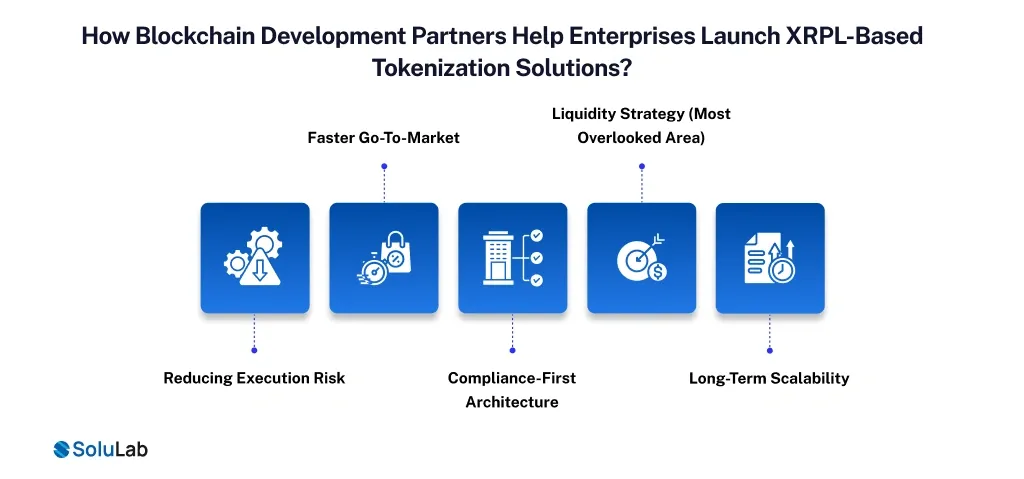
Most enterprises underestimate one thing: Tokenization is not just a tech problem. It’s a financial + regulatory + infrastructure problem combined.
This is where the right RWA tokenization development partner, like SoluLab, becomes critical. What SoluLab offers you:
1. Reducing Execution Risk
Our experienced real-world asset tokenization experts help:
- Avoid incorrect asset structuring
- Prevent compliance gaps
- Design scalable architecture from day one
This alone can save:
- 6–12 months of rework
- Significant legal costs
2. Faster Go-To-Market
With pre-built modules and XRPL expertise:
- Token issuance frameworks are ready
- Compliance integrations are standardized
- Wallet and custody systems are pre-tested
Result:
- Launch timelines reduced by up to 40–50%
3. Compliance-First Architecture
A strong partner ensures:
- Regulatory alignment from day one
- Integration of KYC/AML providers
- Audit-ready infrastructure
This is essential for:
- Institutional investors
- Cross-border operations
4. Liquidity Strategy (Most Overlooked Area)
Technology alone doesn’t create value. Liquidity does.
- Exchange integrations
- Market-making strategies
- Stablecoin pairing (RLUSD)
This directly impacts:
- Asset adoption
- Investor participation
- Platform success
5. Long-Term Scalability
Tokenization is not a one-time build.
A reliable RWA tokenization development services provider ensures:
- Continuous upgrades (XRPL updates, EVM integration)
- Performance optimization
- Security monitoring
| Platform Tier | Estimated Cost | Timeline |
| MVP (Core Issuance) | $15,000 – $25,000 | 6 – 10 Weeks |
| Mid-Level (Compliance + UI) | $30,000 – $50,000 | 10 – 16 Weeks |
| Enterprise (Global Scale) | $30,000+ | 4 – 6 Months |
So, this is the right time to shape your vision and give a digital view to your tokenization platform. Contact us today!
FAQs
Deepika is a content writer who blends storytelling with strategic thinking. She explores topics across digital innovation, emerging tech, and the evolving blockchain industry. She enjoys breaking down complex ideas into simple, engaging narratives in the growing global markets.