Key Takeaways
- Regulatory clarity in 2025–2026 has increased institutional adoption of stablecoin payment infrastructure.
- Stablecoin settlement enables faster cross-border business payments with near-instant blockchain transactions.
- Businesses can integrate stablecoin settlement with treasury systems and global payment workflows.
Enterprise finance has entered the era of “Instant Liquidity.” In 2026, stablecoin settlement is no longer an experiment; it is a core treasury tool moving over $4 trillion in real-economy payments annually.
Following the 2025 passage of the U.S. GENIUS Act and the full implementation of the EU’s MiCA, the legal “green light” has arrived. Enterprises are now replacing fragmented, expensive banking rails with enterprise blockchain solutions for payment infrastructure to move value at the speed of data.
What Does Stablecoin Settlement Mean for Enterprise Treasury Operations?
Stablecoin refers to using fiat-backed digital assets, such as USD Coin (USDC) or Tether (USDT), to process payments on blockchain networks.
Unlike volatile cryptocurrencies, stablecoins maintain a price peg to fiat currencies, typically backed by reserves held in cash or short-term government securities.
Financial institutions, including JPMorgan Chase and Visa Inc., have expanded blockchain settlement pilots between 2025 and 2026, reflecting growing institutional confidence in tokenized payment rails.
For enterprise treasury teams, stablecoin settlement introduces several operational advantages.
Key Treasury Benefits
1. Real-Time Cross-Border Settlement
Payments can settle within minutes instead of the multi-day timelines typical in correspondent banking networks.
2. Reduced Intermediary Costs
Blockchain technology settlement eliminates several intermediary banks, lowering FX spreads and transaction fees.
3. 24/7 Liquidity Movement
Stablecoin networks operate continuously, enabling treasury teams to move funds outside traditional banking hours.
4. ISO 20022 Data Richness
Modern stablecoin settlement platform development now integrates ISO 20022 messaging standards directly into the transaction metadata.
This means every payment carries its own invoice, tax data, and compliance proof. This allows for automated reconciliation in SAP or Oracle without manual human intervention.
5. Programmable Payment Automation
Smart contracts allow conditional payments based on events such as delivery confirmation or milestone completion.
6. Yield on “Cash in Transit.”
A major treasury innovation emerging in 2026 is the ability to earn yield while funds are moving.
Tokenized treasury-backed stablecoins, such as those associated with institutional funds like BlackRock’s BUIDL or tokenized funds from Franklin Templeton, are backed by short-term U.S. Treasury bills.
This means enterprises can potentially earn a 4-5% yield on capital held in settlement flows, something impossible with traditional SWIFT-based payment transfers, where funds earn zero interest during settlement delays.
For multinational businesses managing large liquidity pools, this capability can materially improve treasury efficiency.
Why Are Global Enterprises Accelerating Stablecoin Adoption in 2026?
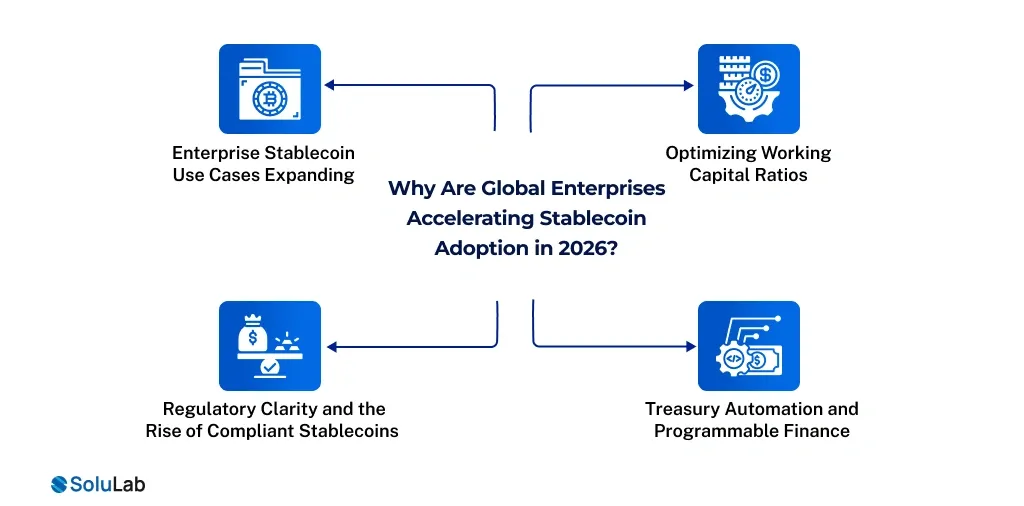
Consulting reports from global financial institutions increasingly point out that stablecoins are becoming part of treasury modernization strategies because they help companies optimize liquidity cycles and financial reporting metrics.
1. Optimizing Working Capital Ratios
One of the biggest financial pressures on global enterprises is managing Days Sales Outstanding (DSO) and cash conversion cycles.
Traditional cross-border payments often delay receivables and supplier payments by several days due to banking intermediaries.
Stablecoin settlement allows payments to finalize within minutes, enabling treasury teams to:
- Shorten receivable cycles
- Reduce capital trapped in settlement pipelines.
- Improve quarterly working-capital reporting metrics
- Optimize liquidity allocation across global subsidiaries
For companies operating across multiple continents, these improvements directly impact cash flow predictability and balance sheet efficiency.
Rather than simply making payments faster, stablecoins help CFOs hit quarterly treasury performance targets.
2. Treasury Automation and Programmable Finance
Another major driver behind adoption is the rise of programmable finance infrastructure.
Stablecoin transactions can be controlled through smart contracts that automatically execute payments when certain business conditions are met.
Examples include:
- Releasing payment once goods are confirmed delivered
- Automated supplier payouts after invoice verification
- Conditional escrow settlements for international trade
This reduces manual reconciliation processes and improves operational transparency between trading partners.
For enterprises managing thousands of global transactions, programmable settlement introduces a new level of operational efficiency.
3. Regulatory Clarity and the Rise of Compliant Stablecoins
The regulatory landscape in 2026 has also created a clear separation within the stablecoin market.
Corporate compliance teams now distinguish between:
- Regulated stablecoins issued by permitted institutions
- Offshore stablecoins with limited reserve transparency
Most enterprises prefer regulated assets such as USD Coin, which meet institutional reporting standards and audit requirements.
New regulations introduced in the United States and Europe now require stablecoin issuers to publish reserve disclosures and maintain clear redemption guarantees.
As a result, enterprise adoption strategies increasingly prioritize regulated digital dollars rather than unregulated alternatives.
4. Enterprise Stablecoin Use Cases Expanding
Companies are now using stablecoin settlement for several operational scenarios:
- Global B2B supplier payments
- Vendor payouts in emerging markets
- Treasury liquidity rebalancing
- Tokenized asset settlement
- On-chain escrow services
The shift is practical and operational. Stablecoins are evolving into a programmable financial rail for global commerce.

How Does Stablecoin Settlement Improve Cross-Border Payment Infrastructure?
Traditional cross-border payment systems rely heavily on correspondent banking networks and SWIFT messaging. While reliable, these networks often introduce settlement delays, intermediary fees, and reconciliation challenges.
Stablecoin infrastructure introduces a fundamentally different financial architecture. Instead of passing through multiple banks, value can move directly across blockchain networks through programmable settlement layers.
1. Atomic Settlement and Delivery-versus-Payment (DvP)
One of the most important innovations introduced by blockchain settlement is atomic settlement.
Atomic settlement ensures that two assets are exchanged simultaneously in a single transaction.
This model is commonly known as Delivery versus Payment (DvP).
In a traditional financial system, settlement risk exists because one party may deliver an asset while waiting for payment confirmation.
Atomic settlement removes this risk.
For example:
- A company transfers a tokenized invoice or asset.
- The counterparty transfers stablecoins.
- Both assets settle simultaneously through a smart contract.
If either side fails, the transaction automatically cancels.
For corporate treasury teams, this eliminates a major financial exposure known as settlement risk, which has historically required additional reconciliation and collateral arrangements.
2. Enterprise Stablecoin Remittance Platforms
Another emerging trend is the development of internal enterprise remittance rails.
Instead of relying entirely on SWIFT networks, companies are building their own stablecoin-based payment infrastructure.
These platforms allow organizations to:
- Move liquidity instantly between global subsidiaries
- Execute supplier payments without correspondent banking delays
- Create internal cross-border settlement networks
This approach is increasingly attractive for multinational corporations managing complex global treasury structures.
3. The Stablecoin Sandwich Model
Even when companies use blockchain settlement internally, suppliers may still prefer traditional fiat payments.
To bridge this gap, many enterprises use what is commonly called the stablecoin sandwich model.
The workflow looks like this:
- Fiat On-Ramp: A company converts local currency into stablecoins through a regulated payment provider.
- Stablecoin Settlement Layer: The payment travels across blockchain networks within minutes.
- Local Currency Off-Ramp: The recipient receives funds converted into their local currency.
This model allows enterprises to benefit from blockchain settlement without requiring vendors to interact directly with digital assets.
For companies operating in emerging markets or fragmented banking environments, this hybrid system significantly improves payment reliability.
How Should Enterprises Build a Scalable Stablecoin Settlement Platform?
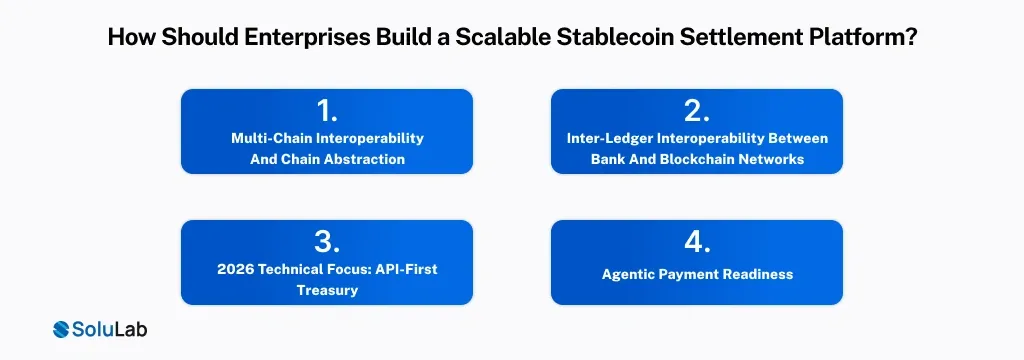
Stablecoin settlement is increasingly treated as a core financial infrastructure layer rather than a simple payment feature.
Enterprises building these systems must focus on interoperability, automation, and integration with existing treasury workflows.
1. Multi-Chain Interoperability and Chain Abstraction
In 2026, enterprises rarely rely on a single blockchain network.
Instead, they adopt chain abstraction layers that allow payments to move across multiple blockchain ecosystems seamlessly.
For example:
- A company sends USDC on Ethereum
- The recipient receives EURC on a Layer-2 network
This process happens automatically through cross-chain settlement infrastructure.
For global enterprises, multi-chain interoperability ensures:
- Lower transaction costs
- Access to multiple liquidity pools
- Reduced dependency on a single blockchain network
This capability is critical for building enterprise-grade cross-chain settlement infrastructure.
2. Inter-Ledger Interoperability Between Bank and Blockchain Networks
Another important capability is inter-ledger interoperability.
Enterprises increasingly operate across both:
- Private banking blockchains (such as internal bank settlement networks)
- Public stablecoin ecosystems
Inter-ledger bridges allow organizations to move liquidity between these environments.
For example, a payment might originate on a private bank network and settle on a public stablecoin rail.
This hybrid architecture is becoming the foundation of institutional digital payment systems.
3. 2026 Technical Focus: API-First Treasury
Modern treasury platforms are also shifting toward API-first architecture.
Instead of building large internal applications, companies integrate white-label neo-banking APIs that handle stablecoin swaps and blockchain settlement in the background.
This allows treasury teams to operate from familiar financial dashboards while blockchain infrastructure manages:
- fiat-to-stablecoin conversion
- cross-chain routing
- compliance verification
- settlement execution
From the user’s perspective, the process feels like a standard bank payment.
Behind the scenes, blockchain networks handle the actual settlement.
4. Agentic Payment Readiness
One of the most advanced innovations emerging in 2026 is the rise of agentic payments.
AI agents can autonomously trigger stablecoin payments once predefined conditions are verified.
For example:
- A logistics system confirms cargo arrival at a port.
- A smart contract validates the shipping data.
- An AI treasury agent automatically releases payment to the supplier.
This model allows companies to automate large parts of global commerce workflows.
Over time, agentic finance could enable fully autonomous supply chain settlement systems.

Conclusion
As said, with the adoption of stablecoins increasing in 2026, many businesses are exploring stablecoin settlement platforms to modernize financial infrastructure and support global operations.
For enterprises planning a stablecoin development, the focus should be on:
1. Settlement Infrastructure: Build blockchain-based rails that support real-time global payments.
2. Interoperability & Compliance: Enable cross-chain transactions with regulatory-ready monitoring.
3. Treasury Integration: Connect stablecoin settlements with ERP systems for automated reconciliation.
At SoluLab, we help enterprises develop secure, scalable, stablecoin settlement platforms for digital finance ecosystems. Contact us today!
FAQs
Deepika is a content writer who blends storytelling with strategic thinking. She explores topics across digital innovation, emerging tech, and the evolving blockchain industry. She enjoys breaking down complex ideas into simple, engaging narratives in the growing global markets.