Key Takeaways
- Tokenizing a stock or ETF on Robinhood Chain means issuing a blockchain token that tracks the price of a real, custodied share, not creating a new class of equity ownership.
- The tokenized equities market moved fast in 2026. CoinDesk Data clocked monthly tokenized stock and ETF trading volume at $11.3 billion in July alone, a 288% jump from June.
- Not every stock or ETF can legally be tokenized the same way. Eligibility depends on issuer rights, jurisdiction, and how the underlying security is actually held.
- ETFs and single stocks tokenize differently under the hood. Basket rebalancing adds an operational layer that a single-share token never has to deal with.
- Regulatory infrastructure is catching up fast. The SEC’s March 2026 interpretive release and Nasdaq’s DTC pilot both moved tokenized securities closer to mainstream market plumbing.
Tokenized stocks crossed roughly $1 billion in circulating value with more than 185,000 holders back in March 2026, up from about $20 million and under 1,500 users just fifteen months earlier.
That kind of growth curve is exactly why Robinhood built its own chain around it. Robinhood Chain launched with Stock Tokens as its flagship product, giving investors outside the US price exposure to American equities and ETFs without a traditional brokerage account.
For a founder or a fintech team, the real question isn’t whether tokenized equities are catching on. They clearly are. It’s what actually has to be built, legally and technically, to tokenize a stock or ETF on this specific chain properly. That’s what this guide covers.
What Does It Mean to Tokenize Stocks and ETFs on Robinhood Chain?
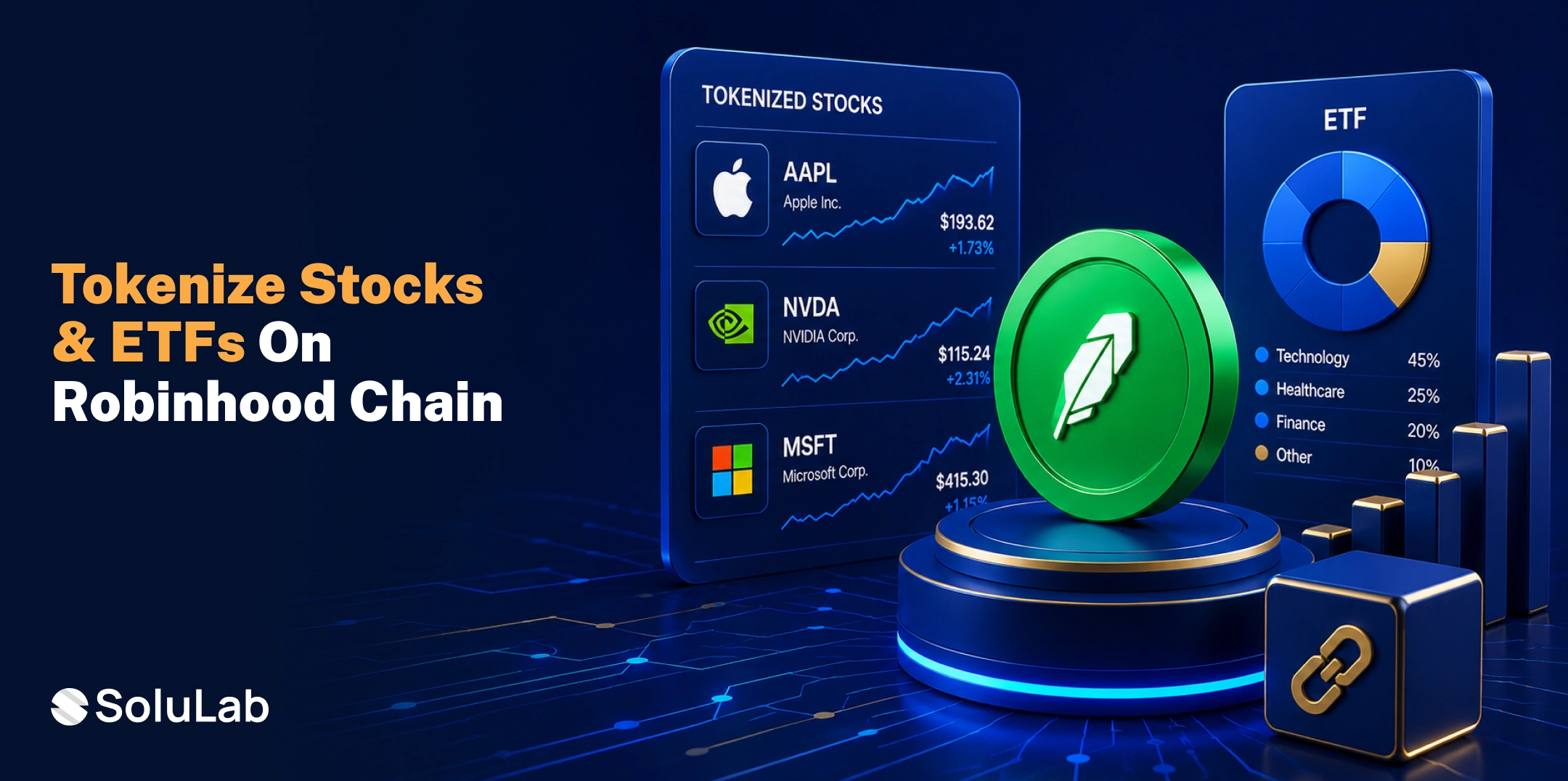
Tokenizing a stock means issuing a blockchain token whose price tracks a real, custodied share, usually one-to-one. The token isn’t the stock itself. It’s a claim, typically structured as a debt security, that mirrors the underlying asset’s price movement without conferring shareholder rights like voting or dividends in the traditional sense. Robinhood built its own Stock Tokens exactly this way, which is a deliberate legal choice, not an oversight.
An ETF token works on the same principle but tracks a basket of holdings instead of one company. Chainlink handles the oracle pricing layer on Robinhood Chain, keeping the on-chain token price aligned with the real market as it moves.
The whole point of the exercise is access: giving someone in a country without direct access to US brokerages a way to get economic exposure to a stock or fund they otherwise couldn’t touch.
Why Firms Are Building on Robinhood Chain Now?
Timing matters here more than most guides admit. The SEC and CFTC’s March 2026 interpretive release formally classified digital securities under existing US securities law, closing a legal ambiguity that had kept a lot of institutional programs on the sidelines.
- A month later, the SEC approved Nasdaq’s proposal to trade tokenized and traditional shares on the same unified order books, covering Russell 1000 constituents, major ETFs, and Treasuries, with identical execution priority for both formats.
- Gartner’s blockchain forecast puts new business value at $3.1 trillion worldwide by 2030, and tokenized securities are one of the categories now actually generating revenue instead of just showing up in a slide deck.
- That’s not a small development. It means tokenized shares are moving from a crypto-native side market into the same plumbing as traditional equities.
- Firms building now are trying to claim early distribution inside Robinhood Wallet before the space gets crowded, and inside a broader push toward real-world asset tokenization that’s pulling in serious institutional capital, not just retail speculation.
- Ondo Finance’s April 2026 partnership with Broadridge, giving tokenized stock and ETF holders proxy voting access and governance communications, is the kind of infrastructure move that signals this isn’t a passing trend.

How Are Tokenized ETFs Different From Tokenized Stocks?
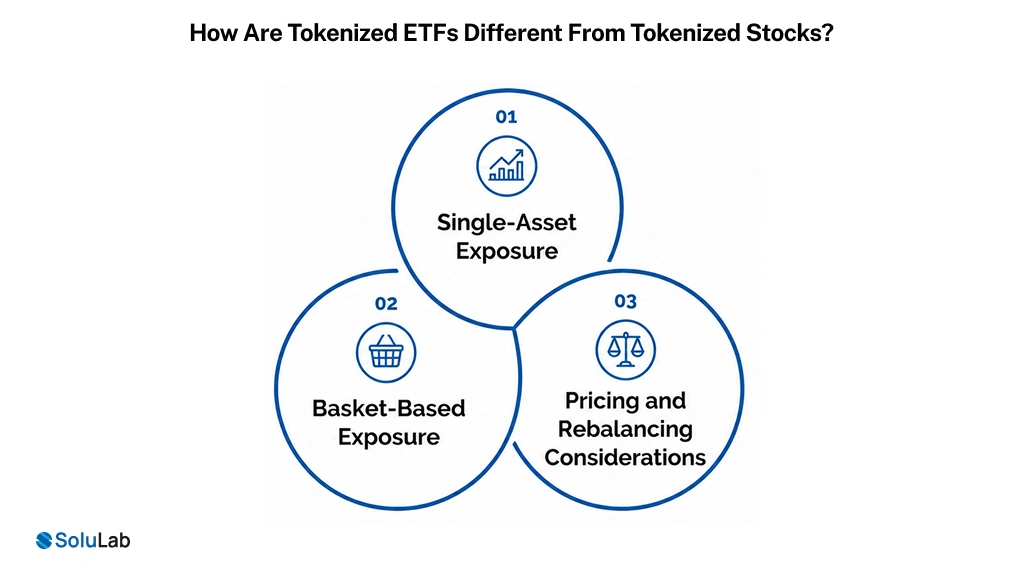
The mechanics look similar on the surface. Underneath, they diverge in ways that matter for anyone building the platform.
1. Single-Asset Exposure
A tokenized stock tracks one company’s share price. Pricing is comparatively simple: one oracle feed, one underlying asset, one custody arrangement to manage.
2. Basket-Based Exposure
A tokenized ETF tracks a basket of holdings, which means the token’s issuer has to account for the fund’s actual composition, not just a single price feed, and that composition can change.
3. Pricing and Rebalancing Considerations
ETFs rebalance. Sector funds shift weightings, index funds add or drop constituents, and a tokenized version of that fund has to reflect those changes on-chain without lagging the real fund or creating a pricing gap traders can exploit.
How to Tokenize Stocks and ETFs on Robinhood Chain?
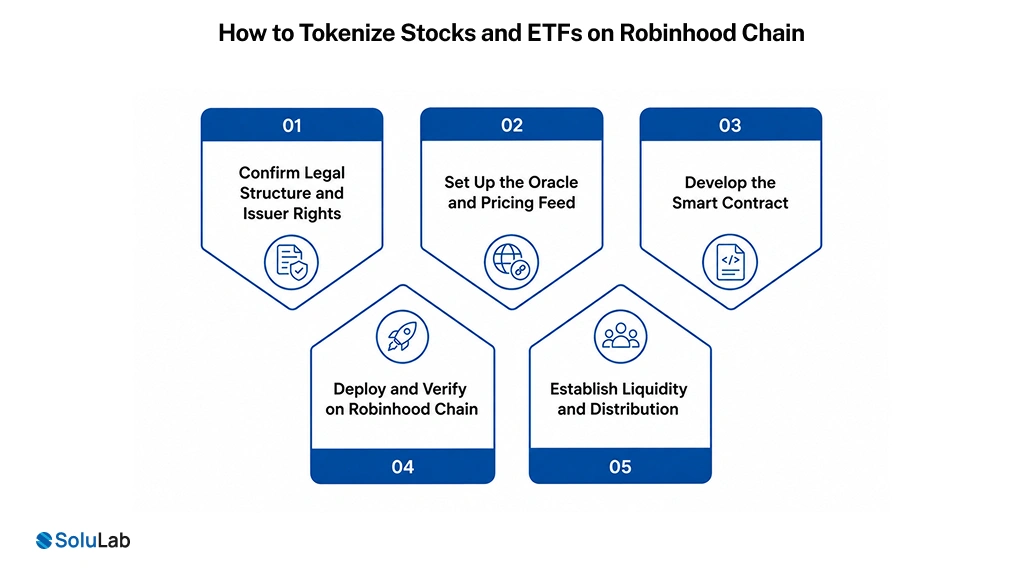
Tokenizing an asset here runs through a fairly standard EVM development flow, but with custody and regulatory work sitting alongside the code at every step.
1. Confirm Legal Structure and Issuer Rights
The starting point isn’t code. It’s paperwork. Someone has to hold the actual shares in custody before a token can legitimately represent them, full stop.
- Secure custody of underlying shares
- Define the token’s legal structure
- Confirm issuer rights are documented
2. Set Up the Oracle and Pricing Feed
Robinhood Chain leans on Chainlink for this, and any serious tokenization project needs the same level of pricing reliability.
- Integrate a reliable price oracle
- Test feed accuracy against live markets
- Build fallback logic for outages
3. Develop the Smart Contract
Contract logic needs to enforce the 1:1 backing claim and any transfer restrictions tied to investor eligibility. Teams without in-house Solidity depth usually bring in an asset tokenization development company at this stage rather than learning the compliance edge cases the hard way, mid-build.
- Write contract enforcing 1:1 backing
- Add jurisdiction-based transfer restrictions
- Test extensively before deployment
4. Deploy and Verify on Robinhood Chain
The chain’s EVM-compatible and permissionless, so once the contract’s ready, deployment itself is genuinely the easy part.
- Deploy verified contract to mainnet
- Confirm via public block explorer
- Lock or renounce contract ownership
5. Establish Liquidity and Distribution
A tokenized stock with no trading venue and no wallet visibility doesn’t actually give anyone access to anything.
- List on Uniswap or Arcus
- Enable Robinhood Wallet visibility
- Monitor liquidity depth continuously
Can You Tokenize Any Stock or ETF on Robinhood Chain?
Short answer: no. The chain’s permissionless smart contract layer doesn’t override the legal and operational requirements sitting above it, and skipping any one of the seven items below usually ends a project before it ever gets to launch.
1. Asset Eligibility
Not every security can be custodied and represented on-chain cleanly. Assets with restricted transferability, unusual corporate structures, or thin trading volume tend to get excluded from early tokenization programs, mostly because backing them reliably just gets harder.
2. Issuer Rights
Whoever’s tokenizing the asset needs a clear legal right to do it. That’s either direct custody of the shares or a licensing arrangement with the issuer, or with a custodian holding them on the issuer’s behalf. No shortcut around this one.
3. Securities Regulations
A tokenized stock still functions as a security no matter which chain it’s living on. Same disclosure requirements, same registration or exemption rules as any other regulated financial instrument, blockchain wrapper or not.
4. Jurisdiction Restrictions
Robinhood’s own Stock Tokens are live in over 120 countries and explicitly excluded from the US. That single fact says more about how much geography shapes what’s legally sellable than most of the technical documentation does.
5. Custody Requirements
Someone has to hold the underlying share in a way that’s auditable and bankruptcy-remote. Skip this and token holders end up exposed the moment a custodian or platform runs into financial trouble, which defeats the entire point.
6. Investor Eligibility
Depending on the offering’s structure, tokenized shares might only be sellable to accredited investors, non-US persons, or other specific categories. And that has to be enforced at the smart contract level. An onboarding checkbox doesn’t count as enforcement.
7. Licensing and Compliance
Running a tokenization platform for securities often means broker-dealer, transfer agent, or equivalent regional licensing on top of whatever blockchain infrastructure gets built. The tech is genuinely the easy part here.
Risks and Challenges of Tokenized Stocks and ETFs on Robinhood Chain
The technology working doesn’t mean the risk disappears. It just changes shape.
1. Regulatory Risk
Rules are still being written in real time here. A structure that’s fully compliant today could face new restrictions six months from now, simply because regulators are still catching up to how fast this market moved in 2026.
2. Liquidity Risk
Headline market-cap figures for tokenized equities and actual tradeable liquidity aren’t the same number, and mid-2026 dashboards made that gap pretty visible. Quoted size looks impressive. What you can actually trade without moving the price is a different, smaller story.
3. Custody Risk
If whoever’s holding the underlying shares fails or mismanages them, token holders can end up with a claim that’s genuinely hard to enforce, no matter what the smart contract technically says.
4. Concentration Risk
A small handful of instruments and platforms currently account for an outsized share of tokenized equity volume. One or two venues having a bad month can swing the sector’s whole reported number, which is worth remembering before treating any single stat as representative.
5. Smart Contract Risk
Bugs or exploits in the contract governing issuance and transfers put investor capital at risk in a way a traditional brokerage account never does. This is the risk category that’s actually new here, not just repackaged from traditional finance.
What’s Next for Tokenized Equities on Robinhood Chain
The next phase isn’t shaping up as one big catalyst. It looks more like several pieces of infrastructure landing close together.
1. Unified Order Book Trading
Nasdaq’s DTC pilot pairs tokenized and traditional shares on the same order book, and it’s the kind of template other exchanges will almost certainly test once regulatory comfort grows a bit further.
2. Governance and Proxy Access
Ondo’s Broadridge partnership now gives tokenized holders proxy voting rights. Governance parity with traditional shareholders is turning into a real expectation rather than a feature someone might get around to eventually.
3. Cross-Chain Distribution
Tokenized equities are expanding beyond Ethereum toward chains like Solana chasing cheaper, faster settlement. That makes interoperability between Robinhood Chain and other networks a bigger technical question than it was a year ago.
4. Institutional Custody Maturity
Bring in larger, more established custodians and the custody risk currently concentrated among a handful of platforms should start thinning out.
5. Broader Asset Coverage
Coverage will likely expand past large-cap US names into smaller-cap stocks, international equities, and eventually pre-IPO shares, tracking the same trajectory real-world asset tokenization has already shown with fund tokenization.
Conclusion
Tokenizing a stock or ETF on Robinhood Chain is technically approachable given the chain’s EVM compatibility, but the hard part was never the smart contract.
Custody, issuer rights, jurisdiction restrictions, and investor eligibility all have to be resolved before a single token gets minted, and skipping that groundwork is how promising projects stall out.
SoluLab works with fintech teams and asset managers on tokenization platform development, from smart contract architecture through custody integration and compliance, for teams building tokenized equities, funds, or broader RWA products, and can help you figure out what your specific launch actually needs.
Book a free consultation to scope your tokenized stock or ETF platform.
FAQs
Neha is a curious content writer with a knack for breaking down complex technologies into meaningful, reader-friendly insights. With experience in blockchain, digital assets, and enterprise tech, she focuses on creating content that informs, connects, and supports strategic decision-making.