NFTs have come a long way since the early days. By May 2022, more than 1 million crypto users had bought or traded one, and the global NFT market is forecast to grow from $3 billion in 2022 to $13.6 billion in 2027. Riding alongside that growth are other blockchain ideas, Decentralized Autonomous Organizations (DAOs) chief among them, which are picking up real momentum by contributing to NFT marketplace platforms.
Honestly, it all sounds a bit unhinged. JPEGs, video clips, and memes selling for millions? People buying virtual houses and land, brands selling makeup and clothes that only exist on screen? If you’re curious what a DAO actually means for the NFT world, stick around.
Start with the basics. NFTs are digital assets that are shaking up a long list of industries. They tokenize all sorts of things, from valuables to artwork, and give each one a clear, provable digital owner. Think of it as holding a one-off object, just online.
NFTs rewrote what digital ownership looks like. DAOs are doing the same for how decentralized communities run themselves. This post looks at what Decentralized Autonomous Organizations (DAOs) actually do in the NFT space, and where they pay off.
First, though, a quick grounding in NFTs themselves, and why they caught on the way they did.
What Are NFTs?
A non-fungible token (NFT) is a unique digital asset that proves you own a particular item, piece of content, or collectible. Bitcoin and Ethereum are fungible: one coin swaps for another, no questions asked. Not so here. NFT platforms deal in tokens that can’t be split up and can’t be replaced.
Every NFT marketplace carries its own value and its own set of traits, and that’s what makes it one of a kind. You’ll find NFTs in digital art, music, virtual real estate, in-game items, and plenty more. Most sit on blockchain platforms such as Ethereum, which supplies the plumbing needed to prove who owns an asset, where it came from, and how scarce it really is.
The Rise of DAOs
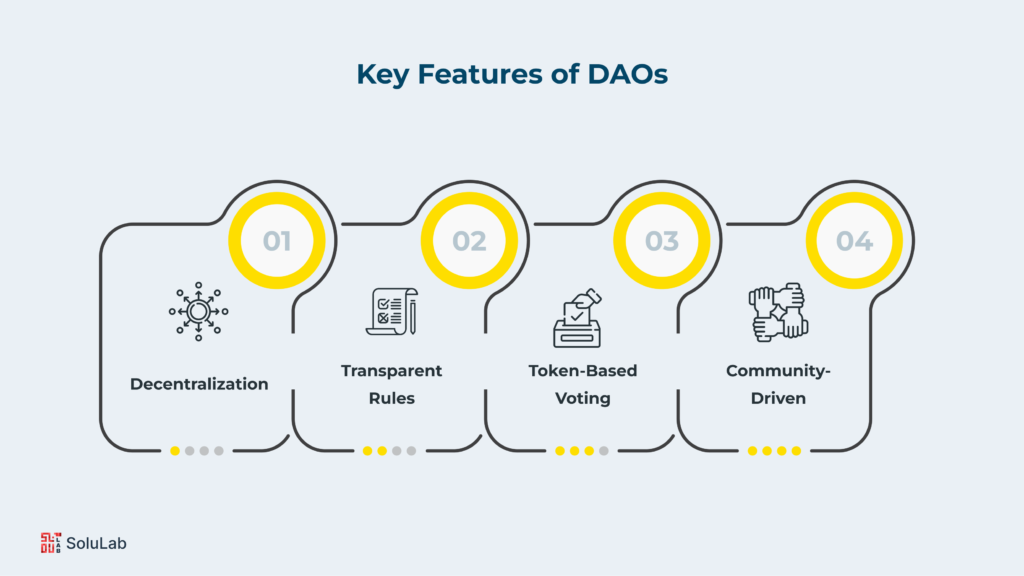
A Decentralized Autonomous Organization (DAO) is run by smart contracts and code. No CEO, no head office calling the shots. A few traits define them:
- Decentralization: They live on blockchain networks, so the power to decide is spread across token holders instead of sitting with one company or person.
- Transparent Rules: Rules and governance steps are written into smart contracts. Anyone can read them, and nobody can quietly rewrite them.
- Token-Based Voting: Tokens are the ballot. Holders take part in governance by voting on proposals with what they hold.
- Community-Driven: Most DAOs are steered by their members, who decide together on direction, policy, and where the money goes.
Before and After DAOs in the Evolution of NFT Platforms
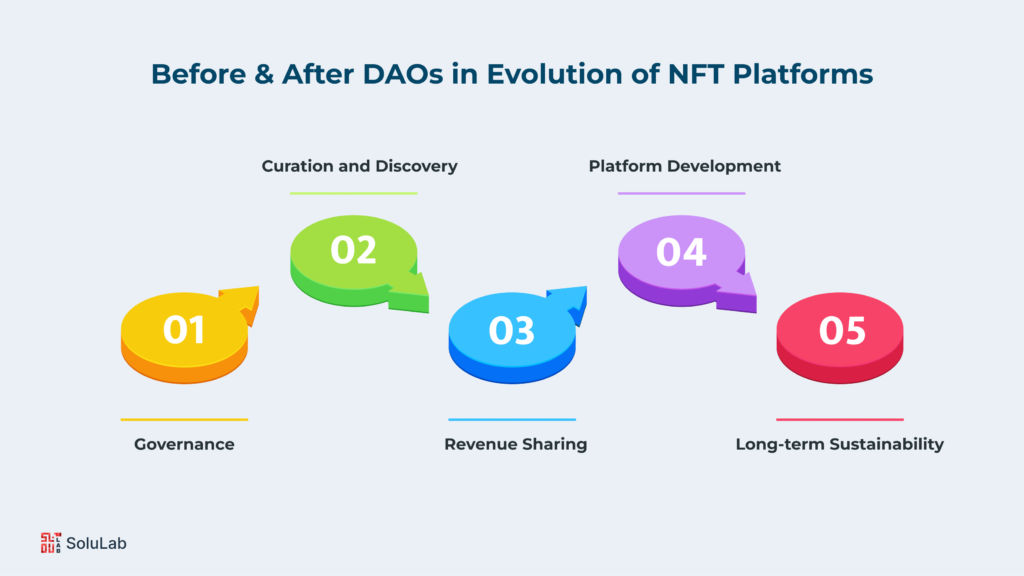
NFT (Non-Fungible Token) platforms look very different now than they did a few years back, and the arrival of Decentralized Autonomous Organizations (DAOs) is a big reason why. Before DAOs, NFT platforms were mostly centralized marketplaces: places to buy, sell, and trade digital assets wrapped as NFTs, and not much else.
They ran like ordinary companies. A hierarchy at the top, and a central authority making the governance calls.
Then DAO development arrived and shook that model up, opening new doors along the way. DAOs handed NFT platforms decentralization, autonomy, and governance by the community itself. The way these platforms operate changed at the root, and users ended up with a lot more say.
So what exactly changed? Here’s the before-and-after, area by area:
Governance
Pre-DAO, one central authority ran the show: it wrote the policies, set the fees, and picked which assets got listed. DAOs moved that power toward the community. A DAO development platform gave token holders a way to vote on decisions, so they could shape the platform’s rules and how those rules change over time.
Curation and Discovery
Curation used to be top-down. Platform admins or in-house curators decided which pieces got the spotlight, and that was that. DAO-based NFT platforms flipped it with decentralized curation, where the whole community helps surface and showcase assets. Token holders can now propose featured pieces and vote on them. The front page, in other words, belongs to the users.
Revenue Sharing
Without a DAO, the math was simple: the platform took a fee or commission on each trade and kept the profit. Once DAO development services came into play, revenue sharing got fairer. A DAO can route part of the platform’s income back to token holders, which rewards the people who contribute and gives the community a reason to stay involved.
Platform Development
Development opened up too. Rather than leaning only on an in-house engineering team, NFT platforms run by DAOs could draw on skilled community members from all kinds of backgrounds. More voices at the table meant a wider, more inventive range of ideas getting built.
Long-term Sustainability
And there’s staying power. When token holders own a stake and get a vote, the DAO-enabled NFT platform builds a stronger sense of ownership among its users. People who feel like owners stick around. That loyal, active community is what keeps a platform growing year after year.
How Might Users Profit From DAO-enabled NFT Platforms?
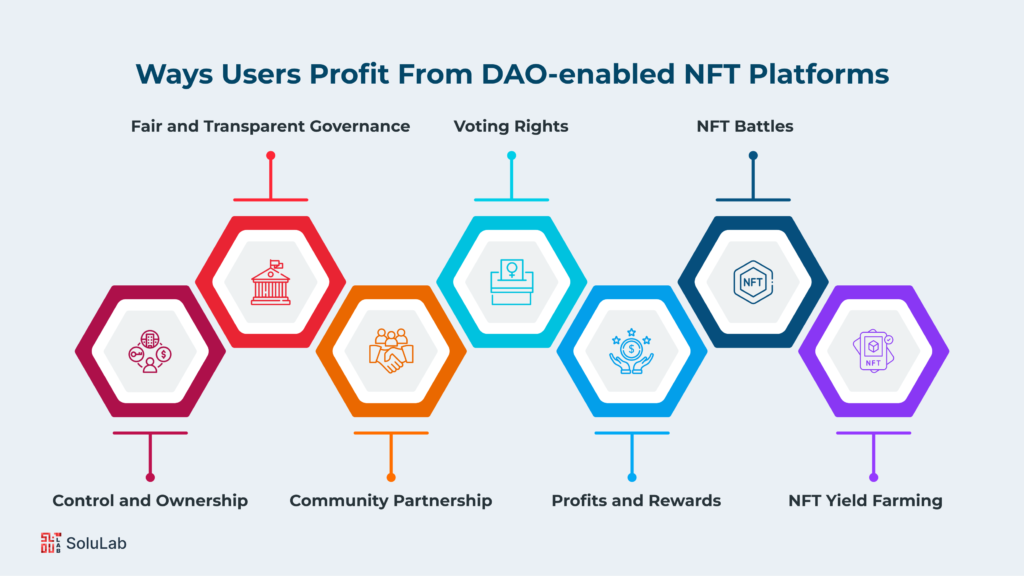
What’s in it for you as a user? On DAO-enabled NFT platforms you get more control, more involvement, and a shot at real rewards. Here’s how that plays out:
Control and Ownership
You own more of the thing you use. On a DAO-enabled NFT system, you can vote on platform rules, governance proposals, and which assets get curated. That vote means you can push the platform’s growth and direction toward what you actually care about.
Fair and Transparent Governance
DAO-based NFT platforms run their governance in the open. Every platform operation, transaction, and decision sits on the blockchain, where you can look it up and check it yourself. That openness builds trust. Decisions get made honestly and together, with no central power leaning on the outcome.
Community Partnership
These platforms are built for people to pitch in. Through DAO processes, users talk to each other, trade ideas, and help the platform grow. Got an idea for a new feature, a partnership, or a project? Any member can put it forward, and the DAO votes on whether it happens.
Read Our Blog Also: An Ultimate Handbook for NFT Creators: Selecting the Best Blockchains for Your NFT Projects
Voting Rights
On the surface these platforms may look like any other. The difference is under the hood, in how they’re governed and how their rules get managed. DAO-enabled NFT platforms use member votes to hand out awards and to amend the rules already on the books. So any user can have a hand in decisions and in setting future community policy, through a process that’s decentralized and visible to all.
Profits and Rewards
Gaming-based NFT platforms keep drawing interest, and it’s easy to see why: they’re new, and they give users several ways to earn. Through the DAO, members can propose options like NFT staking. Staking lets holders put their NFTs to work in liquidity pools without selling them or giving up ownership, which turns an idle collectible into a source of passive income. Expect more creative ways to monetize assets as time goes on. NFT staking platforms are already popular, and holders are already earning from them.
NFT Battles
Then there’s “NFT Battles,” a feature some platforms offer through a decentralized app. Holders go head to head with other holders, putting their resources on the line. Spectators can join in as well. They stake NFT tokens behind the NFT they’re backing and earn returns in NFT tokens and digital assets if it wins.
Have A Look At Our Blog: How is Gaming Contributing to the NFT Industry?
NFT Yield Farming
Yield farming is open to anyone holding both NFTs and the platform’s native token. You stake those assets straight into the platform’s liquidity pools. That supplies liquidity, and in return you earn incentives, paid as tokens plus a limited number of NFTs. One catch. Staking doesn’t automatically qualify you for the rarer NFTs, so check your eligibility before you lock anything up.
Challenges and Considerations in the Integration of DAOs in NFT Platforms
None of this comes free. Bringing Decentralized Autonomous Organizations (DAOs) into NFT (Non-Fungible Token) platforms has clear upsides, but it also drags in problems you have to plan for up front. The main ones:
- Complex Governance Decision-Making: Getting a mixed crowd of token holders to agree is hard. Votes can deadlock, or decisions can drag on for weeks.
- Sybil Attacks: A bad actor can spin up a pile of fake identities to swing a vote. That threatens the integrity of DAO governance at its core.
- Regulatory Uncertainty: Rules for DAOs and NFTs keep shifting and differ from one country to the next, so staying on the right side of them is complicated and often unclear.
Read Also: BSC NFT Marketplace Development: Everything You Need to Know
- KYC and AML Compliance: Running Know Your Customer (KYC) and Anti-Money Laundering (AML) checks inside a decentralized DAO, without trampling user privacy, is a tricky balance.
- Token-Based Manipulation: Big holders can carry outsized weight in votes. Left unchecked, governance drifts right back toward centralization.
- Legal and Taxation Challenges: Securities law, tax rules, and consumer protection all raise serious legal hurdles for NFT platforms run by DAOs.
- Interoperability: Getting different DAOs and NFT platforms to work together is tough, which makes moving assets and governance setups from one network to another far less smooth than it should be.
Future Trends and Developments in DAOs for NFTs
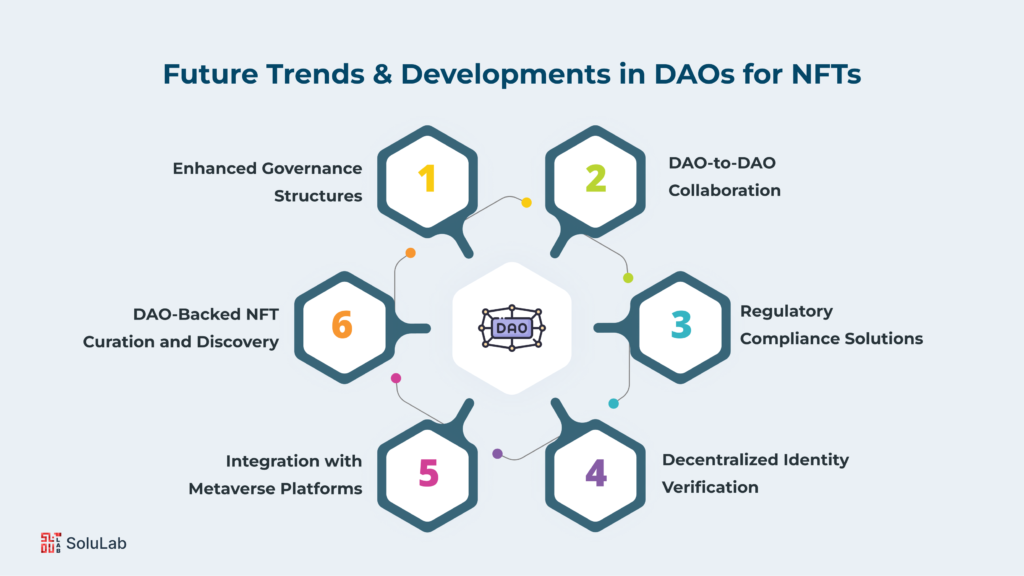
Where does it go from here? As Decentralized Autonomous Organizations (DAOs) settle deeper into the NFT (Non-Fungible Token) space, a handful of trends look likely to shape how digital ownership and governance work next. Here’s what to watch:
1. Enhanced Governance Structures
Governance will get more layered. Expect more multilayered DAOs, where smaller sub-DAOs each own one slice of governance. That gives finer control, and it lets specialists make the calls in their own area.
The payoff is faster, better-fitted decisions across NFT communities. Complex issues get handled by the people best placed to handle them, and the structure bends to what each community actually needs.
Read Blog Also: Why Should You Start Your Own NFT Marketplace Business?
2. DAO-to-DAO Collaboration
DAOs will team up more. That could mean pooling resources, making platforms work across each other, or running joint projects.
When DAOs cooperate, the NFT space starts to feel less fragmented. Projects can borrow each other’s strengths, reach more people, and open up fresh opportunities for the folks holding their NFTs.
3. Regulatory Compliance Solutions
Regulators are paying closer attention to NFTs and DAOs, and that’s pushing up demand for compliance tools built for decentralized governance. Teams will put real effort into tools and frameworks that keep them in line as the rules change.
Good compliance tooling helps NFT platforms and DAOs get through legal challenges and operate on safer footing. Less legal risk. Fewer unknowns.
4. Decentralized Identity Verification
Expect decentralized identity tools that meet KYC (Know Your Customer) and AML (Anti-Money Laundering) requirements without giving away user privacy. They aim for the middle ground between staying compliant and staying decentralized.
With them, NFT platforms can tick the regulatory boxes while users stay anonymous and private. That’s a trust win, and a transparency win, for any DAO-run community.
Know More: How to Build an NFT Marketplace on Ethereum Blockchain?
5. Integration with Metaverse Platforms
NFT DAOs and the metaverse are heading toward each other. Ownership and governance will stretch to cover virtual real estate, in-world assets, and experiences inside these immersive spaces.
For holders, that means one identity and one voice across several virtual worlds, with a smooth experience moving between them. The line between physical and digital gets blurrier still.
6. DAO-Backed NFT Curation and Discovery
DAOs will do more of the picking. Under decentralized curation, token holders decide together which NFTs get seen and celebrated.
It puts curation in everyone’s hands. Good work gets noticed because the community agrees it’s good, not because a gatekeeper said so, and that tends to bring more variety and more fresh ideas into the NFT space.
Conclusion
DAOs are changing who’s in charge of NFTs. By bringing Decentralized Autonomous Organizations (DAOs) into the picture, NFT development platforms and NFT marketplace development services have moved toward decentralized decisions, stronger communities, and room for more people at the table. The hard parts haven’t gone away. Governance is messy and regulation is still a moving target. But the trend lines are encouraging: smarter governance structures, DAOs working with other DAOs, and new approaches to compliance.
From here, DAOs look set to keep steering where NFTs go, and to strengthen the case for NFTs as a lasting digital asset class rather than a fad. The real shift is this: owning an NFT stops being about just holding it. It becomes about taking part, with the community having a say in what gets made, what gets featured, and what gets decided.
That’s where SoluLab comes in. With deep blockchain and NFT development experience, we help NFT platforms get the most out of DAOs. Our NFT Marketplace Development services and NFT development platform solutions are built to plug DAO features in cleanly, improving governance, security, and the user experience. We tailor each build to tackle scalability, regulatory compliance, and smart contract security, and we keep a close eye on what’s emerging in NFTs. By Partnering with SoluLab, you can move through the shifting NFT and DAO space with confidence and open up new options for decentralized ownership and community-led growth.
FAQs
Shipra Garg is a tech-focused content strategist and copywriter specializing in Web3, blockchain, and artificial intelligence. She has worked with startups and enterprise teams to craft high-conversion content that bridges deep tech with business impact. Her work translates complex innovations into clear, credible, and engaging narratives that drive growth and build trust in emerging tech markets.