
Most blockchain projects don’t fail at launch, as they fail the moment the wrong consultant says yes instead of why. The technology is powerful, but it is unforgiving: early assumptions harden into architecture, contracts, and governance that are expensive and sometimes impossible to unwind.
That’s why Gartner estimates blockchain could create $3.1 trillion in business value by 2030, yet only a small fraction of companies will actually capture it. The winners are not the ones who moved fastest; they’re the ones who made the right calls first.
If you’re considering blockchain consulting services, this article is your unfair advantage. Not because it explains blockchain, but because it shows you how to interrogate the people who claim to understand it better than you do.
The questions you ask in the first few conversations will quietly decide whether you’re building a durable, scalable system or funding a very expensive lesson.
Read this before you hire anyone.
Key Takeaways
- The Status Quo: Most businesses start blockchain conversations already excited, and that excitement makes it easy to skip the hard questions as Scope drifts, timelines slip, and systems get built that no one can maintain or scale.
- Why it matters: A set of sharp, honest pre-hire questions that forces any blockchain consulting company to show its real depth, not just its deck. The kind of questions that separate delivery partners from vendors chasing a statement of work.
- How SoluLab Can Help: SoluLab is a trusted blockchain development company with 9+ years of production deployments across DeFi, supply chain, finance, and healthcare. We help businesses move from we want blockchain to this is what we built and why it’s working with full transparency from day one.
10 Essential Questions to Ask Before Hiring a Blockchain Consultant
Most blockchain failures don’t happen during blockchain development; they happen before it starts. These questions are designed to expose weak assumptions, misaligned incentives, and consultants who say yes too quickly.
Read them carefully – the answers will tell you whether you’re building a scalable asset or an expensive experiment
1. What business problem are we solving by adding value with blockchain?
This is the one question most teams skip because they’re already convinced.
- But what does a blockchain consultant do in that situation?
- Do they validate your excitement or challenge it?
A consultant worth hiring challenges it. Every single time.
The truth is that blockchain technology is a fit only when your problem involves multiple parties who don’t fully trust each other, requires data immutability, or where removing a central intermediary creates real value.
If none of those conditions are true, a standard database does the job better, faster, and cheaper.
The best blockchain consulting services and solutions don’t lead with the technology; they lead with your business model. Watch closely how a consultant responds to this question. If they immediately pivot to tech, that’s a signal you must avoid.
2. Which blockchain model fits our use case with alternatives?
Public, private, consortium, hybrid, and layer-2 rollups – every one of these carries different tradeoffs in performance, cost, compliance exposure, and partner onboarding. The decision you make here shapes your architecture for years.
Enterprise blockchain consulting teams should walk you through this comparison with reasoning specific to your industry and transaction model, not just a preference for whatever stack they’re most comfortable deploying.
This is one of the important considerations before investing in a blockchain project that gets rushed when people are eager to start building. Don’t let it get rushed, as the model decision deserves its own discovery session, not a slide in a pitch.
3. How Do You Validate ROI, Incentives, and Long-Term Sustainability?
Blockchain ROI considerations are almost always undercooked in early proposals. Consultants are usually good at selling capability. Very few have an honest conversation about operating cost, timeline to value, and what the unit economics look like at 10x scale.
- Ask for a framework, not just a projected number.
- Ask for case studies with real figures from comparable deployments.
- Ask what broke in year two and how they fixed it.
According to Statista, global blockchain spending is expected to surpass $19.9 billion by 2025, growing at a compound rate of over 46% annually. That means competition is already flooding into every vertical.
If your ROI story doesn’t hold up to board scrutiny, you’ll lose the runway before the system matures.
Blockchain strategy consulting services should include sustainability modeling, like token economics if applicable, governance cost projections, and a realistic break-even timeline. If the model they give you only looks good on paper, keep pushing.
4. What Does Your Discovery Phase Include Before Any Development Starts?
No serious blockchain consulting services provider skips discovery. This is the phase where they map your workflows, audit technical readiness, validate assumptions, and align stakeholders before a single line of code is written.
- Ask what discovery produces.
- Architecture documentation?
- A risk register?
- Stakeholder alignment report?
- A dependency-flagged roadmap?
- These are standard deliverables.
If the answers are vague, that’s your answer too.
What questions should I ask a blockchain consultant before hiring? This one is near the top of the list. Discovery is where the real thinking happens. If a firm doesn’t protect this phase, you’ll spend the development budget fixing decisions that should have been made in week two.
5. How Do You Define Success Across MVP, Launch, and Scale Phases?
How blockchain consultants help businesses shows up most clearly in how precisely they can define what is meant at each phase and whether those definitions match your business objectives, not just their delivery milestones.
MVP success is not the same as launch success, and launch success is not the same as scale. So push for measurable, phase-specific benchmarks like transaction throughput targets, smart contract audit requirements before go-live, and governance model checkpoints. If they can’t define these for your project specifically, they’re not ready for your project.
6. How Do You Approach Security, Audits, and Upgradeability From Day One?
What does a blockchain consultant do when a vulnerability is found post-launch? If they don’t have a prepared answer, you’re looking at serious exposure.
Smart contract security is not something you add at the end; it’s architectural.
- Ask which audit partners they work with.
- Do they engage CertiK, Trail of Bits, or OpenZeppelin?
- How do they handle proxy patterns for upgradeable contracts?
- What does incident response look like?
The WEF identified blockchain security governance as one of the top enterprise adoption challenges for 2024–2025. This is a mainstream risk now, not an edge-case concern. Any enterprise blockchain consulting company USA operating at a serious level should have a documented security process, not just a checklist.

7. How Will This System Scale Technically and Operationally?
Scaling a blockchain system goes beyond hardware. It’s governance evolution, partner onboarding workflows, wallet management infrastructure, gas optimization or equivalent, and most critically, the operational load it puts on your internal team as volume grows.
How to evaluate blockchain consulting companies often comes down to this one question.
- Ask for production examples taken from early user counts to production scale.
- Ask what broke.
- Ask how they recovered.
Those stories reveal more about a team’s real capability than any client logo on a slide.
Blockchain consulting solutions built for scale look fundamentally different from those built to impress in a demo. Know which one you’re buying.
8. How Do You Handle Compliance, Regulatory Risk, and Legal Coordination?
This is where a lot of blockchain development companies show their limits. Regulatory exposure, like MiCA in Europe, FinCEN guidelines in the US, and sector-specific rules in healthcare, insurance, and financial services, is real and growing.
Any credible enterprise blockchain consulting team builds compliance into the delivery model from the start.
- Ask who on their team handles legal coordination.
- Do they partner with external counsel?
- Do they have specific experience in your industry’s regulatory environment?
If their answer is, We’ll loop in legal when we get there, that’s a problem. By the time you get there, the architecture decisions may already be non-compliant.
9. How Are Pricing, IP Ownership, and Exit Scenarios Structured?
Blockchain consulting and development cost is an uncomfortable conversation that you have to have anyway. Get a full breakdown: fixed vs. time-and-materials, how scope changes are handled, and what the change request process looks like. Understand what happens to the budget when requirements shift, and they will shift.
More importantly, ask about IP ownership.
- Who owns the code?
- Who owns the smart contract logic?
- What rights do you retain if you switch vendors?
Lock-in is a real risk, especially when architectures are tightly coupled to a firm’s proprietary tooling. A legitimate blockchain consulting services and solutions provider will have clear, documented answers. If they don’t, that structure probably benefits them, not you.
What are the most popular blockchain consulting options for IT services companies?
Generally falls into three categories: boutique blockchain specialists, large system integrators with a blockchain practice, and full-stack development firms.
Each has tradeoffs. Full-stack firms, when they’re the right ones, offer depth and continuity that’s hard to replicate across the others. Ask any firm you’re considering where they fall and what that means for ownership, handoff, and long-term cost.
10. What Ongoing Support, Governance, and Optimization Do You Provide Post-Launch?
Post-launch is where the real work starts. Protocol upgrades, smart contract maintenance, governance participation, performance monitoring, and tokenomics adjustments are not optional. They’re ongoing, and they’re expensive if unplanned.
Questions to ask before blockchain implementation almost always stop at the build phase. Don’t let yours stop there. Ask specifically what their post-launch model includes: retainer structure, SLA terms, dedicated maintenance engineers, or a support queue. Know before you sign.
A serious blockchain development company treats post-launch support as part of the engagement, not a line item that shows up in month four as a surprise upsell.
How to Compare Blockchain Consultants Objectively?
Once you’ve run through these, you’ll have a much clearer picture. Here’s a quick checklist:
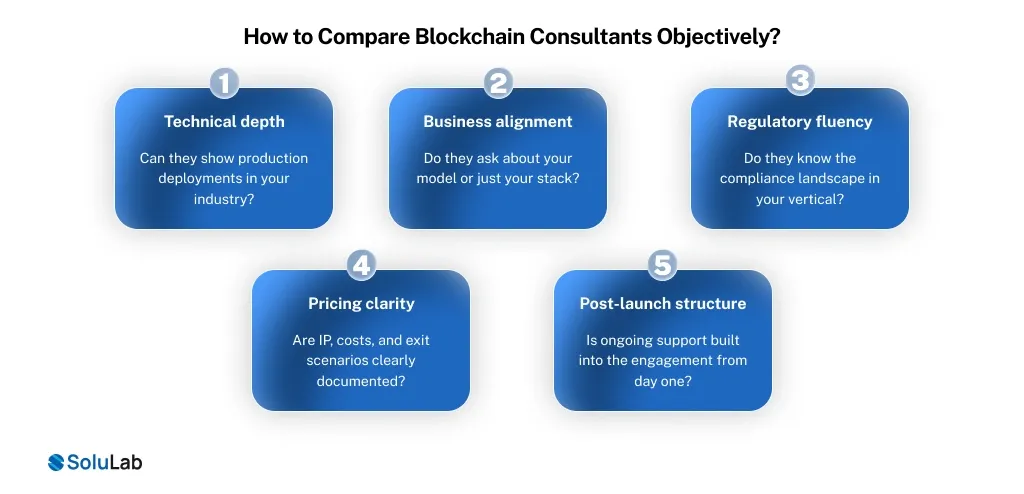
- Technical depth — Can they show production deployments in your industry?
- Business alignment — Do they ask about your model or just your stack?
- Regulatory fluency — Do they know the compliance landscape in your vertical?
- Pricing clarity — Are IP, costs, and exit scenarios clearly documented?
- Post-launch structure — Is ongoing support built into the engagement from day one?
How to hire a blockchain consultant the right way means treating this selection more like a board-level hire than a vendor shortlist.
- References matter.
- Track record matters.
- And how they behave during the sales process usually tells you exactly how they’ll behave during delivery.
How to choose a blockchain consultant also means checking who they’ve actually worked with, not just which logos they can put on a slide.
- Ask for references you can actually call.
- Ask about the tough moments in past projects.
The firms that survive that conversation are the ones worth hiring.
Why Choose SoluLab as Your Blockchain Partner?
SoluLab isn’t just another name on a list of blockchain consulting companies. We’ve spent over nine years doing one thing well: turning complex blockchain strategies into systems that run in production, hold up under scrutiny, and actually serve the business problem they were built for.
We work across DeFi, supply chain, healthcare, real estate, and enterprise finance. Our team covers blockchain architecture, smart contract engineering, compliance advisory, and business strategy because the technology is only useful when the business case is solid.
As a leading enterprise blockchain company, USA businesses trust us across geographies, as we’ve helped 500+ startups and enterprises move from we want blockchain to measurable outcomes with clear ROI.
Our approach is simple: discovery first, architecture second, build third, security always, support forever. We’re one of the few blockchain consulting services and solutions providers that will tell you honestly if blockchain isn’t right for your situation yet. Because the wrong project at the wrong time costs everyone, and we’d rather earn your trust now than lose it in month six.
If Blockchain strategy consulting is done right, it isn’t a proposal – it’s a partnership. That’s what we show up to build.

Conclusion
The questions in this guide aren’t filters to weed out vendors. They’re the foundation of a real working relationship. The right blockchain technology solutions partner will welcome every one of them because they’ve answered these before, they know the answers matter, and they understand that a client who asks hard questions is a client worth building with.
Blockchain consulting services at their best aren’t about the technology. It’s about solving real problems with the right architecture, the right team, and the right expectations. Take your time and do the due diligence. And when you find a team that answers every question without flinching, that’s your team.
FAQs
With over 3 years of experience, I specialize in breaking down complex Web3 and crypto concepts into clear, actionable content. From deep-dive technical explainers to project documentation, I help brands educate and engage their audience through well-researched, developer-friendly writing.