Key Takeaways
- The Problem: AI implementation in enterprises is associated with the frequent inability to eliminate model errors, hallucinations, bias, and accountability. Unless well controlled, fully automated systems make wrong decisions in risks such as finance, healthcare, and compliance.
- The Solution: Human-in-the-Loop models involve the automation of AI at the expense of human validation. AI is used to process huge amounts of data, and human professionals go over crucial results, leave comments, and constantly enhance the accuracy of the model and its regulation.
- How SoluLab can help: SoluLab is an AI-native company, i.e., AI is a part of our internal processes and development. This enables us to develop Human-in-the-Loop systems more quickly, decrease the development expenses, and provide AI solutions, equipped with in-built human supervision and learning functionalities.
Businesses are using AI to automate decision-making, process large amounts of data, and simplify their processes. However, total dependence on automated systems tends to generate accuracy gaps, compliance risks, and trust problems.
Without proper supervision, many organizations find that AI models make wrong predictions, hallucinate images, or make biased decisions. This is a huge challenge in sectors where errors may cause loss of money, regulatory fines, or business downturn.
To resolve this issue, companies are involving human expertise in the workflow of artificial intelligence directly. Automation and expert supervision allow businesses to check the results, fix mistakes, and constantly enhance the performance of the models.
In fact, 93% of companies now use AI in some form, but most rely on human-AI collaboration for decision-making and validation.
This strategy is called HITL in Business and guarantees the responsible implementation of AI. Enterprises are currently integrating humans into the loop of any machine learning system to develop systems where both humans and AI cooperate.
What Is Human in the Loop?
Human-in-the-Loop (HITL) refers to an AI development and decision-making method in which human knowledge is incorporated into automated procedures to proof-read, overrule, or refine AI products. Rather than permitting artificial intelligence to work entirely independently, human supervision will make sure that decisions are correct, ethical, and trustworthy.
The first task in an HITL system is carried out by AI, e.g., prediction, classification, or content generation. The next step is the intervention of humans who aim at confirming the results, making corrections, and assessing the results in a way that assists in advancing the AI model in the future.
Why Enterprises Are Adopting Human-in-the-Loop AI
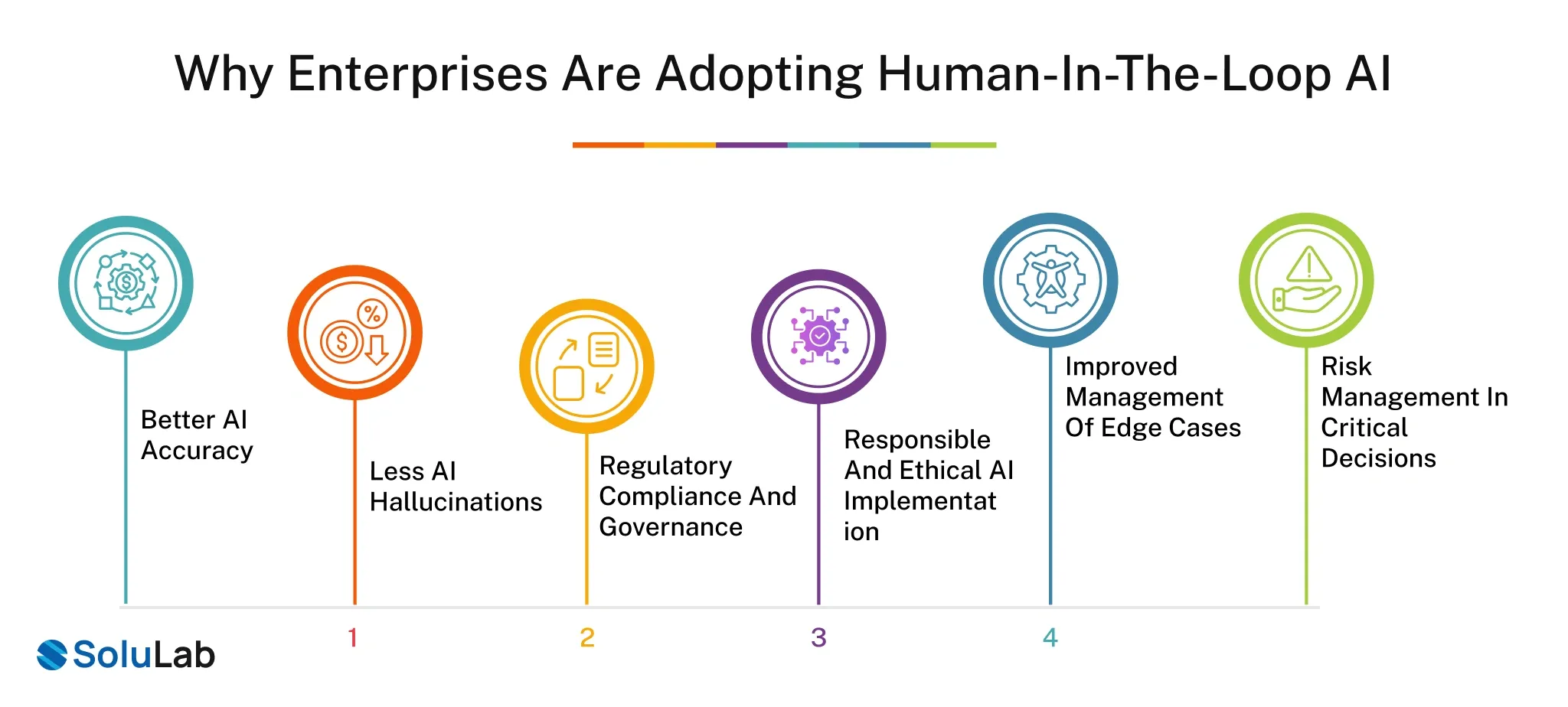
Human-in-the-Loop AI is becoming especially popular among enterprises as a way to strike a balance between automation and human knowledge and ensure quality decisions, regulatory adherence, and the ongoing process of model enhancement, and mitigate the risks of fully autonomous artificial intelligence systems.
- Better AI Accuracy: Human raters assess AI outputs and increase misclassifications, and use contextual judgments. Such feedback enhances the quality of model training data and decreases error rates in prediction, which results in more stable enterprise AI systems over time.
- Less AI Hallucinations: Generative AI systems are able to give false or fabricated information. Human control assists in the recognition of hallucinations, the confirmation of outputs, and the factual correctness of enterprise applications like finance, healthcare, and legal services.
- Regulatory Compliance and Governance: The banking industry, healthcare, and insurance sectors have to comply with stringent regulations. The human-in-the-loop models enable the careful screening of sensitive decisions by specialists, which assists organizations in preserving compliance and audit transparency.
- Responsible and Ethical AI Implementation: Human supervision is useful to determine bias, unfairness, and unforeseen consequences of AI models. This makes sure that the AI systems used by enterprises are responsible and not contrary to ethical principles and values.
- Improved Management of Edge Cases: AI models cannot cope with edge cases that are not found in the training data. These edge cases can be examined by human experts and steer systems to make better decisions in complicated circumstances.
- Risk Management in Critical Decisions: To achieve high-stakes decision-making, as in a medical diagnosis or monitoring compliance, human supervision can help avoid expensive mistakes, as well as review AI recommendations before implementation.
How Does Human-in-the-Loop Work?
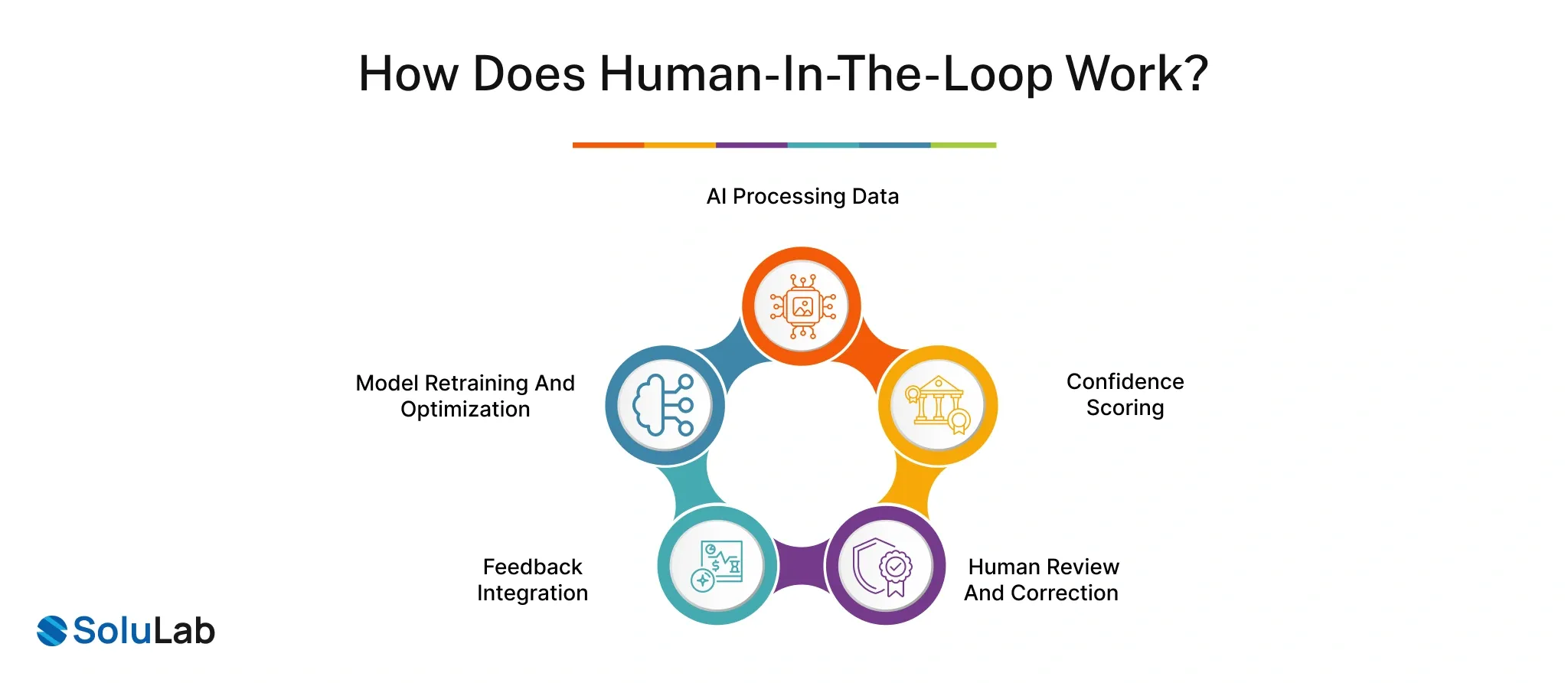
Human-in-the-Loop systems are systems that make use of the knowledge of human beings in order to have the best possible decision-making. The method enables the AI to automate tasks, and humans can review, correct, and constantly enhance the outputs of models.
1. AI Processing Data: The AI model takes input data, be it textual, pictorial, or transactional, and makes predictions, classifications, or recommendations based on the trained algorithms and patterns based on historical data.
2. Confidence Scoring: Once the AI makes an output, it attaches a confidence score to it that shows the degree to which the model is confident in its prediction. Minimum confidence prediction is typically subject to human scrutiny.
3. Human Review and Correction: The outputs are reviewed by human expertstoo correct errors or approve decisions. This is to pass sensitive or high-risk tasks through human judgment.
4. Feedback Integration: The correction process by the human reviewer is integrated and recreated into the machine learning pipeline. This response enables the AI system to learn through errors and make predictions in the future.
5. Model Retraining and Optimization: The system progressively retrains the AI model based on the updated datasets and human corrections, leading to a better performance of the model, fewer errors, and the process of automation will become more reliable with time.
How to Implement Human-in-the-Loop Frameworks?
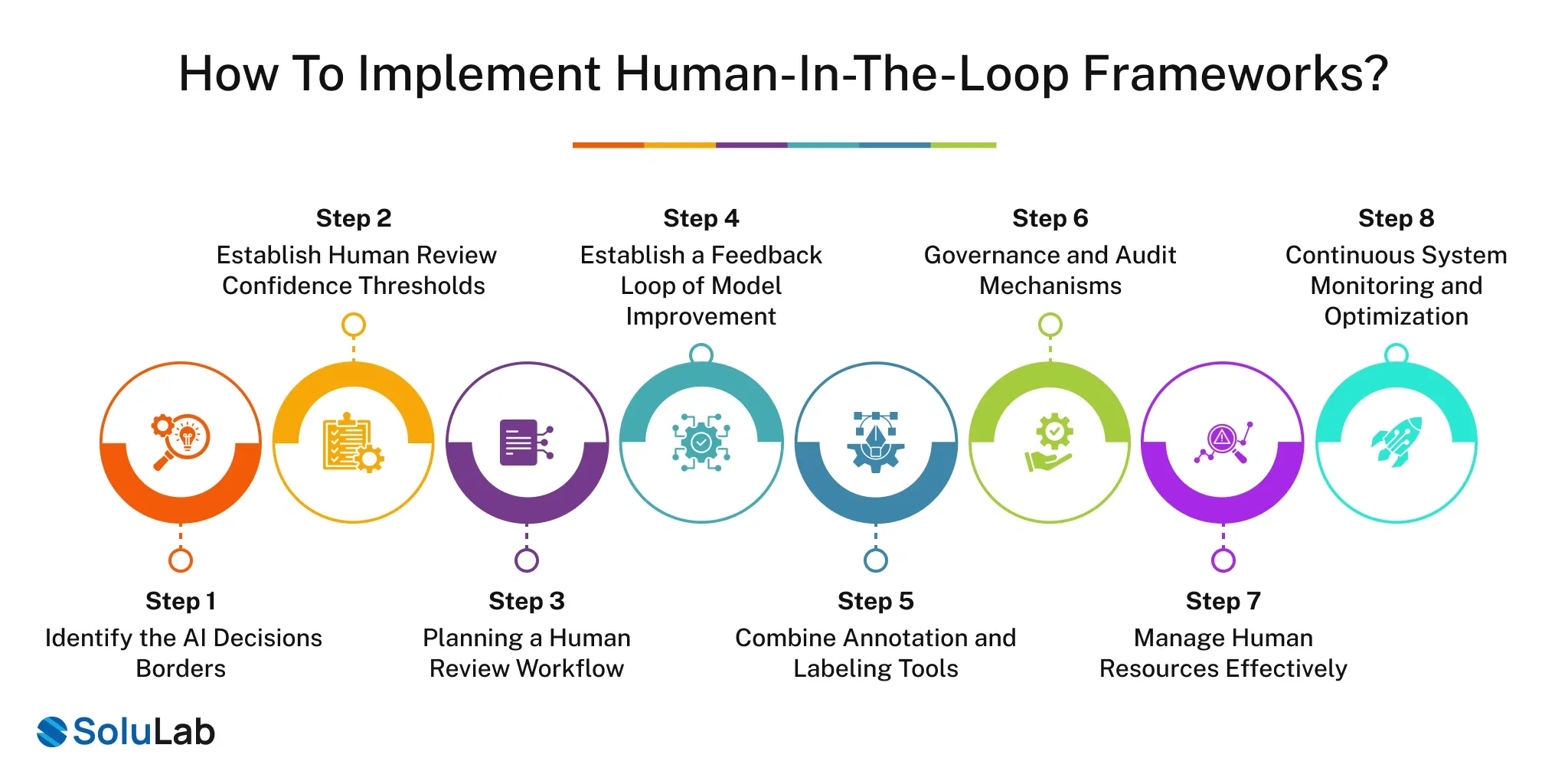
Businesses that use AI systems are adopting Human-in-the-Loop models to guarantee accuracy, responsibility, and ethical decision-making by integrating automated intelligence with human knowledge in all phases of the model.
1. Identify the AI Decisions Borders
Determine which activities may be automated and those that need human supervision. Develop explicit guidelines regarding the instances when AI works autonomously and when human confirmation should be involved in the work process.
2. Establish Human Review Confidence Thresholds
Turn on models to provide confidence scores to predictions. The system will automatically redirect outputs to human reviewers whenever the accuracy level of the output is less than a predefined threshold.
3. Planning a Human Review Workflow
Establish systematic checkpoints of AI output where domain experts make assessments of the results, refute errors, and endorse decisions. This workflow must be incorporated into the enterprise tools and operations.
4. Establish a Feedback Loop of Model Improvement
Record human corrections and reintroduce them into the training dataset. This process of continuous learning enhances the output of such models and minimizes the errors as time progresses.
5. Combine Annotation and Labeling Tools
Human feedback should be simplified by the use of data annotation platforms. These aids allow the reviewers to label datasets, correct predictions, and preserve high-quality training data of machine learning models.
6. Governance and Audit Mechanisms
Implementation of monitoring systems to monitor AI decisions, human interventions, and logs. This will enhance transparency, compliance, and accountability throughout enterprise AI deployments.
7. Manage Human Resources Effectively
High-risk decisions should be prioritized, and human involvement is needed, i.e., finance, healthcare, or compliance tasks. This includes automating routine cases, with expert review being done on complex or uncertain predictions.
8. Continuous System Monitoring and Optimization
Review model performance, human feedback patterns, and operational metrics periodically. Tuning thresholds and workflows are useful in ensuring organizations continue to be accurate as they increase their use of AI.
Human in the Loop vs Human on the Loop
Human-in-the-loop (HITL) requires direct human intervention in AI workflows for review or approval before actions proceed, while human-on-the-loop (HOTL) involves supervisory monitoring with optional intervention.
| Aspect | Human-in-the-Loop (HITL) | Human-on-the-Loop (HOTL) |
| Human Role | Active participant; reviews/approves every output | Supervisor; monitors via dashboards/alerts |
| Intervention | Mandatory before action completes | Reactive, only on anomalies |
| Use Case | High-risk decisions like loan approvals | System monitoring is like air traffic control |
| Scalability | Lower due to per-task human input | Higher for high-volume routine tasks |
| Error Handling | Prevents errors pre-release | Detects/fixes post-release |
Use Cases of Human-in-the-Loop in Enterprises
Human-in-the-Loop (HITL) systems have become popular among enterprises to achieve the balance between AI automation and human knowledge to provide accuracy, compliance, and responsible decision-making in critical processes in industries and complex workflows.
- Financial Services: Human-in-the-Loop models of fraud detection and credit risk models are employed by Banks and fintech firms to identify suspicious transactions and confirm or deny the alerts by human analysts before financial transactions or account restrictions are made.
- Healthcare AI: Healthcare organizations use AI in medical imaging analysis and clinical prediction, yet the outcomes are checked by doctors before diagnosis or treatment choices. It is possible to guarantee patients’ compliance with regulations and better diagnostic accuracy.
- Autonomous Systems: Robotics, drones, and autonomous vehicles industries make use of Human-in-the-Loop supervision where AI takes care of navigation or tasks, but human operators supervise systems and take action in case of uncertainty or high-risk situations.
- Content Moderation: AI is applied in social media and digital platforms to automatically identify harmful content, spam, or misinformation, and human moderators examine flagged posts to make sure that community guidelines are properly enforced.
- Enterprise Document Processing: The AI-based document processing allows companies to extract the information on the invoices, contracts, and forms, and the human reviewers validate the information to eliminate mistakes and ensure the quality of the data in the business processes.
Conclusion
Businesses are now implementing Human-in-the-Loop systems to make AI systems more correct, transparent, and consistent with the actual business requirements.
Through integrating automation with human skills, organizations are able to minimize risks, enhance the quality of decision-making, and keep on improving model execution.
The use of HITL in business automation is compatible with keeping control over processes that have a significant impact on companies, and also in enjoying AI efficiency.
With increased adoption, humans in-the-loop will become very important to the creation of trustworthy enterprise AI systems.
In case your organization is considering using this strategy, SoluLab, an AI development company, can support your organization to design and implement scalable HITL solutions.
FAQs
Neha is a curious content writer with a knack for breaking down complex technologies into meaningful, reader-friendly insights. With experience in blockchain, digital assets, and enterprise tech, she focuses on creating content that informs, connects, and supports strategic decision-making.