
Key Takeaways
- AI agents provide 24/7 personalized support, enabling banks to resolve customer queries faster while improving satisfaction without significantly increasing operational costs.
- Intelligent automation reduces repetitive manual tasks, allowing human agents to focus on complex customer needs and deliver higher-value interactions.
- Real-time data analysis enables proactive banking experiences, such as personalized product recommendations, fraud alerts, and instant issue resolution.
- Scalable AI-powered customer service helps banks manage growing customer volumes without the need for proportional increases in support staff or infrastructure.
- Successful AI agent adoption combines automation with human expertise, ensuring seamless, secure, and compliant customer experiences while driving long-term loyalty.
In banking, customers expect instant, personalized, and secure services across every digital touchpoint.
How do you improve customer satisfaction, reduce operational costs, and deliver exceptional banking experiences at scale?
AI agent development can assist customers 24/7, resolve routine queries, detect fraud in real time, automate loan processing, simplify KYC, and provide personalized financial recommendations. All while reducing manual effort and improving operational efficiency.
In fact, 17% of banking CIOs have already deployed AI agents, while 41% plan to deploy them within the next 12 months, according to Gartner’s 2026 CIO & Technology Executive Survey.
This guide explores how AI agents in banking are changing, delivering better customer experiences, and helping financial institutions stay competitive.
Let’s dive in!
What are AI Agents in Banking?
AI agents in banking are software systems that can understand customer requests, make context-aware decisions, execute multi-step tasks, and continuously learn from interactions with minimal human intervention.
Unlike traditional chatbots that primarily answer predefined questions, AI agents can autonomously perform banking workflows such as account management, loan processing, fraud detection, customer support, compliance monitoring, and personalized financial recommendations.
The global AI agents in financial services market is expected to grow to USD 6.54 billion by 2035, at a 13.84% CAGR.
Why Are Banks Rapidly Adopting AI Agents in 2026?
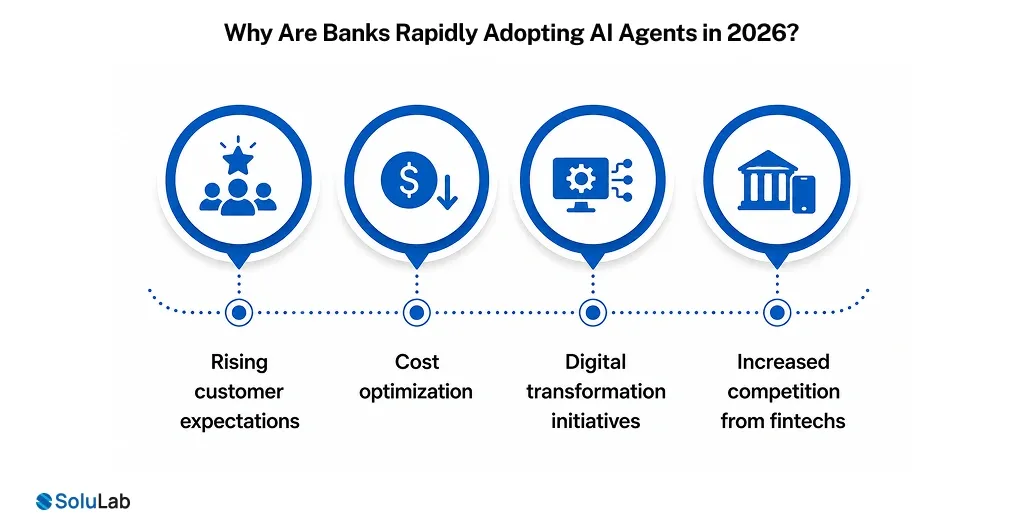
As customer expectations evolve and operational costs increase, banks are adopting AI agents to deliver faster services, streamline operations, and create highly personalized banking experiences without significantly increasing operational expenses.
- Rising customer expectations: Customers expect instant, personalized, and 24/7 banking services, prompting financial institutions to deploy AI assistants that deliver faster responses and seamless support across every channel.
- Cost optimization: Banks leverage AI agents to automate repetitive processes, reduce manual workloads, and improve operational efficiency, enabling them to lower costs while maintaining high-quality customer service.
- Digital transformation initiatives: Financial institutions are accelerating digital modernization by implementing autonomous AI agents in banking, helping replace legacy workflows with intelligent, scalable, and data-driven operations.
- Increased competition from fintechs: As fintech companies continue offering faster and more innovative digital services, banks are adopting AI agents to enhance agility, strengthen customer engagement, and maintain a competitive edge.
How do AI Agents Improve Customer Satisfaction Without Increasing Costs?
Banks are leveraging AI agent solutions to deliver faster, more personalized, and always-available customer experiences while reducing manual effort, optimizing operational costs, and improving service quality across every banking touchpoint.
1. 24/7 Instant Customer Support
Customers no longer want to wait for business hours or long call queues. AI agents in financial services provide round-the-clock assistance, resolving routine queries instantly and ensuring uninterrupted banking support.
- Instant responses, anytime, anywhere
- Reduced call center workload
- Faster issue resolution
2. Personalized Banking Experiences
AI agents analyze customer behavior, preferences, and transaction history to deliver tailored recommendations, relevant financial products, and personalized interactions that strengthen customer relationships.
- Customized financial recommendations
- Personalized customer interactions
- Better engagement and loyalty
3. Faster Query Resolution
AI in banking understands customer intent, retrieves relevant information, and completes multi-step tasks quickly, significantly reducing response and resolution times.
- Intelligent intent recognition
- Quick access to information
- Faster request completion
4. Omnichannel Customer Assistance
Customers receive consistent support across mobile apps, websites, chat, email, and voice channels without repeating information, creating a seamless banking experience.
- Unified customer conversations
- Consistent cross-channel support
- Improved customer convenience
6. Reduced Wait Times
By handling high volumes of customer interactions simultaneously, AI agents eliminate long queues and ensure customers receive immediate assistance.
- Parallel request handling
- Minimal customer waiting
- Improved service efficiency
7. Consistent Customer Experience Across Channels
Enterprise AI agents for banking maintain consistent communication, service quality, and contextual awareness across every interaction, ensuring customers enjoy reliable experiences regardless of the platform they choose.
- Consistent service quality
- Unified customer experience
- Higher customer satisfaction
Step-by-Step Guide on How to Build an AI Agent for Banking
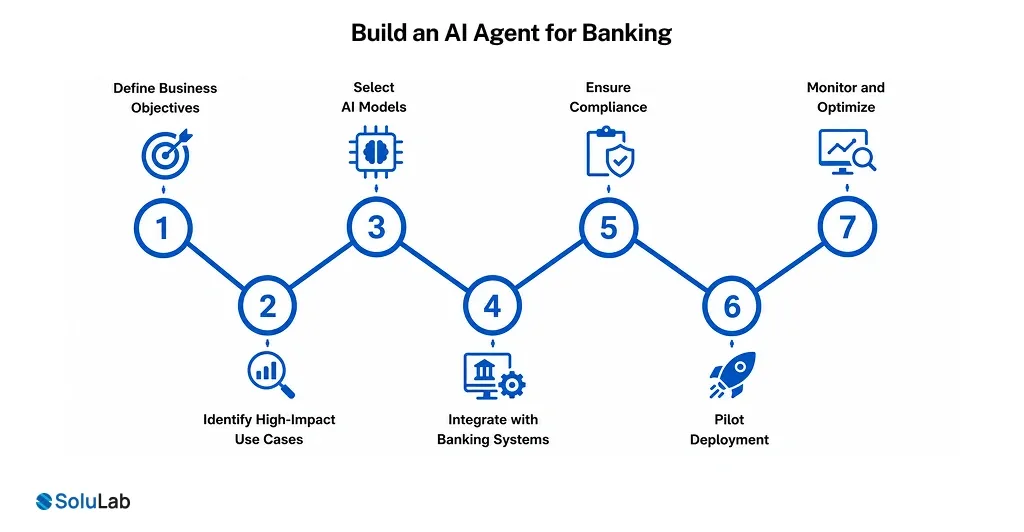
Building successful AI agents requires more than selecting the right AI technology. Banks need a structured implementation strategy that aligns business goals, regulatory requirements, and customer expectations to maximize long-term value and scalability.
1. Define Business Objectives
Begin by identifying the specific business problems your AI agent should solve. Clear objectives ensure the solution aligns with organizational priorities and delivers measurable business outcomes.
- Improve customer satisfaction
- Reduce operational costs
- Increase process efficiency
2. Identify High-Impact Use Cases
Prioritize banking processes where AI can generate the greatest value. Focusing on high-impact areas accelerates adoption and maximizes the ROI of AI development solutions.
- Customer support automation
- Fraud detection workflows
- Loan processing assistance
3. Select AI Models
Choose AI models based on your business goals, data quality, and required capabilities. The right models improve accuracy, scalability, and intelligent decision-making.
- Large language models
- Predictive machine learning
- Natural language processing
4. Integrate with Banking Systems
Connect AI agents with core banking platforms, CRM systems, and third-party applications to enable seamless workflows, secure data access, and real-time decision-making.
- Core banking integration
- CRM system connectivity
- Secure API integration
5. Ensure Compliance
Incorporate security, governance, and regulatory compliance throughout development to protect sensitive financial data and maintain adherence to industry standards.
- Data privacy protection
- Regulatory compliance checks
- Enterprise-grade security
6. Pilot Deployment
Deploy the AI agent in a controlled environment to validate its performance, collect user feedback, and resolve any issues before implementing it organization-wide.
- Test real-world scenarios
- Gather stakeholder feedback
- Measure pilot performance
7. Monitor and Optimize
Continuously evaluate performance using customer and operational metrics. AI Agents for Banking become more accurate and efficient through ongoing monitoring and optimization.
- Track business KPIs
- Refine AI performance
- Continuously improve accuracy

Use Cases of AI Agents in Banking
AI agents are changing banking by automating complex workflows, enhancing customer experiences, reducing operational costs, and enabling financial institutions to deliver faster, smarter, and more secure services at scale.
1. Intelligent Customer Support
AI agents provide instant, context-aware assistance across multiple channels, resolving routine queries without human intervention. This improves response times while ensuring consistent and personalized customer experiences.
- 24/7 multilingual customer assistance
- Instant account query resolution
- Reduced call center workload
2. Fraud Detection and Prevention
AI agents continuously monitor transactions to identify suspicious activity in real-time. They help banks detect fraud early, minimize financial losses, and strengthen overall security.
- Real-time transaction monitoring
- Instant fraud risk alerts
- Faster anomaly detection
3. Loan Processing and Credit Assessment
AI agents automate document verification, eligibility checks, and credit evaluations, significantly reducing loan approval times while improving decision accuracy.
- Automated document verification
- Faster loan approvals
- Accurate credit risk analysis
4. Personalized Financial Advisory
Powered by generative AI in banking, AI agents analyze customer behavior and financial goals to deliver tailored recommendations, helping customers make informed financial decisions.
- Personalized savings recommendations
- Investment portfolio suggestions
- Goal-based financial planning
5. Customer Onboarding and KYC
AI agents simplify onboarding by automating identity verification, document validation, and compliance checks, ensuring a faster and more secure customer registration process.
- Digital identity verification
- Automated KYC compliance
- Faster account activation
6. Compliance and Risk Management
AI agents help financial institutions monitor regulatory requirements, identify compliance risks, and generate audit-ready reports with minimal manual effort.
- Continuous compliance monitoring
- Automated regulatory reporting
- Reduced operational risks
7. Wealth Management and Investment Support
AI agents assist relationship managers by analyzing market trends and customer portfolios, enabling personalized investment strategies and proactive financial guidance.
- Portfolio performance insights
- Smart investment recommendations
- Predictive market analysis
8. Payment and Transaction Automation
AI agents improve payment processing, detect transaction failures, and ensure secure fund transfers, improving operational efficiency across AI in the BFSI sector.
- Automated payment processing
- Secure transaction validation
- Faster payment settlements
Common Mistakes Banks Make When Deploying AI Agents
Deploying AI agents requires more than advanced technology. Many banking projects underperform because of avoidable implementation mistakes that impact adoption, compliance, customer experience, and long-term business value.
Treating AI as Only a Chatbot
Many banks limit AI agents to answering FAQs instead of enabling autonomous decision-making and workflow automation. This prevents organizations from realizing the full potential of intelligent AI capabilities.
Ignoring Governance
Implementing AI without strong governance frameworks can create compliance risks, security vulnerabilities, and ethical concerns. Clear policies are essential for responsible and trustworthy AI deployment.
Poor Data Quality
AI agents rely on accurate, complete, and well-structured data. Inconsistent or outdated information leads to unreliable insights, poor recommendations, and reduced customer satisfaction.
Lack of Employee Training
Employees who are unfamiliar with AI tools may resist adoption or use them ineffectively. Proper training helps teams collaborate with AI agents and maximize productivity.
No KPI Tracking
Without clearly defined performance metrics, banks cannot measure AI effectiveness or identify improvement opportunities. Continuous monitoring is essential to optimize business outcomes.
Weak Change Management
Introducing AI without a structured change management strategy often leads to employee resistance, low adoption rates, and implementation delays, reducing the overall success of AI initiatives.
Read more: AI in the BFSI sector
Best Practices for Successful AI Agent Implementation
As banks scale AI agent adoption, long-term success depends on more than deployment. Following these best practices helps maximize performance, improve customer trust, and ensure secure, compliant, and scalable AI operations.
- Implement a human-in-the-loop approach for complex financial decisions, enabling AI agents to automate routine tasks while human experts handle exceptions and high-risk scenarios.
- Prioritize transparency by ensuring AI agents provide explainable responses and clear reasoning, helping build customer trust and support regulatory compliance.
- Design AI agents with omnichannel capabilities to deliver consistent customer experiences across mobile apps, websites, chat platforms, AI voice agents, and contact centers.
- Regularly retrain AI models using updated banking data, customer interactions, and regulatory changes to maintain accuracy, relevance, and decision quality.
Future Trends of Banking AI Agents
Banking AI agents are rapidly evolving beyond automation, enabling autonomous decision-making, intelligent collaboration, and hyper-personalized services that will redefine how financial institutions operate and engage customers in the future.
- Autonomous banking operations: AI agents independently execute routine banking workflows with minimal human oversight.
- Agentic AI ecosystems: Multiple agents collaborate seamlessly to optimize complex banking processes.
- Voice-first banking: Customers interact naturally through voice for faster, hands-free banking experiences.
- Multi-agent banking systems: Multiple AI agents coordinate tasks across departments for greater operational efficiency.
- Autonomous compliance monitoring: AI continuously tracks regulatory changes and ensures ongoing compliance automatically.
- Hyper-personalized customer experiences: AI banking agent solutions deliver tailored financial guidance using real-time customer insights.
- Smarter digital banking experiences: AI agents for digital banking enable proactive support, intelligent recommendations, and seamless omnichannel interactions.
Why Choose SoluLab to Build AI-Powered Banking Agents
SoluLab, an AI-native company, combines deep AI expertise with banking domain knowledge to build secure, scalable, and intelligent AI-powered agents. Here are a few services we can help with:
- AI Banking Agent Consulting
- Custom AI Banking Agent Development
- Conversational AI Banking Solutions
- AI-Powered Customer Support Agents
- Autonomous Banking Workflow Automation
- AI Loan Processing Automation
- AI-Based Fraud Detection Solutions
- AI-Powered KYC & Compliance Automation
- Core Banking System Integration
- AI Wealth Management Assistants
- Voice AI Banking Assistants
- Multi-Agent Banking Systems
- Generative AI Integration for Banking
- AI Agent Training & Fine-Tuning
For example, SoluLab built UpdateIA, a multi-agent AI platform for a French startup, enabling 14+ autonomous agents coordinated by Jarvis. It unified enterprise workflows, reduced manual effort, ensured compliance, and improved real-time decision-making across HR, CRM, finance, and legal systems.
Our AI agent development services help banks build intelligent, secure, and scalable AI agents that automate operations. Book a call with us today!

Conclusion
AI agents are changing the banking industry by enabling faster customer service, personalized experiences, automation, and operational efficiency, all without significantly increasing costs.
From streamlining loan processing and fraud detection to delivering 24/7 support and proactive financial guidance, AI agents empower banks to meet evolving customer expectations while improving productivity and scalability.
SoluLab, an AI development company in the USA, can help your business design, develop, and deploy secure, scalable AI banking agents tailored to your unique requirements.
FAQs
Neha is a curious content writer with a knack for breaking down complex technologies into meaningful, reader-friendly insights. With experience in blockchain, digital assets, and enterprise tech, she focuses on creating content that informs, connects, and supports strategic decision-making.