Hyperliquid isn’t just a fast DEX anymore. It grew up. After the hyperliquid hype token launch caught fire, the platform crossed a line most chains never reach: over $2.7 trillion in total trading volume, with days that routinely clear $10 billion in a 24-hour window.
- HyperEVM went live on mainnet, and that flipped a switch for on-chain builders.
- The Hyperliquid token (HYPE) is now the native hyperliquid gas token.
- Under the hood: a sub-second, EVM-compatible network moving institutional-grade volume without choking.
Maybe you’re watching the hype token hyperliquid price. Maybe you want to ship something on the most liquid chain in Web3. Either way, sitting this one out is no longer a smart move.
Key Takeaways
- HYPE is the native hyperliquid gas token now, running a sub-second EVM-compatible chain.
- As much as 97% of protocol revenue goes toward daily HYPE buybacks and burns, which pushes supply net-deflationary.
- Through HyperBFT consensus, the platform handles 100,000+ operations per second and settles in 0.2s.

Why Traders and Enterprises Are Switching to Hyperliquid Token Environment in 2026
At its core, Hyperliquid is a high-performance decentralized derivatives exchange. What makes it different is that it runs on its own proprietary blockchain infrastructure, Hyperliquid Chain (HyperEVM), rather than renting space on someone else’s.
So what actually sets it apart?
- Zero Gas Fees: You pay tiny trading fees and nothing else (Maker: 0.01% / Taker: 0.035%).
- HIP-4 Outcomes: A 2026 upgrade that brought fully collateralized prediction markets and event-based hedging, no liquidation risk attached.
- Community Neutrality: No private VCs. No backroom market maker deals. The value stays with the community.
This was built for perpetual futures trading from day one, with the kind of professional tooling serious desks expect:
- Scale orders
- TWAP execution
- Copy trading
- Advanced risk management
- Ultra-fast low-cost execution
And because it all runs on-chain, you keep custody of your assets the whole time. Fast execution and deep liquidity, no giving up your keys.
These days Hyperliquid Hype Token serves both crowds, retail traders and institutional players, with:
| Feature | Hyperliquid (2026 Update) | Industry Standard (DEX) |
| Daily Burn | ~33,000+ HYPE tokens | Minimal or None |
| Throughput | 100,000 ops/sec | 500 – 2,000 ops/sec |
| Staking APY | ~10-15% (Adjustable) | 3 – 8% |
| Asset Class | Crypto + RWAs + Outcomes | Crypto Only |
Put it all together and you get one of the most capable decentralized trading stacks in crypto right now. Full stop.

HyperBFT & HyperEVM: The Dual-Architecture Powering 0.2s Finality
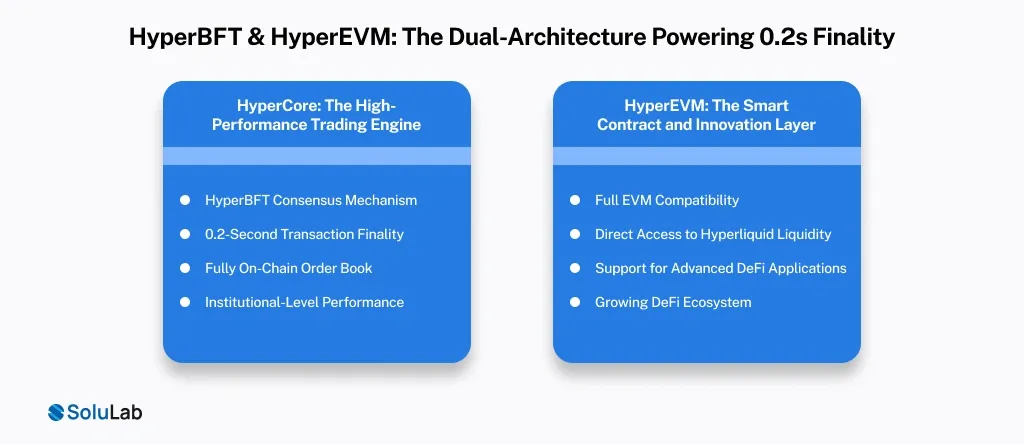
Here’s the clever part. The network splits into two layers, keeping high-frequency trading execution separate from smart contract operations. That separation is why the Hyperliquid token can stay blisteringly fast and still host a full stack of decentralized apps at the same time.
Two pieces do the heavy lifting: HyperCore, which runs the trading engine, and HyperEVM, which handles smart contracts and gives developers room to build.
1. HyperCore: The High-Performance Trading Engine
HyperCore is the trading layer underneath everything. It’s what the Hyperliquid hype token exchange actually runs on.
Key characteristics of HyperCore include:
- HyperBFT Consensus Mechanism: Hyperliquid runs a custom consensus called HyperBFT, built off the HotStuff algorithm. Blocks confirm remarkably fast because of it.
- 0.2-Second Transaction Finality: As of March 2026, finality sits around 0.2 seconds. Trades settle almost the instant you place them.
- Fully On-Chain Order Book: Most decentralized exchanges lean on automated market makers. Hyperliquid doesn’t. It keeps a fully on-chain order book that trades like a centralized exchange but stays transparent.
- Institutional-Level Performance: It handles very high volume without clogging up, which is exactly what pro trading firms and algo strategies need.
The result: Hyperliquid gets you centralized-exchange speed without asking you to hand over custody or transparency.
2. HyperEVM: The Smart Contract and Innovation Layer
HyperEVM is the programmable side of the house. This is where builders live.
It shipped to mainnet in February 2025. What you get is an Ethereum-compatible environment where you write and deploy smart contracts in plain Solidity.
Important features of HyperEVM include:
- Full EVM Compatibility: Build and deploy decentralized applications with the same tools you already use on Ethereum. Nothing new to learn.
- Direct Access to Hyperliquid Liquidity: Apps on HyperEVM plug straight into the deep liquidity pools sitting on the Hyperliquid trading network.
- Support for Advanced DeFi Applications: Lending protocols, yield vaults, automated trading strategies, whole financial systems, it’s all fair game.
- Growing DeFi Ecosystem: By 2026, HyperEVM turned Hyperliquid into a DeFi “super-app,” home to everything from stablecoin vaults to institutional trading bots.
In short, builders can stack complex financial apps right on top of Hyperliquid’s trading infrastructure.
Infrastructure Capabilities Powering Hyperliquid Company in 2026
A handful of infrastructure pieces make institutional-scale trading and DeFi possible on the Hyperliquid network. Here’s what they are.
Key capabilities include:
- High Throughput: More than 200,000 operations per second. Big trading volumes flow through without backing up.
- Native Gas Token Utility: HYPE is the gas token for HyperEVM, so every smart contract transaction creates fresh demand for it.
- Multi-Chain Asset Access: A native bridge lets assets like USDC, BTC, and SOL move onto the chain fast, and safely.
- HIP-3 Protocol: Permissionless Market Creation: Want a new perpetual market? Stake HYPE and launch it. Markets expand as quickly as people want to build them.
- HIP-4 Protocol: Outcome Trading: HIP-4 brought prediction markets and event-based trading, so you can hedge against real-world events without the usual liquidation risk.
Together, these upgrades built out a next-generation decentralized trading base that’s fast, secure, and ready to scale. That last word matters most.
Building on Hyperliquid: Development Opportunities in 2026
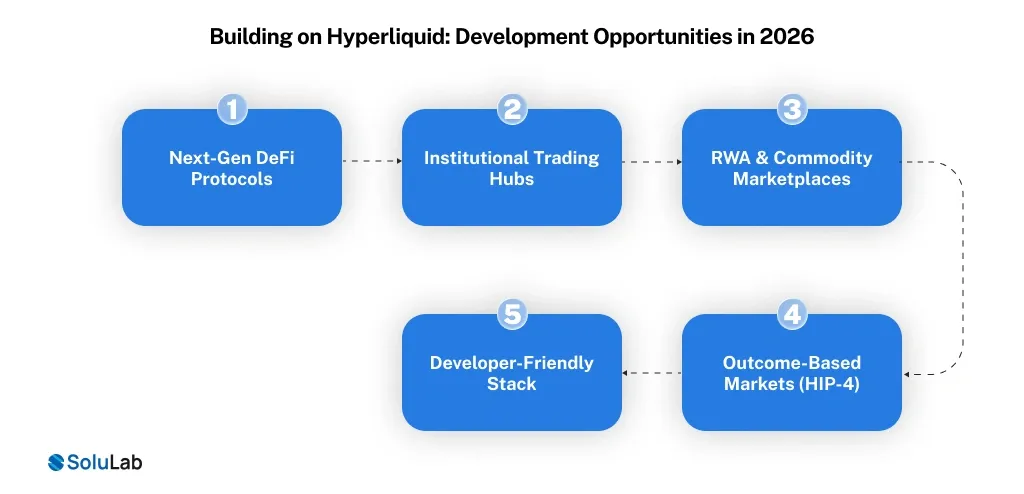
With HyperEVM maturing on mainnet through 2026, Hyperliquid stopped being a fast exchange and became a programmable financial platform. For fintech startups and institutional teams, that matters. This is the first Layer-1 that gives you centralized-server speed with blockchain-grade security, both at once.
So where’s the real opportunity this year? A few places stand out.
1. Next-Gen DeFi Protocols
HyperEVM isn’t another “copy-paste” Ethereum fork. Apps here can talk directly to the native Hyperliquid order book, and that changes what you can build.
- What’s being built: Serious lending platforms (HyperLend is one), cross-margin yield vaults, structured products.
- The Edge: Same Solidity and Hardhat you know, with one big upgrade: 0.2s transaction finality.
2. Institutional Trading Hubs
The wall between Wall Street and Web3? Gone. With the 2026 Ripple Prime integration, institutional-grade liquidity flows straight onto the chain.
- What’s being built: Custom trading dashboards, High-Frequency Trading (HFT) bots, institutional risk-management tools.
- The Edge: You can wire professional-grade APIs that connect traditional hedge funds to decentralized markets, minus the lag and “gas spikes” that plague other chains.
3. RWA & Commodity Marketplaces
Real-World Asset (RWA) tokenization is the “gold rush” of 2026. HyperEVM’s throughput happens to be a great fit for the volume fractional ownership demands.
- What’s being built: Platforms for tokenizing gold, oil, and private equity.
- The Edge: With HIP-3, you can spin up permissionless perpetual markets for any asset, giving 24/7 liquidity to investments that normally sit still.
4. Outcome-Based Markets (HIP-4)
Outcome Trading is one of the fresher frontiers here. Teams are building “prediction” and “hedging” layers that skip standard liquidations entirely.
- What’s being built: Event-based insurance tools, macro-economic hedging platforms, political outcome markets.
- The Edge: They’re fully collateralized, which makes them a comfortable fit for risk-averse institutional clients.
5. Developer-Friendly Stack
No new language required. If your team already knows Viem, Foundry, or Hardhat, they’re Hyperliquid developers already. That’s it.
- The 2026 Difference: Developers now get “Native Hooks,” so a smart contract can fire off actions automatically when prices move in the main Hyperliquid order book.

Conclusion
Hyperliquid outgrew the “just a DEX” label. It’s now a high-performance Layer-1 running the next wave of decentralized trading and apps. Between HyperEVM, 0.2-second finality, and a developer base that keeps growing, it’s raising the bar for what scalable on-chain finance looks like, and giving the HYPE ecosystem token real work to do.
Building the Future with SoluLab
As a leading hyperliquid crypto token development company, SoluLab helps businesses build and scale solutions within advanced blockchain ecosystems like Hyperliquid.
What we do:
- HyperEVM-based dApp development
- Custom token and tokenomics design
- Real-world asset (RWA) tokenization platforms
- DeFi and trading infrastructure development
Planning to build on Hyperliquid, or launch a Web3 product? Our team can take you from idea to a production-ready solution. Talk to SoluLab and start building your blockchain project.
FAQs
Deepika is a content writer who blends storytelling with strategic thinking. She explores topics across digital innovation, emerging tech, and the evolving blockchain industry. She enjoys breaking down complex ideas into simple, engaging narratives in the growing global markets.