Key Takeaways
- A successful VARA-compliant crypto wallet begins with regulation-led architecture, supporting licensing, governance, asset protection, monitoring, cybersecurity, and audit readiness from launch.
- Businesses offering virtual asset services in or from Dubai must assess VARA licensing obligations before launching products or onboarding customers.
- Enterprise crypto wallets require advanced controls such as MPC, multi-signature approvals, role-based permissions, policy engines, audit logs, and disaster recovery.
- Compliance should be embedded into wallet workflows, including transaction screening, risk scoring, recordkeeping, reporting support, and client protection process controls.
- A reliable VARA Crypto Wallet Development Company can reduce compliance rework, technical gaps, operational friction, and post-launch regulatory risks.
Dubai has become a strategic launchpad for virtual asset businesses that want regulatory clarity, market credibility, and long-term growth. But building a VARA Crypto Wallet Development for this market requires more than sleek design and blockchain connectivity.
A VARA-ready wallet must be secure, compliant, scalable, and built for real-world operations from the start. From private key protection and custody controls to transaction monitoring, recordkeeping, and user safeguards, every layer must support regulatory confidence and commercial trust.
This guide explains how businesses can approach VARA Crypto Wallet Development in Dubai with the right technology, compliance framework, and execution strategy.
What Is a VARA-Compliant Crypto Wallet?
A VARA-compliant crypto wallet is a digital wallet built to support virtual asset services under Dubai’s regulatory expectations. It can help users store, receive, send, and manage virtual assets, while giving the operator the controls needed for compliance, security, governance, and reporting.
The Vara compliance depends on your business model, licensing activity, operating entity, governance, policies, technology controls, and ongoing supervision.
Key Reasons Why Businesses Need a VARA-Compliant Crypto Wallet in Dubai
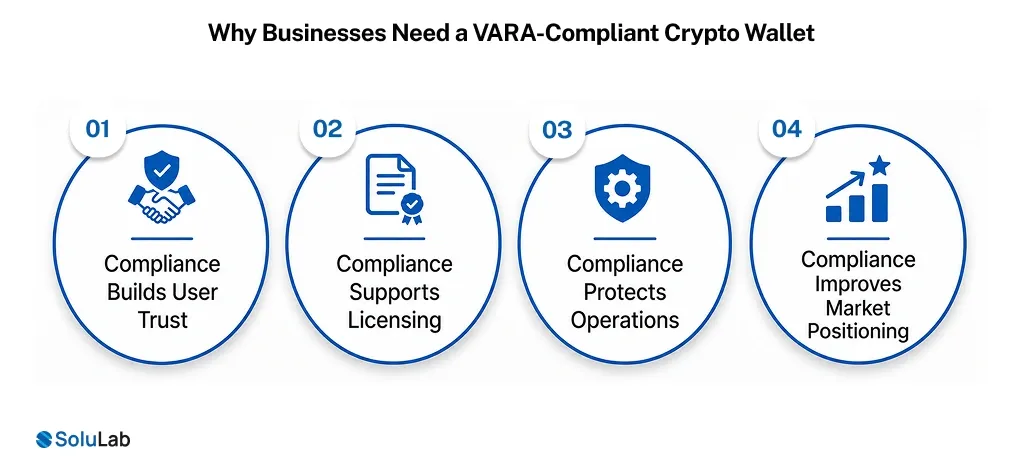
- Compliance Builds User Trust- Users want to know their assets, data, and transactions are protected. A compliance-first wallet gives them more confidence than a basic app with weak controls.
- Compliance Supports Licensing- If you plan to operate in Dubai, your platform should support VARA review from the beginning. Retrofitting compliance later often costs more.
- Compliance Protects Operations– Strong policies, audit logs, access controls, and recovery plans reduce operational risk. They also make your team more prepared for incidents.
- Compliance Improves Market Positioning– A regulation-ready wallet can attract exchanges, institutions, funds, fintech partners, and high-value users who expect professional-grade infrastructure.
How to Build a VARA-Compliant Crypto Wallet: A Step-By-Step Guide
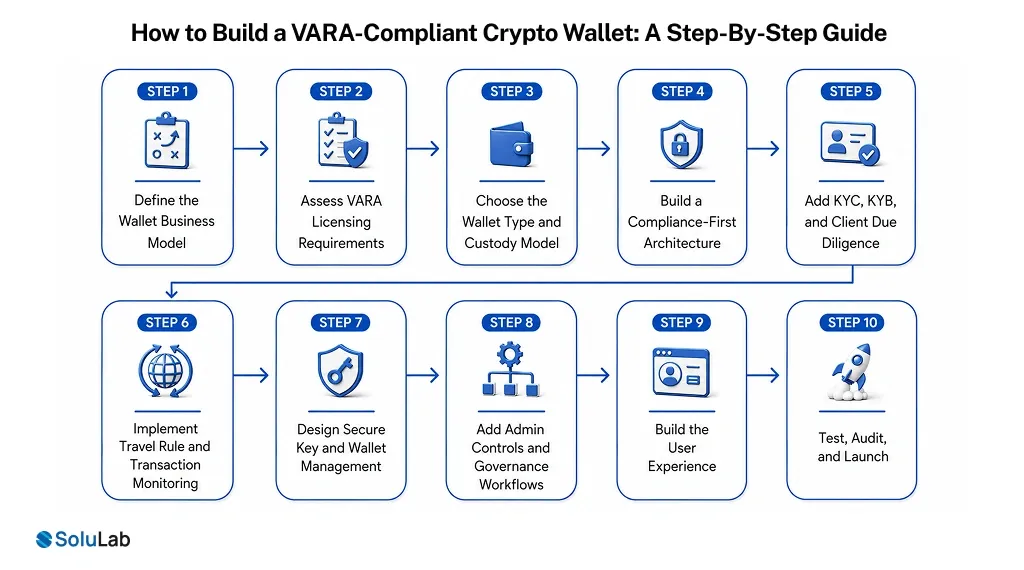
Building a crypto wallet requires a structured roadmap. The best approach is to align legal, compliance, product, security, and engineering teams before development begins.
Step 1: Define the Wallet Business Model
Start by deciding what your wallet will do. A retail non-custodial wallet has different requirements from an institutional custody wallet. A wallet connected to exchange services has different controls from a treasury wallet for corporate users.
If you are planning VASP wallet development, map every wallet function to the relevant VARA activity. This includes custody, transfers, exchange access, settlement, staking, swaps, fiat deposits, withdrawals, and institutional account management.
Step 2: Assess VARA Licensing Requirements
Identify whether your wallet business may require a VARA licence. New firms follow a two-stage licensing process:
Approval to Incorporate, and then the VASP licence application. The process involves documentation such as business plans, beneficial owner details, senior management details, governance framework, financial projections, insurance, and wind-down planning.
Here, the VARA-compliant crypto wallet development company can help you design technology that supports the licensing journey instead of creating gaps later.
Step 3: Choose the Wallet Type and Custody Model
Your custody model is one of the most important decisions in VARA crypto wallet development. A strong wallet design must separate access rights, require approval workflows for high-risk transactions, and keep backups protected.
- For consumer wallets, you may choose non-custodial key management, seed phrases, social recovery, or smart contract wallets.
- For institutions, you may need MPC, multi-signature wallets, hardware security modules, approval policies, transaction limits, and cold storage.
VARA’s Technology and Information Rulebook requires VASPs to address cryptographic key generation, transaction signing, key storage, seed phrase storage, wallet creation, and wallet management within their technology governance and risk assessment framework.
Step 4: Build a Compliance-First Architecture
VARA-compliant crypto platform development should include identity verification, client risk scoring, sanctions screening, PEP checks, transaction monitoring, suspicious activity alerts, Travel Rule support, wallet address screening, and audit logs.
VARA’s AML/CFT controls expect VASPs to have effective systems to manage AML/CFT risks, including distributed ledger analytics tools and transaction screening capabilities.
Step 5: Add KYC, KYB, and Client Due Diligence
Your wallet should verify users before allowing regulated activities. Verify client identity before or during the establishment of a business relationship, or before executing transactions for clients without an existing relationship.
For enterprise wallets, KYB is just as important as KYC. Institutional users need role-based access, entity verification, authorized signers, transaction approval limits, and documented account ownership.
Step 6: Implement Travel Rule and Transaction Monitoring
A wallet built for Dubai should be ready for the Travel Rule. These controls are essential for any business building a regulated wallet infrastructure. Your wallet should support:
- Transaction screening before deposits and withdrawals
- Counterparty VASP due diligence
- Beneficiary and originator data collection
- Unhosted wallet risk assessment
- Alerts for suspicious patterns
- Case management for compliance teams
- Records for regulator review
Step 7: Design Secure Key and Wallet Management
A wallet must protect private keys, seed phrases, signing processes, recovery workflows, and administrative access.
If you are building for institutions, consider MPC wallet development. MPC helps split signing authority across different parties or systems, reducing the risk of one compromised key causing asset loss.
An MPC wallet development company with experience in institutional wallet architecture can help here.
Step 8: Add Admin Controls and Governance Workflows
Deploy an admin system for the team to manage compliance, security, users, transactions, support tickets, and risk alerts. The admin dashboard should include:
- User verification status
- Wallet activity monitoring
- Transaction approval queues
- Risk score management
- Sanctions and address screening results
- Travel Rule data
- Suspicious transaction cases
- Audit logs
- Role-based team access
- Reporting exports
Step 9: Build the User Experience
The best wallet experience hides complexity without hiding risk. Users should always understand what they are approving and what happens after they sign a transaction.
Step 10: Test, Audit, and Launch
Before launch, test everything. This includes security, performance, compliance workflows, wallet recovery, transaction monitoring, admin approvals, third-party integrations, and incident response.
Must-Have Features in a VARA-Compliant Crypto Wallet
A wallet should balance security, compliance, and usability. The following features are important for startup and enterprise-grade builds.
Secure User Onboarding
The wallet should support identity verification, document upload, biometric checks, risk scoring, sanctions screening, and approval workflows. This creates a safer entry point for users.
Multi-Chain Asset Support
Users may want Bitcoin, Ethereum, stablecoins, tokenized assets, and other supported networks. Build multi-chain support carefully to avoid security and compliance gaps.
MPC and Multi-Signature Security
Institutional wallets should support MPC, multi-signature approvals, cold storage, policy-based signing, and transaction limits. This reduces operational and insider risk.
Transaction Monitoring
The system should screen incoming and outgoing transfers, detect suspicious activity, check wallet addresses, and create alerts for compliance review.
Travel Rule Readiness
Travel Rule workflows should collect, store, and transmit required originator and beneficiary data where applicable. This is vital for regulated VASP operations.
Client Asset Segregation
Custodial wallet providers should separate client assets and maintain clear ownership records. VARA’s custody rules state that client virtual assets held by a custody VASP are not depository liabilities or assets of the VASP, and custody VASPs must segregate client assets in separate wallets.
Admin and Compliance Dashboard
The platform should give internal teams full visibility into users, wallets, approvals, alerts, investigations, reports, and audit history.
Audit Logs and Reporting
Every important action should be recorded. Logs help with investigations, regulatory reviews, customer disputes, and internal security audits.
Business Continuity Planning
Your wallet should include backup systems, disaster recovery, incident response, and continuity planning. VARA requires VASPs to implement, maintain, test, and update a business continuity and disaster recovery plan annually.
What is the Cost to Build a VARA-Compliant Crypto Wallet?
The cost to build a VARA-compliant crypto wallet usually starts from $30,000 to $60,000 for an MVP and can go beyond $250,000 to $500,000+ for an enterprise-grade platform. The final budget depends on how advanced the wallet needs to be, what virtual asset services it supports, and how deeply compliance, custody, and security controls are built into the product.
MVP Wallet: $30,000–$60,000
An MVP wallet is suitable for startups that want to validate the product before moving into a larger, compliance-heavy build. It may include user onboarding, basic wallet creation, send/receive functionality, transaction history, admin access, and limited compliance integrations.
Growth-Stage Wallet: $70,000–$180,000
A growth-stage wallet is built for businesses preparing to serve more users, assets, and operational workflows. It may include KYC/KYB integration, transaction monitoring, Travel Rule support, MPC or multi-signature security, multi-chain support, role-based admin controls, and reporting dashboards.
Enterprise Wallet: $200,000–$500,000+
An enterprise VARA-ready wallet requires stronger architecture, security, and governance. It may include institutional custody, custom approval workflows, treasury controls, API access, exchange connectivity, audit automation, business continuity planning, disaster recovery, and advanced compliance features.
White-Label Wallet: $25,000–$120,000+
White-label crypto wallet development can reduce cost and launch time if the base platform is reliable. However, businesses still need customization for VARA-related controls, branding, supported assets, compliance workflows, third-party integrations, and internal operating processes.
Business Use Cases for VARA-Compliant Crypto Wallets
A well-built wallet can support several business models in Dubai and the wider UAE.
Crypto Exchange Wallet
A crypto exchange needs user wallets, deposit addresses, withdrawal controls, liquidity integrations, risk monitoring, and admin workflows. This connects naturally with crypto exchange development.
Enterprise Treasury Wallet
Companies holding digital assets need approval workflows, treasury limits, multi-user access, reporting, and secure storage. This is where Enterprise crypto wallet development creates strong business value.
Custody Wallet
Custody providers need segregated asset storage, MPC or cold storage, account statements, reconciliation, and strong client agreements. These features support digital asset custody solutions.
White-Label Wallet
A fintech or startup may choose white-label crypto wallet development to launch faster. The platform should still support compliance, security, and customization.
Stablecoin Wallet
A stablecoin wallet can support payments, remittance, merchant settlement, or treasury movement. If this is your direction, a stablecoin development company can help users explore the next step.
Web3 Wallet
A Web3 wallet may connect users to dApps, NFTs, DeFi, and digital identity tools. Strong Web3 wallet development still needs secure signing, user education, and risk alerts.
Build A Vara-Compliant Crypto Wallet With SoluLab!
SoluLab is a leading VARA-compliant crypto wallet development company that helps businesses develop crypto wallets designed for VARA-focused workflows.
From custom Web3 wallet development to MPC-based security and Wallet-as-a-Service models, our experts bring the technical depth needed to build production-ready wallet platforms.
Our Dubai Crypto Wallet Development Company can also help align product decisions with regional expectations and launch a secure, scalable wallet ready for commercial operations.
Hire VARA crypto wallet developers to plan your architecture, compliance workflows, and launch roadmap for Dubai’s regulated virtual asset market.
Conclusion
Building a VARA-compliant crypto wallet in 2026 is not only a technology project. It is a financial infrastructure project that requires security, compliance, governance, custody controls, user experience, and operational readiness.
Start with your business model, map VARA activities, design secure key management, integrate compliance workflows, test thoroughly, and launch with strong operational controls.
A well-planned VARA Crypto Wallet Development project can help your business enter Dubai’s virtual asset market with more confidence, stronger investor trust, and a platform built for long-term scale.
FAQs
Shipra Garg is a tech-focused content strategist and copywriter specializing in Web3, blockchain, and artificial intelligence. She has worked with startups and enterprise teams to craft high-conversion content that bridges deep tech with business impact. Her work translates complex innovations into clear, credible, and engaging narratives that drive growth and build trust in emerging tech markets.
![How to Build a Japan-Ready Crypto Wallet: Must-Have Features [2026]](https://www.solulab.com/wp-content/uploads/2026/02/Build-Japan-Ready-Crypto-Wallet.webp)