Key Takeaways
- Generative AI for billing automation reads invoices, checks them against your records, and moves payments along without much manual work.
- Gartner expects 90% of finance teams to be using at least one AI tool by 2026.
- AI billing software catches the typos and mismatched numbers that happen when people enter data by hand.
- Businesses using AI in finance tend to get invoices out the door faster, which usually means getting paid sooner too.
- The rollouts that actually work start small, on one process, before expanding.
- AI-powered billing solutions give finance teams real-time numbers instead of last month’s spreadsheet.
- Picking the right development partner makes the whole process a lot less painful.
Nobody enjoys billing work. Someone still has to type in numbers, double-check invoices, and chase people who haven’t paid. It’s slow, and it’s the kind of work where a tired person types “10,500” instead of “1,050,” and nobody notices for weeks.
Generative AI development for billing automation fixes a lot of that. It’s software that reads your invoices, checks the numbers, and handles the repetitive parts on its own. It doesn’t get bored halfway through a stack of bills.
This guide walks through what generative AI in billing actually means, why so many companies are picking it up right now, how it works, and how you’d go about adding it to your own business

What Is Generative AI in Billing?
Generative AI in billing is software that handles billing tasks with very little human input. That covers reading invoices, checking they’re correct, flagging anything odd, and even drafting reports.
Picture a helper who never gets tired or distracted. It reads a bill, figures out what’s on it, checks it against what you already have on file, and calls out anything that looks off. A person used to do all of that by hand, line by line. Now it happens in seconds.
This is a step past the old kind of automation, which just followed rigid if-this-then-that rules. Generative AI can handle messy, real-world documents that don’t fit a template, learn from patterns over time, and explain in plain words what it found and why.
Why Are Businesses Adopting Generative AI for Billing?
More finance teams are turning to AI billing automation every year, and it’s not hard to see why once you look at what it actually fixes.
1. Reduces Manual Billing Errors
People typing numbers all day will eventually make a mistake. It’s just how it goes. AI doesn’t get tired, so it catches the typos and wrong figures that a rushed employee might miss on a Friday afternoon.
2. Speeds Up Invoice Processing
A person might sit on one invoice for days before it gets approved. AI invoice processing handles the same job in minutes, so bills move through the system instead of piling up in someone’s inbox.
3. Improves Cash Flow Management
Faster invoices mean money moves faster, too. Teams can see what’s coming in and going out as it happens, instead of piecing it together at month-end.
4. Enhances Financial Decision-Making
AI doesn’t stop at processing bills. It can spot patterns, like a vendor who’s always three weeks late, and hand finance teams useful tips instead of raw numbers.
5. Improves Customer Billing Experience
A confusing bill annoys people. AI can send out clear, accurate invoices right on time, and customers who understand their bill tend to pay it faster.
Gartner puts a number on this trend: by 2026, 90% of finance functions will have deployed at least one AI-enabled technology solution. A few years ago, that figure would’ve sounded like a stretch.
How Does Generative AI Work in Billing Automation?
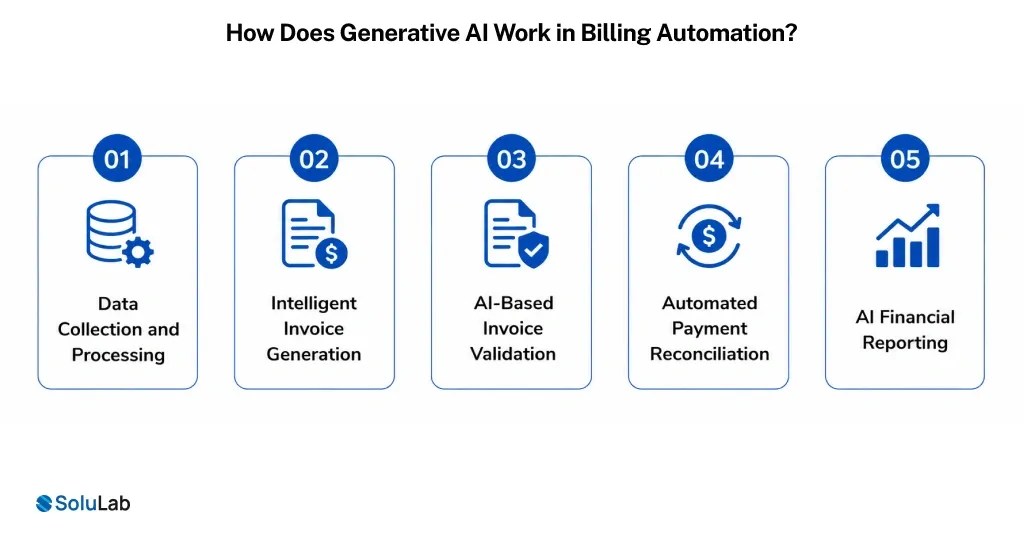
So what’s actually happening behind the scenes when a bill runs through an AI system? Here’s the short version:
1. Data Collection and Processing
First, the AI pulls together information: old invoices, payment history, vendor details, whatever it needs. It reads through all of it before doing anything else.
2. Intelligent Invoice Generation
From there, it can generate invoices on its own. It already knows what goes where, so the bills come out correctly formatted every single time, without someone rebuilding a template.
3. AI-Based Invoice Validation
Before a cent gets paid, the AI checks the invoice against purchase orders and past records to make sure everything actually lines up. Businesses that lean on strong Intelligent document processing solutions tend to catch mismatches here that a person would’ve missed entirely.
4. Automated Payment Reconciliation
This is where AI matches each payment to the right invoice, so nobody’s digging through a spreadsheet at 6 p.m. trying to figure out what got paid.
5. AI Financial Reporting
Finally, it turns all that raw data into reports people can actually read, so finance teams get a clear picture of spending and trends without building a chart by hand.
How to Implement Generative AI for Billing Automation?
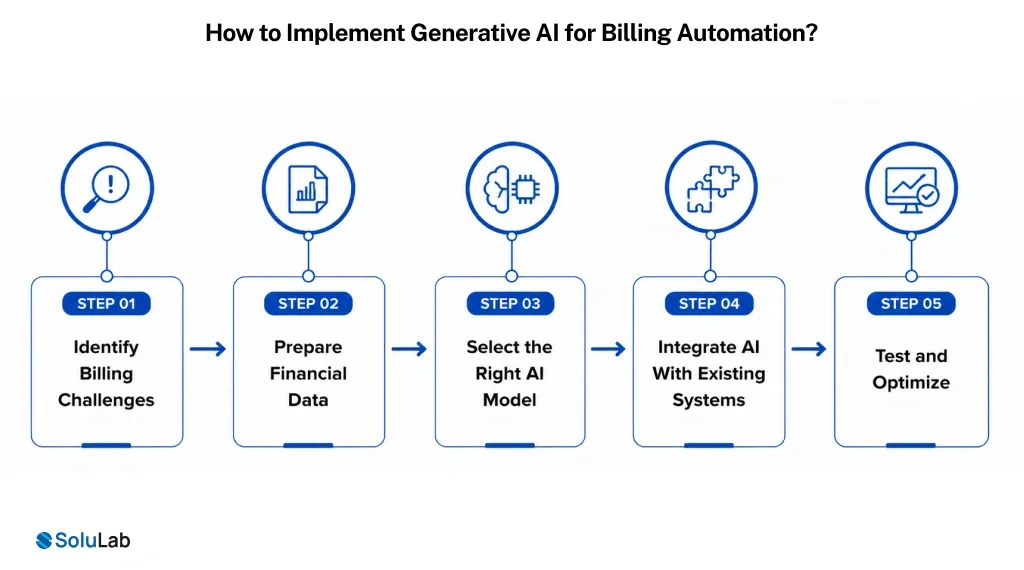
Rolling this out is a lot easier when you break it into small steps instead of trying to flip everything on at once.
Step 1: Identify Billing Challenges
Before bringing in any tool, look closely at where your billing process actually breaks down. Skip this step, and you’ll end up fixing a problem you don’t really have.
- Find your slowest billing steps
- List out common invoice mistakes
- Ask your team what frustrates them most
Step 2: Prepare Financial Data
Artificial Intelligence is only as good as the data you feed it. Messy, scattered records will just confuse the system and give you bad results back.
- Clean up old invoice records
- Remove duplicate vendor entries
- Keep everything in one place
Step 3: Select the Right AI Model
Not every AI tool fits every business. The right one depends on your invoice volume, industry rules, and what you’re already running. This is usually where working with top generative AI development partners saves you from an expensive wrong guess.
- Compare a few AI vendors
- Check for industry compliance
- Test with a small sample
Step 4: Integrate AI With Existing Systems
Your new AI tool needs to actually talk to what you already have, like your ERP or accounting software, or it won’t save you any real time.
- Connect AI to your ERP
- Link your accounting tools
- Set clear data permissions
Step 5: Test and Optimize
Don’t flip the switch and walk away. Run it alongside your old process for a while, watch what happens, and fix what needs fixing.
- Run a small pilot test
- Track errors and speed
- Adjust settings as you go
Measuring the ROI of Generative AI in Billing Operations
ROI just asks one question: Was this worth the money? For AI billing automation, there are a few honest ways to answer that.
Start with time saved. If invoices used to take five days and now take one, that’s real hours back on your team’s calendar. Error rates matter too. Fewer mistakes usually mean fewer late fees and fewer awkward calls to vendors explaining what went wrong.
You can also track how fast payments actually come in, and what it costs you to process a single invoice. Gartner has found that finance organizations using cloud ERP tools with built-in AI assistants could see a 30% faster financial close by 2028. That’s a real, measurable outcome, not a marketing promise.
And don’t ignore the quieter wins, like employees who aren’t stuck doing repetitive data entry all day. That matters more than it sounds for keeping good people around.
Adopting Generative AI in Billing: Challenges and Best Practices
AI payment processing doesn’t work perfectly right out of the box. Here’s where things usually go wrong, and what tends to fix it.
- Messy or outdated data is the most common snag. AI-led development can only work with what you hand it, so cleaning up records before plugging in any tool saves a lot of headaches later.
- Staff pushback is another one worth taking seriously. Some people genuinely worry AI is coming for their job, so it helps to be upfront about what’s changing and show that AI is taking the boring parts off their plate, not the whole role.
- Picking the wrong tool is the third big trap. Not every AI billing software fits every business, and it’s worth testing before signing anything long-term.
- On the flip side, the businesses that get this right tend to start small, prove it on one process like invoice matching, and keep a person reviewing anything unusual before it goes fully hands-off.
- Studies also found that 80% of large enterprise finance teams will rely on internally managed generative AI platforms trained on their own business data by 2026.
- That tells you something: businesses aren’t just buying an off-the-shelf tool and hoping for the best. They’re building AI tailored to their own process, often working with an AI consulting services team to determine the right approach before writing any code.
How SoluLab Helps Businesses Build Generative AI Billing Solutions?
SoluLab builds AI billing tools around how your business actually works, not a generic product with your logo slapped on it.
Custom billing automation platforms are the starting point. Beyond that, our team builds AI-powered financial assistants that can answer questions or flag issues in plain language, and connect everything to the ERP or accounting software you’re already running. For businesses that want to go further, our AI agent development company team builds AI agents that can handle repetitive finance workflows on their own.
If your billing process handles a lot of paper invoices and contracts, we also work as a FinTech Software Development Company for teams in banking and lending, where compliance isn’t optional.

Conclusion
Generative AI for billing automation isn’t a passing trend. It’s fast becoming the normal way businesses handle invoices, payments, and financial reporting. Done right, it cuts down errors, speeds up the slow parts, and frees your team up for work that actually needs a human brain behind it.
Start small. Pick one billing headache, clean up the data behind it, and test an AI tool before going all in. The companies seeing the best results here usually aren’t the fastest movers.
SoluLab is a generative AI integration company that helps you automate your business billing processes. Book a free consultation call with us!
FAQs
Neha is a curious content writer with a knack for breaking down complex technologies into meaningful, reader-friendly insights. With experience in blockchain, digital assets, and enterprise tech, she focuses on creating content that informs, connects, and supports strategic decision-making.