Key Takeaways
- Generative AI security protects models, prompts, training data, retrieval systems and AI agents from attacks, leaks, and misuse.
- The biggest new risk is prompt injection. Instructions hidden in a document, email or web page can redirect what a model does.
- Most real exposure is internal. Employees pasting sensitive data into unapproved AI tools is a larger risk for most companies than outside attackers.
- AI agents raise the stakes. Once a model can send email, query databases or call APIs, a successful attack becomes an action, not just a bad answer.
- Security has to be tested continuously. Red teaming before launch and monitoring after launch catch different problems.
Generative AI security is the practice of protecting generative AI systems, including large language models, their training and retrieval data, the applications built on them, and the agents that act on their output, from attacks, data leaks, and misuse.
It covers threats that traditional security tools were never designed to see, such as prompt injection and model manipulation.
Gartner predicts that by 2027, more than 40% of AI-related data breaches will be caused by improper use of generative AI across borders, driven by unmanaged data flows and inconsistent policies.
Most of that risk is preventable. This guide covers what generative AI security involves, how it works in layers, the frameworks security teams actually use, and how to build a strategy that holds up once real users and real data arrive.

What Is Generative AI Security?
Generative AI security is the set of controls, processes and testing that keep generative models and the systems around them confidential, accurate and under control. It spans the model, the data it learns from and retrieves, the application layer, the identities that access it and the monitoring that watches it.
1. Security of AI, Not AI for Security
These two get confused constantly. Generative AI security means protecting AI systems themselves. AI for security means using AI to defend other systems, such as detecting intrusions or triaging alerts. Both matter, and they are different disciplines. The second is covered in our overview of AI in cybersecurity. This guide is about the first.
2. What Makes Generative AI Different
Traditional software follows code. Generative AI follows instructions written in natural language. It cannot reliably tell an instruction from its developer apart from one hidden inside the content it is processing. That single property creates most of the new risk.
3. What Needs Protecting
Five assets, typically. The model itself and its weights. System prompts and configuration. Training, fine-tuning and retrieval data. The application and its integrations. And the tools and permissions any AI agent can use. Each one has its own threats and its own controls.
Why Generative AI Security Matters
Because adoption is running ahead of control, the attack surface is new, and the consequences grow sharply once AI can take actions rather than just produce text.
Spending shows how fast this is moving. In the 2026 Gartner CIO and Technology Executive Survey, 84% of respondents expected their enterprise to increase generative AI funding this year. Gartner also projects that by 2028, half of organisations will adopt a zero-trust approach to data governance as unverified AI-generated data spreads.
1. Prompt Injection Is Hard to Prevent Completely
An attacker can place instructions inside a PDF, email, web page or support ticket. When the model reads that content, it may follow the hidden instructions: leak data, ignore rules or call a tool. There is no single filter that stops every variant, which is why layered defences matter.
2. Sensitive Data Leaks Through Normal Use
Employees paste customer records, source code, or financial figures into AI tools to get work done faster. Models can also reveal information from their context, their retrieval sources or, in some cases, their training data. Much of generative AI data privacy risk comes from ordinary behaviour, not attacks.
3. Agents Turn Bad Outputs Into Actions
A model that only writes text can embarrass you. An AI agent with access to email, databases or payment systems can act on a manipulated instruction. More tools and permissions mean a successful attack can do more. That is why teams doing AI agent development now treat permission design as a security task.
4. The AI Supply Chain Is Long
Open models, third-party APIs, plug-ins, datasets, embedding models and orchestration libraries all come from outside your organisation. Any of them can introduce vulnerabilities, poisoned data or unexpected behaviour.
5. Regulation Is Catching Up
Frameworks such as the EU AI Act require risk management, logging, human oversight and robustness for high-risk systems. Security controls now double as compliance evidence.
How Generative AI Security Works
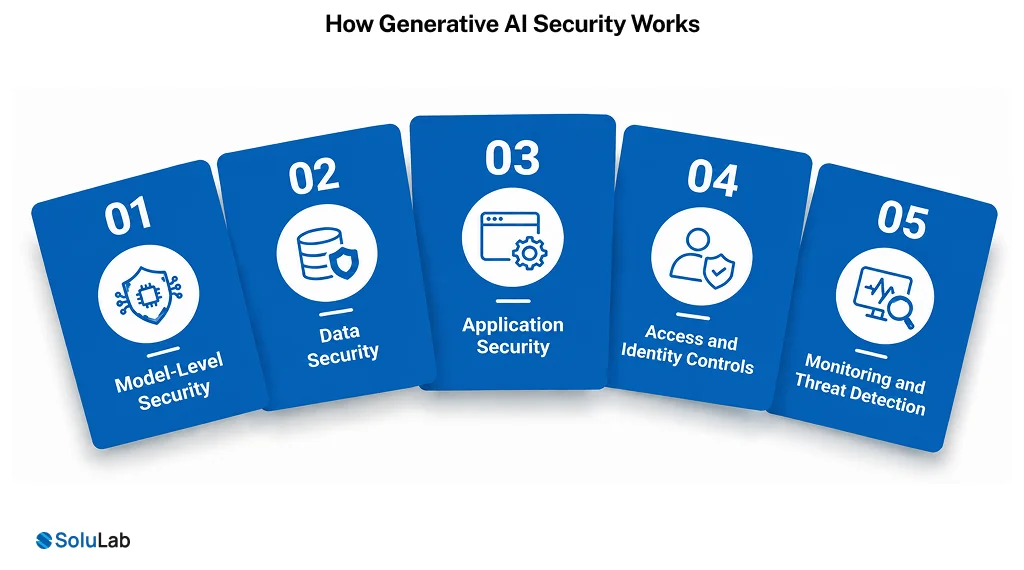
Generative AI security works in layers. Each layer assumes the one before it may fail, so a single bypass does not become a breach. Five layers cover most production systems.
1. Model-Level Security
Protecting the model and how it behaves. This includes choosing models from trusted sources, verifying weights and dependencies, safety tuning and guardrails, protecting system prompts from extraction, and limiting what the model can be tricked into producing. Because no model is fully resistant to manipulation, model-level controls are necessary but never sufficient on their own.
2. Data Security
Protecting data at every stage: training, fine-tuning, retrieval, and prompts. Key controls: classify what data can reach a model, redact or mask sensitive fields, and encrypt data at rest and in transit. Control who can add documents to retrieval stores. Watch for poisoned or manipulated content.
Retrieval systems deserve special attention because a RAG platform can expose documents to users who should never see them if access controls aren’t enforced at query time.
3. Application Security
Protecting the application around the model. Treat all model output as untrusted input: validate and sanitise it before it reaches a browser, a database, or another system. Separate trusted instructions from untrusted content. Rate-limit requests to prevent runaway costs. Standard secure development practices still apply in full.
4. Access and Identity Controls
Controlling who and what can use the AI system, and what the AI itself is allowed to do. Users get least-privilege access. AI agents get their own identities with narrowly scoped permissions, rather than borrowing broad service accounts. Sensitive actions require human approval. Authorisation decisions are made by external systems, never delegated to the model.
5. Monitoring and Threat Detection
Watching the system in production. Log prompts, outputs, tool calls and retrieval queries. Flag suspicious patterns such as repeated jailbreak attempts, unusual data access or unexpected tool use. Track quality and drift over time. Much of this runs on standard MLOps tooling, extended with generative AI threat detection rules.
Generative AI Security vs Traditional AI Security
Traditional AI security protected predictive models and their data. Generative AI adds natural language instructions, open-ended outputs and autonomous actions, which change where attacks happen and how defences must work.
| Dimension | Traditional AI Security | Generative AI Security |
| Main attack surface | Training data and model inputs | Prompts, retrieved content, outputs and connected tools |
| Typical input | Structured features or images | Natural language, documents, code and web content |
| Signature threats | Data poisoning, evasion, model theft | Prompt injection, jailbreaks, system prompt leakage, excessive agency |
| Output risk | Wrong classification or score | Harmful, false, or data-leaking content, and actions taken on it |
| Data exposure | Mostly during training | Training, fine-tuning, retrieval stores, and every user prompt |
| Access model | Users query a model | Users and AI agents, each needing scoped permissions |
| Testing approach | Accuracy and robustness testing | Adversarial red teaming plus continuous evaluation |
| Monitoring focus | Model drift and performance | Prompt abuse, data leakage, tool misuse, cost spikes, and drift |
Generative AI Security Frameworks and Standards
Four frameworks do most of the work. OWASP names the specific threats, NIST gives a risk management structure, and the two ISO standards turn that into an auditable management system.
1. OWASP Guidance for LLM Security
The OWASP Top 10 for LLM Applications is the most widely referenced list of generative AI threats. The 2025 edition covers prompt injection, sensitive information disclosure, supply chain risks, data and model poisoning, improper output handling, excessive agency, system prompt leakage, vector and embedding weaknesses, misinformation, and unbounded consumption. System prompt leakage and vector and embedding weaknesses were added in that edition, reflecting real incidents and the spread of retrieval systems.
In December 2025, the OWASP GenAI Security Project also released a Top 10 for Agentic Applications, covering risks such as agent goal hijacking, tool misuse, and identity and privilege abuse. OWASP updates these lists regularly, so check the current edition before an audit.
2. NIST AI Risk Management Framework
The NIST AI RMF organises AI risk work into four functions: govern, map, measure and manage. NIST’s Generative AI Profile extends it with risks specific to generative systems, such as confabulation, data privacy and information security. It is voluntary, widely adopted, and a useful structure for any AI governance framework.
3. ISO/IEC 42001
The international standard for AI management systems. It sets requirements for governing AI across its lifecycle, including risk assessment, impact assessment, controls, and continual improvement. Organisations can certify against it, which makes it useful evidence for customers and regulators.
4. ISO/IEC 27001
The established standard for information security management systems. Most generative AI data protection, access control, supplier management and incident response controls sit naturally inside an existing 27001 programme. Teams that already hold 27001 usually extend it to cover AI rather than starting again.
5. How the Frameworks Fit Together
Use OWASP to identify threats, NIST to structure risk decisions, ISO/IEC 27001 for information security controls and ISO/IEC 42001 for AI-specific governance. Gartner’s AI TRiSM model, covering trust, risk and security management, offers another lens that brings these together.
How to Build a Generative AI Security Strategy
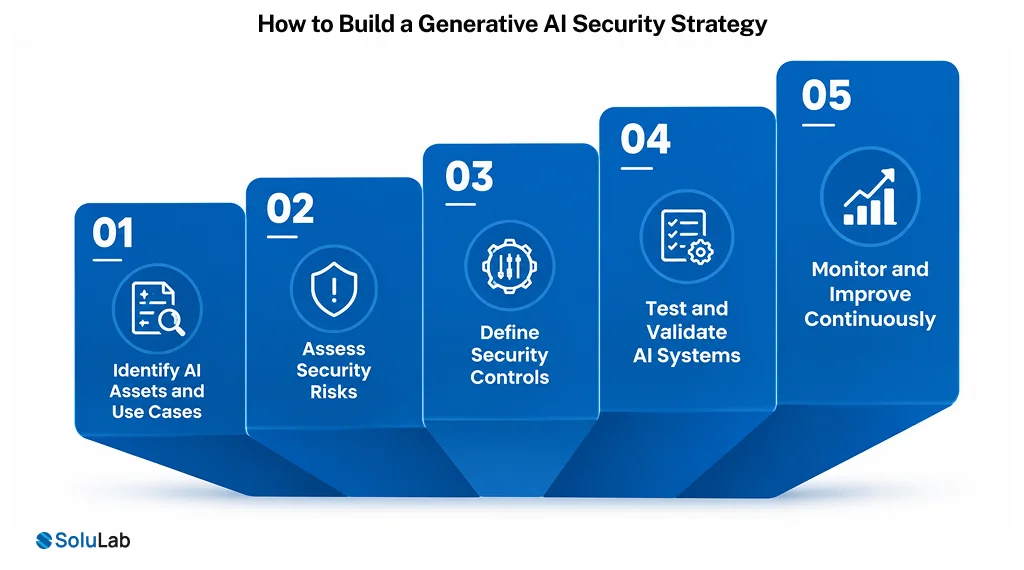
Run as a cycle rather than a one-off project. The first step is the one most organisations skip, and it is the one everything else depends on.
1. Identify AI Assets and Use Cases
Build an inventory of every generative AI system in use: internal tools, customer-facing assistants, agents, APIs, and vendor features that quietly added AI. Record what data each touches, who uses it, and what actions it can take. Most organisations find far more AI in use than leadership expected.
2. Assess Security Risks
For each system, map likely threats using the OWASP lists, then rate impact and likelihood. Customer-facing systems, systems with access to sensitive data and agents with write permissions come first.
3. Define Security Controls
Match controls to risks across the five layers: model, data, application, identity and monitoring. Write a short, usable AI policy that names approved tools and prohibited data. This is where security connects with responsible AI practice, because bias, transparency and human oversight belong in the same control set.
4. Test and Validate AI Systems
Test before launch and after every significant change. Structured AI red teaming probes for prompt injection, jailbreaks, data leakage and tool misuse. Automated evaluation suites catch regressions. An LLM security audit reviews architecture, permissions and logging against a recognised framework. What drives generative AI security assessment cost? Mainly the number of systems in scope, how many can take actions, and whether testing covers integrations as well as the model.
5. Monitor and Improve Continuously
Log and review activity, investigate anomalies, track new attack techniques and update controls. The results feed back into step one, because new tools and use cases keep appearing. Governance has not kept pace with deployment. In Deloitte’s State of AI in the Enterprise research, only about one in five companies reported a mature governance model for autonomous AI agents.
Future of Generative AI Security
The direction is clear: more autonomy, more connected systems and more regulation, with security moving from the application edge into the agent runtime itself.
1. Agent Security Becomes the Core Problem
As AI agents take on multi-step work, securing their identities, tool access, and memory becomes central. Controls that enforce permissions outside the model, rather than relying on instructions inside it, will become standard. The same shift is visible in agentic AI in cybersecurity, where agents are both a defensive tool and a new attack surface.
2. Security Moves Below the Model
Leading architectures now put deterministic controls beneath the model: sandboxed execution, network egress filtering and credential isolation. A manipulated model still cannot do serious damage. Expect this pattern to spread.
3. AI Bills of Materials
Just as software bills of materials record code dependencies, AI bills of materials will record models, datasets and components, making supply chain risk easier to track.
4. Continuous, Automated Red Teaming
Point-in-time testing will give way to ongoing automated adversarial testing, because models, prompts and tools change too often for annual reviews.
5. Security as Compliance Evidence
As AI regulation takes effect, logs, test results and control documentation will be requested by regulators and customers. Security teams that design for evidence from the start will spend far less time assembling it later.
How SoluLab Can Help With Generative AI Security
We build generative AI systems and secure them as part of the build, not as an afterthought. That gives us a practical view of where these systems actually break.
1. Security Assessments and LLM Audits
Reviewing your generative AI systems against OWASP, NIST and ISO frameworks, with prioritised findings and remediation guidance.
2. Red Teaming and Adversarial Testing
Structured testing for prompt injection, jailbreaks, data leakage and agent misuse before launch and after changes.
3. Secure Architecture and Integration
Designing retrieval, agent permissions, output handling and logging so security holds even when the model is manipulated. Most of this work happens during AI integration services, where models meet real systems and data.
4. Governance, Policy and Compliance
Helping you write usable AI policies and map controls to regulatory requirements. Our generative AI consulting team works through risk, governance and roadmap decisions with your security and legal teams.
5. Ongoing Monitoring and Support
Setting up monitoring and threat detection for production systems. Teams that need extra capacity can hire AI developers with security experience for defined phases.
Conclusion
Generative AI security is not a single product or a one-time review. It is a layered discipline that protects models, data, applications, identities and actions, and it needs continuous testing because both the systems and the attacks keep changing.
The organisations doing this well start with an inventory. They focus first on customer-facing systems and agents that can act. They put permission controls outside the model, and they treat red teaming and monitoring as ongoing work. The frameworks help. OWASP names the threats, NIST structures the decisions and ISO turns them into auditable practice, but the real protection comes from applying them to your own systems.
SoluLab, an AI development company, can help your business assess generative AI risks, build security into your AI architecture, test systems against real attack techniques and set up the monitoring that keeps them secure in production. We will also tell you plainly which risks matter most for your systems, so effort goes where it counts.
FAQs
Neha is a curious content writer with a knack for breaking down complex technologies into meaningful, reader-friendly insights. With experience in blockchain, digital assets, and enterprise tech, she focuses on creating content that informs, connects, and supports strategic decision-making.