Key Takeaways
- Case volume growth, not cost, is what forces this decision. Safety teams are absorbing more reports each year without proportional headcount, and manual triage does not scale with it.
- Duplicate detection, MedDRA coding support and narrative drafting are where AI pays back first. All three are high volume, rules-adjacent and already measured.
- Regulators have published their expectations. The EMA reflection paper, the EU AI Act and the CIOMS draft report between them set out risk assessment, documentation, validation and human oversight obligations you can design against today.
- The oversight model is the central design decision. Human in the loop, on the loop, or in command are genuinely different architectures, and the choice has to be made per task rather than per system.
- Validation is not a launch gate, it is a standing obligation. Continuous performance monitoring against a reference standard is what keeps a qualified system qualified.
Pharmacovigilance has a scaling problem that technology did not create and now has to solve. Report volumes rise year after year while safety teams grow slowly, and every individual case safety report still needs intake, deduplication, coding, assessment, and submission inside a regulatory clock.
Deloitte’s 2026 Life Sciences Executive Outlook, which surveyed 280 C-suite executives across pharma and medtech, found 78% describing AI as a cost and growth lever that will drive major change while only 9% reported significant ROI, and 60% named regulatory complexity and data submission requirements their leading barrier.
That combination describes pharmacovigilance precisely: high conviction, thin proof, and regulation in between. This guide covers where AI in pharmacovigilance works across the case lifecycle, how to implement it step by step, what EMA, the EU AI Act and CIOMS expect of you, and what a validated build costs.
What Is AI in Pharmacovigilance?
AI in pharmacovigilance is the use of machine learning and language models across drug safety operations: receiving and structuring adverse event reports, detecting duplicates, suggesting MedDRA codes, drafting case narratives, screening literature and supporting signal detection. In regulated steps the model proposes and a qualified person decides, because the medical judgment and the regulatory accountability remain human.
Three things separate this from general enterprise AI, and each one changes the build.
1. Every Output Sits Inside a Regulated Process
Case processing operates under good pharmacovigilance practices. An AI step inside it is part of a validated computerised system, which means qualification evidence, change control, data integrity under ALCOA principles and an audit trail an inspector can follow.
2. The Clock Does Not Stop for Technology
Expedited reporting deadlines are fixed. A model that improves accuracy but adds latency to a 15-day submission path has made the process worse, not better, and that trade-off has to be measured rather than assumed.
3. The Failure Mode Is a Missed Signal
A wrongly coded event or a missed duplicate does not just create rework. It can distort a safety signal, which is a patient safety question rather than an operational one. This is why oversight design dominates the engineering.
For the wider sector view, see our overview of AI use cases in healthcare and, on the discovery side of the lifecycle, AI in drug discovery.
Where AI Fits in the Pharmacovigilance Workflow
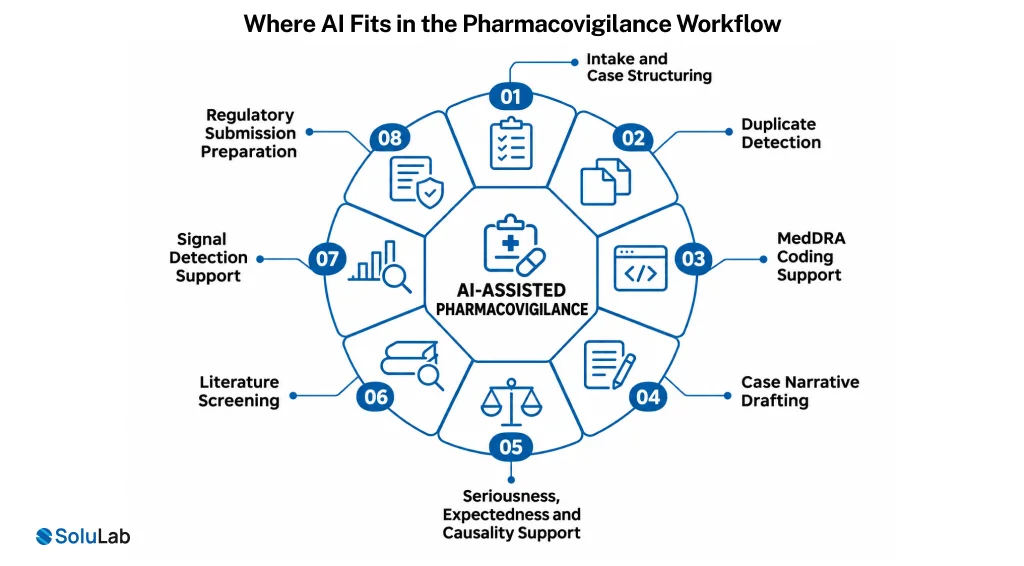
Eight points in the ICSR lifecycle, ordered by how reliably they pay back today.
1. Intake and Case Structuring
Reports arrive as emails, call centre transcripts, web forms, literature, social listening and partner files. Language models extract patient, product, event, dates and reporter details from any of those formats into structured fields. AI adverse event reporting intake is the highest-volume win because the current process is almost entirely manual transcription. Call centre intake overlaps with the patterns in AI for customer support, since medical information lines are a primary AE source.
2. Duplicate Detection
The same case frequently arrives through several channels. Matching on fuzzy patient identifiers, product, event and dates is a classic machine learning problem and one where models comfortably outperform rule-based matching. Low risk, immediate value.
3. MedDRA Coding Support
Mapping verbatim reported terms to MedDRA preferred terms is high volume, requires consistency and is where inter-coder variation creeps in. Models propose codes with confidence scores; coders confirm. Consistency improves even when accuracy holds flat.
4. Case Narrative Drafting
Generating the narrative from structured case data in house style, for a safety reviewer to edit rather than write. Document handling of this kind sits close to our intelligent document processing work.
5. Seriousness, Expectedness and Causality Support
The model flags candidate assessments against the reference safety information. This is medical judgment, so it is decision support only, and the qualified person’s determination is what enters the record.
6. Literature Screening
Screening published literature for cases and safety information is enormous in volume and highly repetitive. Models triage by relevance and extract candidate cases, with human confirmation on anything surfaced.
7. Signal Detection Support
Disproportionality analysis has been statistical for decades. What is new is models surfacing patterns across unstructured narrative text that structured coding misses, as a supplement to established methods rather than a replacement.
8. Regulatory Submission Preparation
E2B(R3) file assembly, completeness checks before transmission and drafting of periodic reports. Related control design appears in AI for regulatory compliance.
How to Implement AI in Pharmacovigilance: An Eight-Step Guide
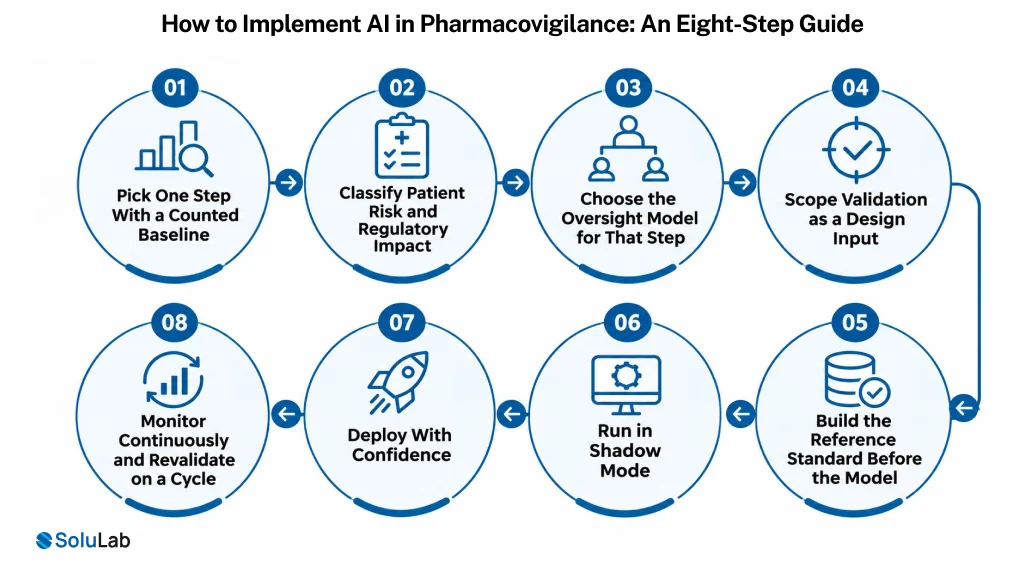
Here’s a step-by-step implementation guide on AI in pharmacovigilance:
1. Pick One Step With a Counted Baseline
Duplicate detection rate, coding hours per case, narrative drafting time, literature screening throughput. If it is not measured today, improvement cannot be evidenced to an inspector or a budget holder.
2. Classify Patient Risk and Regulatory Impact
The EMA reflection paper distinguishes systems posing high patient risk from those with high regulatory impact. Duplicate detection and causality assessment sit in very different places on both axes, and that classification drives everything downstream.
3. Choose the Oversight Model for That Step
Before architecture, decide whether the task needs a human in the loop, on the loop or in command. The next section covers the three. Getting this wrong is the most expensive mistake available here.
4. Scope Validation as a Design Input
Risk assessment, qualification approach, reference standard, and traceability decided alongside the architecture. Validation designed in costs a fraction of validation retrofitted into a live GVP system.
5. Build the Reference Standard Before the Model
A curated set of cases with agreed correct outputs, assembled by your own safety team. Without it, you cannot measure the model, qualify it, or detect drift later. This step is routinely skipped and routinely regretted.
6. Run in Shadow Mode
The model processes real cases without its output being used. Compare against what your team actually did. This produces your true accuracy on your own data and your false-negative rate, which is the number that matters most in safety.
7. Deploy With Confidence
The threshold at which a case routes to human review is a safety decision. Your qualified person should own it, and it should be documented and reviewed on a schedule.
8. Monitor Continuously and Revalidate on a Cycle
The CIOMS draft report recommends continuous performance monitoring to detect model drift. Build the monitoring before go-live and set the revalidation cadence in your quality system rather than leaving it to judgment.
Teams building rather than buying will recognise the sequence from our healthcare AI consulting and development engagements, where validation effort consistently exceeds model effort.
What Regulators Expect
Enough has been published that you can design against it rather than guess.
1. The EMA Reflection Paper on AI in the Medicinal Product Lifecycle, 2024
Calls for regulatory impact and risk assessments, documentation of model performance, and alignment with good pharmacovigilance practices. Its distinction between high patient risk and high regulatory impact is the most practically useful idea in it, because the two do not always coincide.
2. The EU AI Act, 2024
Applies a four-tier risk framework. Healthcare and pharmacovigilance systems are potentially high-risk, with classification depending on the specific use, which means a case-by-case assessment rather than a blanket answer. High-risk systems carry obligations for human oversight, documentation, traceability and explainability.
3. FDA Guidance on AI for Regulatory Decision-Making, January 2025
Also risk-based, framing the credibility of an AI model as a function of its context of use rather than a property of the model itself.
4. The CIOMS Draft Report
The most operationally detailed of the four. It recommends establishing reference standards, validating models with real-world pharmacovigilance data both qualitatively and quantitatively, continuous performance monitoring for drift, and disclosure of model architecture, expected inputs and outputs, and the human-AI interaction design. Comments closed in June 2025.
5. The Common Thread
All four are risk-based rather than prescriptive, and all four put the burden on you to document why your approach is appropriate for the specific task. None of them bans anything outright. That is a more demanding position than a rulebook, because there is no compliance checklist to hide behind.
6. Existing GVP Obligations Have Not Changed
Computerised system validation, data integrity, change control and the qualified person’s responsibilities apply to an AI step exactly as to any other. The new guidance sits on top of that, not instead of it.
Choosing Your Human Oversight Model
The CIOMS draft report sets out three models and maps them to PV tasks. This is the single most useful framework in the field, and it belongs in your design document rather than your appendix.
1. Human in the Loop
A person reviews and approves every output before it has effect. Highest assurance, lowest throughput gain. Appropriate for causality assessment, seriousness determination and anything feeding a regulatory submission directly.
2. Human on the Loop
The system acts, and a person monitors, sampling outputs and intervening on exceptions. Moderate assurance, substantial throughput gain. Appropriate for MedDRA coding support, duplicate detection and literature triage, with sampling rates set by risk.
3. Human in Command
The system operates with a person retaining authority over its configuration, scope and shutdown, without reviewing individual outputs. Appropriate only for low patient risk, high volume tasks such as initial intake structuring where downstream steps will catch errors.
4. Why This Is a Per-Task Decision
One PV system will typically use all three across different steps. Applying a single model system-wide either strangles the throughput benefit or over-delegates on the steps that matter. Document the choice per task with the reasoning, because that document is what an inspector will ask to see.
5. The Question That Settles It
If this output is wrong and nobody catches it, what happens to a patient? Where the honest answer is serious, the human is in the loop.
What It Costs and How Long It Takes
Cost tracks validation scope and integration count far more than model choice.
| Engagement | Typical range | What it covers | Timeline |
| Assessment and oversight design | $10,000 to $22,000 | Step selection, risk and regulatory impact classification, oversight model per task, validation plan, build estimate | 3 to 5 weeks |
| Single-step pilot, low risk | $30,000 to $70,000 | Duplicate detection or intake structuring, reference standard build, shadow mode, qualification documentation | 8 to 14 weeks |
| Coding or narrative support build | $70,000 to $160,000 | Model development, confidence thresholds, safety database integration, full audit layer, validation cycle | 14 to 22 weeks |
| Multi-step PV automation programme | $80,000+ | Several workflow steps, shared extraction layer, orchestration, governance framework, revalidation cadence | 24 weeks+ |
| Independent validation support | Scoped separately | Third-party qualification review and documentation | 3 to 8 weeks |
| Monitoring and revalidation retainer | Monthly, scoped to case volume | Drift monitoring, threshold review, model updates under change control, reporting | Rolling |
How SoluLab Can Help
We build and validate AI systems for pharma, biotech and medtech, with the qualification documentation delivered alongside the system rather than after it.
1. Workflow Assessment and Oversight Design
We classify each candidate step by patient risk and regulatory impact, recommend the oversight model per task, and produce the validation plan before any code exists.
2. Intake and Case Processing Builds
Extraction from email, transcripts, forms and literature into structured case fields, with source linkage on every field and confidence-based routing to review.
3. Duplicate Detection and Coding Support
Matching models and MedDRA coding assistance with reference standards built from your own cases, measured on recall rather than headline accuracy.
4. Signal Detection and Literature Screening
Narrative text analysis supplementing established disproportionality methods, and literature triage with human confirmation on anything surfaced.
5. Validation and Audit Readiness
Reference standard construction, shadow-mode evaluation, qualification documentation, drift monitoring and change control, built to survive inspection.
6. Platform Engineering for PV Software Vendors
For companies building what safety teams buy, we handle extraction architecture, model orchestration, audit logging and validation-ready infrastructure. Scaling patterns appear in enterprise AI solutions for healthcare, and the broader lifecycle view in AI in medicine and generative AI in healthcare.

Conclusion
Implementing AI in pharmacovigilance is less a modelling problem than a sequencing one. The models are good enough today to structure intake, catch duplicates, propose codes and draft narratives, and most large safety organisations have proved that somewhere in a pilot.
What separates the pilots that reached production is unglamorous: a step chosen because it was already measured, a reference standard built from the organisation’s own cases, an oversight model chosen per task rather than per system, and validation treated as a design input rather than a gate at the end. Regulators have been clearer than the market gives them credit for.
If you are deciding where to start, which oversight model a step needs, or how to move a pilot into a validated environment, SoluLab, an AI development company, can help your business scope it properly. Book a discovery call and we will work through the first workflow with you.
FAQs
Neha is a curious content writer with a knack for breaking down complex technologies into meaningful, reader-friendly insights. With experience in blockchain, digital assets, and enterprise tech, she focuses on creating content that informs, connects, and supports strategic decision-making.