Key Highlights
- A custom DAO platform helps enterprises turn governance into a growth engine, not just a voting mechanism.
- DAO platform development enables enterprises to make quick decisions, improve treasury transparency, automate approvals, and increase stakeholder trust.
- DAOs support business use cases across the web3 ecosystem.
- AI-powered DAO governance can help businesses to improve proposal review, risk scoring, compliance checks, treasury analysis, and voting intelligence.
- SoluLab builds secure, scalable, and commercially useful Web3 governance infrastructure.
In 2026, businesses are choosing decentralized governance over traditional practices for smarter decision-making. The global DAO market is expected to reach $333 million in the next five years. This is a result of rising demand for enterprise-grade infrastructure in companies with blockchain integration and AI governance. DAO platform development helps businesses to make the governance programmable, transparent, and auditable, and reduces the approval friction, improves treasury visibility, and scales stakeholder participation with new digital ownership models.
This guide explores how to build a DAO platform that works as a growth engine, risk mitigator, and competitive differentiator.
Understand the DAO Platform
A Decentralized Autonomous Organization platform enables businesses to make decisions through transparent governance rules. This enables the members to propose, vote, approve, and execute decisions following the rules mentioned in smart contracts.
- Proposal creation
- Voting system
- Governance tokens
- Wallet login
- Treasury controls
- Smart contract execution
- Member roles
- Activity records
- Governance dashboard
The purpose is better accountability. When members can see how proposals are created, who voted, what passed, and how funds moved, trust becomes easier to maintain. Decentralized governance platform development is now becoming useful beyond crypto-native communities.
Businesses can use DAOs for protocol governance, investment groups, community funds, employee ownership models, gaming ecosystems, real estate tokenization, creator networks, and nonprofit fund management.
Why Traditional Governance Slows Enterprise Growth?
Most enterprises struggle due to a slow decision-making process, which affects product launches, increases the compliance costs, affects investor engagement, damages token value, and affects user retention.
Decentralized governance platform development gives businesses a structured way to manage proposals, votes, treasury, and decision execution using smart contracts. It replaces scattered governance workflows with transparent, rule-based infrastructure.
Core Technical Capabilities of a Business-Ready DAO Platform
Technical features only matter when they create business outcomes.
A serious DAO software development roadmap should connect every capability to cost reduction, faster execution, risk control, or revenue growth.
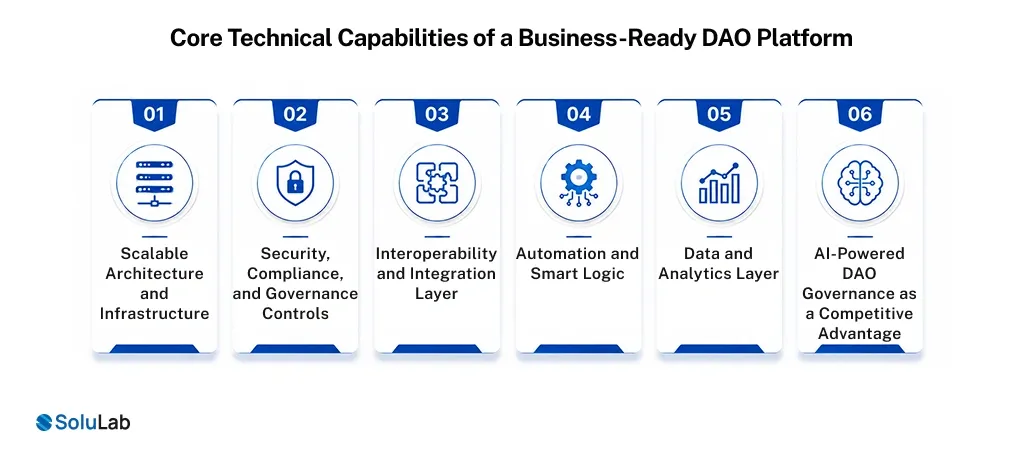
- Scalable Architecture and Infrastructure
A DAO platform must support growth across users, proposals, wallets, tokens, and treasury actions. The architecture may use public, private, and a hybrid setup. The choice depends on transaction cost, speed, security, wallet support, and ecosystem fit. For enterprises, scalability means the platform can support thousands of members, frequent proposals, multiple business units, and future integrations without rebuilding from scratch.
A scalable architecture reduces future migration costs and supports faster time-to-market for new governance products.
- Security, Compliance, and Governance Controls
Security is not a technical add-on in DAO smart contract development. A DAO may control treasury funds, token rights, protocol decisions, investment approvals, or community rewards. If the smart contracts fail, the business may face financial loss, reputational damage, and stakeholder distrust. A secure DAO platform should include:
- Audited smart contracts
- Multi-signature treasury approvals
- Timelock execution
- Role-based permissions
- Emergency pause controls
- Proposal thresholds
- Access verification
- Transparent audit logs
- Secure wallet integrations
These controls reduce governance abuse, fund misuse, and unauthorized execution.
- Interoperability and Integration Layer
Enterprise systems rarely operate in isolation. A DAO platform may need to integrate with CRM, ERP, analytics tools, compliance systems, identity providers, custody platforms, accounting software, and internal dashboards. Interoperability helps the DAO fit into the existing business environment. This reduces adoption friction. The business does not need to replace every system. It can add a governance layer that connects to current operations. A strong Web3 DAO development services team plans this integration layer early.
- Automation and Smart Logic
Smart contracts automate approved decisions. They can release funds, distribute rewards, update protocol parameters, manage staking, trigger governance actions, and enforce voting rules. Automation reduces manual intervention, and it also improves execution accuracy.
For example, once a proposal reaches quorum and passes approval, the platform can automatically queue execution through a timelock and then complete the action after the waiting period. This gives the business speed without removing control.
- Data and Analytics Layer
Enterprise leaders need visibility. A DAO analytics layer can show proposal volume, voter turnout, treasury movement, token concentration, member activity, governance participation, and execution history. This data helps leadership answer important questions:
- Are members engaged?
- Are decisions moving fast enough?
- Is voting power too concentrated?
- Are treasury requests aligned with strategy?
- Are governance rules working as intended?
Without analytics, a DAO becomes difficult to manage at scale. With the right dashboard, governance becomes measurable.
- AI-Powered DAO Governance as a Competitive Advantage
DAO participation can decline when proposals become too long, technical, or frequent. Members may not read every document. Executives may lack time to review every governance thread. Finance and legal teams may miss early risk signals. AI-powered DAO governance can solve part of this problem.
Artificial intelligence can summarize proposals, compare them with past decisions, identify duplicate ideas, detect unusual voting behavior, review sentiment, flag compliance risks, and model treasury impact.
For example, an AI layer can review a funding proposal and highlight whether the requested amount is above historical averages. It can detect whether the recipient wallet has appeared in previous proposals. It can summarize community sentiment from governance forums. It can also help classify proposals by risk level.
Business Use Cases for DAO Development Services
The best DAO platforms are built around vertical-specific KPIs.
- DeFi Protocols
DeFi platforms can use DAOs to manage protocol upgrades, fee changes, liquidity incentives, treasury allocation, and risk parameters. A well-designed DAO can shorten proposal cycles, improve user trust, and make governance decisions easier to audit. For protocol teams, this can reduce centralization concerns and support community-led growth.
- Gaming Companies
Gaming businesses can use DAO platforms to let players vote on tournaments, reward models, NFT utilities, asset rules, and roadmap priorities. This can improve retention because players feel closer to the product. A gaming DAO can also support creator economies, marketplace governance, and player-led campaigns.
- Real Estate Platforms
Tokenized real estate projects can use DAO governance for property acquisition, maintenance budgets, rental income allocation, refinancing, and sale decisions. A strong DAO platform can help issuers expand investor participation across regions while maintaining structured voting and compliance checks. This creates a more scalable model than manual investor coordination.
- Investment Firms
Investment DAOs can help members review deals, vote on allocations, manage shared treasury funds, and track portfolio decisions. For a mid-size investment group, this can reduce decision friction and improve transparency across members. Compliance and treasury security are critical in this use case.
- Enterprise Consortiums
Enterprises working with vendors, distributors, franchisees, or industry partners can use permissioned DAO platforms to coordinate decisions across multiple stakeholders. This can support joint budgets, shared infrastructure, policy approvals, and performance-based incentives. The result is a transparent governance model without exposing sensitive data publicly.
- Creator and Media Networks
Creator platforms can use DAOs for fan voting, content funding, royalty sharing, project approvals, and membership rewards. This gives creators a direct way to engage audiences while building new monetization models.
For media businesses, it can improve loyalty and unlock community-backed projects.
How a DAO Platform Helps Businesses Scale?
Most enterprises build B2B infrastructure, but their customers often serve large user or investor bases. Custom DAO platform development should support internal governance and customer-facing scale. A white-label DAO platform can allow a business to offer governance tools to its clients, investors, or communities under its own brand.
This multi-tenant structure creates leverage. The business does not build governance once for one use case. It builds a repeatable operating model and helps the business serve more stakeholders without increasing manual governance overhead at the same rate.
Core Features of a Business-Ready DAO Platform
A strong DAO platform should be easy to use, secure to operate, and flexible enough to grow.
1. Wallet-Based Member Access
Members should be able to connect wallets without friction. The platform may support MetaMask, WalletConnect, Coinbase Wallet, Phantom, Ledger, or other chain-specific options. Once connected, users should see their role, voting power, proposals, rewards, and governance history.
Wallet access should feel simple. Many users may not understand blockchain details, so the interface must explain each action before they sign a transaction.
2. Governance Token System
Governance tokens define who can participate and how much influence each member has. A platform may use ERC-20 tokens, NFTs, reputation points, soulbound tokens, or a hybrid model. The design depends on the use case. Token-weighted voting may suit DeFi protocols. NFT-based membership may work for gaming or creator communities. Reputation-based voting can help contribution-driven groups.
3. Proposal Management
A DAO needs a clear proposal process. Members should be able to submit proposals with a title, summary, budget, deadline, voting choices, wallet address, expected result, and supporting documents. Proposal templates help members write better submissions. They also reduce confusion during review. In business DAOs, weak proposal quality often leads to low participation. Members vote more confidently when they understand the request, cost, risk, and benefit.
4. Voting Engine
The voting engine is the heart of DAO software development. Common voting methods include token-weighted voting, quadratic voting, delegated voting, reputation voting, one-member-one-vote, and multi-stage approval.
Each method has trade-offs. Quadratic voting can reduce whale influence. Delegation helps inactive members assign voting power to trusted representatives. Reputation voting rewards contribution instead of capital.
The right model depends on business goals. A real estate DAO, gaming DAO, and DeFi DAO should not use the same voting structure without review.
5. Treasury Management
A DAO often manages shared funds. That makes treasury security one of the most important parts of the DAO platform development.
A treasury proposal should clearly mention the amount, the recipient, the purpose, the timeline, and the expected outcome. Members should never have to guess why funds are being moved.
6. Smart Contract Execution
Smart contracts turn approved decisions into action. They can release payments, update protocol settings, distribute rewards, manage staking, execute grants, or control access. DAO smart contract development must be handled carefully. A single bug can create financial loss, voting abuse, or governance failure. Contracts should be modular, tested, audit-ready, and written with secure libraries where possible.
7. Governance Dashboard
A DAO dashboard should make complex activity easy to understand. Members should see active proposals, vote deadlines, treasury balance, personal voting power, quorum status, past decisions, and execution records. Good dashboards increase participation because members do not have to search across multiple tools. For businesses, analytics can also show voter turnout, proposal quality, token distribution, delegation trends, and treasury health.
8. AI-Powered DAO Governance
Large DAOs can produce long discussions and complex proposals.
Members may not have time to read every detail.
AI-powered DAO governance can help by summarizing proposals, comparing similar past decisions, flagging treasury risk, detecting unusual voting behavior, and analyzing community sentiment.
AI should assist members, not replace them.
A mature platform keeps final authority with voters and smart contract rules. AI outputs should be explainable, transparent, and treated as decision support.
How to Build a DAO Platform? Step by Step
Businesses asking how to build a DAO platform should begin with governance design before development.
Code comes later.
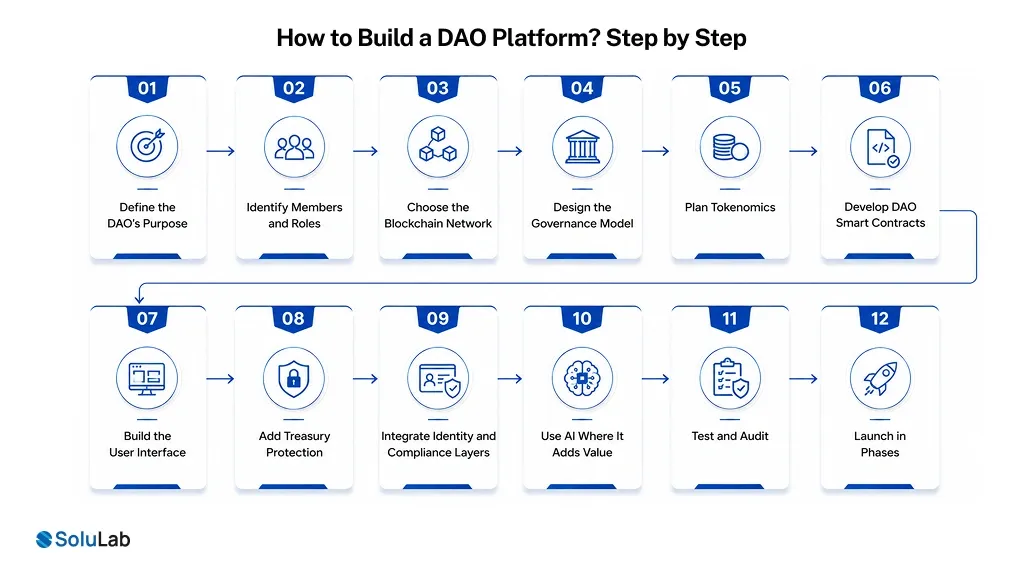
Step 1: Define the DAO’s Purpose
The first step is to identify what the DAO will govern. Will members vote on treasury spending? Product updates? Protocol upgrades? Grants? Investments? Property decisions? Game assets? Partner approvals?
Without it, members may not understand why they should participate. Low participation weakens governance and reduces trust.
Step 2: Identify Members and Roles
A DAO may include founders, investors, customers, employees, contributors, partners, validators, creators, or token holders.
Each group may need different rights. Some users may create proposals. Others may vote, review, moderate, audit, or execute approved actions.
Role planning prevents confusion. It also helps businesses meet access, compliance, and operational requirements.
Step 3: Choose the Blockchain Network
The blockchain affects transaction fees, security, speed, wallet support, developer tools, and user adoption.
Ethereum blockchain has strong ecosystem maturity. Polygon offers lower fees with EVM compatibility. Arbitrum and Optimism support scalable Layer 2 governance. Solana provides high throughput. Avalanche, BNB Chain, Base, and other networks may suit specific business needs. The right choice depends on users, budget, speed requirements, integrations, and long-term maintenance.
Step 4: Design the Governance Model
Governance design defines how decisions are made. This includes voting method, quorum, proposal threshold, approval percentage, voting period, delegation rules, and execution delay.
A DeFi protocol may need token voting with timelocks. An enterprise DAO may need permissioned governance with approval tiers. A creator community may prefer NFT membership with reputation scores. A DAO development services provider will test governance scenarios before development starts.
This helps avoid deadlocks, whale control, spam proposals, and low-quality voting.
Step 5: Plan Tokenomics
Tokenomics should support useful participation. A token may provide voting rights, access, rewards, staking benefits, contribution value, or ownership alignment.
Businesses should define supply, distribution, vesting, utility, transfer rules, reward logic, and voting impact. A token should not exist only for hype. Weak tokenomics attracts short-term speculation. Strong design encourages long-term contribution.
Step 6: Develop DAO Smart Contracts
Smart contracts define how the DAO works.
They may include governance contracts, token contracts, treasury modules, timelock logic, delegation systems, staking contracts, rewards, and access controls. This part requires experienced DAO smart contract development.
Developers should use secure coding standards, proven libraries, automated tests, manual review, gas optimization, and third-party audits. Contracts should also include emergency controls where business risk requires them.
Step 7: Build the User Interface
The user interface should make governance easy for both Web3 users and non-technical members. A clear dashboard should show active proposals, voting status, treasury activity, member rights, and historical records.
Before any blockchain action, the platform should explain what the user is signing. A skilled DAO app development company focuses on clarity. Confusing interfaces reduce voting activity and create support problems.
Step 8: Add Treasury Protection
Treasury protection should be planned from the beginning. Businesses should use multi-signature wallets, transaction limits, timelocks, approval workflows, and audit trails.
For high-value DAOs, spending rules should be strict. A payment proposal should not pass unless members understand the purpose, recipient, amount, and impact.
Step 9: Integrate Identity and Compliance Layers
Some DAOs are public while others need verified access.
A business may use wallet allowlisting, decentralized identity, NFT passes, soulbound tokens, KYC, or role-based permissions. This is common in investment, real estate, enterprise, and regulated sectors. Identity does not remove decentralization. It helps align governance with business responsibility.
Step 10: Use AI Where It Adds Value
AI powered solutions can improve governance quality when applied with care.
Useful features include proposal summaries, risk scoring, duplicate detection, treasury forecasting, sentiment analysis, and governance attack alerts. The platform should show where AI recommendations come from.
Members should remain responsible for the final decision.
Step 11: Test and Audit
Testing should cover smart contracts, wallets, frontend flows, backend systems, proposal logic, treasury actions, permissions, and edge cases. The team should test low turnout, quorum failure, vote manipulation, spam proposals, failed transactions, wallet compromise, and contract upgrade paths. A DAO that controls assets should not launch without proper audits.
Security is cheaper before launch than after an exploit.
Step 12: Launch in Phases
A phased launch reduces risk. The business can begin with selected members, limited treasury access, smaller proposals, and monitored voting. After feedback, it can expand access, increase limits, and decentralize more functions.
This approach gives members time to learn and gives the team room to improve the product.
Business Benefits Of DAO Platform Development
A DAO platform should be evaluated like any strategic enterprise investment.
The business case should include cost savings, risk reduction, revenue expansion, and operational speed.
- Reduced Operational Cost
Manual governance requires coordination across teams, tools, meetings, and approval chains. A DAO platform can reduce administrative overhead by automating proposal routing, voting, treasury execution, and audit record creation. For businesses managing frequent stakeholder decisions, this can lower governance operations costs over time.
- Faster Stakeholder Onboarding
Wallet-based access, digital identity, token permissions, and automated role assignment can speed up member onboarding. This matters for investor communities, gaming ecosystems, partner networks, and creator platforms. Faster onboarding can directly improve activation and participation rates.
- New Revenue Streams
A DAO platform can support paid memberships, token-based access, ecosystem grants, white-label governance products, premium dashboards, investment pools, and community-led digital products. For Web3 businesses, governance can become part of the commercial model.
- Lower Regulatory and Operational Risk
A strong platform creates better audit trails, access controls, approval records, and treasury visibility. This reduces the risk of undocumented decisions, unauthorized payments, and unclear accountability.
- Better Investor and Community Retention
Members are more likely to stay involved when they can see decisions, vote on meaningful proposals, and track outcomes. This can improve long-term retention, especially in tokenized ecosystems, investment groups, and gaming communities.
Best Tech Stack for DAO Software Development
The tech stack depends on the blockchain and platform scope.
- For Ethereum-compatible networks, teams often use Solidity, Hardhat, Foundry, OpenZeppelin, Ethers.js, Wagmi, and The Graph.
- For Solana projects, Rust and Anchor are common.
- Frontend development may use React, Next.js, TypeScript, or Vue.js.
- Decentralized storage can include IPFS, Arweave, or Filecoin.
- Wallet support may include MetaMask, WalletConnect, Coinbase Wallet, Phantom, Ledger, and Trezor.
- Analytics may use subgraphs, custom indexers, or blockchain data pipelines.
A capable Web3 development services provider chooses tools based on security, scalability, budget, and user experience.
Future Roadmap for Enterprise DAO Platforms
DAO platforms will continue moving toward more advanced enterprise capability.
Several trends are already shaping the next phase.
AI-Driven Compliance Analytics
AI will help businesses detect governance risks, review proposals, monitor treasury actions, and identify compliance gaps earlier.
Cross-Chain Governance
Enterprises will need DAO platforms that work across multiple chains, assets, communities, and liquidity environments.
Modular Governance Standards
Future DAO platforms will use more configurable modules for voting, treasury, identity, rewards, and analytics.
This will help businesses launch faster without losing control.
Enterprise-Grade Interoperability
DAO platforms will connect more deeply with CRM, ERP, accounting, custody, investor management, and compliance systems.
This will make DAO governance part of the core enterprise infrastructure.
Advanced Member Intelligence
Platforms will offer better insight into voter behavior, contribution quality, delegation patterns, and community health.
This will help leadership manage governance as a measurable business function.
Conclusion
DAO platforms are becoming a business infrastructure. For enterprises, the opportunity is not only community voting. It is faster governance, better transparency, stronger treasury control, lower operational risk, and new stakeholder-led growth models. A business that invests in DeFi platform development can build a governance layer that supports scale, trust, and market differentiation. The strongest results come from a clear strategy, secure smart contracts, practical user experience, measurable analytics, and a roadmap that fits enterprise goals.
Launch A Scalable and Compliant DAO Platform with SoluLab!
SoluLab is a leading DAO Platform Development company that helps businesses to design, build, and launch custom DAO platforms that solve governance challenges. Our team brings experience across blockchain development services, smart contract engineering, treasury modules, wallet integration, AI governance tools, white-label dashboards, and end-to-end deployment.
We work with businesses that want decentralized governance to improve performance, reduce risk, and create long-term competitive advantage. If your company is ready to build a custom DAO platform, we can help turn the strategy into a secure, scalable, and market-ready product.
FAQs
Shipra Garg is a tech-focused content strategist and copywriter specializing in Web3, blockchain, and artificial intelligence. She has worked with startups and enterprise teams to craft high-conversion content that bridges deep tech with business impact. Her work translates complex innovations into clear, credible, and engaging narratives that drive growth and build trust in emerging tech markets.