Key Takeaways
- Blockchain integration means connecting existing enterprise systems to a blockchain network through APIs and middleware. It’s a fundamentally different project than building a chain from scratch, and a much faster one.
- Statista-tracked spending on blockchain solutions has climbed past $19 billion globally, and Fortune 500 firms account for a growing share of that number.
- Integration success depends less on the blockchain itself than on how well it connects to the legacy systems, compliance workflows, and data a company already runs on.
Big companies didn’t wait for blockchain to get simple before adopting it. They found a faster path in integration rather than reinvention.
Instead of building a blockchain from the ground up, most Fortune 500 companies are plugging blockchain capabilities into systems they already run, their payment rails, their supply chain software, their identity verification tools through APIs and middleware that don’t require ripping anything out.
60 % of Fortune 500 companies are actively working on blockchain initiatives as of 2025, according to Coinbase’s State of Crypto report, up from 47% just a year earlier.
That distinction matters more than most coverage of “enterprise blockchain” admits. This piece breaks down why large companies are investing now, what actually separates integration from building a chain from scratch, how to build a real integration strategy, and where Fortune 500 companies are already putting this to work across industries.
Why Are Fortune 500 Companies Investing in Blockchain Integration?
The drivers aren’t abstract anymore. They show up directly on a balance sheet. JPMorgan’s Kinexys platform alone has processed more than $4 trillion in transactions since launch, with daily volume now exceeding $7 billion, proof that this isn’t pilot-stage anymore for the companies doing it seriously.
- Faster transaction settlement tops the list for a reason. JPMorgan’s Kinect’s platform now moves over $7 billion a day, and that speed advantage compounds fast at enterprise scale.
- Greater supply chain visibility and improved data transparency follow close behind, since a shared, tamper-resistant ledger gives every party in a supply chain the same version of the truth instead of reconciling conflicting records after the fact.
- That reconciliation work, incidentally, is exactly what reduced reconciliation as a driver refers to: fewer disputes, fewer manual audits, fewer finance-team hours spent chasing down mismatched numbers between systems that were never designed to talk to each other.
- Digital asset management and cross-border payments matter for a different reason. Moving money or tracking tokenized assets across borders through traditional banking rails is slow and expensive, and blockchain rails cut both the time and the fee stack meaningfully.
- Automated workflows, driven by smart contracts executing predefined rules without a human in the loop, save real operational cost once volume gets high enough to matter.
- And better auditability rounds out the list: an immutable, timestamped record gives auditors and regulators something concrete to check against, which is worth more than it sounds like to a company operating under enterprise blockchain solutions mandates and heavy compliance scrutiny.
What Makes Blockchain Integration Different From Building a Blockchain From Scratch?
Building a chain from zero means owning consensus mechanisms, network security, and node infrastructure. Integration skips almost all of that.
1. Existing Blockchain Networks
Integration means connecting to a proven, already-secured network, Ethereum, a permissioned chain, or a specialized enterprise ledger, rather than building and securing a new one from the ground up.
2. Enterprise Applications
The work centers on connecting a company’s actual software, ERP systems, CRM platforms, and payment processors, to blockchain functionality, not writing the blockchain itself.
3. APIs and Middleware
This is where most of the real engineering effort lives. APIs and middleware translate between a company’s existing systems and blockchain protocols so neither side needs to be rebuilt.
4. Smart Contracts
Rather than architecting an entire protocol, integration typically means deploying smart contracts on an existing network to automate specific business logic.
5. Legacy System Connectivity
The hardest part usually isn’t the blockchain side at all. It’s getting a fifteen-year-old ERP system to talk cleanly to anything modern, blockchain included. Working with established top blockchain development companies that have solved this exact problem before saves months most teams don’t realize they’re about to lose.
Blockchain Integration vs. Building a Blockchain From Scratch
Cost, timeline, and risk all shift dramatically depending on which path a company takes, and the gap is bigger than most internal proposals account for.
| Factor | Blockchain Integration | Building From Scratch |
| Typical timeline | 3–9 months | 12–24+ months |
| Relative cost | Lower, leverages existing infrastructure | Significantly higher, full protocol development |
| Security burden | Inherited from established network | Owned entirely in-house |
| Talent required | Integration engineers, blockchain developers | Protocol engineers, cryptographers, node operators |
| Flexibility | Constrained by chosen network’s capabilities | Fully customizable, at a real cost |
| Best fit | Most enterprise use cases | Highly specialized, proprietary requirements |
For the overwhelming majority of Fortune 500 use cases, integration wins on every axis that matters to a CFO signing off on the budget.
How to Build a Blockchain Integration Strategy for Businesses
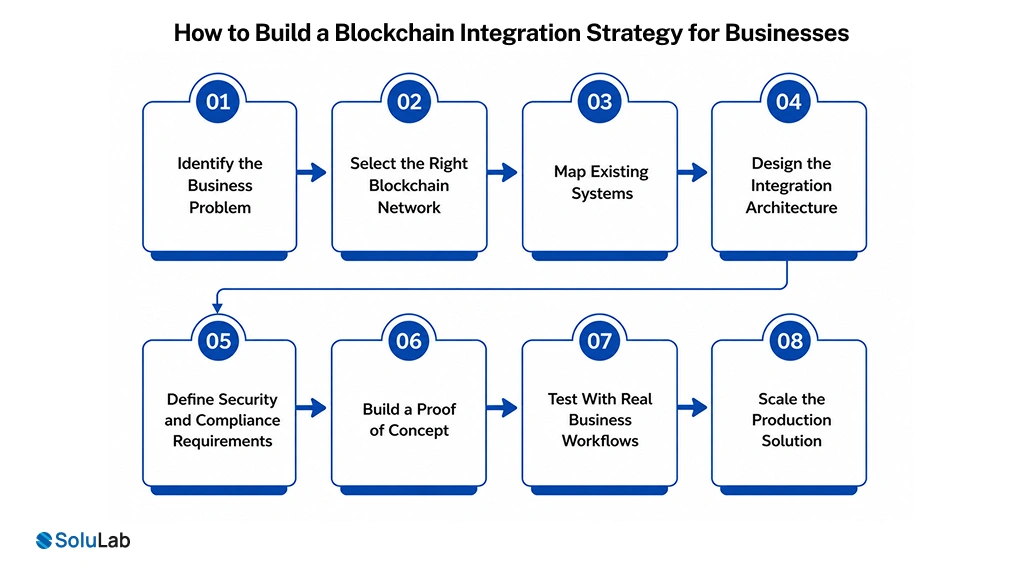
Getting this right takes more planning than most teams budget for, but the payoff shows up fast once the strategy is actually sound.
1. Identify the Business Problem
Start with what’s actually broken, not with “we should use blockchain.” A clear problem statement keeps the whole project honest, and it’s genuinely the step most teams rush.
- Define the specific pain point
- Confirm blockchain is the right fix
2. Select the Right Blockchain Network
Public, private, or consortium chains each fit different needs. Picking wrong here is expensive to reverse once code’s already been written against it.
- Compare public versus permissioned options
- Weigh throughput against decentralization needs
- Check the network’s regulatory track record
3. Map Existing Systems
Someone needs a clear picture of what’s actually running today, and how data moves between it, before a line of integration code gets written.
- Document current data flows fully
- Identify integration points and gaps
- Flag legacy systems that’ll need bridges
4. Design the Integration Architecture
APIs, middleware, and smart contract logic get mapped out concretely here. Not conceptually, not “roughly,” concretely.
- Define the API and middleware layer
- Plan smart contract interaction points
5. Define Security and Compliance Requirements
Skip this step, or treat it as a checkbox, and enterprise blockchain projects end up back in legal review months after they should’ve already launched.
- Map applicable regulatory requirements
- Define access control and permissions
- Plan for full audit trail completeness
6. Build a Proof of Concept
A limited-scope POC surfaces integration problems while they’re still cheap to fix. Most teams that skip this step regret it, usually within the first month of trying to scale something that was never actually validated. Bringing in a partner to hire blockchain developers with real integration experience at this stage tends to pay for itself within the first sprint.
- Scope a narrow, testable use case
- Build with production architecture in mind
- Set clear success criteria upfront
7. Test With Real Business Workflows
Lab conditions and production reality rarely match.
- Run the pilot on real transaction data
- Involve actual end users early
8. Scale the Production Solution
Once the pilot holds up under real conditions, scaling means expanding both the technical infrastructure and the organizational buy-in it takes to run this long-term, not just the code.
- Expand infrastructure for full volume
- Train internal teams on new systems
- Monitor performance against original goals
How Are Fortune 500 Companies Using Blockchain?
The use cases have moved well past pilot programs into infrastructure companies that actually depend on them.
1. Cross-Border Payments and Settlement
JPMorgan’s Kinexys platform has processed over $4 trillion in cumulative transactions, now running at more than $7 billion a day, serving institutional clients across five continents. That’s not an experiment. That’s core payments infrastructure.
2. Digital Identity and Credential Verification
Blockchain-based identity systems let enterprises verify credentials, employment history, or certifications without relying on a single centralized database that becomes both a bottleneck and a target.
3. Tokenization of Real-World Assets
Large asset managers are tokenizing funds, treasuries, and other holdings, giving institutional clients faster settlement and more granular ownership records than traditional fund administration ever offered.
4. Loyalty and Digital Rewards
Blockchain-based loyalty programs give companies programmable, transferable rewards infrastructure, though this use case has had a rockier track record than payments or identity, with a few high-profile programs scaled back after launch. The lesson most companies took from that: build loyalty tokenization around real utility, not novelty.
Blockchain Use Cases for Fortune 500 Companies by Industry
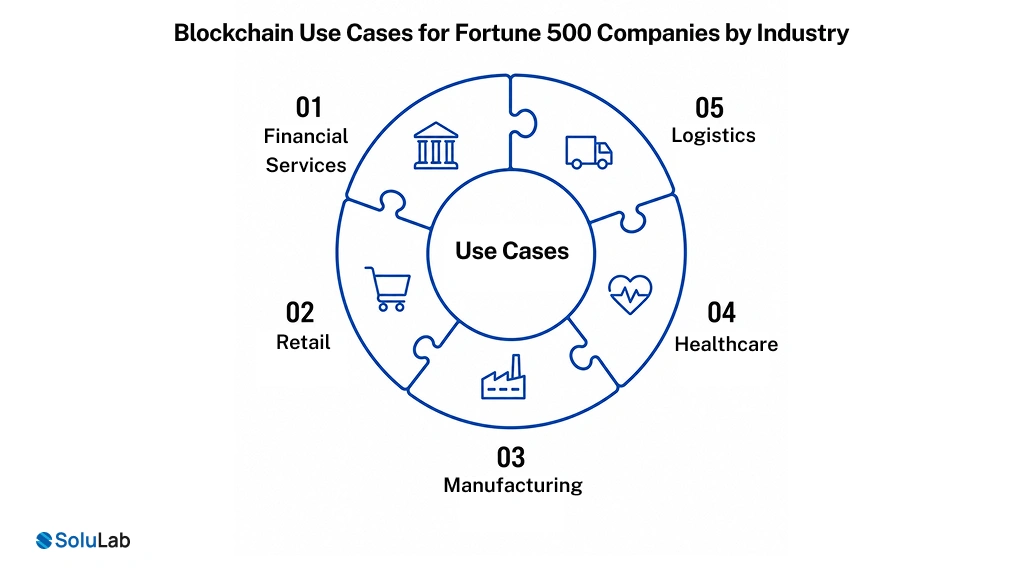
The specific application shifts a lot depending on the industry, even when the underlying blockchain infrastructure looks similar.
1. Financial Services
Banks lead adoption by a wide margin, using blockchain for cross-border settlement, tokenized deposits, and trade finance. Several major institutions are also layering AI in blockchain systems together now, using machine learning to flag anomalous on-chain transactions in something close to real time.
2. Retail
Retailers use blockchain primarily for supply chain provenance, proving where a product actually came from, and increasingly for tokenized gift cards and loyalty infrastructure that doesn’t depend on a single vendor’s proprietary system.
3. Manufacturing
Manufacturers lean on blockchain for parts traceability and supplier verification. In industries where one counterfeit component creates outsized safety or liability risk, that traceability isn’t optional anymore.
4. Healthcare
Healthcare use cases center on secure, auditable data sharing between providers, drug supply chain verification, and credential checks for medical staff. A tamper-proof record carries obvious regulatory value here, more so than in almost any other sector.
5. Logistics
Logistics companies track shipments across multiple carriers and customs jurisdictions on-chain, swapping paper trails and disconnected tracking systems for one shared record everyone actually trusts.
How SoluLab Helps Fortune 500 Companies With Blockchain Integration?
Enterprise integration work looks nothing like a greenfield blockchain build, and it needs a team that’s actually done both.
1. Blockchain Integration With Existing Systems
SoluLab connects blockchain functionality to the ERP, CRM, and payment systems a company already depends on, without forcing a rip-and-replace of infrastructure that’s working fine everywhere else.
2. Smart Contract Development and Integration
From automating settlement logic to enforcing compliance rules on-chain, SoluLab builds and integrates smart contracts tailored to the specific workflow they’re meant to replace, not a generic template.
3. Legacy System Integration
Bridging older infrastructure into a modern blockchain stack is usually the hardest part of any enterprise project, and it’s where blockchain consulting services earn their keep, working through the technical debt most internal teams don’t have bandwidth to untangle alone.
Conclusion
Blockchain integration has moved from experiment to infrastructure for a majority of Fortune 500 companies, and the ones seeing real results got there by connecting blockchain to what they already run instead of trying to rebuild everything from zero.
The technical path is well understood at this point: pick the right network, map existing systems honestly, prove it small, then scale.
SoluLab, a blockchain development company, can help your business figure out exactly where that path starts for your specific systems and goals. Book a free consultation to scope your blockchain integration strategy.
FAQs
Neha is a curious content writer with a knack for breaking down complex technologies into meaningful, reader-friendly insights. With experience in blockchain, digital assets, and enterprise tech, she focuses on creating content that informs, connects, and supports strategic decision-making.