
Key Takeaways
- Blockchain for small businesses works best as a fix for a specific operational bottleneck, not a company-wide overhaul nobody asked for.
- Seven use cases cover most of what actually moves the needle: automating repetitive processes, supply chain visibility, fewer data errors, faster payments, simpler audits, credential verification, and transparency between partners.
- Implementation runs through stages, starting with identifying the right process and ending with measuring results before scaling anything further.
- Blockchain doesn’t beat traditional automation everywhere. It wins specifically where multiple parties need to trust the same data without a middleman.
- Getting the process selection right at the start matters more than any technology decision that comes after it.
Most SMBs that try blockchain and give up on it made the same mistake: they picked the wrong problem to solve first.
Blockchain for SMBs works when it’s aimed at something specific, a reconciliation headache, a supply chain dispute that keeps recurring, a payment process bogged down in intermediaries, not when it’s deployed as a vague upgrade to “how the business runs.
The technology itself has matured enough that enterprise blockchain solutions once reserved for large companies are now genuinely accessible at SMB scale and budget.
This guide covers how blockchain actually improves operational efficiency, seven use cases worth knowing, a six-stage way to implement without disrupting everything else, what it looks like across different SMB industries, and how to actually measure whether it worked.
How Blockchain Works for Business Operations
At its core, blockchain gives multiple parties a shared, tamper-resistant record instead of each keeping their own separate version of the truth.
- For a business operation, that means a transaction, a shipment status, or a contract term gets recorded once, and every relevant party sees the same data, in real time, without waiting on someone to manually update a spreadsheet or forward an email.
- Gartner has forecast blockchain generating $3.1 trillion in new business value worldwide by 2030, and a meaningful chunk of that comes from exactly this kind of operational friction disappearing, not from speculative crypto activity.
- The applications aren’t exotic anymore either. Reviewing blockchain applications across industries shows the same pattern again and again: the technology works best wherever reconciling data between separate parties currently eats real time.
7 Ways SMBs Can Use Blockchain to Improve Operational Efficiency
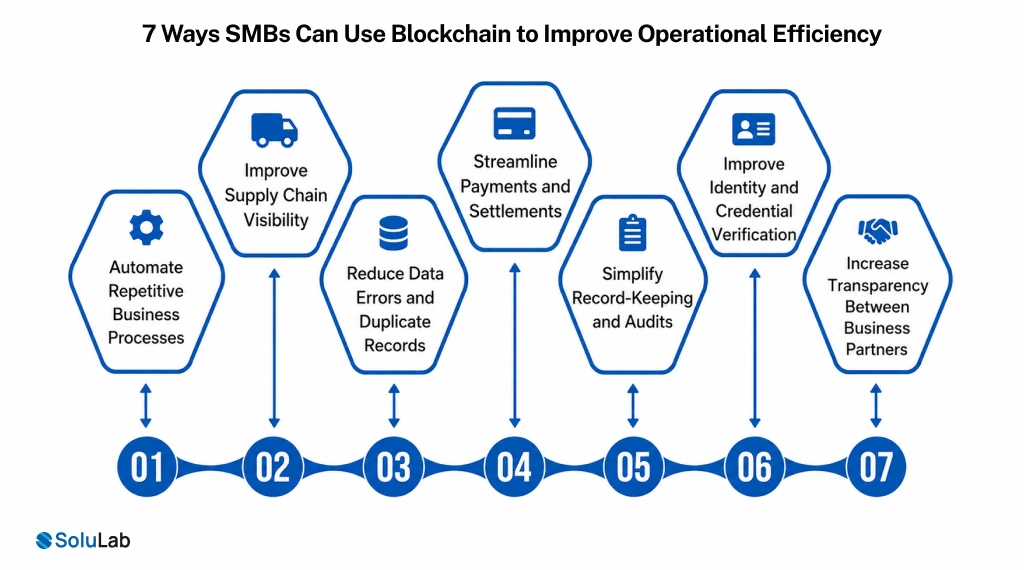
Blockchain solves a specific class of problem: multiple parties needing the same trusted data without a middleman slowing things down. Here’s where that shows up in practice.
1. Automate Repetitive Business Processes
Smart contracts execute predefined rules automatically. Payment on delivery, approval after verification- no one manually pushing each step through.
- Trigger payments on confirmed delivery
- Cut manual steps from routine tasks
2. Improve Supply Chain Visibility
A shared ledger means every party sees the same shipment status. No more chasing updates across systems that don’t talk to each other.
- Track shipments across every party
- Eliminate conflicting status reports
- Reduce disputes over delivery timing
3. Reduce Data Errors and Duplicate Records
Every time information gets re-entered into a second or third system, there’s a real chance it drifts. That drift, and reconciling it, is where a lot of SMB admin time quietly disappears.
- Enter data once, share everywhere
- Lower reconciliation time significantly
4. Streamline Payments and Settlements
Cutting out intermediary delays and fees matters more for a business that doesn’t have the volume to negotiate better banking terms.
- Settle payments faster than banking rails
- Reduce fees paid to intermediaries
- Enable near-instant cross-border transfers
5. Simplify Record-Keeping and Audits
An immutable, timestamped ledger gives an auditor something concrete to check against. Beats stitching records together from five different sources.
- Maintain one tamper-resistant record
- Reduce back-and-forth with auditors
6. Improve Identity and Credential Verification
This one matters most for a business that works across regions, or with a rotating pool of contractors and vendors who need onboarding fast.
- Verify identity without central databases
- Speed up vendor onboarding significantly
- Reduce fraud risk at signup
7. Increase Transparency Between Business Partners
Shared visibility into the same data tends to reduce disputes before they even start. No ambiguity left about who saw what, and when.
- Give all parties equal data visibility
- Build trust without a middleman
How Can SMBs Implement Blockchain to Improve Operational Efficiency?
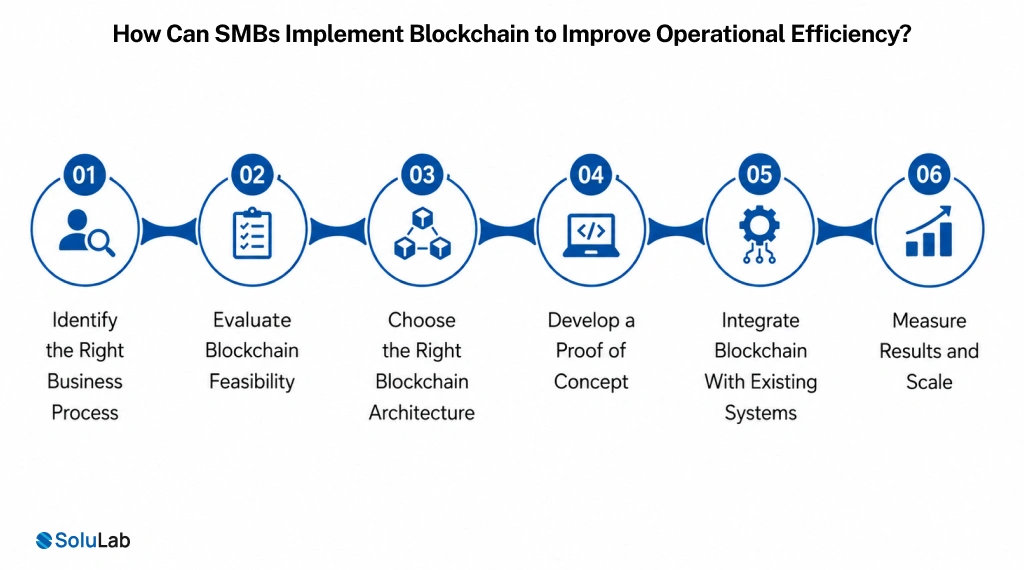
Six stages take a business from an idea to a validated, scaled implementation, and skipping the early ones is how projects drift.
1. Identify the Right Business Process
Not every process needs this. The right candidate is one where reconciliation eats real time, or where multiple parties currently keep separate, sometimes conflicting, records.
- Pinpoint the specific operational bottleneck
- Confirm multiple parties are involved
2. Evaluate Blockchain Feasibility
Here’s the question worth asking honestly before anything else: would a shared database solve this just as well, for a lot less effort?
- Rule out simpler solutions first
- Confirm trust and verification requirements
- Estimate realistic implementation complexity
3. Choose the Right Blockchain Architecture
Public, private, or consortium setups fit different situations, and an SMB rarely needs what a global enterprise runs on.
- Compare public versus permissioned chains
- Size the architecture to actual need
- Avoid building for scale you don’t have
4. Develop a Proof of Concept
A narrow POC catches integration problems and unrealistic assumptions while they’re still cheap to fix.
- Scope one clear, testable use case
- Set measurable success criteria upfront
5. Integrate Blockchain With Existing Systems
This step, not the blockchain itself, is usually where the real engineering effort goes. Most SMB accounting, CRM, or inventory systems weren’t built expecting a blockchain layer bolted onto them. A security review at this stage, covered under standard blockchain security practices, catches integration gaps before they become production problems.
- Map integration points to current software
- Build bridging APIs where needed
- Test data flow in both directions
6. Measure Results and Scale
Only expand once the pilot has actually proven the case with real numbers, not internal enthusiasm.
- Track outcomes against original baseline
- Scale to additional processes gradually
Read more: How Blockchain Can Benefit Consumer Goods And Retail Industries
Blockchain Use Cases Across Different SMB Industries
The specific application shifts a lot depending on the industry, even when the underlying technology looks the same.
1. Blockchain for Retail and E-commerce
Retailers use it mainly for supply chain provenance, proving where a product actually came from, plus loyalty infrastructure that doesn’t lock a business into one vendor’s proprietary system.
2. Blockchain for Manufacturing
Manufacturers lean on it for parts traceability and supplier verification. Where one counterfeit or defective component creates outsized downstream cost, that traceability stops being optional.
3. Blockchain for Logistics
Companies moving goods across multiple carriers replace paper trails and siloed tracking systems with a single record everyone can actually check. Blockchain in supply chain management frameworks built specifically for this beat a custom build from scratch most of the time.
4. Blockchain for Professional Services
Firms handling contracts, credentials, or client verification get tamper-proof records and faster verification out of it, cutting the back-and-forth traditional document checks usually require. Similar logic shows up increasingly in blockchain in finance work, where verification speed and auditability carry outsized weight.
5. Blockchain for Real Estate
Smaller real estate businesses use it for title verification and, increasingly, fractional ownership structures. Opens a property to far more investors than a traditional deal ever would.
Blockchain vs Traditional Automation for SMBs
Traditional automation and blockchain solve overlapping but genuinely different problems, and picking the wrong one wastes budget either way.
Statista-tracked global spending on blockchain solutions is projected to reach roughly $19 billion, a meaningful share of it now flowing into smaller-scope business automation rather than headline institutional projects. Here’s how the two compare directly.
| Factor | Traditional Automation | Blockchain |
| Best fit | Internal, single-party processes | Multi-party processes needing shared trust |
| Data ownership | Centralized, one system of record | Distributed, shared across parties |
| Setup complexity | Generally lower | Higher, especially with legacy integration |
| Auditability | Depends on internal logging | Immutable by design |
| Cost driver | Software licensing and maintenance | Development, integration, and security |
| Typical use case | Internal workflow automation | Cross-party reconciliation and verification |
Key Metrics to Measure Blockchain ROI
Vague efficiency claims don’t justify the investment. These five metrics do.
1. Processing Time
How long a transaction or process takes end to end, before versus after, is the most direct signal blockchain actually helped. Or didn’t.
2. Operational Costs
Fewer intermediaries, less manual reconciliation. That should show up as a real cost reduction, not just a theoretical one on a slide deck.
3. Error Rates
Deloitte’s research on blockchain adoption found that businesses seeing the strongest returns consistently cite fewer data discrepancies as one of the clearest outcomes they can point to.
4. Reconciliation Time
Hours spent resolving mismatched records between parties are easy to track before and after. It’s also one of the more convincing numbers to a skeptical stakeholder.
5. Payment Settlement Time
Faster settlement is usually the most visible win to anyone outside the project. Customers and partners notice this one first, every time.
How SoluLab Helps SMBs Improve Operational Efficiency With Blockchain?
Getting from “we should look into this” to a working system usually takes more than in-house bandwidth allows. That’s where the right partner earns its cost back quickly.
1. Blockchain Consulting and Use-Case Discovery
SoluLab’s blockchain consulting work starts with figuring out which specific process is actually worth solving first, not jumping straight to a build because a build feels like progress.
2. Custom Blockchain Solution Development
Architecture selection through deployment, sized to an SMB’s actual scale. Not a scaled-down enterprise template with the same overhead attached.
3. Smart Contract Development and Integration
Automating payment, verification, or approval logic through smart contracts is frequently where the fastest, most visible efficiency gains actually show up.
4. Blockchain Integration With Existing Systems
Connecting blockchain functionality to whatever accounting, CRM, or inventory software a business already runs. No disruptive rip-and-replace required.
5. Blockchain Proof of Concept Development
A scoped, testable blockchain POC before any full commitment, so a business can validate real results before spending on a full rollout it hasn’t earned yet.

Conclusion
Blockchain earns its place in an SMB’s operations when it’s aimed at a real bottleneck, not deployed as a broad technology upgrade. The businesses seeing genuine efficiency gains started with one process, proved it worked with real numbers, and scaled only after that.
SoluLab, a blockchain development company, can help your business figure out exactly where that starting point is for your specific operations.
Book a free consultation to identify your best blockchain use case!
Neha is a curious content writer with a knack for breaking down complex technologies into meaningful, reader-friendly insights. With experience in blockchain, digital assets, and enterprise tech, she focuses on creating content that informs, connects, and supports strategic decision-making.