
Key Takeaways
- Public blockchains are open networks anyone can join, read, and validate; private blockchains restrict participation to approved members under a governing entity.
- Public networks trade some speed and privacy for transparency and censorship resistance, making them the default for tokenization, DeFi, and cross-border payments.
- Private and consortium blockchains give regulated industries the auditability of a shared ledger without exposing sensitive data publicly.
- Hybrid architectures, where private transaction data anchors to a public chain for proof, are becoming the practical middle ground for enterprises.
Go public when transparency and open, third-party verification matter more than control; think tokenization or DeFi. Go private when you need data privacy, regulatory compliance, and a say in who can transact, which is why most banks, hospitals, and manufacturers stick to permissioned networks.
The right call has less to do with the technology than with who needs access to your data, and how much control your business is legally on the hook to keep.
We’ve fielded this question from clients who arrive already leaning one way, usually toward whichever network their developer mentioned first. Blockchain is projected to generate more than $3.1 trillion in global business value by 2030.
That’s rarely the right starting point. Below is how public and private blockchain integration actually work for business, once you get past the whitepapers, where each model earns its place, and a way to think through the decision.

What Is a Public Blockchain?
A public blockchain technology is a network anyone can join without asking permission first. Download the client, spin up a node, and you’re in; you can read every transaction ever recorded, submit your own, and even help validate the ledger if you want to run the hardware for it. Bitcoin and Ethereum are the two most people have actually heard of. Nobody owns a public blockchain in the traditional sense.
Instead, thousands of independent participants, spread across the globe, all keep their own copy of the same ledger and agree on updates through a consensus mechanism, usually Proof of Work or Proof of Stake. That’s the whole point: no single company or government gets to quietly edit history, because too many other copies exist for that to go unnoticed.
What Is a Private Blockchain?
A private blockchain flips that model. One organization, or a small group acting together, decides who’s allowed to join, who can submit transactions, and who only gets read access. Think of it less like an open town square and more like a company intranet built on blockchain principles.
You still get an immutable, shared ledger and cryptographic proof that nobody’s quietly altered a record after the fact, but only approved participants ever see the data in the first place.
Why This Decision Shapes Everything Downstream?
Blockchain integration for business isn’t really a technology choice. It’s an architectural commitment. It shapes your compliance posture, your integration cost, and how much engineering effort you’ll sink into maintenance three years from now.
- We’ve seen teams skip this step entirely, default to whatever network a vendor happened to pitch first, and rebuild the whole thing eighteen months in because a compliance officer finally asked who could see the transaction history.
- So, define the term properly before comparing the two models. A blockchain is permissionless when anyone can join, submit transactions, and help validate them without asking a central party for approval.
- It’s permissioned when a governing entity decides who gets a node, who can write, and who’s stuck reading only. Public and private chains sit at opposite ends of that spectrum.
- There’s a third category worth knowing too: consortium blockchain, where a small group of organizations, say five banks or a cluster of manufacturers, jointly govern the network rather than leaving one company in charge.
- That permissioned-versus-permissionless line matters more than the “public” or “private” labels themselves. It’s what actually decides your security model, your throughput, and your compliance story.
Public vs Private Blockchain Integration: Side-by-Side Comparison
Here’s the side-by-side we usually sketch out on a whiteboard for clients, cleaned up.
| Criteria | Public Blockchain | Private Blockchain |
| Access | Open to anyone, no permission required | Restricted to approved participants only |
| Governance | Decentralized, no single owner | Controlled by one organization or a consortium |
| Consensus mechanism | Proof of Work, Proof of Stake (resource-intensive) | PBFT, Raft, or permissioned PoA (lightweight, fast) |
| Transaction speed | Slower; Ethereum mainnet handles roughly 15-30 TPS [SOURCE NEEDED: current network throughput] | Faster; permissioned chains like Hyperledger Fabric can reach 3,000+ TPS in typical enterprise configurations [SOURCE NEEDED: verify against latest benchmark] |
| Data privacy | Fully transparent; every transaction is publicly visible | Data visible only to approved network members |
| Security model | Security through decentralization and economic incentives | Security through access control and vetted participants |
| Regulatory fit | Harder to align with data-residency and privacy laws | Easier to design for HIPAA, GDPR, and financial regulations |
| Cost profile | Lower infrastructure cost; higher gas/transaction fees at scale | Higher setup and node-hosting cost; lower per-transaction cost |
| Best-fit use cases | Tokenization, DeFi, NFTs, DAOs, public verification | Banking, healthcare, government, supply chain, insurance |
The scalability and security tradeoff is the one businesses underestimate most. Public chains earn trust by making thousands of independent validators check every single transaction. That’s also exactly why they’re slow.
Private chains skip most of that overhead because participants are already vetted, so speed comes back. Still, now you’re trusting the governing entity’s access controls instead of a decentralized network of strangers. Neither one is “more secure” in some abstract sense. They’re just secure against different things going wrong.
When Should Businesses Choose to Integrate with a Public Blockchain?
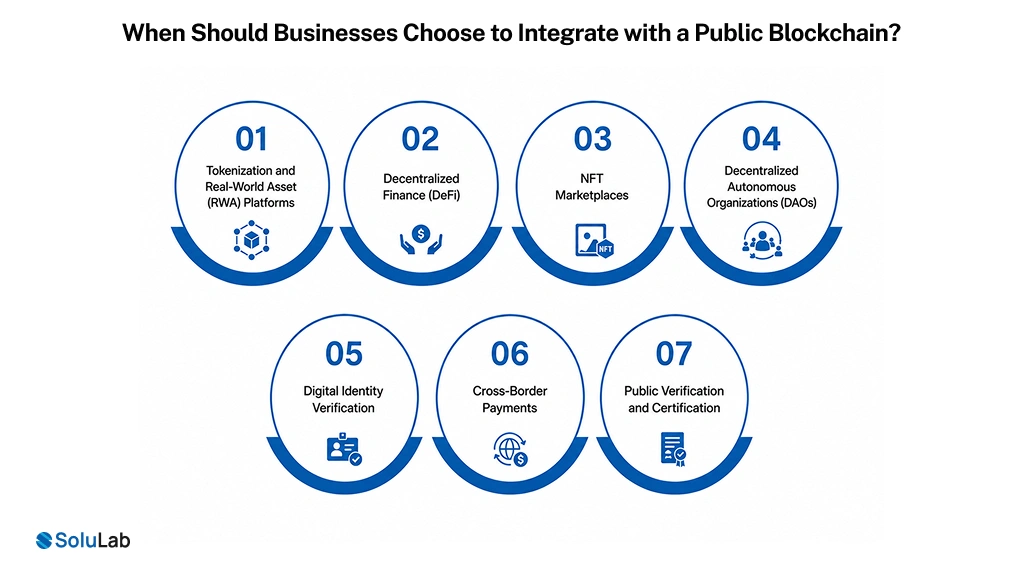
Public blockchain integration makes sense when your application’s value depends on outsiders verifying it independently, without needing your permission or your word for it. Ask yourself one thing: if you removed that open verification, would the product still work? If the answer is no, you probably need a public or permissionless network.
1. Tokenization and Real-World Asset (RWA) Platforms
Turning real estate, private equity, or physical commodities into tradeable digital tokens tends to work best on public infrastructure, mostly because investors, auditors, and secondary marketplaces all need to check ownership on their own, not take a company’s word for it.
2. Decentralized Finance (DeFi)
Lending protocols, decentralized exchanges, and yield platforms run on public, auditable smart contracts for a reason. Users want to see the code and the liquidity themselves before locking funds in. A private DeFi protocol is a bit of a contradiction; it defeats the entire premise.
3. NFT Marketplaces
Digital collectibles and licensing platforms live and die on public provenance. A buyer wants to trace an asset’s full ownership history without just trusting one company’s internal database, because that database could change tomorrow.
4. Decentralized Autonomous Organizations (DAOs)
DAOs coordinate voting, treasury spending, and governance across members who may never actually meet. That setup only holds together if every vote and every fund movement can be checked independently, on a ledger nobody controls.
5. Digital Identity Verification
Self-sovereign identity systems let people prove things about themselves- age, a license, citizenship- without handing a central database all their data. Public chains let any relying party check a credential’s authenticity without ever contacting the original issuer.
6. Cross-Border Payments
Stablecoin-based payment rails move money between countries faster and cheaper than correspondent banking. Part of why: public settlement layers don’t need every intermediary bank to trust every other bank first. We worked on an enterprise stablecoin payment network for a payments client where settlement times dropped 92%, and processing costs came down 74%.
7. Public Verification and Certification
Diploma verification, carbon credit registries, chain-of-custody certificates for public goods- these all benefit from a ledger that anyone can audit, not just people who’ve paid for access.
When Is Private Blockchain Integration the Better Choice?
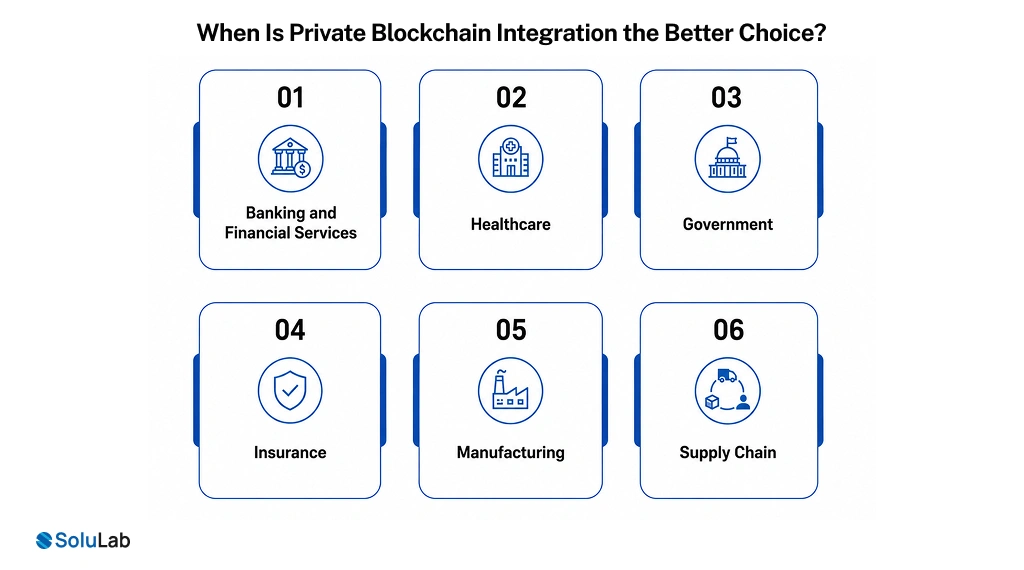
Private blockchain integration wins when your industry is bound by regulation, when the data itself is commercially sensitive, or when what you actually want is process efficiency between parties you already know and trust, not trust between strangers.
If you’re already vetting every participant by hand, you’re paying for decentralization you don’t need.
1. Banking and Financial Services
Interbank settlement, trade finance, and loan syndication all involve counterparty data too sensitive to sit on a public ledger. One trade-finance client digitized letters of credit and shipment milestones on Hyperledger Fabric. Processing time dropped 66%, document-handling costs fell 58%, and every record stayed restricted to the banks actually party to the deal.
2. Healthcare
Patient records, clinical trial data, and pharmaceutical supply chains all carry strict privacy obligations under regulations like HIPAA. In one pharmaceutical track-and-trace deployment on Hyperledger Fabric, drug traceability improved 91% and counterfeit detection time fell 73%, and none of that required exposing patient or shipment data outside the permissioned network.
3. Government
Land registries, voting infrastructure pilots, and inter-agency data sharing need an auditable ledger, but citizen data still has to stay within controlled, legally accountable custody.
4. Insurance
Claims processing and reinsurance settlement benefit from a shared ledger between insurer, reinsurer, and adjuster. That said, policyholder data isn’t something any of those parties actually wants sitting out in public.
5. Manufacturing
Multi-tier supplier networks lean on private and consortium chains to share quality certifications and component provenance, without handing pricing or supplier relationships to competitors who’d love to see them.
6. Supply Chain
End-to-end traceability, raw material to shelf, is probably the cleanest example of a private-blockchain use case there is. One manufacturing enterprise recorded every supply-chain event on a Hyperledger Fabric ledger. Product traceability improved 93%. Recall investigation time dropped 61%. Visibility stayed limited to verified partners, not the open internet.
Hybrid Blockchain Solutions: Getting Both Models to Work Together
Most enterprises don’t actually have to pick a side forever. Hybrid blockchain solutions keep day-to-day transaction data on a private or consortium network for speed and confidentiality, then periodically anchor a cryptographic hash of that data onto a public chain like Ethereum as tamper-evident proof.
Auditors and regulators get to verify records haven’t been altered, without ever laying eyes on the underlying private data.
We see this pattern come up in three recurring scenarios:
- Supply chain provenance with public proof: internal logistics data stays private, while certificates of authenticity get anchored publicly so end customers can check them.
- Regulated tokenization: security tokens trade on a public chain for liquidity, while KYC and investor records stay locked down on a private, access-controlled layer.
- Consortium blockchain vs private blockchain for shared industries: a group of competitors, three logistics companies, say, might run a consortium network they jointly govern rather than let one company control a fully private chain. It splits the infrastructure bill while keeping data out of public view.
The tradeoff is complexity. You’re now maintaining two systems plus a bridging mechanism instead of one, which is exactly why hybrid designs tend to make sense only once volume and compliance requirements justify the extra engineering. For a five-person startup, it rarely does.
Enterprise Blockchain Architecture: What to Decide Before You Build
A handful of architectural decisions end up driving most of your total cost of ownership. Settle these before development starts, not three sprints in.
1. Consensus Mechanism
Public networks typically run Proof of Work or Proof of Stake, both built to make cheating expensive when validators have no reason to trust each other. Permissioned networks get away with lighter mechanisms, PBFT (Practical Byzantine Fault Tolerance) or Raft, because participants are already known and accountable. Consensus can then prioritize speed instead of defending against strangers.
2. Node Hosting and Infrastructure
Private and consortium blockchains put you on the hook for provisioning, securing, and maintaining your own validator nodes, usually on AWS or Azure. That’s a recurring infrastructure cost public-chain projects simply don’t carry.
Blockchain integration cost for business
Three things drive cost more than the chain you end up picking:
- Smart contract development and audit are usually the biggest line item no matter which network you’re on, and not something to skimp on if the contract moves money.
- Node infrastructure (private or consortium only), ongoing hosting, monitoring, DevOps for every validator node you run.
- Integration with existing systems, wiring the chain into your ERP, CRM, or core banking platform. Teams underestimate this constantly, and it often ends up costing more than the blockchain piece itself.
Where AI Fits In
A fair number of enterprise blockchain deployments now pair the ledger with AI, for fraud pattern detection on transaction data, automated compliance monitoring, smart contract auditing before anything ships. It’s a genuinely useful pairing rather than just an “ai blockchain integration” buzz phrase, mostly because AI models catch the kind of anomaly a rules-based smart contract simply isn’t built to notice.
How to Choose the Right Blockchain Model for Your Business?
Work through these in order. Most businesses land on an answer by question three.
- Who needs to see this data? If competitors, regulators, auditors, or the general public need independent verification, lean public. If only known counterparties need access, lean private.
- What does your regulator require? If you’re in banking, healthcare, insurance, or government, check whether your compliance framework restricts where personal or transactional data can be stored before you evaluate any chain.
- What transaction volume are you expecting? High-frequency, high-volume use cases (payments processing, supply chain events) usually need the throughput of a permissioned chain or a Layer 2 public solution.
- Do you control all participants, or are they external? Internal or known-partner networks favor private and consortium models. Open marketplaces and public-facing products favor public chains.
- What’s your realistic budget for ongoing infrastructure? Public chains shift cost toward transaction fees; private chains shift it toward node hosting and DevOps. Model both over a 3-year horizon, not just launch cost.
Still torn after all five? That’s usually the sign you need a hybrid architecture, not a forced pick between the two.
Conclusion
Public vs private blockchain integration doesn’t have one universal winner, and anyone who tells you otherwise is probably trying to sell you something.
Public blockchain integration for business fits products built on open, third-party verification: tokenization, DeFi, NFTs, cross-border payments.
Private blockchain integration fits regulated, high-trust environments: banking, healthcare, government, supply chains, anywhere control and confidentiality matter more than public transparency.
Getting this decision right the first time saves months of rework down the line. SoluLab, a blockchain development company, helps businesses evaluate consensus mechanisms, model what integration actually costs, and build the architecture, public, private, or hybrid, that fits their real compliance and scale requirements instead of whatever’s trending.
FAQs
Neha is a curious content writer with a knack for breaking down complex technologies into meaningful, reader-friendly insights. With experience in blockchain, digital assets, and enterprise tech, she focuses on creating content that informs, connects, and supports strategic decision-making.
![How to Build a Private Blockchain Like R3 Corda? [2026 Edition]](https://www.solulab.com/wp-content/uploads/2026/05/Blockchain-Like-R3-Corda.webp)