Key Takeaways
- Private blockchains enable secure data sharing, faster transactions, and controlled access across enterprise networks.
- The right blockchain framework depends on your business model, regulatory requirements, scalability goals, and integration needs.
- A structured development process minimizes implementation risks and supports long-term network performance.
- Governance, security, and compliance should be incorporated from the planning stage to avoid costly changes later.
- Partnering with an experienced private blockchain development company helps accelerate delivery while reducing technical and operational risks.
91% of executives expect meaningful returns from blockchain within five years, per Deloitte’s own research. That’s not hype talk. Walmart cut a 7-day food trace down to 2.2 seconds using one. HSBC, Citi, and Standard Chartered run live trade finance on private networks today.
- Fewer nodes,
- faster consensus,
- zero random strangers reading your ledger.
If you’re building a system where trust, records, and speed actually matter, building a private blockchain might be your answer. However, the right way of building suiting your industry and your goals is the key to save 80% of your budget, and the remaining 20% depends on the blockchain development company you are partnering with.
What Is a Private Blockchain and Why Does It Matter for Businesses?
A private blockchain is a permissioned ledger. Only approved members can join it. Unlike public networks like Bitcoin, nobody can read or write data here. Every participant is verified before they get access. This makes it a good fit for businesses that handle sensitive records. Think banks, hospitals, and supply chain networks.
The core idea is control.
- A company or a group of companies runs the network. They decide who joins, what data gets shared, and how consensus works. This is why it’s often called a permissioned or enterprise blockchain.
- It behaves less like an open internet and more like a shared vault. Everyone inside can see and verify entries, but the doors stay locked to outsiders.
If you’re wondering whether this fits your business, ask a simple question. Do multiple parties need to trust the same data? If yes, you need to build a private blockchain that could solve that problem better than a regular database.
There’s also a middle ground worth knowing about.
- A consortium blockchain is run by a group of organizations, not just one. Think of it as several banks sharing one ledger for settlements. Nobody owns it alone, yet nobody outside the group gets in. This setup works well when competitors need to cooperate on shared infrastructure without giving up their own data.
Compare that to a public blockchain like Ethereum.
- Anyone can join, mine, or verify a public chain. There’s no gatekeeper, and that openness is the whole point. A private blockchain flips that script entirely. It trades openness for speed, privacy, and predictable governance.
- Neither model is universally better. It genuinely depends on what your business needs to protect and who needs to see it.
Industries Using Private Blockchain Right Now
Private blockchain adoption isn’t theoretical anymore. Real companies use it daily across very different sectors. Here’s a quick snapshot of where it’s already working.
| Industry | Common Use Case | Example Platform |
| Banking and Finance | Trade finance, cross-border settlement | Corda (used by HSBC, Citi) |
| Retail and Supply Chain | Food traceability, product provenance | Hyperledger Fabric (Walmart, IBM) |
| Healthcare | Patient records, drug supply tracking | MediLedger (pharma consortium) |
| Real Estate | Property ownership, tokenized assets | Ethereum-based private networks |
| Insurance | Claims verification, fraud reduction | Quorum-based consortiums |
As you can see, the pattern repeats everywhere. Multiple parties need one shared truth. Creating a private blockchain gives them that, without exposing sensitive data to the public.
What Are the Key Phases of Building a Private Blockchain?
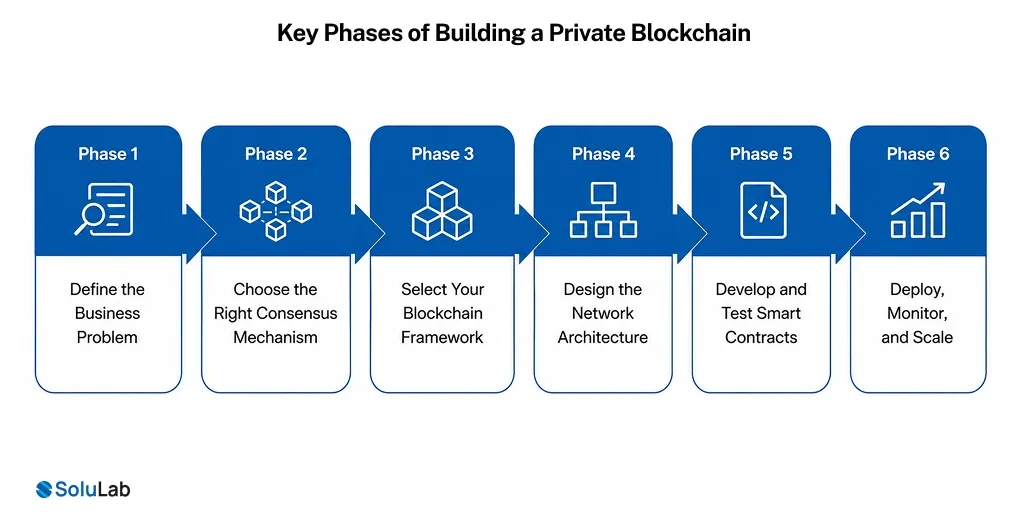
Building a private blockchain isn’t a single step. It’s a journey with clear stages. If you skip one, the whole structure can wobble later. However, if you follow each phase carefully, you save time and money.
Phase 1: Define the Business Problem
Start with the problem, not the technology. What breaks today in your workflow? Maybe it’s slow reconciliation. Maybe it’s fraud in your supply chain. Write this down clearly. A blockchain only helps if the pain point is real.
Phase 2: Choose the Right Consensus Mechanism
Consensus decides how the network agrees on data. Private networks generally use lighter mechanisms than public chains. Options include Practical Byzantine Fault Tolerance, Raft, or Proof of Authority. Each has trade-offs in speed and fault tolerance. Pick one based on your network size.
Phase 3: Select Your Blockchain Framework
This step shapes everything that follows. Hyperledger Fabric, Corda, and Quorum are the usual picks. Your choice depends on your industry and your compliance needs. A finance firm may lean toward Corda. A supply chain project may lean toward Fabric.
Phase 4: Design the Network Architecture
Decide how many nodes you need. Decide who runs them. Map out permissions for each participant. This phase also covers data privacy rules. Some members may see full records. Others may see only partial data.
Phase 5: Develop and Test Smart Contracts
Smart contracts automate rules on your network. If a payment condition is met, the contract executes automatically. Testing matters here more than anywhere else. A bug in a smart contract can be costly. Test on a small network first.
Phase 6: Deploy, Monitor, and Scale
Once testing wraps up, move to production carefully. Monitor performance, node health, and transaction speed. Additionally, plan for growth from day one. Adding new members later should be simple, not painful.
One more thing worth mentioning here. Documentation matters more than most teams expect. Write down every decision, every node configuration, every access rule. Six months later, your team will thank you. New hires will onboard faster, too. Building a private blockchain without documentation becomes a black box fast, and nobody wants to inherit that mess.
How Reliable Is a Private Blockchain and What Do Compliance Costs Look Like Across Countries?
Reliability in a private blockchain comes from its structure. Fewer nodes mean faster consensus. Known participants mean less risk of bad actors. However, reliability also depends on good governance. Without clear rules, even a private network can face disputes.
Compliance is where things get regional. Every country treats blockchain data differently. If you’re building across borders, this part needs real attention. Data residency laws, financial regulations, and privacy rules all vary. Moreover, costs move up or down based on legal complexity and developer rates.
Compliance and Cost Snapshot by Country
Here’s a general breakdown. Treat these as planning estimates, not fixed quotes, since project scope changes everything.
| Country | Key Compliance Requirement | Approx. Development Cost (Range) |
| United States | SEC guidelines, state money transmission laws | $50,000 to $250,000+ |
| United Kingdom | FCA cryptoasset registration, GDPR | $45,000 to $200,000 |
| Germany | BaFin licensing, strict GDPR enforcement | $50,000 to $220,000 |
| India | RBI guidance, IT Act data rules | $20,000 to $100,000 |
| UAE | VARA licensing for blockchain firms | $30,000 to $150,000 |
| Singapore | MAS Payment Services Act compliance | $40,000 to $180,000 |
Generally, Western markets cost more due to stricter audits and higher developer wages. In case your business operates across two or more of these regions, budget for legal review in each one separately. This isn’t a place to cut corners.
- There’s an old saying that trust is earned in drops and lost in buckets. That fits blockchain governance perfectly. One weak node, one skipped audit, and the whole network’s credibility takes a hit.
- However, if you build compliance into your architecture from the start, you avoid rebuilding it later under pressure.
- First, map every jurisdiction where your data will travel. Second, involve a local legal advisor early, not after launch. Third, keep an audit trail that regulators can actually read.
- Additionally, revisit your compliance checklist every year, since rules keep changing. What passed review in 2023 might not pass today.
Which Companies Built Private Blockchains and What Was Their Actual ROI?
Numbers convince better than promises. Here’s one grounded example, followed by a look at platform alternatives.
Real World Case: Walmart and IBM Food Trust
In 2016, Walmart partnered with IBM to pilot a food traceability system. They built it on Hyperledger Fabric, a private and permissioned framework. The project ran two pilots. One tracked pork in China. The other tracked mango origins in the United States.
Before blockchain, tracing a mango’s source took Walmart nearly 7 days. One internal test clocked the old method at 6 days, 18 hours, and 26 minutes. After deploying the IBM Food Trust system, that same trace dropped to just 2.2 seconds. That’s roughly a 99.9% improvement in speed.
This wasn’t just a speed win. Walmart could now trace over 25 products back to 5 different suppliers using the same system.
By 2018, Walmart began requiring leafy green suppliers to join the network. The ROI here shows up as reduced recall costs, faster response during contamination scares, and stronger consumer trust. Fewer wasted products also means direct savings on write-offs.
Alternative Ways to Build a Private Blockchain
Hyperledger Fabric isn’t the only road available. Depending on your goals, other frameworks might fit better.
- Corda: Built for finance. Popular with banks running trade and settlement networks.
- Quorum: An Ethereum-based private chain, good for firms wanting EVM compatibility.
- Hyperledger Besu: Combines private permissioning with public Ethereum tooling.
- Multichain: Simpler setup, often used by smaller enterprises testing pilots.
- Blockchain-as-a-Service (BaaS): Cloud providers like AWS or Azure host the network for you, cutting setup time.
If you don’t want to build a private blockchain infrastructure from scratch, BaaS is worth exploring. It trades some control for a faster launch.
Comparing the Major Frameworks
Choosing a framework feels overwhelming at first. Here’s a simple way to think about it:
- Hyperledger Fabric fits supply chain, retail, and healthcare projects best. Its modular design lets you plug in only what you need.
- Corda was built for banking and trade finance. It shares data point-to-point instead of broadcasting to everyone.
- Quorum suits finance firms that already know Ethereum tooling. It uses a voting-based consensus model.
- Multichain works well for small enterprises running quick pilots. Setup takes days, not months.
No single framework wins every time. However, matching the framework to your industry saves months of rework later. A trade finance firm choosing Fabric over Corda often ends up retrofitting features. Corda already had those built in.
How Can SoluLab Help You Build a Private Blockchain?
Building a private blockchain alone is like building a house without a blueprint. You might finish it, but cracks show up later. This is where an experienced partner earns its place.
SoluLab has spent over a decade in blockchain and Web3 development. The team has completed more than 1,500 projects for over 500 clients across various countries. Their work spans Hyperledger, Ethereum, Solana, and Corda-based networks. They’ve also built private blockchain systems specifically for supply chain transparency, giving businesses real-time tracking from origin to destination.
Here’s what working with SoluLab generally looks like:
- Discovery and consulting: They study your workflow first, not the tech first.
- Framework selection: They recommend the right chain based on your industry.
- Smart contract development: Built, tested, and audited before launch.
- Compliance guidance: Support across regions like the US, UK, UAE, and India.
- Post-launch support: Monitoring, upgrades, and scaling help as your network grows.
Whether you’re a startup or an enterprise, this guidance shortens your learning curve. Moreover, it lowers your risk of costly rework down the line.
Final Thoughts
A private blockchain is a working tool for companies that need shared trust without public exposure. The phases matter, the compliance details matter, and the platform choice matters. Get these right, and the payoff shows up in real numbers, just like it did for Walmart.
If you’re ready to start, don’t rush the discovery phase. Talk to our SoluLab blockchain development team, which has actually shipped these networks before. That single step often decides whether your project becomes a case study or a cautionary tale.
FAQs
Deepika is a content writer who blends storytelling with strategic thinking. She explores topics across digital innovation, emerging tech, and the evolving blockchain industry. She enjoys breaking down complex ideas into simple, engaging narratives in the growing global markets.