
Key Takeaways
- Blockchain integration helps businesses automate workflows, improve transparency, and reduce operational costs.
- Dubai’s supportive regulations, VARA framework, and government initiatives make it one of the leading enterprise blockchain hubs.
- Finance, real estate, logistics, healthcare, and retail are driving enterprise blockchain adoption across the UAE.
- Smart contracts, digital identity, asset tokenization, and document verification deliver measurable business value.
- Successful blockchain implementation starts with solving a business problem, running a pilot, and scaling in phases.
- Working with an experienced blockchain development company reduces implementation risks and accelerates deployment.
Walk into almost any discussion about digital transformation in the Gulf today, and blockchain is part of the conversation within minutes. It is no longer viewed as a trend. It has become business infrastructure. Dubai Customs uses blockchain to streamline trade, financial institutions apply it to trade finance, and real estate companies use it for real estate tokenization.
Analysts estimate the UAE blockchain market is worth between $9 billion and $12 billion, with forecasts suggesting annual growth of 35% to 42% through the early 2030s. While exact figures vary across research firms, they all point to one conclusion. Blockchain adoption is accelerating across the UAE.
The real question for businesses is no longer whether blockchain is worth considering. It is where blockchain fits into existing operations and how to implement it successfully.
Why Dubai Became a Blockchain Hub Instead of Just Talking About One?
A lot of markets talk about blockchain readiness. Dubai wrote it into government policy. The Dubai Blockchain Strategy and the broader Emirates Blockchain Strategy 2021 set an explicit, dated target: shift roughly half of eligible government transactions onto blockchain rails by 2031, with a longer-term ambition of moving the majority of government documentation onto distributed ledgers entirely. The government has already pushed digital service delivery from around 80% in 2020 to roughly 95% today, and blockchain is a core part of what makes that jump durable rather than a temporary UX fix.
That policy backbone matters more than it sounds like it should. When regulators like the Virtual Assets Regulatory Authority (VARA) and the Dubai International Financial Centre (DIFC) build clear licensing frameworks instead of ambiguous guidance, enterprises stop treating blockchain as a legal grey area and start treating it as a procurement decision.
Reports estimate the UAE government has committed upward of $400 million directly to blockchain initiatives, and crypto-related capital inflows into the country topped an estimated $34 billion in a recent 12-month window, numbers that reflect institutional money, not retail hype.
Add Dubai’s position as a logistics and trade crossroads between Asia, Europe, and Africa, and you get a market where blockchain isn’t chasing a use case. It’s solving ones that already exist: cross-border settlement friction, document fraud in trade, and the sheer number of intermediaries baked into regional supply chains.
What “Blockchain Integration” Actually Means in Practice?
It’s worth being precise here, because the term gets used loosely. Blockchain integration rarely means ripping out your existing tech stack and replacing it with something decentralized. In almost every real deployment, blockchain technology sits alongside the systems you already run: your ERP, your CRM, your payment gateway, your document management platform, acting as a verification and trust layer underneath them.
Think of it less as a new application and more as a new kind of record-keeping that your existing applications can plug into. Instead of a transaction living in one company’s database where it can, in theory, be altered, it lives on a shared, cryptographically verified ledger that every authorized party can check independently. That’s the entire value proposition in one sentence: verifiable trust without a single point of failure.

The Real Benefits Businesses Are Seeing with Blockchain
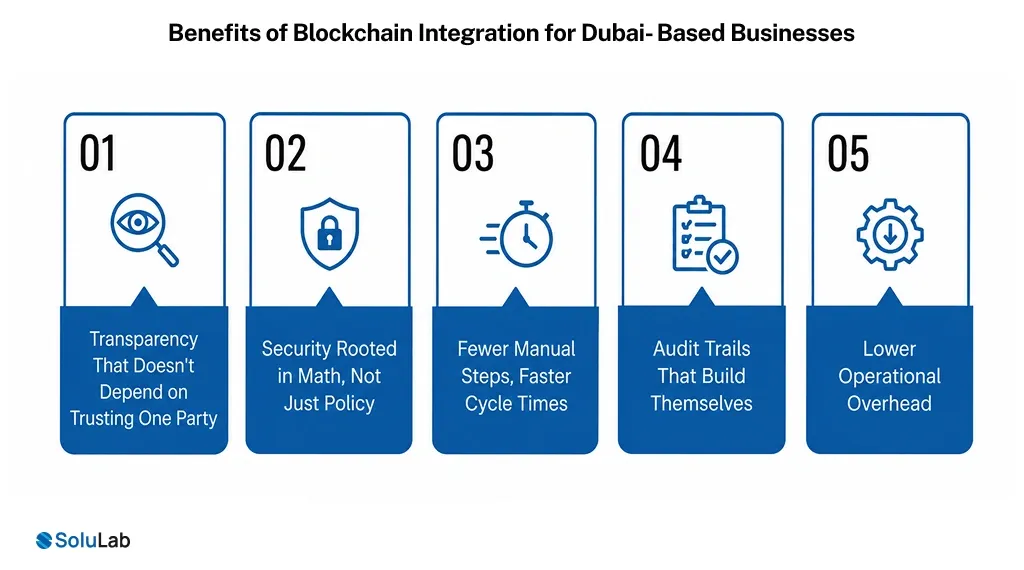
- Transparency That Doesn’t Depend on Trusting One Party
Every recorded transaction a payment, a contract approval, an asset transfer, becomes traceable by every permissioned participant, not just the party who happens to control the database. For multi-stakeholder processes (think a shipment moving through five different customs and logistics handoffs), that removes a huge amount of the “who said what happened” friction that normally requires phone calls and email chains to resolve.
- Security Rooted in Math, Not Just Policy
Blockchain’s cryptographic structure makes retroactively altering a record extremely difficult without every participant in the network noticing. That doesn’t eliminate risk, nothing does, but it meaningfully raises the cost and difficulty of data tampering, fraudulent transaction entries, and unauthorized record manipulation, which matters enormously for sectors handling sensitive financial or medical data.
- Fewer Manual Steps, Faster Cycle Times
Contract execution, vendor onboarding, compliance checks, and payment approvals; most of these involve someone manually verifying something someone else already verified. Smart contracts automate the “if this condition is met, execute this action” logic, which is exactly the kind of repetitive verification work that eats up days in procurement and finance teams.
- Audit Trails That Build Themselves
Traditional audits often mean weeks of document reconciliation. A blockchain-based system generates its audit trail as a byproduct of normal operation; every transaction is already timestamped and immutable the moment it’s recorded. Financial institutions, logistics providers, and healthcare organizations, in particular, are finding that this cuts audit prep time significantly.
- Lower Operational Overhead
Less paperwork, fewer reconciliation cycles, fewer intermediaries taking a cut or adding a delay at each handoff. The savings compound: a procurement workflow that used to need three approval layers and a manual paper trail might need one automated check instead.
The Industries Actually Driving This in Dubai
- Financial Services and Banking
Still the biggest adopter by volume. Cross-border payments, trade finance, KYC verification, and settlement processing are all workflows built around trust between parties who don’t fully trust each other by default, which is exactly blockchain’s home turf. Industry estimates suggest financial services account for the largest single share of enterprise blockchain revenue globally, and Dubai’s banking sector is tracking that pattern closely, with institutions like Abu Dhabi Islamic Bank among the early movers onto shared KYC platforms.
- Real Estate
Dubai’s property market has leaned hard into tokenization, splitting ownership of a property into digital shares that can be bought, sold, and verified on-chain. Beyond tokenization, blockchain is simplifying title verification, digital property records, and rental agreement management, cutting down the paperwork burden that traditionally makes cross-border property investment slow.
- Supply Chain and Logistics
Given Dubai’s role as a global freight and trade hub, this one’s almost inevitable. Dubai Customs has already deployed a blockchain platform to streamline clearance procedures. Enterprises use similar infrastructure to track shipments in real time, verify product origin, and cut down on the documentation errors that create costly delays at borders.
- Healthcare
Patient record management, prescription tracking, insurance verification, and clinical data sharing all benefit from a system where records can’t be silently altered, and access can be tightly controlled. Healthcare providers are using blockchain less for the “cool factor” and more because data integrity failures in this sector carry real consequences.
- Retail and E-Commerce
Product authentication (increasingly important given counterfeit concerns in luxury retail), loyalty programs, and supply chain transparency are the main entry points. Consumers are getting more vocal about wanting to know where products actually come from, and blockchain gives retailers a credible way to answer that.
Use Cases Worth Knowing Before You Scope a Project
- Smart contracts automate agreements once predefined conditions are met, with no manual sign-off needed.
- Digital identity management cuts down the time and cost of verifying customers, vendors, and partners while giving users more control over what data they actually share.
- Asset tokenization turns ownership of real estate, commodities, investment funds, or intellectual property into tradeable digital units, which can meaningfully improve liquidity for assets that are traditionally hard to sell in pieces.
- Document verification addresses a genuinely persistent problem, fraudulent certificates, licenses, and credentials, by making documents checkable against an immutable record instead of relying on the issuing party’s word.
The Challenges Nobody Should Skip Past
Blockchain projects fail for boring, predictable reasons, not because the technology doesn’t work.
- Integration complexity: Most enterprises are running legacy systems that were never designed with blockchain connectivity in mind. Data migration and integration architecture need real evaluation before a single line of smart contract code gets written.
- Regulatory compliance: Blockchain initiatives have to align with whichever regulatory bodies apply to VARA for virtual assets in Dubai, DIFC rules for the financial free zone, and sector-specific requirements layered on top. Legal and compliance teams need to be in the room from day one, not brought in at launch to sign off.
- Scalability: Not every blockchain platform performs the same under load. Transaction volume expectations, user growth, and data storage needs should shape the architecture decision, not the other way around.
- User adoption: The technology can be flawless, and the project can still stall because the people expected to use it weren’t trained, weren’t consulted, or don’t understand why the new process replaced the old one.
A Practical Path to Blockchain Integration
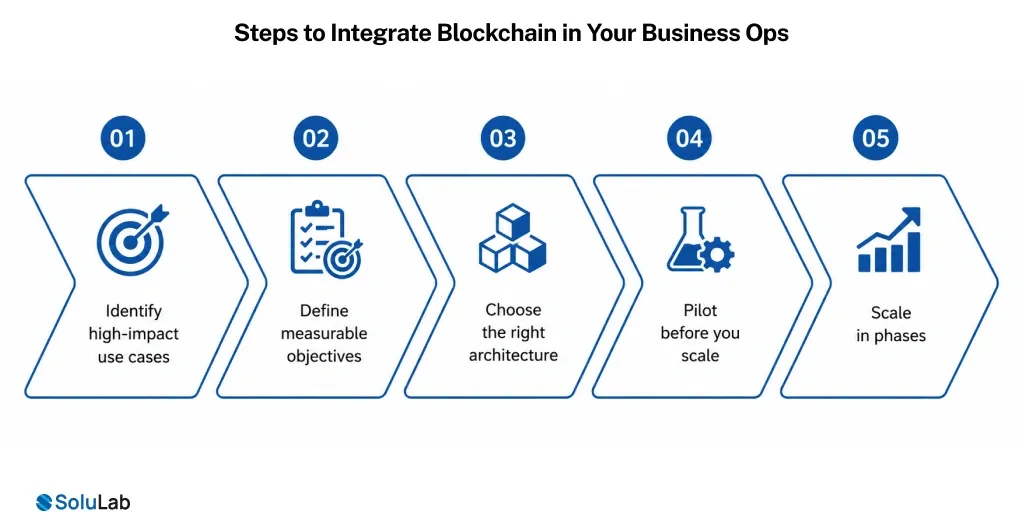
1. Identify high-impact use cases. Look for processes involving multiple stakeholders, frequent delays, heavy verification requirements, or excessive paperwork. That’s usually where blockchain earns its keep fastest.
2. Define measurable objectives. “We implemented blockchain” isn’t an outcome. “We cut vendor onboarding time by 2x” or “we reduced reconciliation errors by 80%” is.
3. Choose the right architecture. Public, private, consortium, or hybrid, the right call depends on how much privacy, governance control, and scalability your specific blockchain use case actually needs. This is where most projects either get built right or get built expensively wrong.
4. Pilot before you scale. A contained pilot lets you test workflows, gather real stakeholder feedback, and catch integration problems while the cost of fixing them is still low.
5. Scale in phases. Once the pilot validates the model, expand deliberately across departments and partners rather than flipping the switch everywhere at once.
Mistakes That Sink Otherwise Good Projects
- Solving for the technology instead of the problem. If nobody can articulate the operational pain point blockchain is fixing, that’s a warning sign, not a detail to figure out later.
- Leaving business and compliance teams out of planning. Technical teams alone rarely have visibility into every operational and regulatory constraint.
- Choosing a platform for its reputation instead of its fit. Popularity doesn’t guarantee it’ll scale with your specific transaction volume or integrate with your existing stack.
- Underestimating governance. A blockchain network still needs access controls, ongoing oversight, and clear rules for who can do what.
- Skipping the pilot. It’s tempting to move fast. It’s expensive to fix architecture problems after full deployment instead of before.
Where This Goes Next?
The next wave of adoption in Dubai looks less like isolated blockchain projects and more like blockchain woven into broader digital infrastructure paired with AI for fraud detection and anomaly monitoring, layered under smart city initiatives, and extended into cross-border trade corridors that connect the UAE to the rest of the region.
Initiatives like the Dubai AI & Web3 Campus signal where government attention (and funding) is heading: not blockchain as a standalone bet, but blockchain as one layer in a much larger automation and trust stack.
The Bottom Line
Blockchain integration in Dubai has moved well past the pilot-project-for-PR-purposes phase. Financial institutions, property developers, logistics operators, and healthcare providers are picking blockchain development solutions because it solves specific, expensive operational problems, not because it’s fashionable. The organizations getting real value out of it share a pattern: they start with a clearly defined business problem, choose an architecture that matches their actual scale and compliance needs, pilot before committing fully, and treat governance as part of the build rather than an afterthought.
Ready to Build Blockchain Into Your Operations with SoluLab?
If you’re evaluating where blockchain fits into your business, whether that’s smart contract automation, asset tokenization, or a full enterprise-grade deployment, the difference between a project that delivers ROI and one that stalls usually comes down to the team behind it.
SoluLab has spent over a decade building blockchain, AI, and Web3 products for enterprises and startups across North America, Europe, the Middle East, and APAC, with a track record of 150+ blockchain projects delivered across networks including Ethereum, Polygon, Solana, and Hyperledger. Our SoluLab’s blockchain development team supports
- compliance frameworks relevant to regulated markets,
- VARA requirements specific to Dubai, and
- a structured six-step development process designed to take a project from architecture assessment through pilot to full-scale deployment.
Whether you’re scoping a smart contract system, a tokenization platform, or a broader enterprise blockchain rollout, talk to SoluLab’s blockchain team to map out the right architecture and a realistic path to production for your business in Dubai.
FAQs
Deepika is a content writer who blends storytelling with strategic thinking. She explores topics across digital innovation, emerging tech, and the evolving blockchain industry. She enjoys breaking down complex ideas into simple, engaging narratives in the growing global markets.