
If you are running a business unit or a startup, you are probably not asking Is blockchain important anymore, you are askingWhat is the cheapest, safest, least painful way to get it into production? A lot of teams jump into in‑house builds, only to realize 6–12 months later that the real cost is not just developers, but infra, audits, compliance, 24/7 Ops, and continuous upgrades.
At the same time, Blockchain‑as‑a‑Service (BaaS) has matured into enterprise‑grade offerings where you get ready infrastructure, security, monitoring, and tooling on a subscription or usage basis, so you shift from heavy capex to predictable opex.
The question isn’t BaaS or custom? in a vacuum, it’s What is the right trade‑off between speed, control, and lifetime cost for my business model?
Key Takeaways
- The Problem: More than 60% of enterprise blockchain projects slow down or stall, mostly because teams underestimate hiring, infrastructure, and long-term costs, and many internal builds take 12–18 months before any real ROI shows up.
- The Solution: Starting with blockchain consulting helps teams compare BaaS and custom builds using real numbers, which often cuts validation time by nearly 50% and prevents overbuilding too early.
- How SoluLab Helps: SoluLab works alongside startups and enterprises as both a BaaS as a blockchain development partner, helping teams move faster, spend smarter, and scale without locking themselves into the wrong setup.
What Is Blockchain‑as‑a‑Service (BaaS)?
In simple terms, BaaS is like managed cloud hosting for blockchain: you get pre‑configured nodes, networks, monitoring, backups, and security out of the box, and you focus on business logic and blockchain use cases.
Most leading Blockchain‑as‑a‑Service providers give you ready support for popular networks (public or permissioned), SDKs, APIs, dashboards, and compliance‑friendly tooling, so your team does not wrestle with low‑level DevOps.
From your lens, the Benefits of Blockchain‑as‑a‑Service fall into a few buckets:
- Faster go‑live: Blockchain PoCs and MVPs can be deployed in weeks instead of quarters because infra and security baselines are already in place.
- Lower upfront spend: BaaS lets you avoid buying/maintaining specialized hardware and assembling a full‑time core infra team.
- Pay‑as‑you‑grow: You match spend to adoption, which matters if you’re not yet sure which use cases will scale.
This is why many firms now start with BaaS and only move to full Custom blockchain development solutions when a specific use case clearly justifies deeper control and customization.
Understanding In-House Blockchain Development for Enterprises
When you build internally, you’re not just writing smart contracts. You are effectively deciding to build enterprise blockchain platform capabilities inside your organization: infra, security, DevOps, governance, and product evolution.
Typical ingredients:
- Architecture and protocol decisions (consensus, permissioning, data model).
- Node management, monitoring, scaling, and disaster recovery.
- Smart contract development, audits, and ongoing upgrades.
- Integrations with core systems (ERP, CRM, payment rails, identity providers).
The challenges of building blockchain internally show up fast – talent is scarce and expensive, integration work is complex, and governance is non‑trivial.
A Statista‑reported study cited that around 28% of enterprises flagged lack of in‑house skills as a barrier to blockchain adoption, while a PwC survey found 55% of CEOs saw skills gaps as a major innovation blocker.
This is exactly why many CIOs now involve external Blockchain consulting services from day zero, even when they eventually want a strong in‑house team.
Cost Comparison of BaaS vs In-House Blockchain Development for Enterprises
From a cost perspective, the honest answer is – BaaS wins on upfront cost and speed, whereas custom/in‑house can win on long‑term strategic fit if fully utilized.
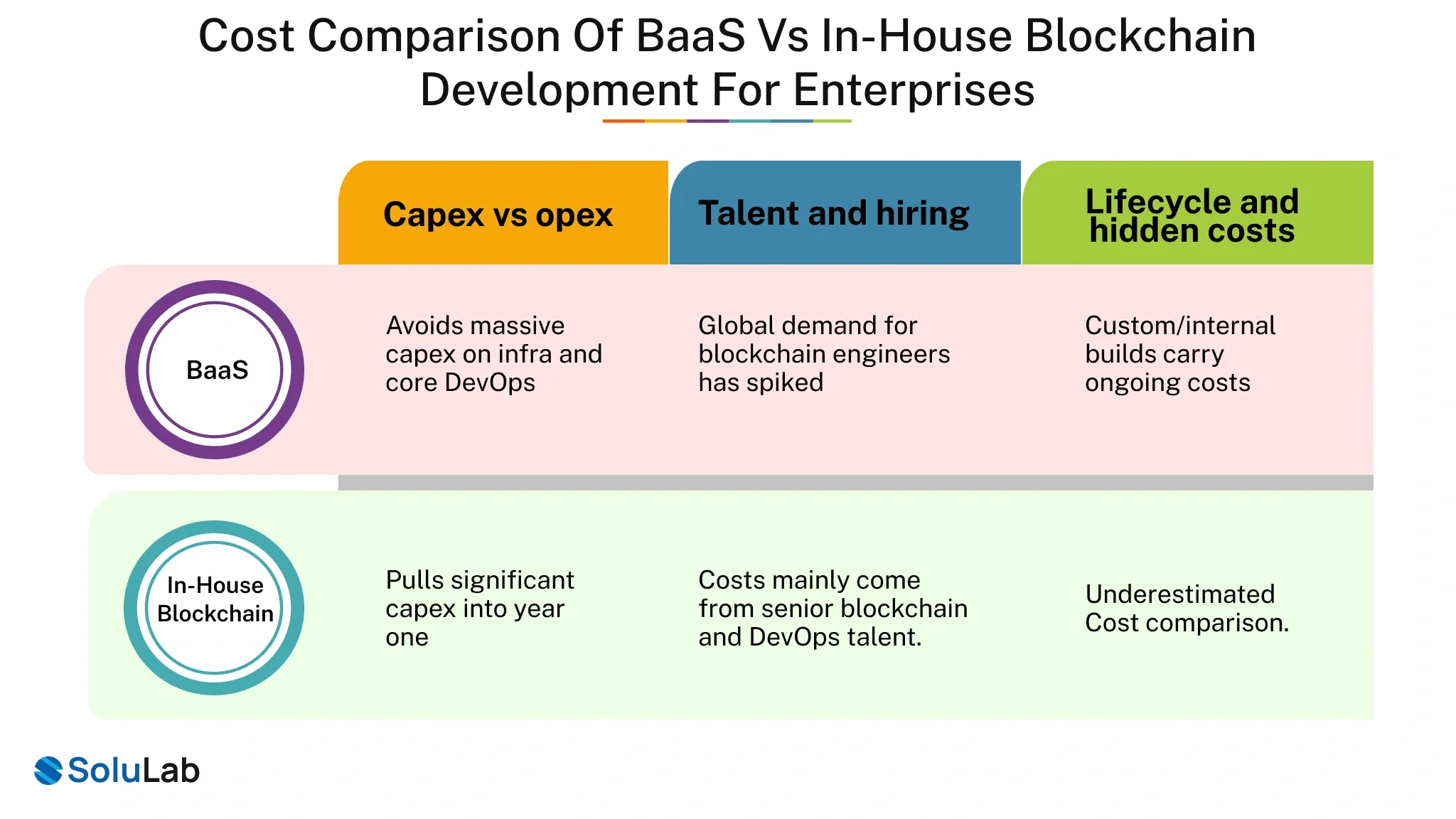
Think about BaaS vs custom blockchain development cost across three buckets:
1. Capex vs. Opex
- BaaS lets you avoid massive capex on infra and core DevOps services, turning those into predictable opex.
- Building in‑house pulls significant capex into year one: infra, licenses, security tooling, audits, and hiring.
2. Talent and hiring
- Global demand for blockchain engineers has spiked; one study reported a 500%+ year‑on‑year increase in demand in recent years, pushing salaries up sharply.
- So when you compare BaaS vs in‑house blockchain development, a big part of the delta is the fully loaded cost of senior blockchain architects, security engineers, DevOps, and product owners.
3. Lifecycle and hidden costs
- Custom/internal builds carry ongoing costs: upgrades, new regulatory needs, performance tuning, and incident response.
- Many organizations underestimate the cost comparison of BaaS vs custom blockchain over 5 years; BaaS may look more expensive per transaction, but full custom stacks often have lower utilization and higher fixed overhead.
For reference, one 2025 cost analysis showed blockchain app development ranging roughly from low five figures for MVPs to over 200,000 USD for complex, audited, enterprise solutions.
When you add infra and internal staffing, the real BaaS vs custom blockchain cost gap can easily reach 30–40% in early years, especially for smaller teams
Choosing Between BaaS and In-House Blockchain Development
Below is a simplified view relevant for CXOs making the Build vs buy blockchain solution call.
| Aspect | BaaS (Managed) | In‑House / Custom |
| Speed | Fast pilots and rollout, infra ready. | Slow initial cycles, longer design and build |
| Cost profile | Lower upfront, usage‑based; better for uncertain demand. | Higher upfront, potentially better unit economics at very high scale |
| Control | Limited protocol control; within provider’s feature set. | Full control over features, governance, and roadmap. |
| Risk | Vendor lock‑in, roadmap dependency. | Delivery risk, skills risk, and tech‑debt risk are internal. |
| Use cases | Standardized patterns (asset tokenization, traceability, document notarization, etc.). | Highly regulated, highly customized, or IP‑sensitive use cases |
When you map this to Pros and cons of BaaS platforms, the pattern is clear – you trade some level of control and customization for speed, simplicity, and lower early risk.
When BaaS Makes More Financial Sense Than In-House Blockchain Development?
From a business standpoint, BaaS is usually more cost‑effective when:
- You are validating 1–3 use cases and don’t yet have proof that they warrant a full Build enterprise blockchain platform investment.
- You want to keep teams focused on the core product and use external Blockchain‑as‑a‑Service providers, plus a partner BaaS development company for infrastructure and heavy lifting.
- You need compliance and security baselines baked into the platform from day one, but don’t want to assemble the full internal crew yet.
This is also where White‑label blockchain development services shine: you can launch an exchange, NFT marketplace, supply‑chain visibility portal, or loyalty token program on top of a managed stack, customize branding and flows, and test market response before committing to full custom builds.
In BaaS vs custom blockchain cost discussions, this “launch on white‑label, evolve to custom later” pattern is becoming the pragmatic middle road for many founders and innovation leads.
When In-House Blockchain Development Makes Sense for Enterprise Platforms
There are clear situations when to build blockchain in‑house (fully or partially):
- You need very specific consensus logic, privacy controls, or data residency patterns that standard Blockchain‑as‑a‑Service providers can’t deliver.
- Your blockchain layer becomes core IP or a strategic moat and you cannot afford deep dependence on any third‑party roadmap.
- You have (or plan to build) a strong internal tech organization with the capacity to own a Blockchain platform development company‑level capability internally.
However, even then, most mature organizations do not go fully solo. They still bring in Blockchain consulting services and specialized partners to de‑risk architecture, audits, and early releases while they hire blockchain developers gradually and transfer knowledge.
The challenges of building blockchain internally, especially around skills, integration, and governance, mean that hybrid models (internal leadership with expert partners) are often the most rational.
Read More: Launch Blockchain Product with Low Investment and Get Maximum ROI
A Practical Framework for BaaS vs Custom Blockchain Development Decisions
To avoid endless debate, it helps to run a structured how to choose between BaaS and an in‑house blockchain assessment. At SoluLab, we usually look at four lenses:
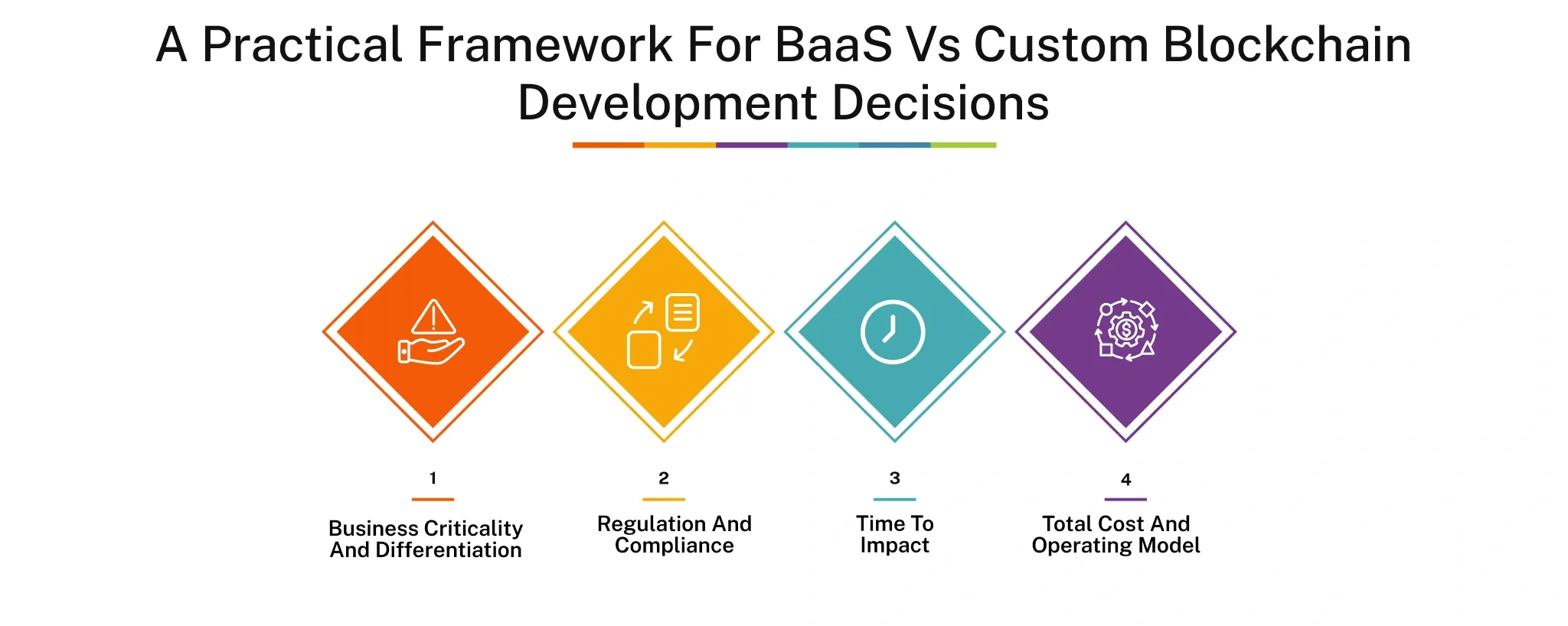
1. Business criticality and differentiation
- If the use case is differentiating but not core IP (e.g., supply‑chain traceability for internal efficiency), BaaS plus selective customization often wins.
- If the ledger logic itself is your product, custom wins.
2. Regulation and compliance
Highly regulated industries may need custom architectures, but many can still safely layer on managed infra with the right enterprise blockchain development services partner.
3. Time to impact
If you need something in production within a quarter, Build vs buy blockchain solution almost always leans toward BaaS or white‑label.
4. Total cost and operating model
- Model BaaS vs in‑house blockchain development over 3–5 years, not just year one.
- Stress‑test different adoption scenarios and see how BaaS vs custom blockchain development cost behaves when usage is lower or higher than expected.
This is where a neutral blockchain consulting services engagement is valuable – the goal is not to sell BaaS or sell custom, but to align tech choices with how your P&L, balance sheet, and risk appetite actually work.
Why SoluLab Is the Right BaaS Development Company for Enterprises?
SoluLab is recognized as a top blockchain development services partner globally, with deep experience in public, permissioned, and hybrid deployments for enterprises and fast‑moving startups.
We combine strategy consulting, architecture, and delivery, so you are not choosing between a slide‑deck firm and a dev shop – you get one team that can help you decide, design, and execute.
Here is what typically resonates with CXOs:
- We function as a practical BaaS development company and integrator, not just a coding vendor, which means we take ownership of outcomes, not just tickets.
- You can hire blockchain developers from SoluLab who have shipped production systems in fintech, DeFi, logistics, healthcare, and gaming, including White‑label blockchain development services where speed to market is critical.
- We support both sides of the BaaS vs in‑house blockchain development decision: from helping you prototype on BaaS to designing Custom blockchain development solutions and helping you build enterprise blockchain platform capabilities over time.
For many clients, we start by stabilizing pilots on BaaS, then gradually transition critical pieces into more customized stacks as adoption grows and economics justify deeper investment.
This lowers the real‑world blockchain development cost because each step is tied to measurable outcomes.
Conclusion
So, is Blockchain‑as‑a‑Service more cost‑effective than in‑house development? For most organizations at the exploration or early scaling stage, yes, BaaS (sometimes combined with White‑label blockchain development services) is typically more cost‑effective and lower risk.
Once blockchain moves into the core of your value proposition and justifies dedicated teams and infra, carefully planned Custom blockchain development solutions and hybrid models start to make more sense.
The safest move is not to bet everything on one path from day one, but to treat how to choose between BaaS and in‑house blockchain as an ongoing strategic decision, revisited as adoption, regulation, and economics evolve. With the best blockchain development services partner like SoluLab, you can keep optionality high while still delivering visible wins to your board and customers.
FAQs
With over 3 years of experience, I specialize in breaking down complex Web3 and crypto concepts into clear, actionable content. From deep-dive technical explainers to project documentation, I help brands educate and engage their audience through well-researched, developer-friendly writing.