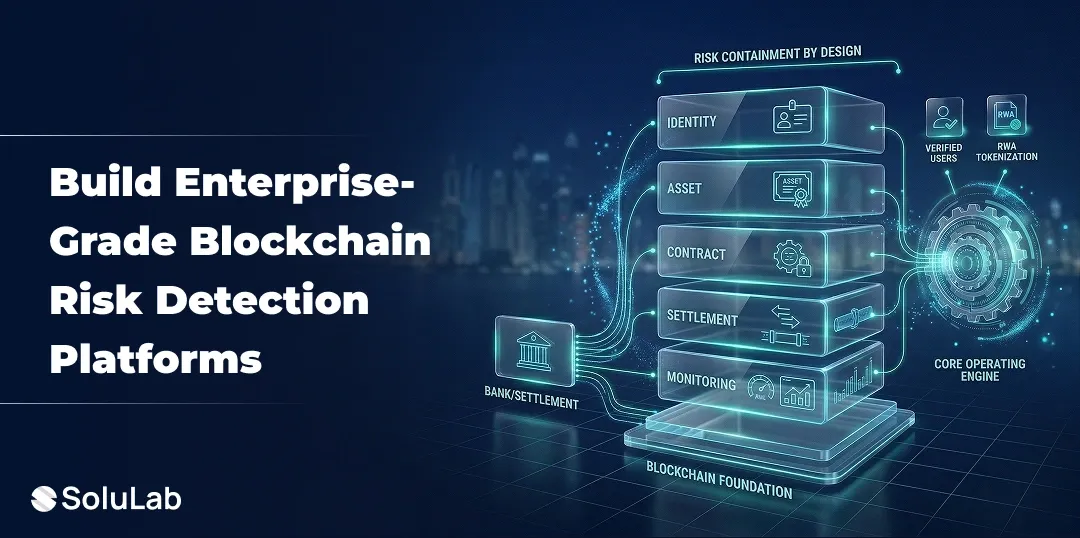
If you’re running an enterprise that touches blockchain, whether it’s payment rails, custody services, DeFi protocols, or tokenized assets, you’re already aware that threats don’t sleep. Blockchain development solutions for enterprise cybersecurity aren’t optional anymore; they’re the foundation that determines whether your platform survives or becomes the next headline about a multi-million-dollar exploit.
| The World Economic Forum’s Global Cybersecurity Outlook 2026 revealed that 87% of surveyed organizations flagged AI-related vulnerabilities as the fastest-growing cyber risk in 2025. |
But here’s the twist: blockchain itself offers an answer to some of these threats, as long as you know how to build enterprise risk detection platform solutions that leverage on-chain transparency, AI-powered pattern recognition, and real-time threat intelligence.
This article walks you through every angle, from understanding the threat landscape to the architecture, compliance layers, and performance optimization tactics so you can build or commission a platform that actually works in production environments where milliseconds and accuracy matter.
Key Takeaways
- The Problem: Enterprises running blockchain rails are getting hit from all sides – sanctions dodging, contract hacks, phishing, insider games, and the 2026 Chainalysis report puts it bluntly: 150 hacks, $2.87B gone in 2025, with the Bybit breach alone at $1.46B, which old-school security tools simply can’t see coming on fast, pseudonymous on-chain flows.
- The Solution: The fix is building risk systems that actually understand blockchain – real-time transaction monitoring, AI anomaly detection, wallet risk scoring, and compliance automation, tied with off-chain intel, so bad patterns surface early, before they turn into real balance-sheet damage.
- How SoluLab Can Help: That’s where SoluLab steps in, working end-to-end with teams from fintechs to exchanges to banks, mapping threats, building enterprise-grade blockchain security platforms, and staying with you post-deploy so you’re not guessing while the threat landscape keeps moving.
How Enterprise Blockchain Risk Detection Platforms Protect Your Business?
Before you build anything, you need to be clear on what you’re actually protecting against, because without that context, most platforms end up feeling secure on paper but fall apart the moment real money starts moving on-chain.
Why Traditional Risk Tools Fall Short?
Most legacy fraud tools were built for slow, centralized systems, but blockchains move fast, stay pseudonymous, and don’t allow rollbacks, which means by the time an alert fires, funds are usually already gone across chains.
What Enterprise Risk Detection Really Means?
At the enterprise level, risk detection isn’t just about alerts; it’s about seeing activity live, understanding who’s behind crypto wallets, and acting fast enough to stop damage before it becomes irreversible.
This usually includes:
- Real-time monitoring across major chains where value actually flows
- Wallet attribution tied to exchanges, protocols, and known bad actors
- Risk scoring based on behavior, exposure, and transaction patterns
- Built-in AML, KYC, sanctions, and reporting workflows
- Automated responses like freezes, blocks, or escalation to humans
Core Threat Categories Enterprises Actually Face
Based on recent industry data from TRM Labs, the most serious risk today clusters around a few repeat patterns, but each behaves very differently on-chain.
The main ones are:
- Sanctions evasion, where Russia-linked networks alone moved over $93B in 2025 using stablecoins like A7A5
- Hacks and exploits, often from weak contracts, leaked keys, or bridges
- Scams and fraud, including pig-butchering and fake investment fronts
- Darknet marketplaces are moving illicit goods quietly through DeFi rails
- Insider threats from people who already have wallet or admin access
Each category needs its own detection logic, which is why serious enterprise platforms are modular by design, because threat actors adapt quickly, and static systems don’t survive for long.
Market Landscape for Enterprise Blockchain Risk Detection Platforms
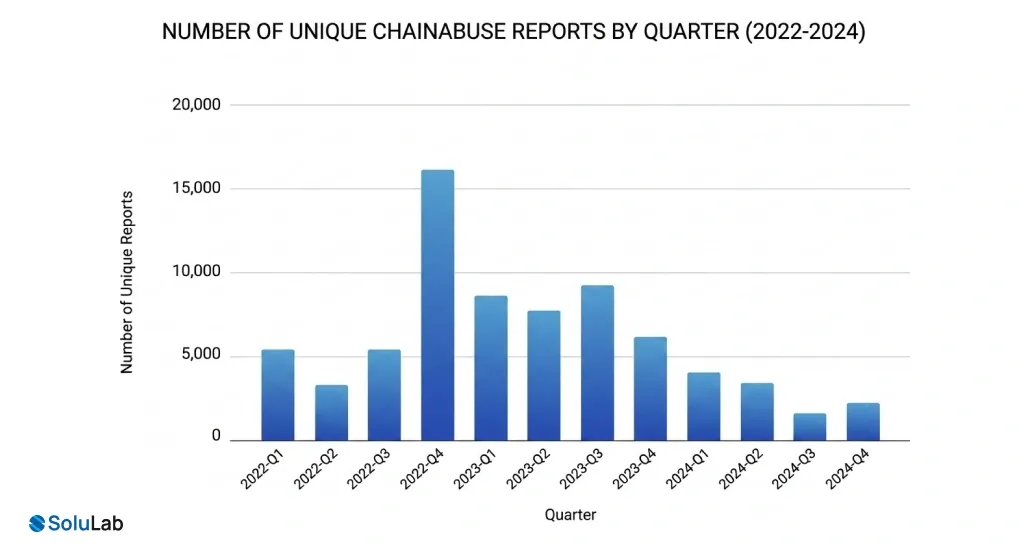
The blockchain risk detection market is moving fast, as enterprises now see on-chain transparency as both leverage and risk, which is pushing real budgets, not experiments, into production systems.
Market Size and Growth
The blockchain security market stood at USD 2.1B in 2024 and is heading toward USD 8.7B by 2033 at a 20.4% CAGR, while fraud-focused blockchain solutions alone are projected to hit USD 77.6B by 2034 with a 26.5% CAGR.
Enterprise Spending Reality
By 2026, enterprise blockchain spend has reached USD 44.29B with 59% YoY growth, and financial services still dominate at 41% share, which is roughly USD 18.2B, which was driven mainly by payments and tokenized securities.
Institutional Adoption Signals
About 72% of institutions now run crypto-specific risk frameworks, 60% use AI tools like Chainalysis and Elliptic, and 67% audit blockchains in real time, with compliance ranking top for 84% of them.
What This Actually Means
This is no longer a speculative market, as enterprises are deploying live systems under regulatory pressure, real capital exposure, and zero tolerance for blind spots.
Competitive Landscape
The space is led by specialists like TRM Labs and Crystal Analytics, alongside legacy security vendors and in-house builds, each trading off speed, depth, and customization.
Core Components to Build an AI-Powered Blockchain Risk Detection Platform
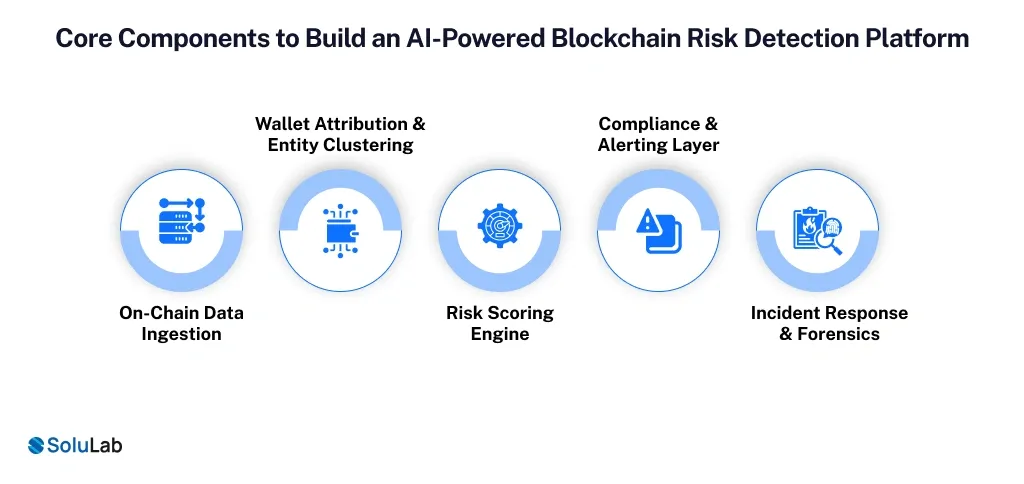
This is where things get real, building a risk system that actually survives production, keeps up with live chains, and catches the threats that cost money, not just the obvious ones.
1. On-Chain Data Ingestion
You can’t manage risk you can’t see, so everything starts with pulling clean, real-time, and historical data from every chain your users touch. Ethereum alone pushes ~1.2M tx/day, and once you add BSC, TRON, Polygon, and L2s, your pipelines must handle millions of events without lag or dropped blocks, which is where most systems quietly fail.
2. Wallet Attribution & Entity Clustering
Addresses mean nothing until you know who’s behind them, so you cluster wallets using spending patterns, flows, and behavior, then enrich that with intel from firms like Chainalysis and Elliptic. Beacon Network is a good example – once an illicit wallet is flagged, that signal spreads instantly across institutions, which is what separates enterprise systems from DIY tools.
3. Risk Scoring Engine
Once attribution is in place, the system has to score risk in a way ops teams actually trust – direct exposure, indirect hops, odd behavior, and velocity tricks all matter. Platforms like TRM and Crystal turn this into a simple 0–100 score with clear labels, but underneath it’s heavy ML crunching years of transaction history in seconds.
4. Compliance & Alerting Layer
Detection only matters if it triggers action, so risk signals must plug straight into AML, sanctions checks, and internal case tools. The World Economic Forum reports 74% of custodians now expect automated audit trails and filings, because anything manual here breaks the moment volume spikes.
5. Incident Response & Forensics
When funds move the wrong way, speed matters more than dashboards, so teams need graph tracing, replay, and cross-chain tracking as attackers hop bridges. Tools like Crystal Analytics let analysts follow money flows end-to-end, build evidence fast, and coordinate with legal or recovery teams before assets disappear.
How Blockchain in Enterprise Security Shapes Compliance and Risk Management?
You can build the smartest fraud detection system out there, but if it slips on compliance or gets breached, it’s already dead, as operators know regulation and security are not add-ons; they are the product.
Regulatory Landscape in 2026
Crypto rules are no longer fuzzy, which makes things harder but also clearer, as frameworks like MiCA, the US GENIUS Act, and the FATF Travel Rule now define exactly how serious enterprise systems must behave.
What actually matters inside those rules?
Sanctions are no longer abstract lists. By 2025, 21 new crypto-related sanctions dropped across the EU, UK, and US, 16 with real wallet addresses, which means your system must rescan old data every time lists update, or you miss risk hiding in plain sight.
Data Privacy vs Transparency
Blockchains are public, but the moment you tie wallets to real people, you’re holding personal data, so GDPR applies whether you like it or not, which is why smart teams minimize identity storage, encrypt attribution data, and design erasure workflows even with immutable chains.
Platform Security Is the Real Attack Surface
Your risk platform itself becomes the prize, and with phishing causing 32% of institutional breaches in 2026, serious operators default to zero-trust, MFA, HSMs, and regular pentests, not because it looks good but because attackers already assume you didn’t.
Performance & Scalability Best Practices for Enterprise Blockchain Risk Detection Platforms
Enterprise systems crash when they can’t handle real load, and blockchains are brutal because on-chain finality gives you only seconds to catch a bad transaction before it’s locked in.
1. Latency Targets
For risk detection to actually work in production:
- block ingestion <2s
- risk scoring <500ms
- alerts <1s.
You need pipelines that are near real-time for live checks, but eventual consistency is fine for historical stuff.
2. Database & Storage Architecture
Raw blockchain data is huge, so traditional RDBMS struggle. Mix time-series (InfluxDB), graph (Neo4j), columnar (ClickHouse), and document stores (MongoDB) to store and analyze transactions, wallet graphs, and alerts. Hot streaming feeds real-time, cold storage handles aggregates for compliance.
| Data Type | DB Type | Use Case |
| Transactions & events | Time-series | Real-time ingestion & monitoring |
| Wallet relationships | Graph | Clustering, identity correlation |
| Historical analytics | Columnar | Reporting, trend analysis |
| Metadata & alerts | Document | Flexible storage & search |
3. Horizontal Scaling & Multi-Chain Support
Add blockchains, and everything scales horizontally: microservices per chain/function, Kubernetes auto-scaling, and distributed tracing to find bottlenecks. Don’t forget cross-chain flows – attacks jump bridges, so stitch identities across chains instead of isolating each one.
Real-World Examples for an Enterprise Blockchain Risk Detection Platform
Theory is great, but let’s see how top platforms actually use blockchain for enterprise security in the wild.
1. Your Transaction (KYT) by Chainalysis
Chainalysis KYT is used by exchanges, banks, and fintechs to screen every transaction in real time.
Key features:
- Real-time monitoring across 30+ blockchains
- Automated alerts for funds touching high-risk wallets (ransomware, darknet, sanctioned addresses)
- Compliance reporting with pre-built SARs and regulatory filings
- API integration to block transactions or trigger manual review
Why it works: Chainalysis keeps one of the biggest proprietary wallet databases, updated through law enforcement and exchange partnerships, plus smart clustering to catch service wallets even if unlabeled.
Use case: A major European exchange cut false positives by 40% and caught sanctions violations missed manually, while automated SARs saved compliance teams ~60 hours/month.
2. TRM Labs: Fraud & Sanctions Monitoring
TRM focuses on blockchain fraud detection and sanctions intelligence, especially for cross-border crime.
Key strengths:
- AI bots scan the web for scam sites and map them to on-chain addresses
- Fraud network mapping shows connected scammer wallets
- Beacon Network shares real-time alerts flagged by law enforcement
- Covers ransomware, DeFi rug pulls, and sanctions evasion
2026 Crypto Crime Report: TRM traced $158B in illicit flows, much detected via automated patterns and shared intelligence.
Use case: A custody provider used TRM to screen withdrawal wallets and blocked 27 transactions totaling $3.2M in the first quarter. Alerts on APP fraud allowed them to warn customers before losses.
3. Crystal Analytics: AML/CFT/KYT for Banks & FIs
Crystal (Bitfury) builds risk analytics for traditional banks entering crypto.
Core capabilities:
- ML-driven monitoring of large datasets for risk scoring
- Drill-down analysis showing all on-chain activity
- Portfolio and entity risk scoring from past transactions
- Compliance-focused with AML/KYC/CFT alignment
Enterprise-ready: Designed for banks with audit trails, role-based access, data retention, and existing workflow integration.
Use case: A regional bank launching crypto custody flagged a high-risk deposit from wallets linked to darknet markets, triggering enhanced due diligence and stopping a shell company tied to money laundering.
The Next Wave of Blockchain-Based Fraud Detection and Risk Management
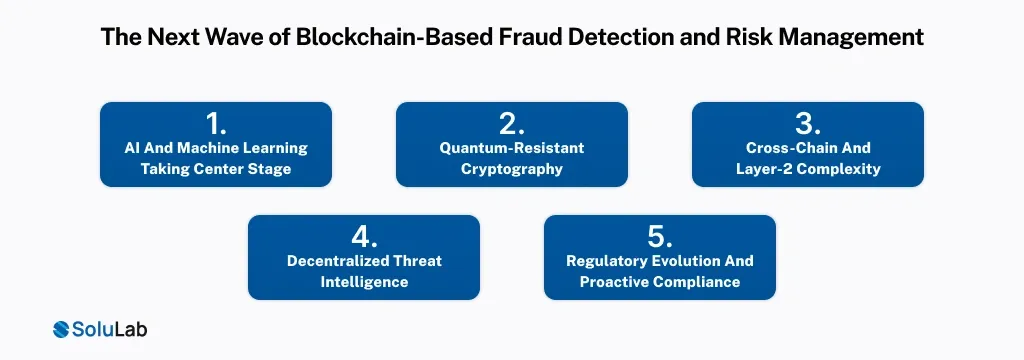
The threat landscape keeps shifting fast, and building enterprise risk detection isn’t just about today – it’s about staying ahead of what’s coming.
1. AI and Machine Learning Taking Center Stage
AI analytics are table stakes, but now LLMs can explain suspicious blockchain activity, behavioral biometrics track users even across pseudonymous addresses, and adversarial ML defends against AI-driven attacks. WEF 2026 says orgs checking AI security jumped from 37% to 64%.
2. Quantum-Resistant Cryptography
Quantum computing could break public-key crypto by 2030, so some enterprise blockchain teams are already planning post-quantum signatures and asset migrations to stay safe without halting operations.
3. Cross-Chain and Layer-2 Complexity
Assets spread across L1s, L2s, and bridges need tracking across rollups like Optimism or Arbitrum, monitoring bridge contracts for hacks, and linking identities across chains to catch attackers splitting funds.
| Risk | Example | Mitigation |
| Rollup batching | Optimism/Arbitrum | Track aggregated flows |
| Bridge exploits | Ronin, Wormhole | Continuous monitoring |
| Multi-chain splitting | Evading detection | Correlate identities |
4. Decentralized Threat Intelligence
Decentralized threats might need decentralized solutions – blockchain-based threat intel, staking systems for analyst accuracy, and oracles aggregating risk scores.
5. Regulatory Evolution and Proactive Compliance
Expect real-time regulatory reporting, cryptographic proof of KYC/AML without revealing user data, and evolving rules. Static checklists won’t cut it; platforms must stay modular and updateable.
SoluLab’s Guide to Building Blockchain-Based Fraud Detection Systems for Enterprises
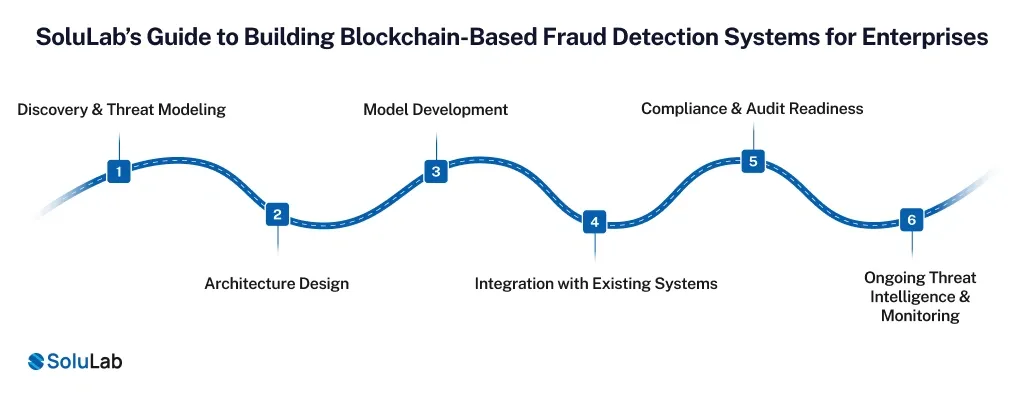
Building a production-grade blockchain cybersecurity platform isn’t a weekend job – it takes deep know-how in blockchain protocols, AI/ML, compliance, and heavy-duty data engineering, plus constant threat intelligence and ops security. SoluLab steps in as your partner for enterprise blockchain development, covering all that.
Our Approach
1. Discovery & Threat Modeling
We dig into your risk profile, whether it’s wash trading on exchanges, sanctions screening for custody, or smart contract exploits in DeFi, and build detection logic that actually fits your use case.
2. Architecture Design
Our architects set up systems that balance real-time alerts with deep analytics, picking the right database, messaging, and compute setup for your scale, latency, and future growth across blockchains.
3. Model Development
We train custom ML models on your transaction history plus external threat intel – think anomaly detection, entity clustering, behavioral profiling, and make sure compliance teams can actually understand why alerts fire.
4. Integration with Existing Systems
No ripping out your stack. We plug into KYC providers, case management, and transaction systems via APIs, supporting hybrid setups that mix on-prem and cloud for regulatory needs.
5. Compliance & Audit Readiness
Everything we build has audit logs, role-based access, and docs to satisfy SOC 2, PCI DSS, or regulator checks, we’ve guided clients through all of it.
6. Ongoing Threat Intelligence & Monitoring
Threats change, so we keep your detection models updated, integrate new sanctions lists, and track new attack patterns, letting you focus on business, not the latest exploit.
Conclusion
Building a serious blockchain risk platform isn’t just about throwing ML at transaction data – it’s about seeing the full threat picture, from networks skirting sanctions handling USD 93B to smart contract exploits costing USD 2.87B yearly, and designing systems that catch and act on these fast.
The numbers speak for themselves – security and risk detection spend is set to hit USD 8.7B by 2033, fraud prevention USD 77.6B by 2034, and already 60% of institutions use AI risk tools, with 67% doing real-time blockchain audits.
If you want to protect your blockchain infrastructure, you need a partner who gets both tech and regulations. SoluLab has been there before it was cool, building platforms that stay secure today and can handle whatever tomorrow throws at them.
Because here, it’s not about if attacks happen, it’s about catching them in time to actually stop them.
FAQs
With over 3 years of experience, I specialize in breaking down complex Web3 and crypto concepts into clear, actionable content. From deep-dive technical explainers to project documentation, I help brands educate and engage their audience through well-researched, developer-friendly writing.