Key Takeaways
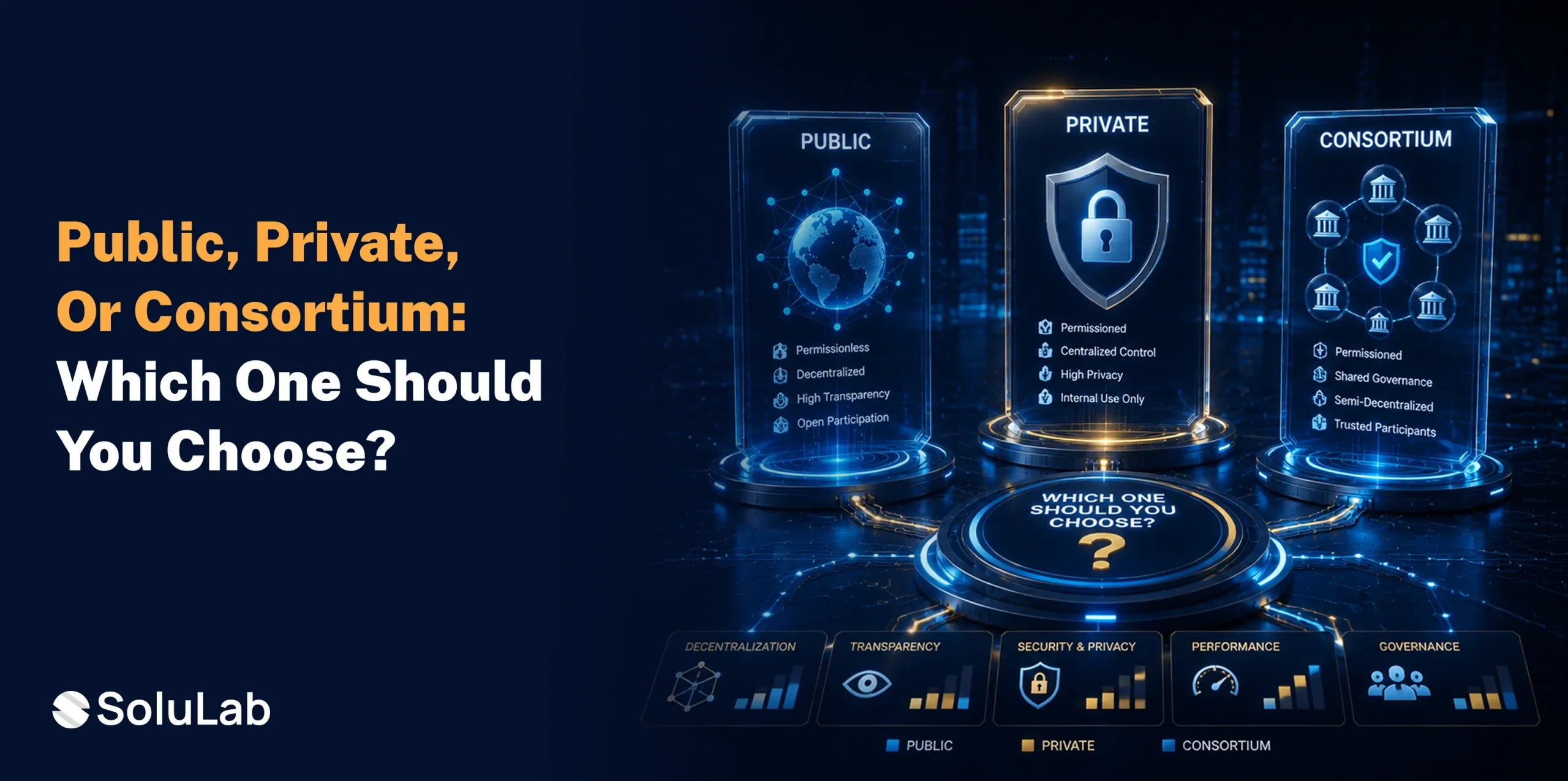
- Public blockchains offer maximum transparency, trust, and open participation but often face scalability and fee challenges.
- Private blockchains prioritize speed, privacy, and operational control for enterprise workflows.
- Consortium blockchains balance governance, compliance, and collaboration across multiple organizations.
- Enterprise blockchain success depends more on governance and interoperability than technology selection alone.
- Modern blockchain development services increasingly combine public and permissioned networks through cross-chain infrastructure.
- Choosing the right blockchain platform requires evaluating access control, compliance, performance, cost, and business objectives.
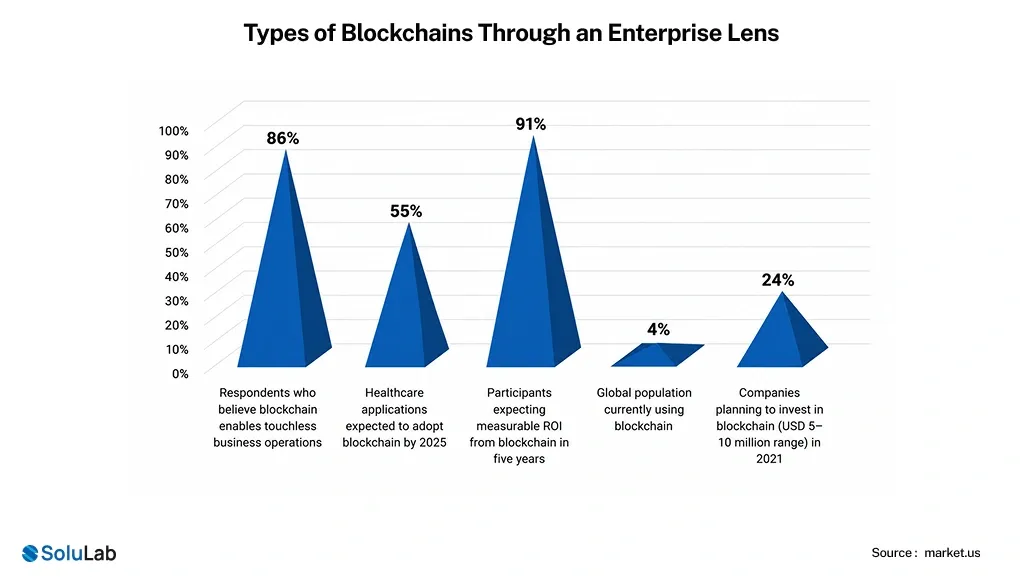
Blockchain adoption is no longer limited to cryptocurrencies. Nearly 90% of businesses have already implemented blockchain in some capacity, while thousands of digital assets continue to operate across global networks. Yet the biggest challenge facing enterprises is not whether to adopt blockchain technology. It is selecting the right architecture.
Public blockchains, Private Blockchains, and Consortium blockchains each deliver distinct advantages in governance, scalability, compliance, and operational control. The wrong choice can increase costs, limit adoption, and create future integration barriers. The right blockchain platform can strengthen collaboration, improve transparency, and create a foundation for long-term digital infrastructure.
Understanding the Types of Blockchains Through an Enterprise Lens
Many organizations approach blockchain selection as a technical decision. In reality, it is a strategic business decision.
- Nearly 20,000 cryptocurrencies exist today, though only about 10,025 remain active, highlighting the competitive and volatile nature of the crypto landscape. However, 90% of the surviving companies adopted the blockchain technology.
The different types of blockchains determine who controls data, who validates transactions, how governance works, and how future integrations can be executed. These decisions directly affect operational efficiency, regulatory readiness, and business scalability.
For enterprises evaluating blockchain development solutions, the primary question is not which technology is most advanced. The question is which architecture aligns with business objectives.
The three dominant models include:
- Public blockchains
- Private Blockchains
- Consortium blockchains
Each serves a different purpose and delivers value in different operating environments.
Why Public Blockchains Continue to Lead Digital Innovation?
Public blockchains operate without centralized ownership. Anyone can access the network, validate transactions, and participate without requiring approval.
Networks such as Bitcoin and Ethereum demonstrate how open participation creates trust at scale.
This model has become the foundation for cryptocurrencies, tokenized assets, decentralized finance, and dApps development initiatives.
1. Enterprise Advantages
Organizations selecting public blockchain infrastructure benefit from:
- Maximum transparency
- Global accessibility
- Strong censorship resistance
- High levels of trust
- Broad developer participation
For businesses building customer-facing products, these characteristics often create stronger market credibility.
2. Enterprise Challenges
Public networks also introduce operational limitations.
- Performance Constraints
Public consensus mechanisms prioritize security and decentralization over transaction speed. As transaction volumes increase, throughput limitations become more visible.
- Variable Transaction Costs
Network congestion can create unpredictable fees, making budgeting difficult for large-scale operations.
- Public Data Visibility
While wallet identities remain pseudonymous, transaction records remain visible to everyone. This creates challenges for enterprises managing confidential business information.
Best Enterprise Use Cases for Public Blockchains
Public blockchain adoption works best when:
- Open participation is required
- Asset ownership must remain publicly verifiable
- Decentralized platform development is a core objective
- Community-driven governance is valuable
- Global liquidity access is important
Examples include:
- Tokenized asset platforms
- Digital identity solutions
- DeFi applications
- NFT infrastructure
- Consumer-facing blockchain platforms
Why Enterprises Choose Private Blockchains?
Private Blockchains operate within controlled environments where participation is restricted to approved users.
Unlike public networks, organizations determine who can read data, validate transactions, and access applications.
This structure makes private networks highly attractive for enterprises focused on operational efficiency and regulatory requirements.
1. Advantages of Private Blockchain Architecture
- Faster Transaction Processing
With fewer validators participating in consensus, transactions can be confirmed rapidly.
This makes private networks suitable for high-volume enterprise workloads.
- Enhanced Data Confidentiality
Sensitive business information remains accessible only to authorized participants.
Industries handling regulated information often view this as a critical requirement.
- Predictable Operational Costs
Organizations avoid fluctuating transaction fees commonly associated with public networks.
This improves budgeting accuracy and long-term planning.
- Simplified Governance
Changes can be implemented quickly without requiring broad stakeholder consensus.
For many enterprises, this agility becomes a significant operational advantage.
2. The Trade-Off Enterprises Must Understand
The greatest strength of private blockchains is also their biggest limitation.
Because control remains centralized, trust becomes dependent on the operating organization.
This reduces transparency compared to public blockchain environments and introduces concentration risk.
3. Best Enterprise Applications for Private Blockchains
Private networks are often selected for:
- Internal auditing systems
- Healthcare records management
- Financial reporting infrastructure
- Supply chain tracking
- Enterprise asset management
Popular implementations include:
- Hyperledger Fabric
- R3 Corda
Organizations seeking blockchain development services for internal process optimization frequently favor private architectures because they align naturally with existing corporate governance models.
Why Consortium Blockchains Are Gaining Enterprise Momentum?
Consortium blockchains combine elements of both public and private networks.
Instead of being controlled by a single organization, governance is shared among multiple stakeholders.
This model has become increasingly attractive for industries where collaboration is essential but complete decentralization is unnecessary.
Banks, insurers, manufacturers, logistics providers, and healthcare organizations often operate within interconnected networks where trust must exist across multiple entities.
Consortium blockchain architecture addresses this challenge directly.
1. Key Advantages
Shared Governance
No single participant controls the network. This reduces concentration risk while maintaining operational efficiency.
Better Transparency
Participants gain visibility into shared processes without exposing information publicly.
Lower Costs
Infrastructure and operational expenses can be distributed across consortium members.
Strong Compliance Alignment
Known participants and permissioned access simplify regulatory oversight and auditability.
2. Challenges That Require Strategic Planning
- Consortium success depends heavily on governance design.
- Without clearly defined voting structures, onboarding processes, and dispute resolution mechanisms, collaboration can stall.
- Technology rarely causes consortium failure.
- Poor governance usually does.
3. Enterprise Use Cases Driving Consortium Adoption
Consortium networks are increasingly used for:
- Cross-border settlements
- Trade finance
- Banking alliances
- Multi-company supply chains
- Shared healthcare data infrastructure
A Financial Services Example
R3 Corda has become a preferred blockchain platform among financial institutions requiring privacy, compliance, and transaction efficiency.
Major banking institutions have explored consortium-led transaction validation because it reduces reconciliation overhead while maintaining regulatory requirements.
Permissioned Blockchain Networks: The Foundation of Enterprise Blockchain
Many enterprise discussions focus on public versus private blockchain models.
However, the more important distinction often involves permissioning.
A permissioned blockchain restricts participation to verified entities.
This approach provides:
- Identity verification
- Role-based access control
- Governance oversight
- Compliance monitoring
- Enhanced confidentiality
Private and consortium architectures typically fall within the permissioned category.
For organizations evaluating AI-powered blockchain development, permissioned frameworks often simplify governance and data management requirements.
Why Hybrid Blockchain Strategies Are Becoming the Enterprise Standard?
The future of enterprise blockchain is unlikely to belong exclusively to Public blockchains, Private Blockchains, or Consortium blockchains.
Instead, leading organizations are combining multiple architectures to capture the strengths of each model.
A financial institution may process transactions on a permissioned network while anchoring transaction proofs to a public blockchain. A supply chain consortium may maintain operational records privately while allowing consumers to verify product origins through public interfaces.
This hybrid approach enables enterprises to combine:
- Privacy
- Transparency
- Compliance
- Scalability
- Public verification
- Market accessibility
The model is particularly attractive for tokenization initiatives where organizations need enterprise-grade governance while also accessing broader liquidity opportunities.
As AI-powered blockchain development continues advancing, hybrid infrastructure is becoming a practical framework for integrating enterprise systems, AI applications, blockchain platforms, and decentralized services into a unified operating environment.
What Enterprises Get Wrong When Choosing a Blockchain Platform?
Many organizations approach blockchain adoption by comparing transaction speeds, consensus mechanisms, and technical specifications. While these factors matter, they rarely determine long-term success.
The stronger approach is to start with business requirements. A blockchain platform should support governance, compliance, scalability, and stakeholder collaboration before technical considerations enter the discussion.
Before evaluating Public blockchains, Private Blockchains, or Consortium blockchains, enterprises should answer several critical questions:
Who Should Control Access?
Open participation may benefit customer-facing platforms, while highly regulated industries often require strict identity verification and access controls.
How Many Organizations Need to Participate?
Internal enterprise systems have different requirements than networks connecting banks, insurers, suppliers, regulators, or healthcare providers.
What Compliance Obligations Exist?
Requirements such as KYC, AML, GDPR, HIPAA, and financial reporting standards often influence architecture decisions long before development begins.
Will Assets Require Public Market Access?
Many tokenization initiatives begin within permissioned environments but eventually require interaction with public markets and decentralized finance applications.
How Complex Can Governance Become?
Governance frameworks frequently determine whether a blockchain network scales successfully or becomes difficult to manage.
Organizations that answer these questions early are far more likely to select the right blockchain development partners and avoid expensive architectural changes later.
Why Enterprises Are Moving Beyond Single-Network Models
A growing number of organizations are no longer choosing between public and private architectures.
Instead, they are combining both.
A private network may manage sensitive operations internally while selected transaction proofs are anchored to public networks.
This approach delivers:
- Confidentiality
- Transparency
- Auditability
- Public verification
- Operational efficiency
The result is a more flexible digital infrastructure capable of supporting enterprise-scale growth.
Technologies such as Chainlink’s Cross-Chain Interoperability Protocol (CCIP) are helping organizations transfer data and value across networks while maintaining security and governance standards.
1. Interoperability Is Becoming a Competitive Requirement
As asset tokenization expands, isolated blockchain environments become less valuable.
Assets created on one network increasingly need access to users, applications, and liquidity across multiple environments.
This is driving investment in interoperability frameworks that connect:
- Public blockchains
- Private Blockchains
- Consortium blockchains
- Enterprise systems
Organizations pursuing advanced blockchain development solutions increasingly prioritize interoperability planning during the architecture stage rather than after deployment.
How Enterprises Should Choose Between Public, Private, and Consortium Blockchains?
Choose Public Blockchains If-
- Open participation is required
- Decentralized applications are central to the business model
- Transparency creates value
- Community governance is important
- Public market access matters
Choose Private Blockchains If-
- One organization controls operations
- Data confidentiality is critical
- Performance requirements are high
- Regulatory oversight is extensive
- Internal process optimization is the primary objective
Choose Consortium Blockchains If-
- Multiple organizations need shared infrastructure
- Collaboration is essential
- Governance must be distributed
- Compliance requirements are significant
- Industry-wide participation creates value
Selecting between Public blockchains, Private Blockchains, and Consortium blockchains is no longer a purely technical decision. The architecture chosen today will influence governance, compliance readiness, interoperability, scalability, and long-term business growth for years to come.

Conclusion
Increasingly, enterprises are also adopting hybrid models that combine the strengths of multiple blockchain environments to support tokenization, AI applications, and cross-industry collaboration.
At SoluLab, we help enterprises move beyond theory and into execution. As a trusted blockchain development company with expertise across enterprise
- blockchain platforms,
- tokenization solutions,
- smart contracts,
- decentralized platform development, and
- AI-powered blockchain development,
our team has delivered scalable solutions for startups, enterprises, and Fortune 500 organizations worldwide.
Backed by certified blockchain architects, solution engineers, and domain specialists, we help businesses identify the right architecture, mitigate implementation risks, and build future-ready digital infrastructure. Contact us today to discuss your blockchain requirement.
FAQs
Deepika is a content writer who blends storytelling with strategic thinking. She explores topics across digital innovation, emerging tech, and the evolving blockchain industry. She enjoys breaking down complex ideas into simple, engaging narratives in the growing global markets.