People like generative AI for a simple reason. It makes content that looks real and holds attention. Text, images, video, even music. If you want to build and run these models without buying a rack of GPUs, AWS gives you a stack of services to do it, and three names come up again and again: Amazon SageMaker, Amazon Rekognition, and Amazon Polly.
Quick orientation. SageMaker is the fully managed one, where you build, train, and deploy machine learning models at scale without babysitting servers. Rekognition looks at images and video and tells you which objects, people, and scenes are in them. Polly goes the other way: you hand it text and it speaks, in a voice that sounds close to human.
Generative AI models could reshape a lot of industries. Think personal experiences for each customer, marketing content that doesn’t look like stock filler, and automation for tasks people still do by hand today.
And 2026 should bring more of it. The tech keeps improving, so expect the models to get more capable and to show up in more places.
Understanding Generative AI and Its Impact on AWS
So what is generative AI, exactly? It’s the branch of artificial intelligence whose job is producing content: text, images, video, music. The field is young. Still, the early results are hard to ignore. OpenAI’s GPT-3 writes text that reads like a person wrote it, and DALL-E 2 turns a written description into a realistic picture.
AWS is the other half of the story. It’s a cloud platform that rents businesses computing power, storage, networking, and a long list of other services. For generative AI, that matters because these apps need somewhere to run and room to grow.
Put the two together and whole industries start to shift. A few examples: marketing campaigns tuned to one person, product photos that were never shot in a studio, and first drafts of creative copy.
That’s the pitch. Generative AI is a strong tool by itself, and on AWS it becomes something you can actually point at real problems and ship.
Where does it stop? Hard to say. As the technology matures, new and stranger uses will keep turning up.
- Defining the Core Principles of Generative AI
Generative AI is a real break from older AI, because the system creates content on its own instead of only sorting or scoring it. On AWS the effect is big. These models chew through huge datasets with fairly sophisticated algorithms to produce something new, and Generative Adversarial Networks (GANs), along with other frameworks, slot straight into the AWS infrastructure.
- Exploring the Significance of AWS in AI Model Development
AWS is one of the biggest names in cloud, and it’s a solid place to develop AI models. You can scale up, scale down, and try things without a long procurement cycle, which makes experimenting with, training, and deploying generative AI models a lot less painful. Amazon SageMaker and AWS Lambda carry much of the load here, cutting out steps across the model’s whole lifecycle.
- Unveiling the Synergy Between Generative AI and AWS Infrastructure
Here’s why the pairing works. AWS cloud services handle the boring but hard parts, scale, uptime, and access, while generative AI algorithms do the creative work. The upshot? A business can put generative AI to work without sinking a fortune into its own compute before it knows whether the idea pays off.
Key Components of Generative AI Models on AWS
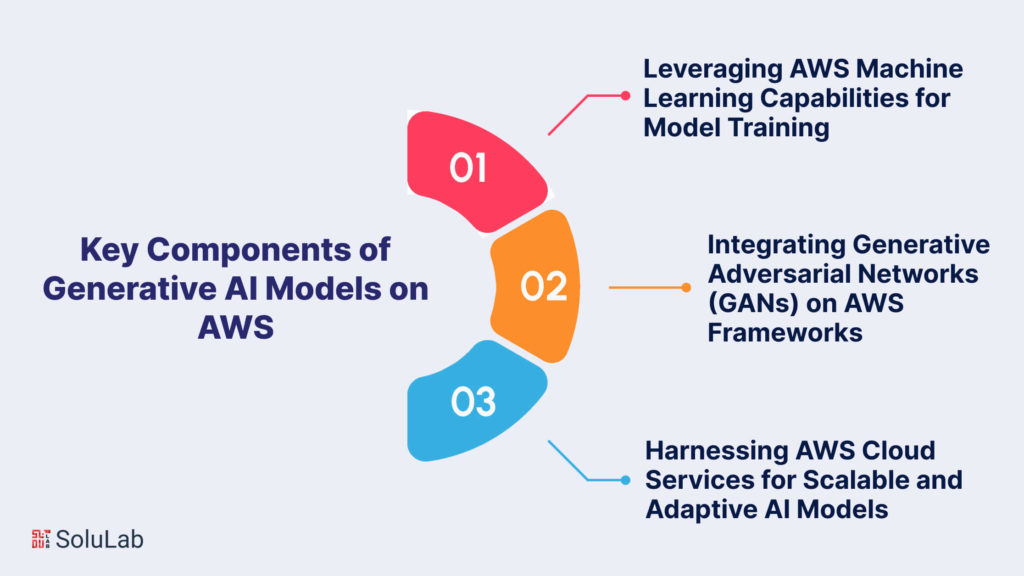
If you’re adopting Generative AI on AWS, you need to know what the models are actually made of. AWS supplies the scalable resources and services for building, training, and deploying Generative AI models. Below, we break down the main parts of Generative AI Models on AWS, the pieces that let a business get creative output, new ideas, and real efficiency out of the technology.
- Leveraging AWS Machine Learning Capabilities for Model Training
Training is where AWS earns its keep. Its machine learning toolset is wide, and Amazon SageMaker is the headline act. You run training on AWS hardware instead of your own, so jobs finish sooner and you spend less time and money getting there.
- Integrating Generative Adversarial Networks (GANs) on AWS Frameworks
GANs sit near the front of generative AI. They plug into AWS frameworks without much friction, and businesses use them to produce realistic, high-quality content. Two networks push against each other. Running that contest on AWS helps the model learn from data faster and produce output that looks like the real world.
- Harnessing AWS Cloud Services for Scalable and Adaptive AI Models
Generative AI workloads are spiky. One week you need a pile of compute for training, the next week almost none. AWS cloud services absorb that swing, letting you scale generative AI applications up or down as the load changes, so you’re not paying for idle machines or starving a busy generative AI app.

The Influence of Generative AI on Data Analysis and Insights
Content creation gets the headlines. But generative AI on AWS also changes how companies analyze data. AWS gives you the infrastructure and tooling to train and deploy these models at scale, which opens up one useful trick: generating new data, such as synthetic data, to train other models on. Then AWS gives you the tools to analyze whatever the models produce. That can surface patterns, correlations, and predictions that traditional analysis methods would miss. In short, pairing generative AI with AWS is changing how businesses pull usable insight out of their datasets.
Put plainly, companies get a new instrument for analysis. It finds patterns, correlations, and predictions they couldn’t see before. Better decisions follow.
- Driving Data-Driven Insights with AWS Integrated Generative AI Models
Generative AI on AWS is good at spotting what’s buried in big datasets. Feed it data through AWS services such as Amazon Redshift and Amazon S3, and generative AI models can pick out patterns, correlations, and anomalies that give decision-makers something concrete to act on.
- Enhancing Predictive Analytics and Pattern Recognition on AWS
Prediction is another area. AWS has its own predictive analytics tools, Amazon Forecast and Amazon Personalize, and they make generative AI models sharper. Use them together and you can recognize complicated patterns in your data. The payoff is forecasts you can trust more and insights you can actually use.
- Optimizing Data Processing and Interpretation through Generative AI Models
Garbage in, garbage out. That old rule still holds for Generative AI on AWS, which is why data processing matters so much. AWS Glue and Amazon Kinesis tidy up and speed up your data pipelines, so generative AI models always pull from datasets that are organized and current. Cleaner input, better generated content.
Real-World Applications of Generative AI on AWS
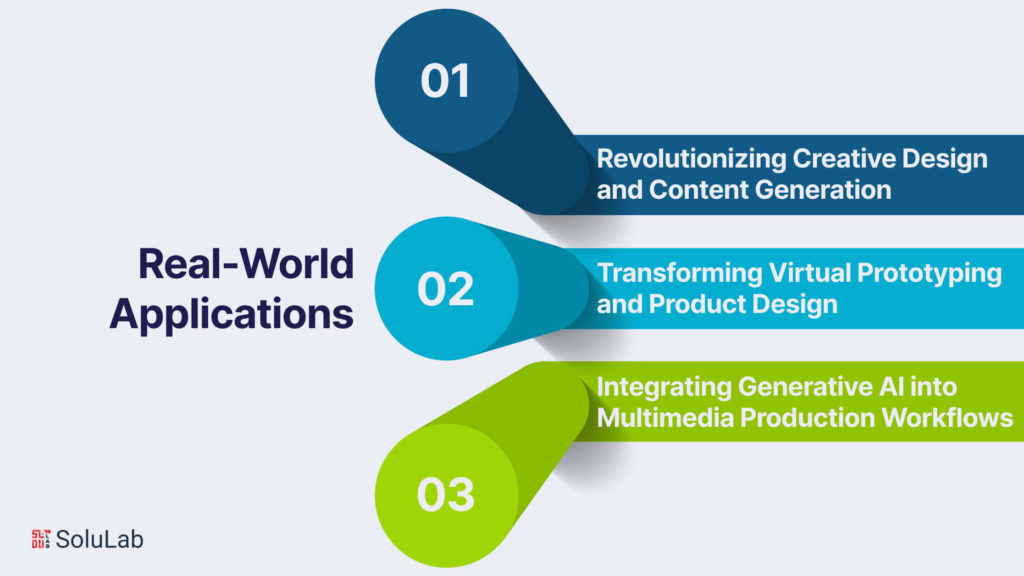
Generative AI on AWS proves itself in production, not in slide decks. Creative design, multimedia production, virtual prototyping: the list of industries keeps getting longer. Here are some practical use cases showing how companies put Generative AI on AWS to work, cutting steps out of their processes and building new products in fields from marketing to healthcare.
- Revolutionizing Creative Design and Content Generation
Creative teams feel it first. Generative AI on AWS changes how design and content get made. Amazon Polly handles the natural language side, Amazon Rekognition handles image and video analysis, and together they give generative AI more to work with when it produces content that’s realistic and actually engaging.
- Transforming Virtual Prototyping and Product Design
Physical prototypes are slow and expensive. With AWS services behind them, generative AI models move a lot of that work into software. Amazon EC2 runs the simulations and Amazon S3 holds the large datasets, which helps teams produce new prototypes and designs in industries as different as automotive and consumer electronics.
- Integrating Generative AI into Multimedia Production Workflows
Dropping generative AI into a multimedia pipeline on AWS is fairly painless. AWS Elemental MediaConvert and AWS Elemental MediaLive process and deliver the media that AI models generate. Production runs faster. Quality goes up too.
Challenges and Opportunities in Deploying Generative AI Models on AWS
None of this is free of trouble. Generative AI on AWS opens plenty of doors, and each one has a catch. The first is training complexity. These models are hard to train and hungry for data, which hurts if your company simply doesn’t have much of it. The second is ethics. The same models can produce fake content, fake news and deepfakes included, and that content can spread misinformation or wreck someone’s reputation. You should think this through before you deploy anything. The third is privacy. Generative AI can produce highly sensitive data, medical or financial records for example, so you have to be careful with how you use it if you want to protect the people behind that data.
So how do teams get past these problems and still capture the upside of Generative AI and AWS? A few approaches work well. Start with pre-trained models. Someone else has already trained them on large amounts of data, so you skip collecting and training your own, and that saves real time and money. Next, transfer learning: you take a model trained on one task and repurpose it for another, which is handy when your own dataset is thin. Last, privacy-preserving techniques. They let you train models without exposing anyone’s personal information.
Use those three and most of the hard parts of Generative AI on AWS become manageable, leaving you free to chase the opportunities.
- Navigating Challenges in Model Training and Optimization
The opportunity with generative AI models on AWS is big, and so are the obstacles. Training and tuning these models takes large-scale compute, and that’s where many businesses need outside help. AWS’s machine learning tools cover a lot of the gap. In practice, though, teams get stuck when they skip planning, so map out your infrastructure and how you’ll allocate resources before the first training run.
- Ensuring Ethical and Responsible AI Usage on AWS
Responsible use can’t be an afterthought once you deploy generative AI models on AWS. AWS builds security features into its AI services, which helps. It isn’t enough on its own. You still have to take your own steps to keep generative AI applications within ethical guidelines, and that goes double when sensitive data is involved.
- Seizing Opportunities for Innovation and Business Growth
Now the good news. Hurdles and all, deploying generative AI models on AWS creates real room for new products and growth. Because AWS services scale and adapt, companies can experiment in fields from healthcare to entertainment. Working with a specialized AWS staffing agency can also give you skilled people who tune deployments and speed up AI-driven change.
Future Trends and Innovations in Generative AI on AWS
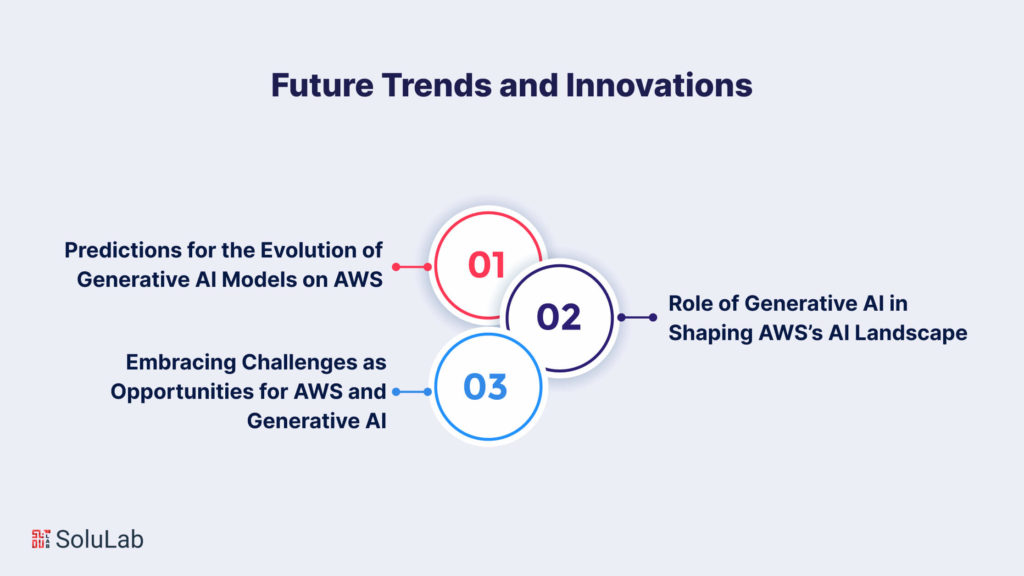
What comes next for Generative AI on AWS looks good, and the pace isn’t slowing. Every step forward in the underlying technology widens what Generative AI models on AWS can do. This section looks at the trends and innovations we expect, so you get a rough picture of what’s ahead if you want to stay near the front of Generative AI on the AWS platform.
First, the models themselves will keep getting stronger and more sophisticated. Images, text, and audio will look and sound more realistic and more accurate. They’ll also train on bigger, messier datasets, and that should push them toward more creative, more original output.
Second, more real-world use. One example: Generative AI can produce realistic training data for other AI systems, self-driving cars among them. Another is personal content for each user, such as product recommendations or news articles.
Our read? The outlook is bright. As innovation continues and models grow more capable, Generative AI on AWS is set to change a long list of industries and applications.
- Predictions for the Evolution of Generative AI Models on AWS
Looking forward, generative AI on AWS has a lot going for it. Progress in predictive analytics and machine learning on AWS should produce more sophisticated generative AI models. Tying in AI services like Amazon Comprehend and Amazon Translate will also strengthen what these models can do with language and content.
- Role of Generative AI in Shaping AWS’s AI Landscape
Generative AI will be one of the main forces shaping AWS’s AI landscape. Companies keep leaning on AI for more kinds of work, and AWS will keep adding and expanding AI services to match. Generative AI, with its creative range and practical uses, will lead that shift.
- Embracing Challenges as Opportunities for AWS and Generative AI
Every hard problem in deploying generative AI on AWS is also a chance to grow. AWS will probably put money into solving them, improving its machine learning products and giving businesses stronger tools for deploying generative AI models. Tackle those problems head on and generative AI on AWS gets easier to adopt and has more effect when you do.

Conclusion
Generative AI on AWS is moving quickly in 2026, with new models and solutions changing how whole sectors work. AWS gives organizations a set of tools for putting AI into their operations and getting improvements that actually matter. SoluLab works with these advances every day, helping businesses put AI strategies in place that hold up. As a leading Generative AI development company, SoluLab brings expertise, commitment, and a forward-looking approach. Our hands-on experience with AWS’s AI capabilities means clients get real value from these technologies, solving real-world problems and hitting their goals. The practical move for you is simple: keep up with what’s changing in generative AI and work with a partner who has done this before, like SoluLab, so AI becomes something your team builds with rather than something it reads about.
FAQs
Bhavya is driving growth through data-backed demand generation for AI and Web3 solutions. With 9+ years in digital marketing, he has spearheaded initiatives that led to a 40% increase in qualified inbound leads. Bhavya shares insights on marketing ROI and scaling a digital presence via AI workflows. He is open to connecting with startups and enterprise teams to help them overcome their challenges.