


01

Banks
Tokenized deposits, bonds, repo and collateral mobility, designed around capital rules and existing custody.

Enterprise tokenization consulting helps banks, asset managers and fintechs decide what to tokenize, how to structure it legally, which chain and token standard to use and how to connect custody, settlement and investor onboarding. SoluLab runs it as a readiness assessment, strategy, architecture and pilot, then builds the platform when you're ready.













Enterprise tokenization consulting is advisory work that takes a regulated institution from "should we tokenize?" to a live, compliant pilot. It covers use-case selection, the business case, legal and token structure, blockchain and standard selection, custody and settlement design, and a phased roadmap, before any large build budget is committed.
Most tokenization projects don't fail on technology. They stall on questions the technology can't answer: who holds legal title, which regulator applies, how the token settles against cash, and whether there are buyers on day one. Consulting answers those first. When the plan is set, our asset tokenization development team builds it.
The same word covers two different jobs.
Asset tokenization represents ownership of a real-world or financial asset as a token on a blockchain.
Enterprise data tokenization replaces sensitive data, such as card numbers, with meaningless tokens to shrink PCI DSS and privacy scope.
This page covers asset tokenization; our guide to tokenization vs encryption explains the data-security kind.
SoluLab's enterprise tokenization consulting services cover readiness assessment, strategy and business case, token and legal structure design, architecture and platform selection, smart contract and compliance design, custody and settlement integration, investor onboarding and distribution, and pilot delivery. Each can be bought on its own or as one programme.

A scored review of your asset, legal position, data, systems and team, ending in a go, wait or no-go recommendation. It tells you whether tokenization fits before you spend on a platform.

Use-case ranking, target investors, revenue model and the cost and time saved against today's process. You get a board-ready case, not a technology pitch.

Security, utility or payment token, SPV or direct issuance, transfer restrictions and investor eligibility, designed with your counsel. Standards like ERC-3643 enforce those rules in the token itself, as our ERC-3643 guide shows.

Public, permissioned or hybrid chain, build or buy, and which enterprise blockchain solutions fit your security and integration rules. We compare vendors on cost, lock-in and control.
Issuance, transfer, corporate-action and redemption logic, with KYC, AML and jurisdiction checks enforced on chain. Our smart contract development team builds and audits what we design.

Qualified custody, wallet models, cash legs (stablecoins, tokenized deposits or fiat rails) and links to core banking, transfer agents and fund administrators.
Digital onboarding with KYC and accreditation checks, subscription flows and secondary-market access, so issued tokens actually find buyers.

A first issuance on a defined asset, then a plan to add assets, jurisdictions and partners. For the build, our tokenization platform development team takes over, or you can run it as tokenization as a service.
Know where you stand before you spend.
Book a tokenization readiness assessmentWe run enterprise tokenization in five steps: readiness assessment, strategy and business case, legal and token design, architecture and pilot build, and scale. Each step ends with a decision point, so you can stop, pause or proceed with evidence. Pilot scope and timeline are fixed once legal structure and architecture are agreed.
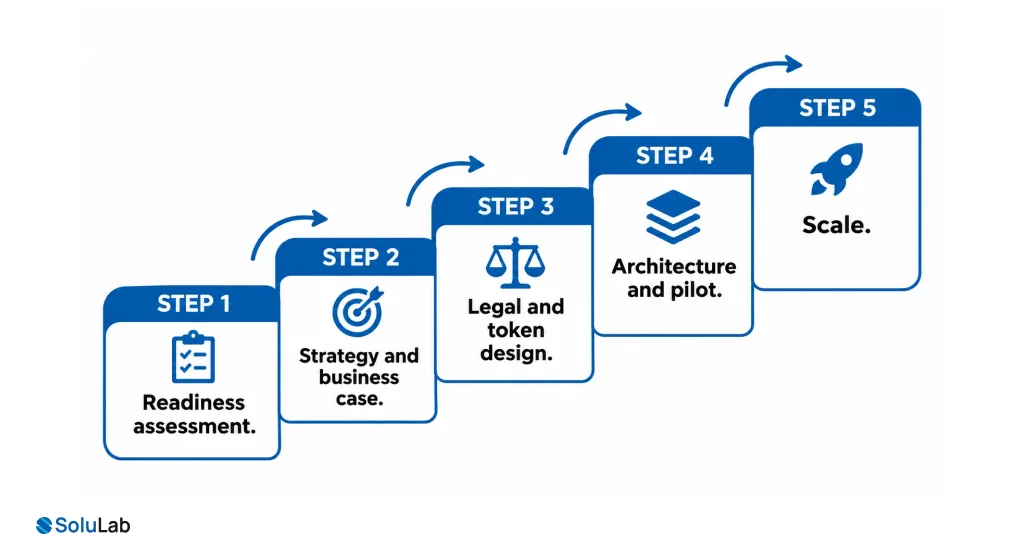
Asset, legal, data, systems and team scored against what tokenization needs.
Use cases ranked, investors defined, costs and returns modelled.
Structure, jurisdictions, transfer rules and token standard agreed with your counsel.
Chain, custody and integrations chosen, then one asset issued to a defined investor group.
More assets, markets and distribution partners, with monitoring and reporting.
We advise banks, asset managers, fintechs and corporate issuers. Banks focus on tokenized deposits, bonds and collateral, asset managers on tokenized funds and private markets, fintechs on new investment products, and corporates on tokenizing receivables, commodities or real estate they already hold.
Tokenized deposits, bonds, repo and collateral mobility, designed around capital rules and existing custody.

Tokenized money market funds, private credit and real estate funds with faster subscriptions and wider distribution.
Fractional investment products, tokenized gold and RWA marketplaces built for retail and accredited investors.

Receivables, commodities, carbon credits and property turned into tradable, auditable digital assets.
Enterprises tokenize real estate, private credit, bonds and treasuries, fund units, precious metals, commodities, carbon credits and receivables. The best first assets have clear legal title, reliable valuation, investor demand and a settlement problem tokenization actually solves. Our real-world asset tokenization guide covers each class.
| Asset class | Why enterprises tokenize it | Typical standard |
|---|---|---|
| Real estate | Fractional ownership, faster fundraising | ERC-3643ERC-1400 |
| Bonds and treasuries | Faster settlement, collateral mobility | ERC-3643ERC-1400 |
| Fund units | Lower distribution cost, 24/7 subscriptions | ERC-3643 |
| Private credit | Wider investor access, transparent servicing | ERC-3643 |
| Precious metals | Fractional, vault-backed ownership | ERC-20 with proof of reserve |
| Carbon credits | Traceable retirement, no double counting | ERC-1155ERC-721 |
Regulation decides most of a tokenization design. In the US, tokenized securities are still securities, and banking regulators confirmed in March 2026 they get the same capital treatment as traditional ones. The EU applies MiCA and the DLT Pilot Regime, the UAE has VARA and ADGM, and Singapore runs Project Guardian.

The Federal Reserve, FDIC and OCC confirmed in March 2026 that tokenized securities get the same capital treatment as their traditional versions. In December 2025, SEC staff gave DTC no-action relief for a three-year pilot recording security entitlements on DLT.

MiCA covers crypto-assets that aren't financial instruments. Tokenized securities fall under MiFID II, with the DLT Pilot Regime for market infrastructure.

Dubai's VARA and Abu Dhabi's ADGM regulate virtual assets, and Dubai has run real estate tokenization programmes.

MAS's Project Guardian tests tokenized funds, bonds and FX with major banks.
We design with your legal counsel, not instead of them.
SoluLab's tokenization work runs in production: a Singapore alternative-assets platform grew active investors 2.1x on ERC-3643, a Dubai real estate firm cut transaction costs by 40%, a gold and silver platform settles 60% faster with audited reserves, and ComplyExchange tokenized 99.6% of tax forms on the first attempt.
 01
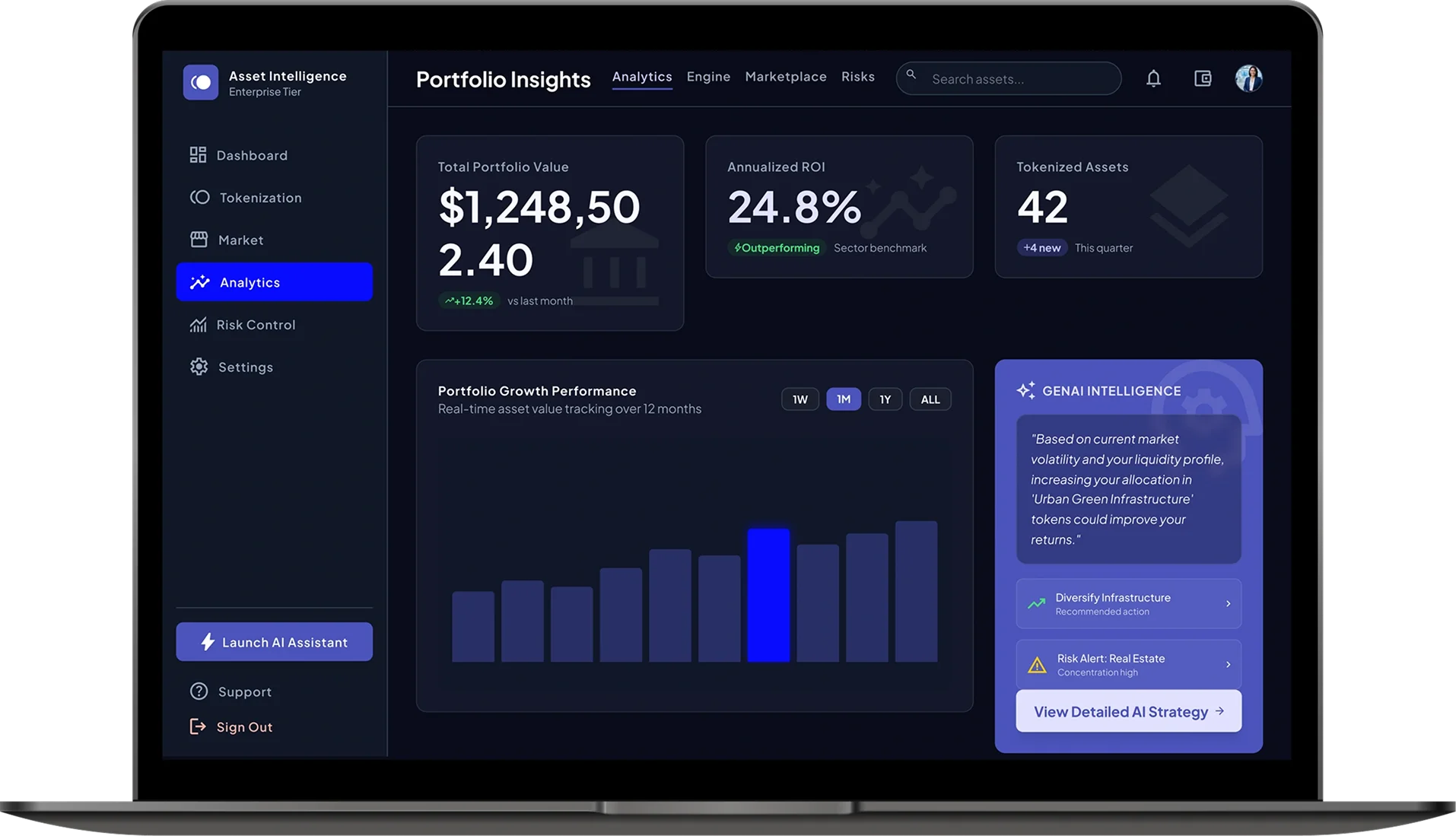
A private investment platform offering real estate, private credit and infrastructure needed issuance, onboarding and secondary trading in one place. We built ERC-3643 tokens on Ethereum and Polygon with GenAI-assisted onboarding, smart-contract compliance and Fireblocks or BitGo custody.
 02
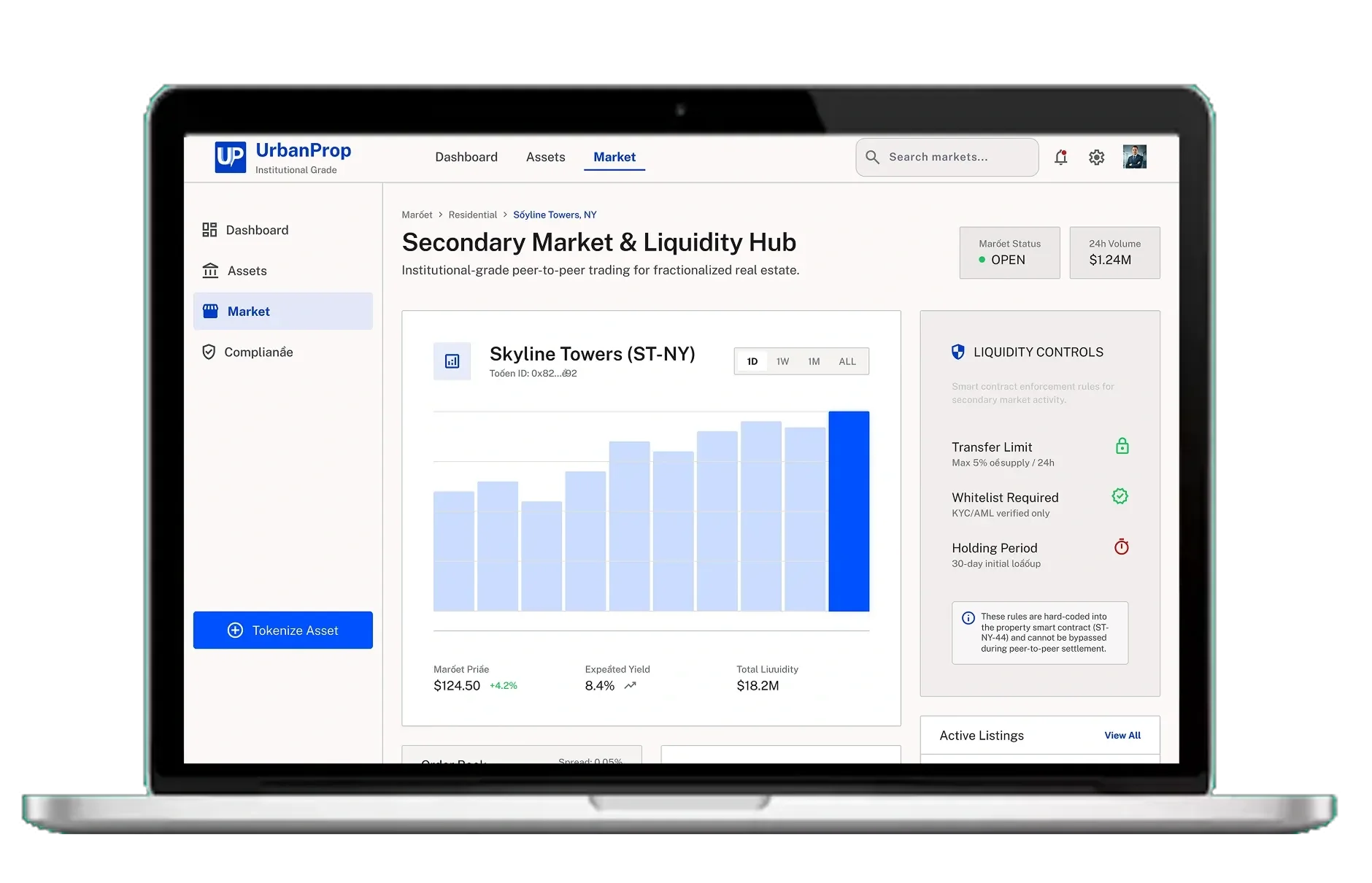
A Dubai firm managing residential and commercial property relied on manual, intermediary-heavy processes and paper onboarding. We built a tokenization platform with AI-assisted KYC and AML, risk scoring and transaction monitoring.
 03
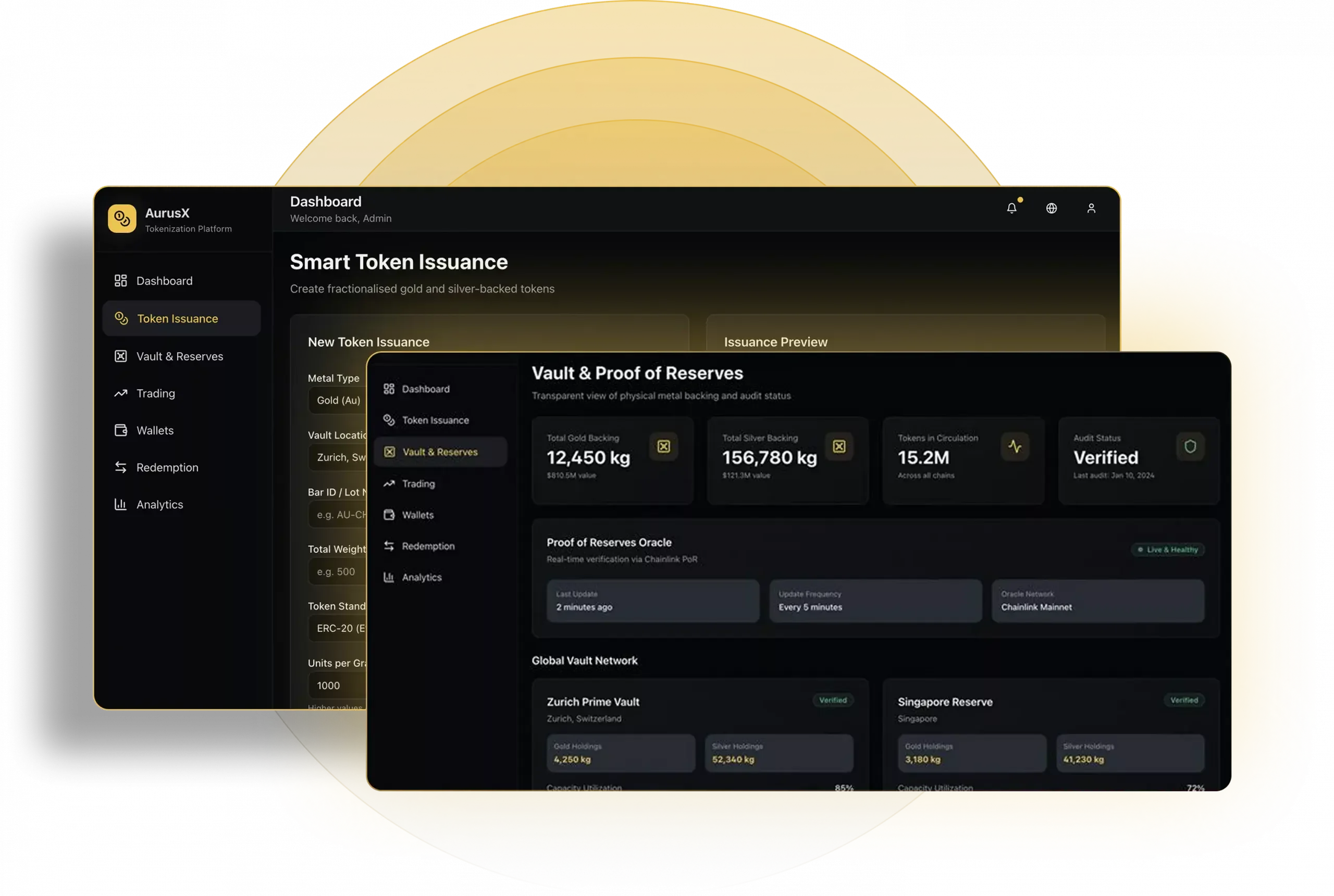
The client wanted precious-metal investing open to more people. We built vault-backed ERC-20 tokens with Chainlink Proof of Reserve, Fireblocks custody, 24/7 trading and redemption to metal or fiat.
 04
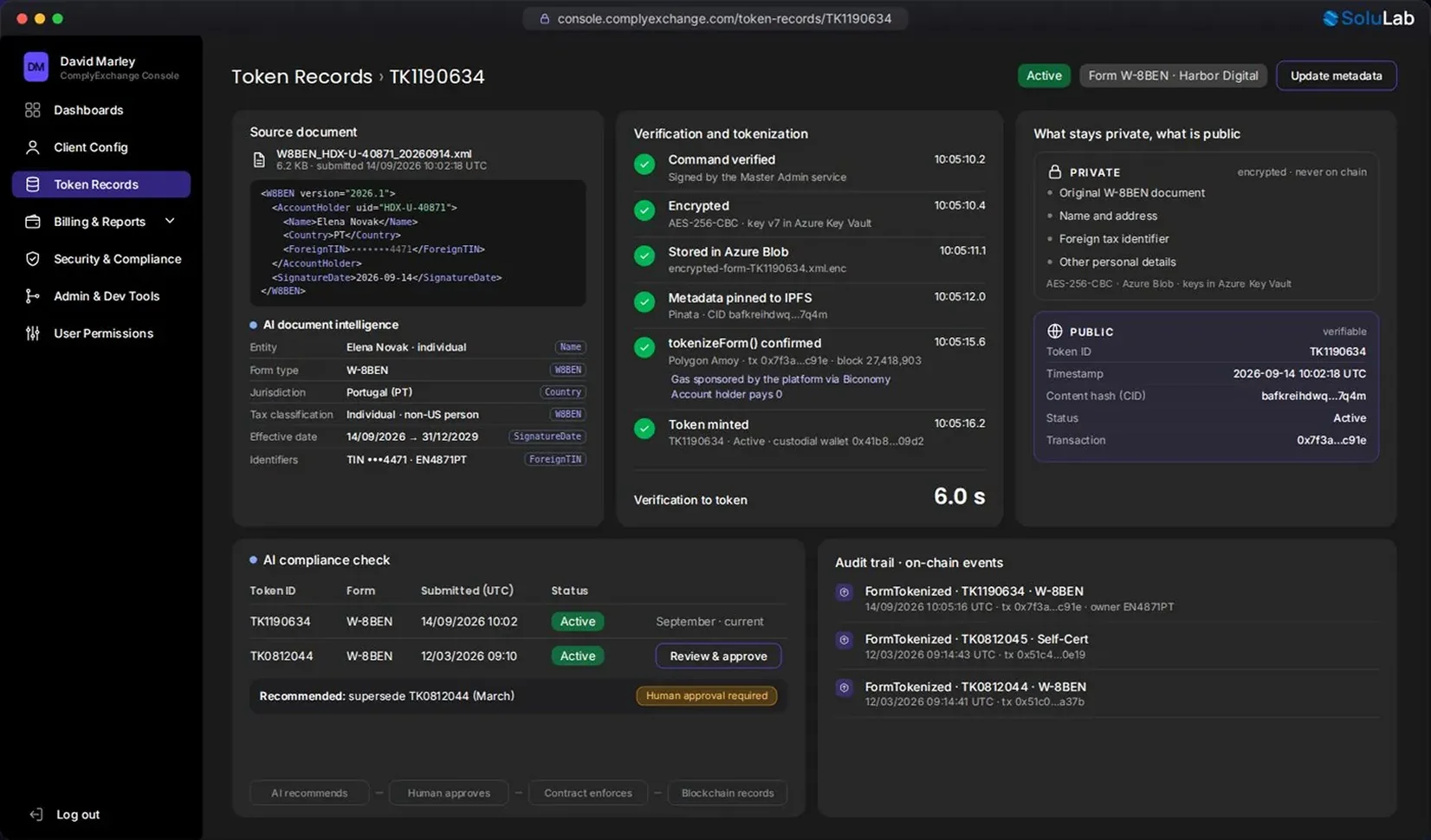
ComplyExchange needed verified W-8 and W-9 forms turned into records it could prove. We built AI extraction, admin-approved supersession and tokenized form histories with no personal data on chain.
Enterprise tokenization consulting is priced per phase after a scoping call, so you only pay for the steps you need. SoluLab's published pricing puts tokenization platform builds from about $10,000, rising with asset type, chain, compliance and integrations. Enterprise programmes across several assets and jurisdictions cost considerably more.
| Phase | What you get | Typical timeline |
|---|---|---|
| 01 Readiness assessment | Scored readiness report and go, wait or no-go | 2 to 4 weeks |
| 02 Strategy and business case | Ranked use cases, investor model, cost and return | 3 to 6 weeks |
| 03 Legal and token design | Structure, jurisdictions, standard, transfer rules | 4 to 8 weeks, with counsel |
| 04 Architecture and pilot | Chain, custody, integrations, first issuance | 8 to 16 weeks |
| 05 Platform build | Production tokenization platform | From about $10,000, scope-based |
Cost drivers are the asset and its legal structure, the number of jurisdictions, custody and cash-leg choices, integrations with core systems and the volume of investors you onboard.
We're chain-agnostic and recommend by requirement: Ethereum and Polygon for public liquidity, Hyperledger Fabric for permissioned networks, ERC-3643 or ERC-1400 for regulated securities, Fireblocks or BitGo for custody and Chainlink Proof of Reserve for asset backing. Choices follow your regulator, investors and integration needs.
 Ethereum
 Polygon
 Avalanche
 Solana
 Hyperledger Fabric
 ERC-3643 (T-REX)
 ERC-1400
 ERC-1404
 ERC-20
 ERC-721
 ERC-1155
 Fireblocks
 BitGo
 Multi-signature wallets
 Chainlink Proof of Reserve
 Solidity
 OpenZeppelin
 Hardhat
 KYC and AML APIs
 On-chain identity
 Jurisdiction rules

Already know the asset you want to tokenize? Get a Tokenization Roadmap for Your First Asset
Get my tokenization roadmapInstitutions choose SoluLab as their enterprise tokenization consulting company because we advise and build. Our tokenization platforms run in production across real estate, private markets, precious metals and compliance records, so the roadmap we write is one we've shipped, with ERC-3643 compliance, custody integration and investor onboarding included.

Every recommendation comes from platforms we've delivered.
A go, wait or no-go answer before any large build budget.

ERC-3643 and ERC-1400 transfer rules, KYC and AML on chain.
Public, permissioned or hybrid, chosen by requirement.

real estate, private credit, funds, metals, carbon credits and records.

so you pay only for the steps you take.

"Chintan advises SoluLab's tokenization clients on capital structure, compliance and investor onboarding, and leads the firm's RWA tokenization practice."
SoluLab transformed our vision for EcoYield into a powerful and intuitive platform. Their team understood the complexity of our model and delivered a design that is modern, engaging and truly aligned with our mission for a cleaner, more sustainable future.

SoluLab turned our verified tax forms into records we can actually prove. Every form, every change and every approval now has evidence behind it, which has made audit preparation and client conversations far more straightforward.

Enterprise tokenization consulting is advisory work that helps banks, asset managers, fintechs and corporates decide what to tokenize and how. It covers readiness, business case, legal and token structure, chain and standard selection, custody and settlement design, and a phased roadmap to a compliant pilot.
SoluLab's services cover a tokenization readiness assessment, strategy and business case, token and legal structure design with your counsel, architecture and platform selection, smart contract and compliance design, custody and settlement integration, investor onboarding, and pilot delivery. Each phase can be bought separately or as one programme.
Consulting is priced per phase after a scoping call. SoluLab's published pricing puts tokenization platform builds from about $10,000, with cost rising by asset type, chain, compliance needs, custody and integrations. Enterprise programmes across several assets and jurisdictions cost considerably more and are quoted on scope.
A readiness assessment usually takes a few weeks. Strategy, legal and token design follow, often in parallel with your counsel. A first pilot issuance on one asset typically takes a few months from agreed design, and scaling to more assets and markets is planned as separate phases.
Start with an asset that has clear legal title, reliable valuation, real investor demand and a settlement or access problem tokenization solves. Fund units, private credit, real estate, bonds and precious metals are common first choices; our readiness assessment ranks your options.
It depends on your investors and regulator. Public chains such as Ethereum or Polygon give liquidity and interoperability, with ERC-3643 enforcing who can hold tokens. Permissioned networks such as Hyperledger Fabric suit closed bank consortia. Many institutions start permissioned and add public distribution later.
ERC-3643, also called T-REX, is an Ethereum token standard for regulated securities. It links each token to verified investor identities, so transfers only succeed between eligible, KYC-checked holders. That lets compliance rules live in the token itself, which is why banks and asset managers favour it.
Yes, within existing rules. Tokenized securities remain securities, and in March 2026 US banking regulators confirmed they get the same capital treatment as traditional ones. The EU, UAE and Singapore have their own frameworks. Your legal structure and jurisdictions decide the exact obligations.
Asset tokenization represents ownership of a real or financial asset as a blockchain token that can be issued, traded and settled. Data tokenization swaps sensitive data such as card numbers for meaningless tokens to reduce PCI DSS and privacy scope. They solve different problems and use different technology.
Yes. SoluLab advises banks, asset managers, fintechs and corporates on tokenization strategy, readiness, architecture and roadmap, then builds the platform. Our tokenization work includes an ERC-3643 RWA platform that grew active investors 2.1x and a Dubai real estate platform that cut transaction costs by 40%.