AI · BLOCKCHAIN · TOKENIZATION · TAX COMPLIANCE

AI-Powered Tax Form Tokenization & Compliance Evidence Platform for ComplyExchange

An enterprise platform that turns every verified W-8 and W-9 into an encrypted, tokenized record on Polygon, with AI document intelligence, human-approved changes, recoverable exceptions and role-based enforcement built in.

AIDocument Intelligence
AES-256Encrypted Storage
IPFSPublic Metadata
PolygonOn-chain Evidence

Project at a Glance

Industry
Tax Compliance & Fintech
Engagement
AI + Blockchain Platform Development
Platform
Web Application + Microfrontends + APIs
AI / Blockchain Technology
AI Document Intelligence, Polygon, IPFS, Smart Contracts
Core Use Case
Tokenization of W-8 / W-9 tax forms with a verifiable audit trail
Data Sources
Comply eForms, Documents on File, Client Admin Systems

Challenge and solution

The Business Challenge

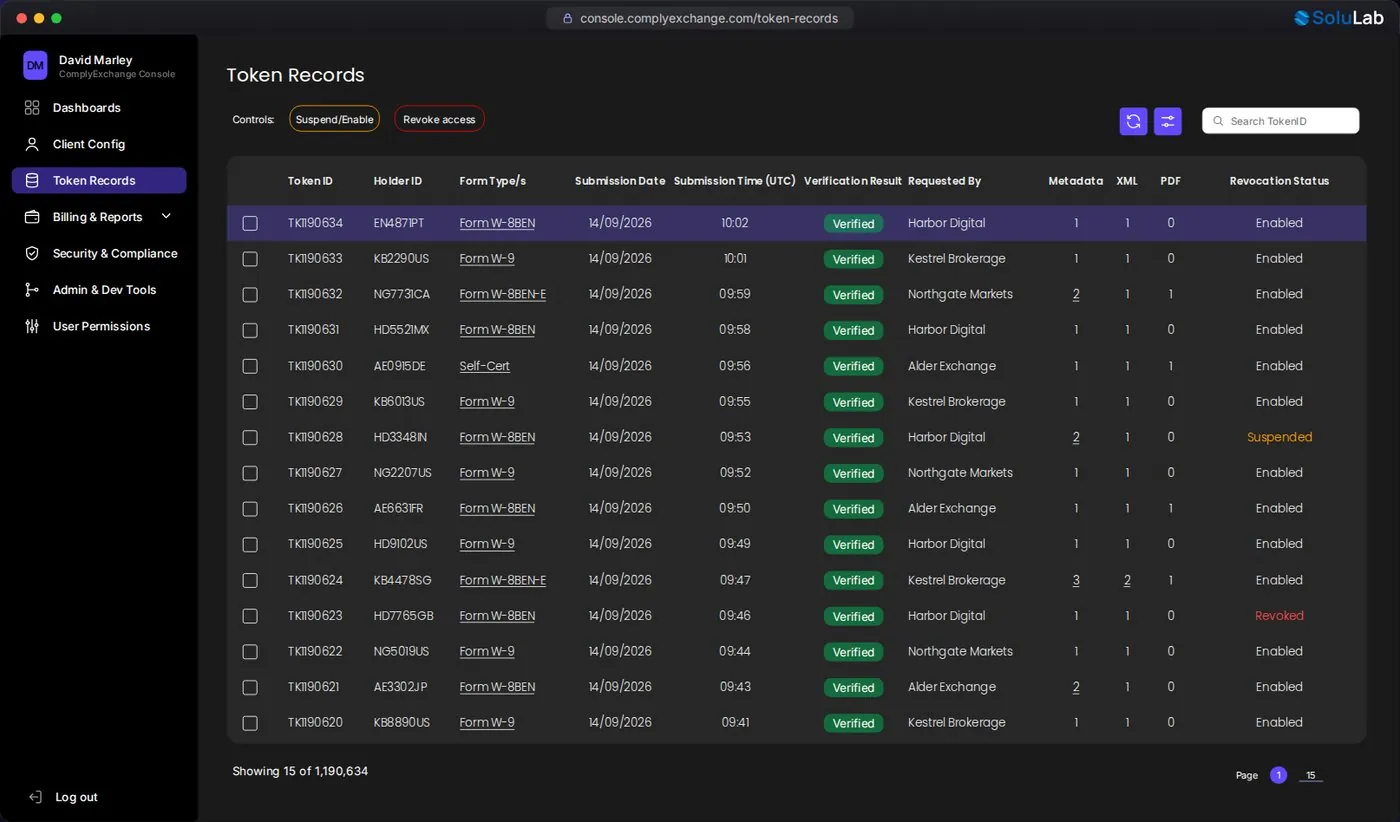
ComplyExchange validates tax forms for exchanges and financial platforms. When an auditor asks which form was in force on a given day, and whether anyone changed it since, the answer had to be assembled from disconnected systems.

  • ✕Verified W-8 and W-9 records lived across form databases, file shares and email threads, with no single source of truth.
  • ✕Proving a form's history relied on internal logs that could be edited and were hard to defend in an audit.
  • ✕Superseded forms stayed active alongside newer ones, leaving room for withholding decisions on the wrong record.
  • ✕Forms carry names, addresses and tax identifiers, so nothing sensitive could ever become public.
  • ✕Bulk processing of historical documents risked silent failures, and client teams needed strictly scoped, read-only access.

The SoluLab Solution

SoluLab designed and built an AI-powered tokenization platform that keeps sensitive data private and makes every verified state change provable.

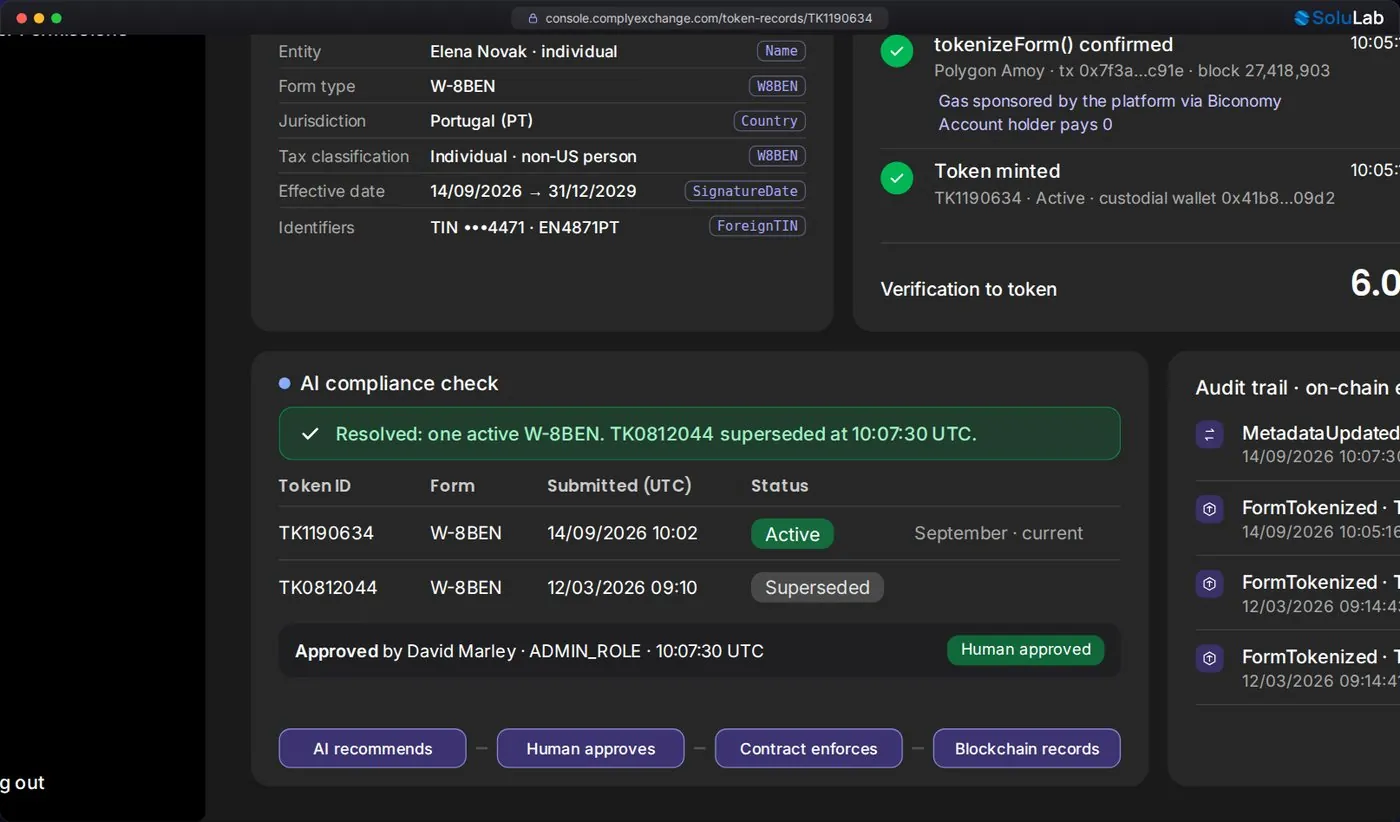
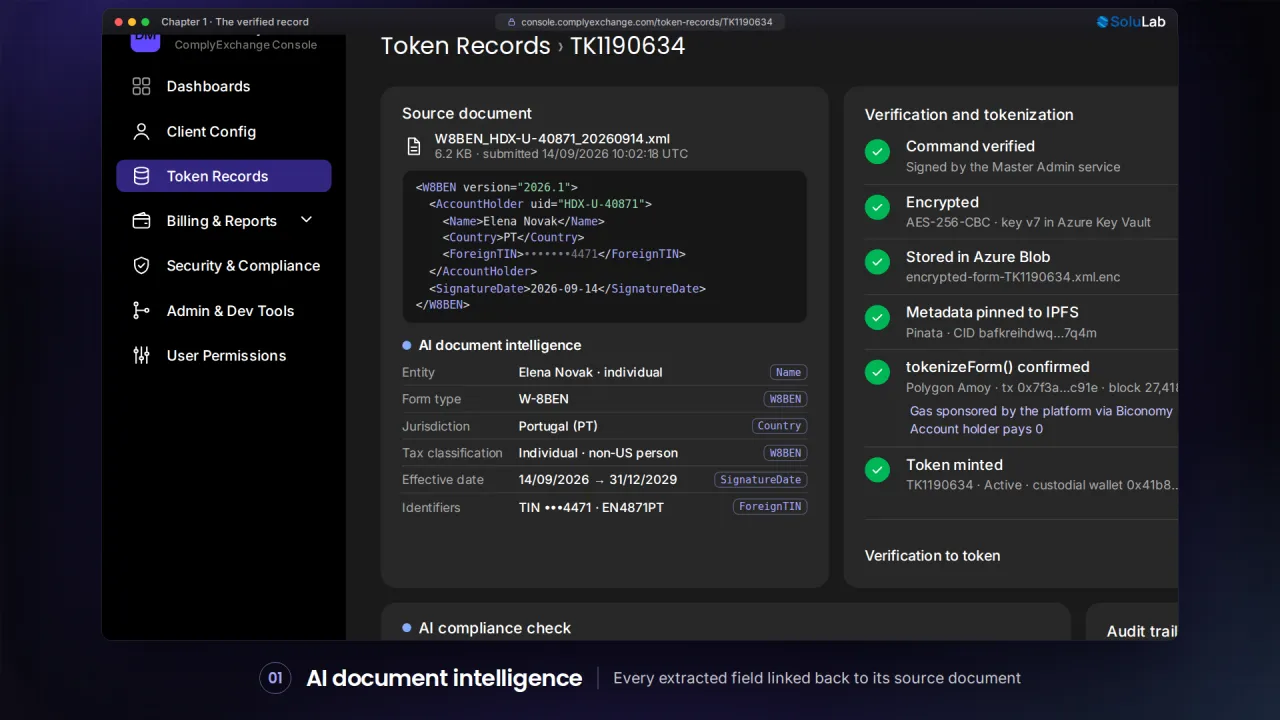
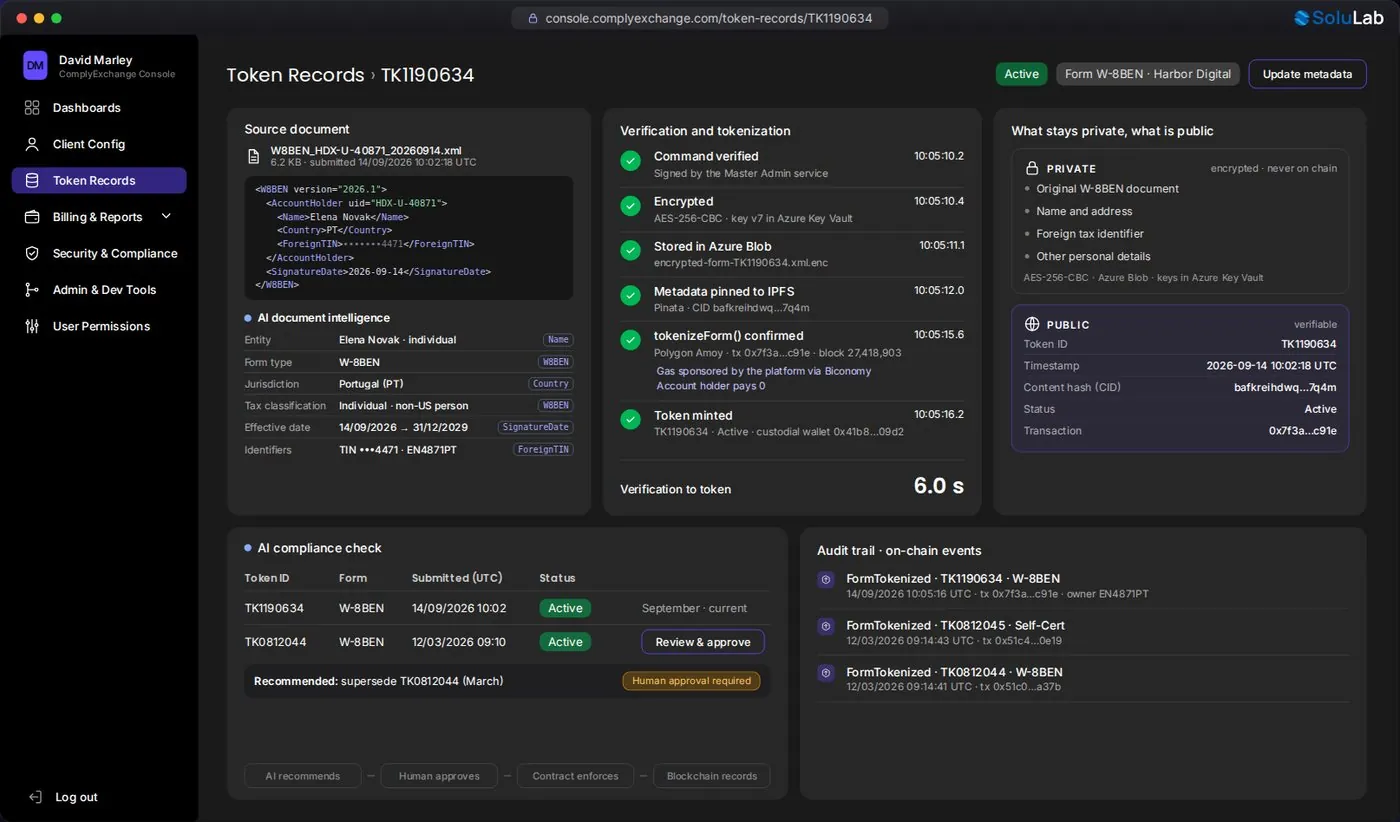
  • ✓AI document intelligence extracts entity, form type, jurisdiction, classification, effective date and identifiers, each linked to its source.
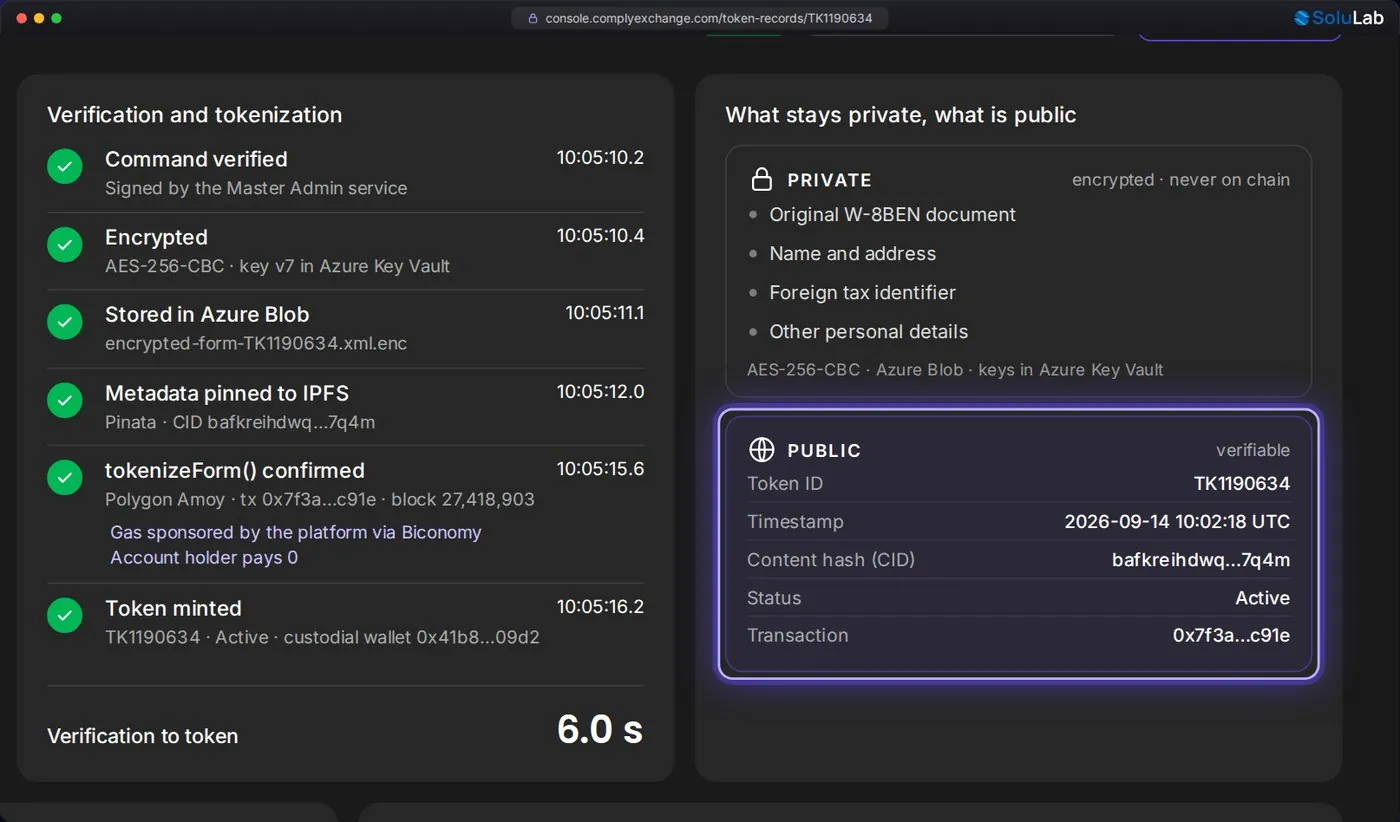
  • ✓Each verified form is encrypted with AES-256-CBC, stored in Azure Blob, and minted as a token on Polygon in about six seconds.
  • ✓Public IPFS metadata holds only a token ID, timestamp, content hash and transaction reference; personal data never goes on chain.
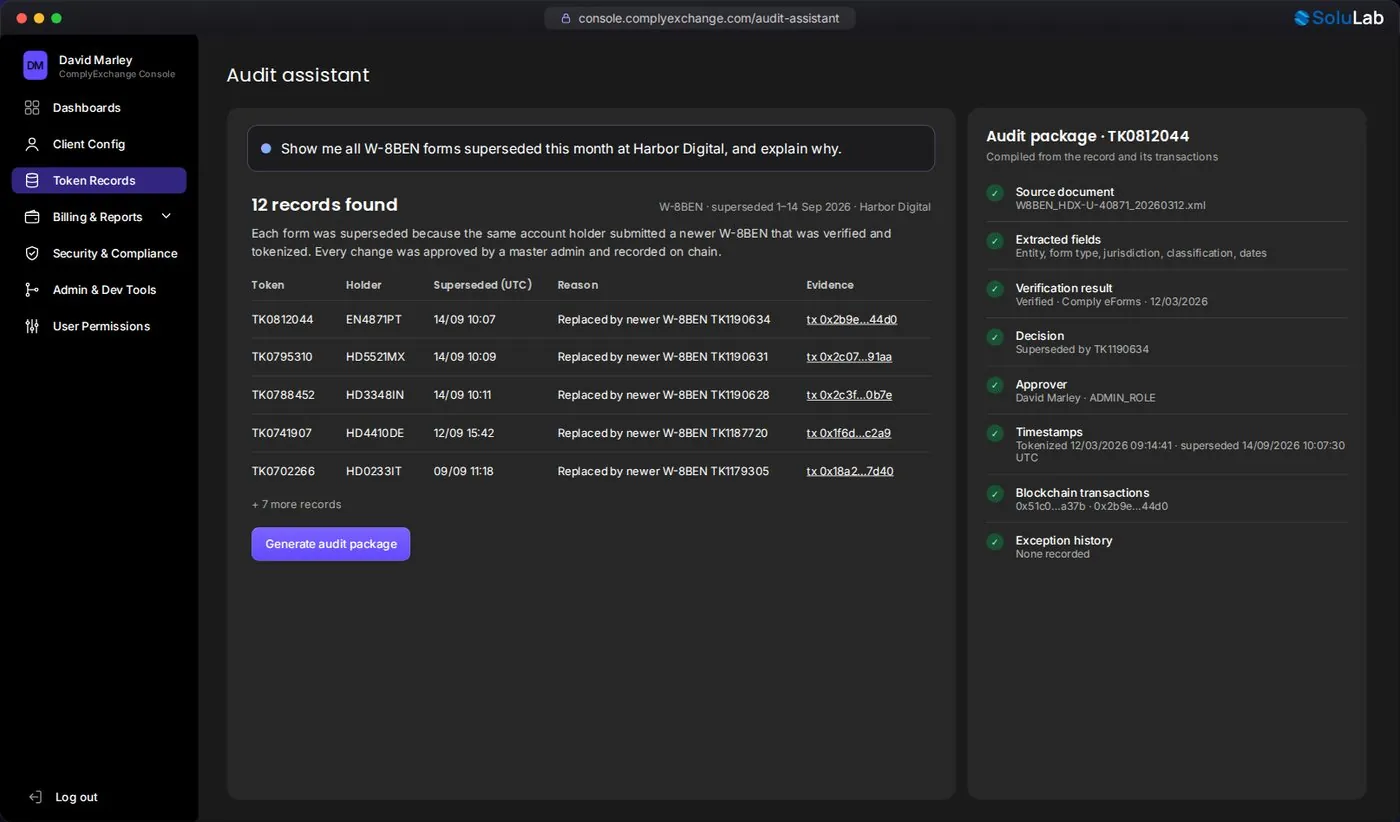
  • ✓An AI compliance check flags duplicate forms and recommends supersession; a master admin approves and the smart contract records it.
  • ✓Gasless transactions through Biconomy and custodial wallets mean account holders never pay or manage gas.
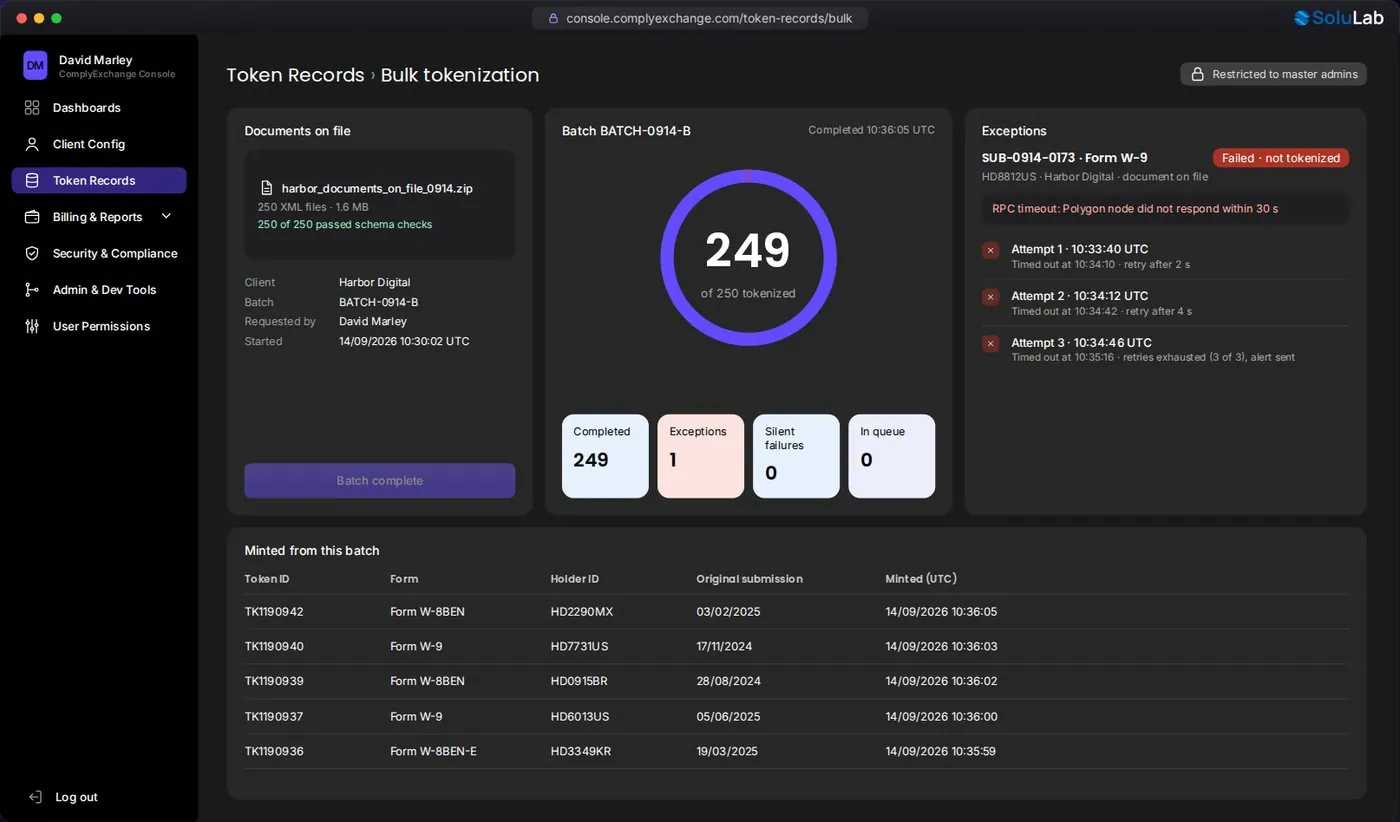
  • ✓Retries with exponential backoff, alerts and a failed queue turn every failure into a visible, recoverable exception.
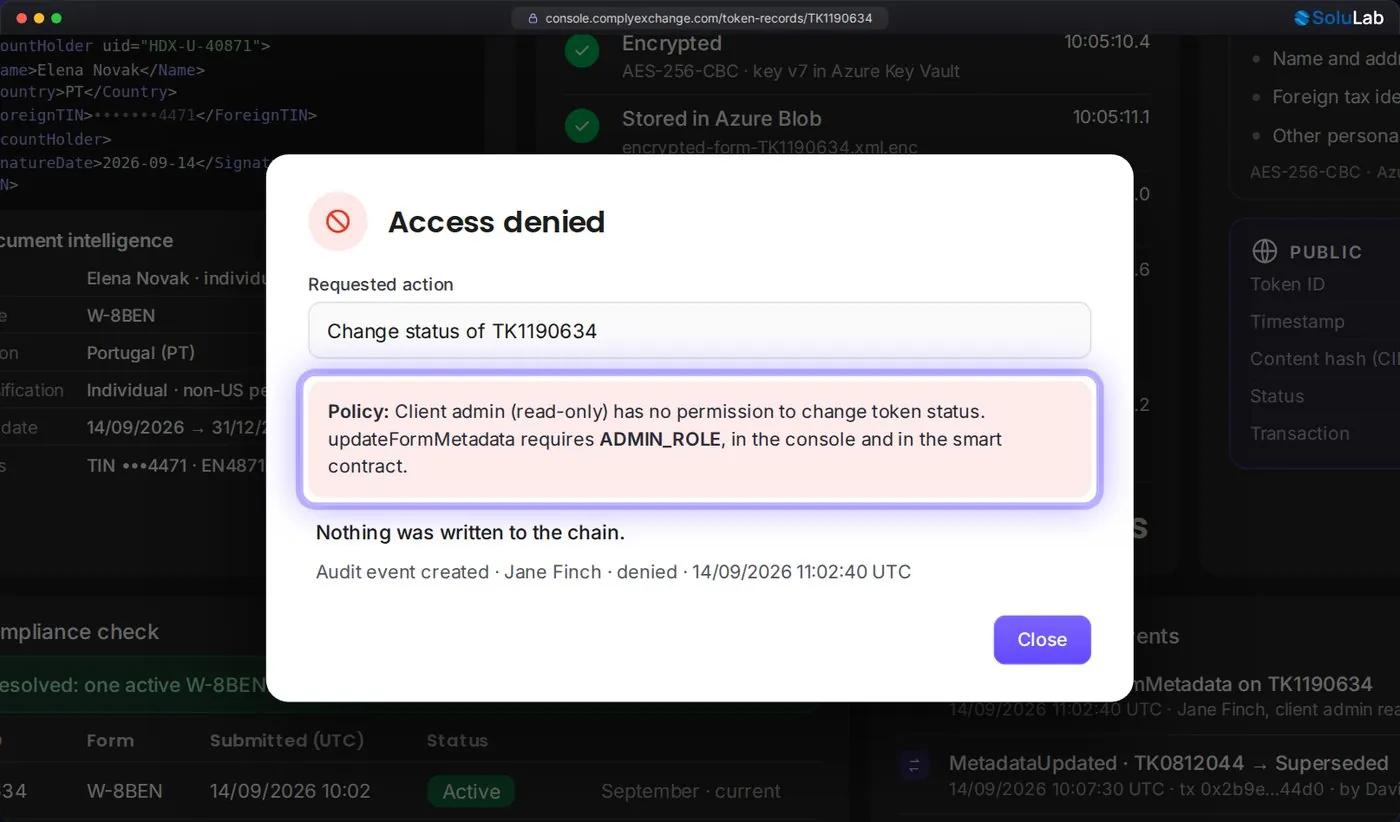
  • ✓Role-based access is enforced in the console and in the smart contract, with every denied attempt logged.

Solution Architecture

We used Azure AI Document Intelligence because it runs inside ComplyExchange's Azure tenant and returns a confidence score and source region per field, so low-confidence values go to human review. Polygon PoS gave us EVM tooling at fees low enough to write every supersession, Biconomy's EIP-712 relayer removes gas from custodial wallets, and the IPFS CID on chain proves metadata integrity while PII stays encrypted in Azure.
Taher PittalvalaAI Practice Head, SoluLab

Why AI and Blockchain: Our Technology Decisions

We chose each technology for a specific compliance problem. AI does the reading and checking that slows teams down. Blockchain provides evidence that a record's history has not been changed. Neither replaces the people who make the decisions.

Why AI

Reading tax forms and spotting conflicts by hand is slow and inconsistent at scale.

Document intelligence
Extracts entity, form type, jurisdiction, classification and effective date from XML, PDFs and scans, and links every field to its source so reviewers can check it.
Compliance checks
Spots duplicate and conflicting forms, such as two active W-8BENs for one account holder, and recommends the right action.
Audit assistant
Answers audit questions in plain language and compiles audit packages, with every answer linked to its evidence.
Human in control
AI recommends; a master admin approves every high-impact change before anything is written.

Why Blockchain

Internal logs can be edited, so on their own they are hard to defend in an audit.

History that can be verified
Every tokenization and status change is a Polygon transaction, so a form's history can be checked independently, not just taken on trust.
One shared record
ComplyExchange, its client exchanges, account holders and auditors all look at the same record.
Rules enforced in code
The smart contract only accepts status changes from ADMIN_ROLE, so permissions hold even outside the console.
Privacy kept
Only a token ID, timestamp, content hash and transaction reference go public. Personal data stays encrypted off chain.

Key technology choices

DecisionWhy we chose it
PolygonLow, predictable fees and fast confirmation for high form volumes, on an EVM chain with mature tooling.
IPFS via PinataContent-addressed metadata: the hash proves the record matches what was originally pinned.
Azure Blob + Key VaultEncrypted private storage and managed key rotation in ComplyExchange's existing cloud environment.
Biconomy relayerGasless transactions and custodial wallets, so account holders never handle crypto or keys.
UUPS upgradeable contractContract logic can improve over time while token data and history are kept.
Human approval stepAI handles volume and spots conflicts; people stay accountable for decisions that change a record.

The result: AI makes compliance faster and more consistent. Blockchain makes each outcome verifiable. People stay in control of every decision in between.

Product Experience

Measurable Results

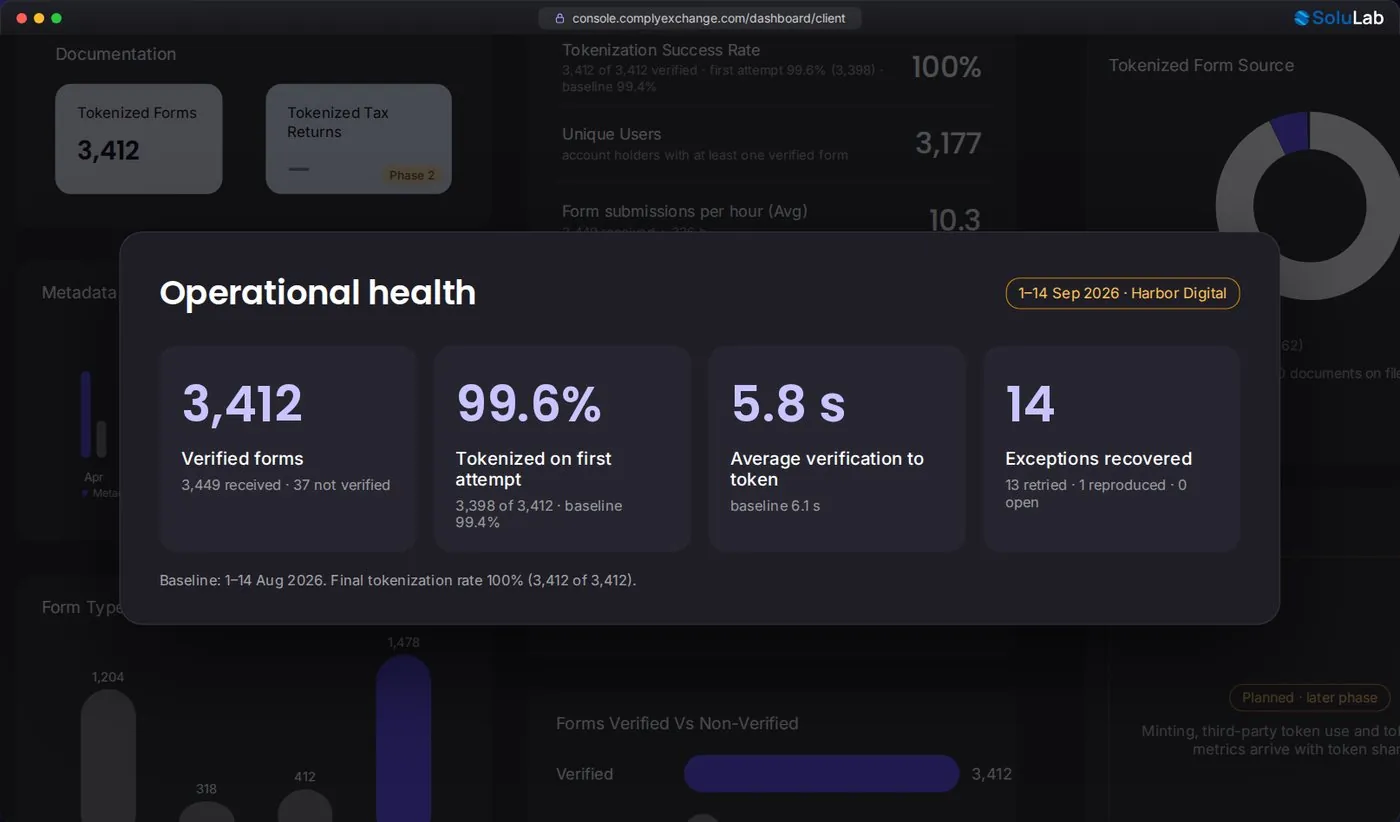
6.0sVerification to minted token
99.6%Forms tokenized on the first attempt
100%Failed transactions recovered
0Personal data fields on chain
0Unauthorized writes accepted

Client Validation

David Marley
SoluLab turned our verified tax forms into records we can actually prove. Every form, every change and every approval now has evidence behind it, which has made audit preparation and client conversations far more straightforward.
David Marleyin
CEO, ComplyExchange

Technology & Integrations

PolygonSolidityOpenZeppelinHardhatEthers.jsBiconomyIPFSPinataAzure Blob StorageAzure Key VaultAzure ADNode.jsReactREST APIsPostgreSQLRedisDockerKubernetesGitHub ActionsAI Document Intelligence

Frequently Asked Questions

1. What does the platform tokenize?

Verified W-8 and W-9 tax forms, including W-8BEN, W-8BEN-E and self-certifications. Each verified form becomes a token on Polygon that points to its encrypted file and its public metadata.

2. Is any personal data stored on the blockchain?

No. Names, addresses and tax identifiers stay in the encrypted form file in Azure Blob Storage. The public layer holds only the token ID, form type, timestamp, content hash and transaction reference.

3. What does AI do in the workflow?

AI extracts key fields from each document and links them to their source, flags potential duplicates or conflicts and recommends an action, and answers audit questions in plain language with links to the underlying evidence.

4. Can AI change a record on its own?

No. AI recommends; a master admin approves high-impact decisions such as superseding a form. The smart contract then enforces the change and records it on chain.

5. What happens when a form is replaced?

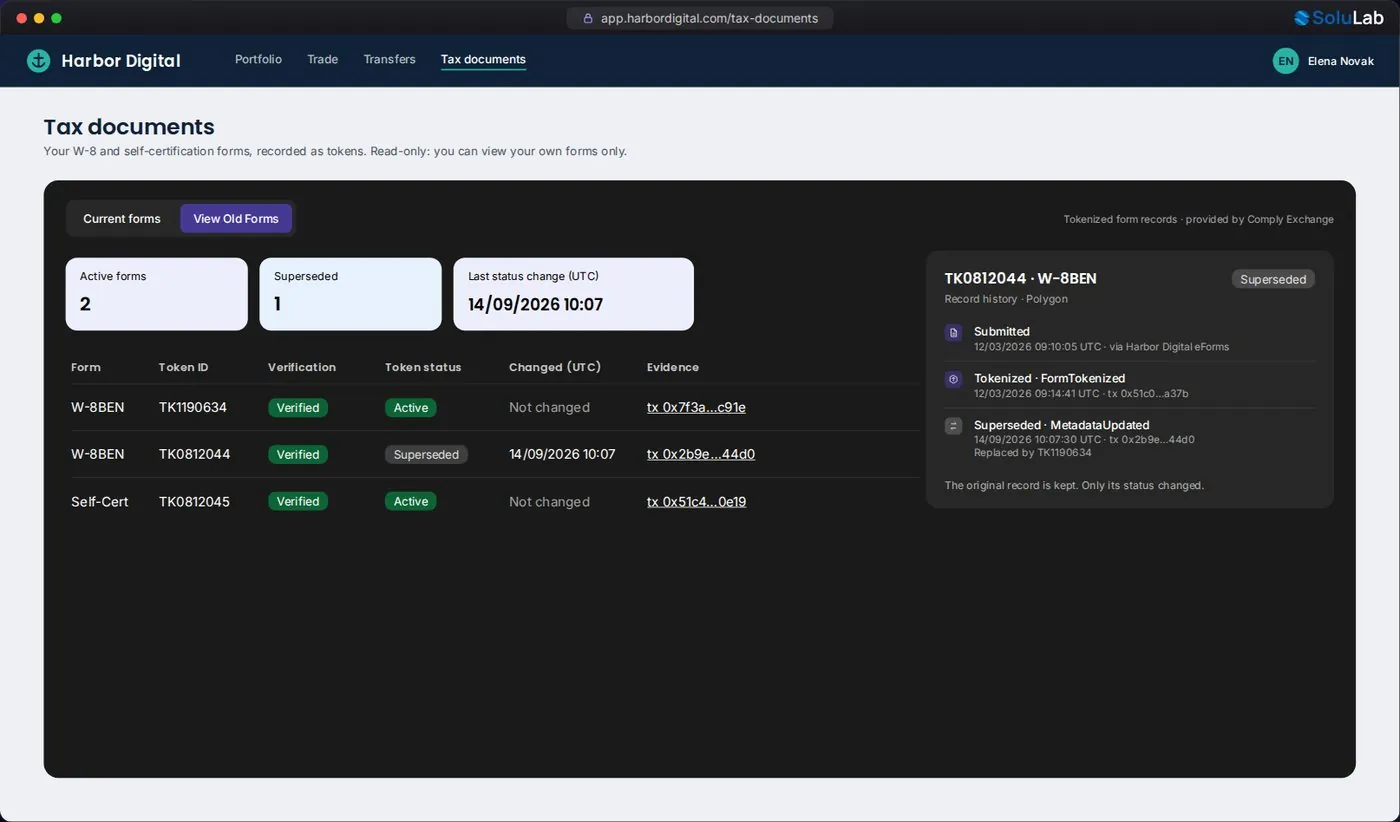
The earlier token is marked Superseded through updateFormMetadata. It is never deleted, so its full history remains visible to the account holder, the client and auditors.

6. Who pays for blockchain transactions?

The platform sponsors gas through the Biconomy relayer using EIP-712 signatures and custodial wallets, so account holders never pay fees or manage keys.

7. How are failed transactions handled?

The engine retries up to three times with exponential backoff. If it still fails, the record moves into an explicit exception state, admins are alerted, and an operator can reproduce it from the failed queue. Every attempt stays in the audit trail.

8. How is access controlled?

Through role-based access control in the Master Admin service and the smart contract. Client admins are scoped to their own organization, and metadata updates require ADMIN_ROLE. Denied attempts are logged.

9. Can large backlogs of historical forms be processed?

Yes. Master admins can bulk-tokenize documents on file. Each form is validated, encrypted and minted, and any exception is isolated without blocking the rest of the batch.

10. Can the smart contract be upgraded?

Yes. The contract uses the UUPS upgradeable proxy pattern from OpenZeppelin, so logic can evolve while token data and history are preserved.