Artificial intelligence is becoming one of the most important technologies used in the global economy. As AI systems influence industries, national security, and digital infrastructure, many governments are focusing on sovereign AI to maintain control over their data and technology.
Instead of relying entirely on foreign AI platforms or models, countries are investing in building their own AI systems trained on local data and hosted on domestic infrastructure.
This approach helps governments protect sensitive information, support local innovation, and ensure AI systems reflect their language, culture, and regulations. It also reduces dependence on a few global tech providers that currently dominate AI development.
As a result, sovereign AI is emerging as a strategic priority for nations that want to strengthen technological independence while preparing their economies for an AI-driven future.
Key Takeaways
- The Issue: Numerous nations are dependent on international AI systems, posing threats to data sovereignty, national security, regulatory oversight, and dependency on third-party technological ecosystems in terms of vital AI services.
- The Solution: Sovereign AI will allow countries to develop and own their own AI models, infrastructure, and data ecosystems, which will guarantee feasibility in the security of their point as well as in compliance and technological sovereignty.
- How SoluLab Can Help: SoluLab assists organizations in designing, developing, and implementing sovereign AI solutions, such as custom AI models, the development of LLM, secure data infrastructure, and scalable AI systems in accordance with national regulations.
What Is Sovereign AI?
Sovereign AI means the capacity of a nation to create, supervise,e and execute artificial intelligence infrastructures in its own infrastructure, data, capability, and regulatory system, without depending on external AI platforms and suppliers.
According Mckinesy the sovereign AI opportunity could expand to 600 billion market by 2030.
Sovereign AI, in simple terms, implies that a country can create and manage its own AI ecosystem, consisting of data centers, AI models, and governance policies, and still make sure that the sensitive data and technology remain nationalized.
Key Elements of Sovereign AI
- Local infrastructure Domestic AI infrastructure Domestic data centres, local computing, and cloud resources.
- National AI models: Large language models, or AI systems that are trained on local datasets.
- Data sovereignty: Data acquired by citizens and the government is stored and processed on the national territory.
- The regulatory control: AI systems that are controlled by local legislation, privacy, and ethical rules.
- Local expertise and innovation: AI creation with the help of local researchers, startups, and businesses.
Why Is Sovereign AI Important?
The sovereign AI is becoming a strategic priority in most countries because artificial intelligence is beginning to affect all aspects of economic development, national security, and technological independence in the world’s digital economy.
- Data Sovereignty and Privacy: With Sovereign AI, countries can store sensitive citizen, government, and enterprise information domestically. This decreases the use of foreign platforms and follows the domestic privacy and data protection rules.
- National Security Protection: The AI technologies’ impact on the cybersecurity and defense systems, as well as on the intelligence processes. The sovereign AI allows governments to manage important AI infrastructure and mitigate the risks of relying on external technology providers.
- Economic Competitiveness: By creating local AI services and systems, companies can make their countries more resilient to innovation and generate high-value jobs, enabling local startups and businesses to develop AI-driven products and services.
- Technological Independence: The development of AI models and AI infrastructure by countries means that they would be less reliant on tech giants in the world, and that they would have a higher degree of control over AI development, implementation, and future technological trends.
- Localized AI Innovation: Sovereign AI can be used to develop models specific to local languages, culture, and region, so that governments and companies can build AI systems that are more aligned with national interests.
Read More: AI Infrastructure as a Service [AIaaS]
How Enterprises Will Benefit from Sovereign AI?
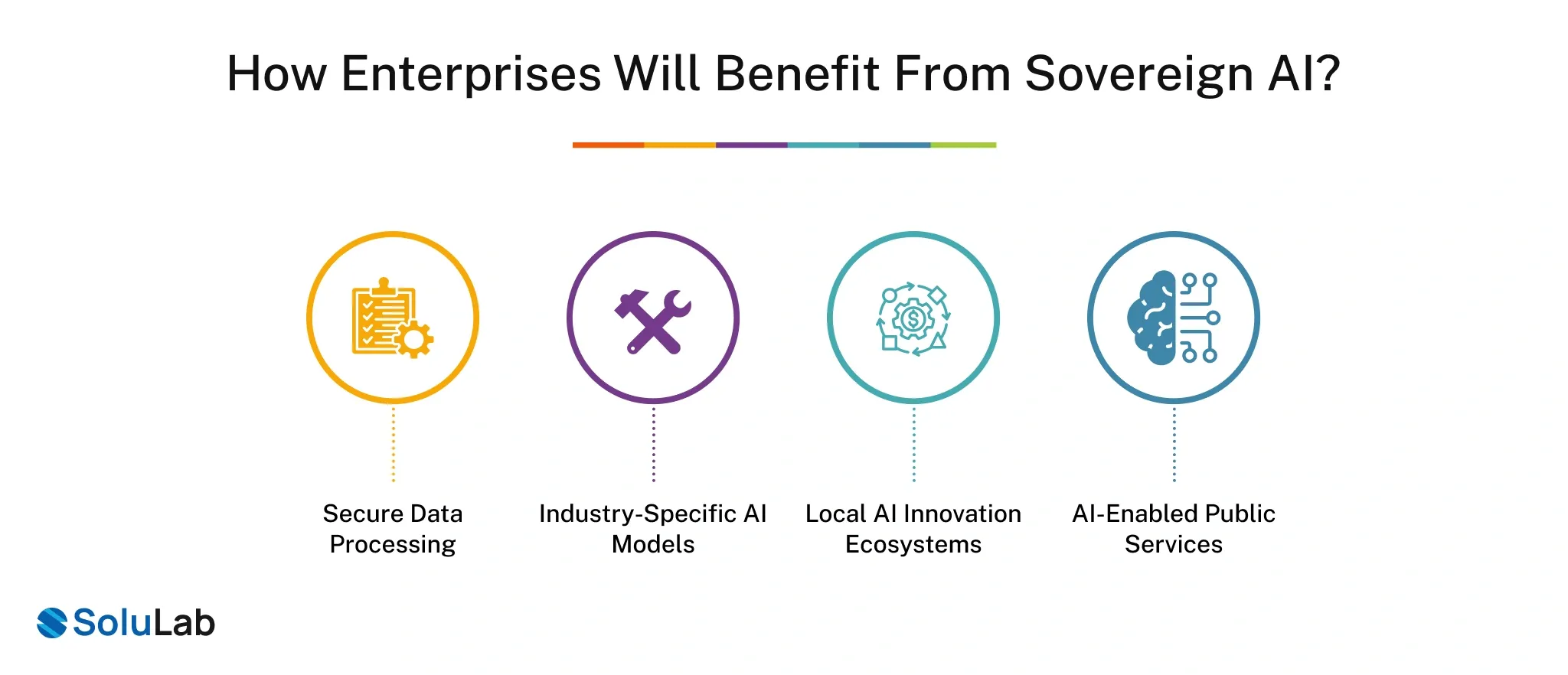
Sovereign AI is becoming a business asset and tool of government, and with it, organizations can build AI systems as a part of the national infrastructure and retain control over sensitive information, regulatory frameworks, and technological innovations.
- Secure Data Processing: Sovereign AI allows businesses to handle delicate business and customer information in the national infrastructure. This enhances data security, regulatory compliance, and lowers risk conflicts that are related to cross-border data storage and third-party AI systems.
- Industry-Specific AI Models: The AI models that are developed by organizations can be specific to the local industries, including healthcare, banking, manufacturing, and retail. These industry-specific models apply national data in order to provide more precise insights and automation solutions that are industry-specific.
- Local AI Innovation Ecosystems: The sovereign AI programs promote partnership between businesses, start-ups, academic institutions, and governments. This enhances the national AI capacity, quickens innovation, and provides a business opportunity to deploy advanced AI technologies in the country.
- AI-Enabled Public Services: The sovereign AI systems that governments can implement to enhance the provision of services to the population, including healthcare management, digital governance, transport planning, and citizen engagement, can be more effective and data-driven, and can be utilized to improve all aspects of the national infrastructure.

Technologies Used in Sovereign AI
Sovereign AI is based on superior technologies where nations are able to develop, train, and implement AI systems on their own systems. These technologies allow high-level data control, scalable computing power, and autonomous AI innovation.
- Machine Learning Models: Machine learning models take input data sets in large quantities, and then they recognize patterns, make automatic decisions, and create insights. They are applied to project analytics predictively by governments and enterprises, to monitor and prevent cybercrimes, detect fraud, and plan policies.
- Large Language Models (LLMs): Large language models are used to support conversational AI, document analysis, and knowledge automation. Nations generate country-specific LLMs, which are trained with the local language, laws, and culture, to guarantee control of data and localized AI functionality.
- High-Performance Computing (HPC): High-performance computing has huge processing capabilities needed to train complicated AI models. With the help of national supercomputers and GPU clusters, it is possible to process data faster, conduct large-scale simulations, and conduct advanced AI studies.
- AI Superclusters: AI superclusters are assemblies of thousands of GPUs and high-speed networking to generate and deploy AI models on a large scale. They offer the computing basis required to develop sovereign AI and national AI infrastructure.
- Edge AI Infrastructure: Edge AI operates on data at the point of origin, e.g., devices, sensors, or local servers. This enhances the privacy of data, minimizes latency, and enables governments to utilize AI applications in real time settings.
- AI Cloud Platforms: AI cloud platforms offer scalable AI model construction, training, and implementation infrastructure. Sovereign clouds enable nations to retain and compute highly confidential information domestically whilst remaining regulatory and security-wise compliant.
Real-World Sovereign AI Initiatives
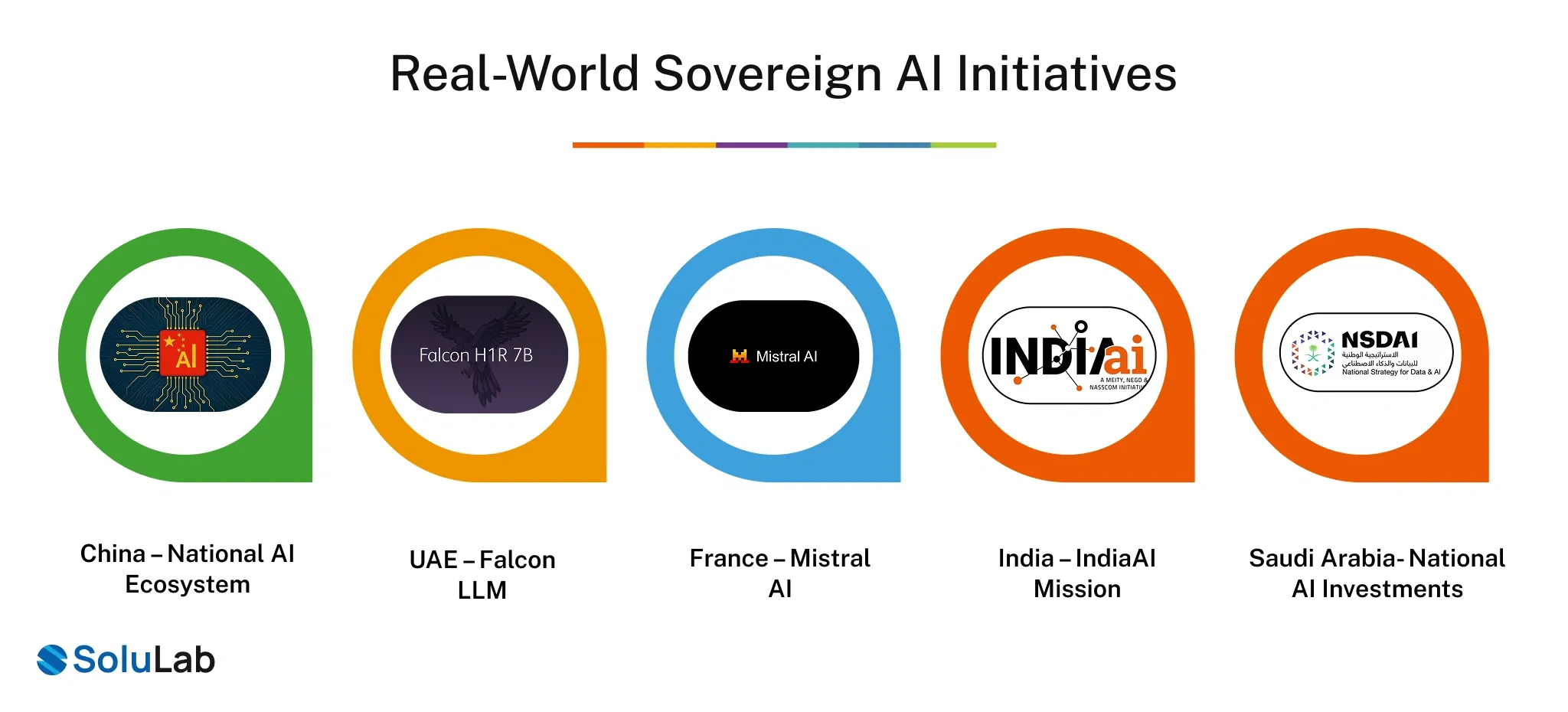
Governments globally are investing in sovereign artificial intelligence projects to establish autonomous AI, enhance technological dominance, safeguard country information, and diminish dependency on external artificial intelligence infrastructure and systems.
1. China – National AI Ecosystem
A state-supported AI ecosystem of combining homegrown AI models, supercomputing facilities, and government-driven innovation initiatives is being developed by China to be at the forefront of artificial intelligence-based technologies as well as digital sovereignty.
2. UAE – Falcon LLM
The UAE introduced Falcon, an effective open-source large language model created by the Technology Innovation Institute, a move that solidifies the national intent to establish itself as an AI hub in the world, as well as sovereign AI infrastructure.
3. France – Mistral AI
France is a proponent of Mistral AI, one of the most successful European AI companies that develops high-quality language models. The project signifies the European quest to have sovereign AI to lessen reliance on AI platforms situated in the US.
4. India – IndiaAI Mission
The IndiaAI Mission aims to develop national AI infrastructure, data platforms, and computing capabilities. The Government of India has selected Sarvam under the IndiaAI Mission to build India’s sovereign Large Language Model.
5. Saudi Arabia- National AI Investments
Through national plans and international relationships, Saudi Arabia is allocating billions in AI to build AI infrastructure, hire AI experts, and establish the nation as a key AI innovation hub in the Middle East.
The Future of Sovereign AI
IDC predicts that the world’s artificial intelligence technology expenditure will surpass half a trillion by 2027, which indicates the fast pace of global investment in sovereign AI projects.
The next stage of global technology leadership is being defined by sovereign AI, with countries investing in AI infrastructure, models, and partnerships at home. This enhances innovation, competition in the economy, and the independence of countries on digital age.
- Regional AI Ecosystems: To increase their speed of innovation, facilitate local AI creation, and lessen reliance on external technology vendors, countries are forming regional AI ecosystems, which unite institutions of research, startups, cloud infrastructure, and government efforts.
- Sovereign LLMs: Countries are creating national-scale large language models that are trained on local data, languages, and rules. Such models also assist governments in keeping sensitive information under control and assist the national industries and state services.
- AI Cooperation between the government and private sector: Sovereign AI development is becoming a necessity that requires public-private partnerships. Governments cooperate with AI firms, higher education, and technology vendors to establish infrastructures and models and speed up the use of AI in industries.
- AI Geopolitics: The development of artificial intelligence is emerging as a geopolitical resource as nations vie for leadership in AI app development and semiconductor value chains, and compute infrastructure, defining the overall economic impact and national security policy.
How SoluLab Helps Organizations Build Sovereign AI Solutions?
Those organizations that are interested in developing sovereign AI systems need secure infrastructure, bespoke AI models, and robust data governance. SoluLab assists businesses and governments in creating scalable AI ecosystems that enable independent, secure, and compliant AI innovations.
- AI strategy consulting
- LLM development
- enterprise AI infrastructure
- AI model deployment
- data governance systems
- AI integration services

Conclusion
The sovereign AI is turning into a strategic priority because nations want to gain more control over information, technology infrastructure, and domestic innovation.
Governments can build up security, enhance economic growth, and decrease their reliance on foreign platforms by building their own AI models and ecosystems. As national investments in AI capabilities keep rising, localized, secure AI solutions will also benefit organizations.
SoluLab, an AI consulting company, can help your business design, build, and deploy scalable AI solutions aligned with evolving sovereign AI ecosystems and enterprise needs.
FAQs
Neha is a curious content writer with a knack for breaking down complex technologies into meaningful, reader-friendly insights. With experience in blockchain, digital assets, and enterprise tech, she focuses on creating content that informs, connects, and supports strategic decision-making.