Key Takeaways
- Deloitte’s latest AI maturity research shows that organizations with higher AI maturity consistently capture more digital value and ROI from their AI programs.
- Most enterprises are testing generative and agentic AI, but only a minority have mature strategies for governance, integration, and workforce readiness.
- A structured AI maturity framework aligns AI integration services, AI implementation services, and AI consulting and integration with clear business outcomes and risk appetite.
- Without a maturity model, custom AI integration, ChatGPT integration services, and generative AI integration services often stall at the proof-of-concept stage.
- Mature enterprises invest across leadership, strategy, data, architecture, culture, and governance, not just in tools or isolated use cases.
- As an AI integration partner, SoluLab uses AI maturity frameworks to design phased, secure roadmaps for enterprise AI integration, agentic AI integration, and AI agents integration that scale.
Artificial intelligence is no longer a standalone initiative. Organizations are embedding AI across operations, products, and customer experiences, making a structured adoption strategy essential. In 2026, an AI maturity framework is the difference between scattered pilots and enterprise-wide AI success.
A well-defined framework helps businesses assess their AI readiness, prioritize high-impact use cases, and build a roadmap for successful implementation. Whether you’re planning AI integration services, generative AI, LLM integration, or agentic AI deployment, an AI maturity framework ensures every investment aligns with business goals and delivers measurable value.
In this guide, we’ll explain what an AI maturity framework is, why it matters, its key stages, implementation best practices, and how organizations can use it to scale AI in 2026.
What Is an AI Maturity Framework in 2026?
An AI maturity framework in 2026 is a structured model that evaluates how ready your organization is to design, integrate, govern, and scale AI across business processes.
It measures maturity across stages of AI adoption (from basic automation to AI-first organization design) and across dimensions like leadership, strategy, data, technology, workforce, and governance.
Deloitte’s AI maturity analysis concludes that organizations at higher maturity levels deliver more value from AI initiatives and are better positioned to turn experimental technologies into stable, revenue-generating capabilities.
Why Does AI Maturity Matter for AI Integration Services and AI Implementation Services?
AI maturity is the leading indicator of whether AI integration services and AI implementation services will translate into durable business value.
For an AI integration company or AI integration partner, your maturity level determines:
- How clearly business outcomes and KPIs are defined.
- Whether your data and architecture can support enterprise AI integration.
- How prepared are your teams to adopt AI-driven workflows.
- How strong your governance and AI security practices are.
Without a maturity framework, organizations often jump into integration projects before they are ready, creating brittle systems, shadow AI tools, and unclear accountability for AI outcomes.
SoluLab’s own AI consulting services emphasize readiness assessment and phased adoption to avoid exactly these pitfalls.
What Are the Core Levels of AI Maturity?
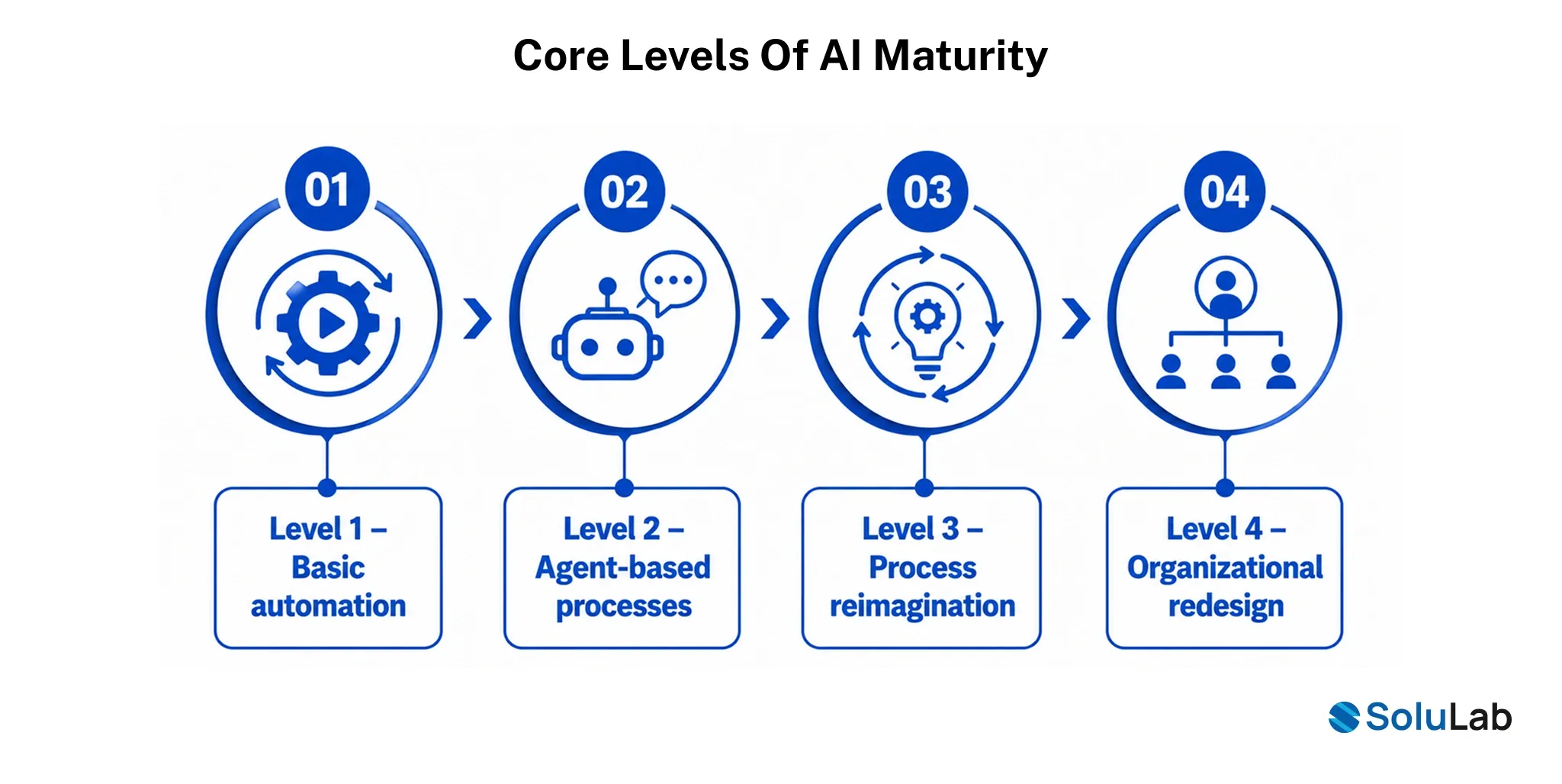
While models vary, recent thought leadership on AI maturity describes four broad levels that are highly relevant to integration and implementation decisions.
Typical AI maturity levels
- Level 1 – Basic automation
Rules-based scripts, RPA, and isolated bots in individual teams without a broader AI strategy. - Level 2 – Agent-based processes
Early agentic AI integration and AI agents integration in select workflows such as support, analytics, and simple orchestration. - Level 3 – Process reimagination
AI implementation services redesign end-to-end processes using custom AI integration, data-driven decisioning, and secure orchestration. - Level 4 – Organizational redesign
AI maturity drives new operating models, AI-first products, and integrated AI across functions with strong governance and culture.
SoluLab’s integration and platform work is typically focused on moving clients from Levels 1-2 into Levels 3-4 through structured AI Integration Services and AI consulting engagements.
How Does AI Maturity Impact Enterprise AI Integration and Custom AI Integration?
Enterprise AI integration means connecting AI capabilities to core systems, data platforms, and business processes across departments. Custom AI integration tailors AI solutions to your specific workflows and industry context.
If your AI maturity is low, premature enterprise AI integration can result in:
- Siloed data and inconsistent sources of truth.
- Unclear ownership for AI models and agents.
- Change-resistant teams and broken processes.
- Security and compliance gaps around AI usage.
At higher maturity, organizations approach integration with:
- Well-articulated AI roadmaps and prioritized use cases.
- Unified data architectures ready for AI.
- Clear governance and AI risk frameworks.
- Cross-functional ownership and monitoring.
SoluLab’s work as an AI Development Company focuses on structured design, integration, and deployment of AI-native systems, ensuring that custom AI integration aligns with maturity level and business goals.
Why Is AI Maturity Critical for Generative AI Integration Services and LLM Integration Services?
Generative AI integration services and LLM integration services (including ChatGPT integration services) are powerful but can be risky when maturity is low.
Common issues in low-maturity environments include:
- Unmanaged use of external LLMs with sensitive data.
- Lack of policies for AI-generated content and decisions.
- No clear escalation or human review for critical outputs.
An AI maturity framework ensures that generative AI integration services and LLM integration services are deployed with:
- Strong data grounding through authorized sources and pipelines.
- Access controls, logging, and audit trails for AI interactions.
- Content, decision, and risk review processes.
- Monitoring for performance, bias, and safety over time.
SoluLab’s Generative AI Consulting Company offering combines consulting and implementation to help enterprises move beyond experiments to scalable generative AI systems. Its ChatGPT Development Company service covers integration with CRM, ERP, websites, and apps under enterprise-grade controls.
How Does AI Maturity Guide Agentic AI Integration and AI Agents Integration?
Agentic AI integration and AI agents integration introduce autonomous or semi-autonomous agents that can reason, call tools, and orchestrate workflows without continuous human prompts.
Because agents act with more autonomy, they require higher levels of maturity in:
- Scope definition: clearly specifying what each agent can do, and where humans review decisions.
- Tooling and integration: connecting agents to CRMs, ticketing systems, data platforms, and security controls.
- Governance and AI security: aligning agent behavior with compliance, risk management, and organizational policies.
Recent enterprise AI research indicates that many organizations are piloting agentic AI without robust governance, increasing operational and reputational risk.
SoluLab’s article on building AI agent platforms shows a maturity-aligned, five-step delivery model strategic evaluation, custom agent design, integration and deployment, testing and optimization, and post-launch improvement that reduces this risk.
What Dimensions Should Your AI Maturity Framework Cover?
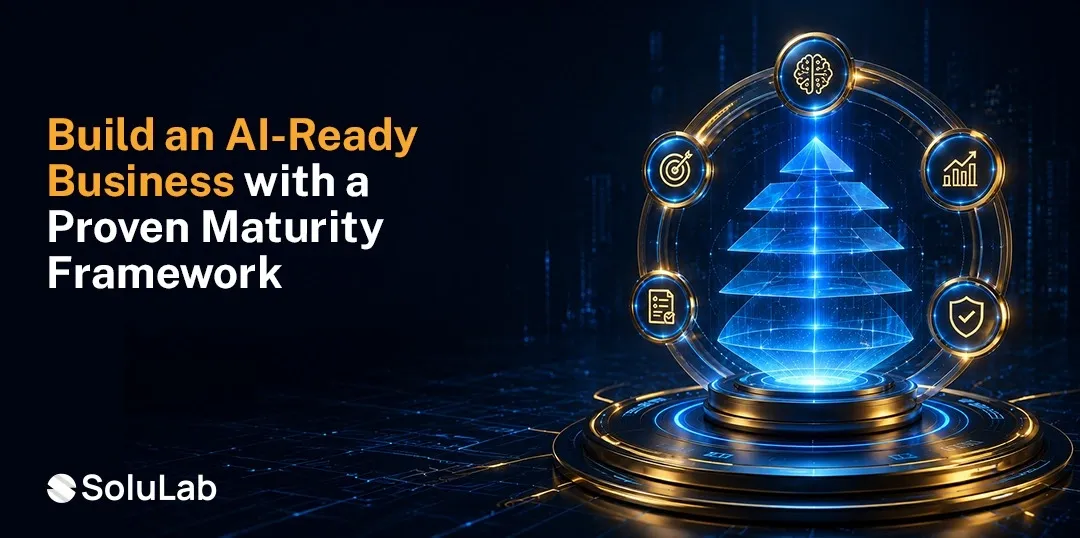
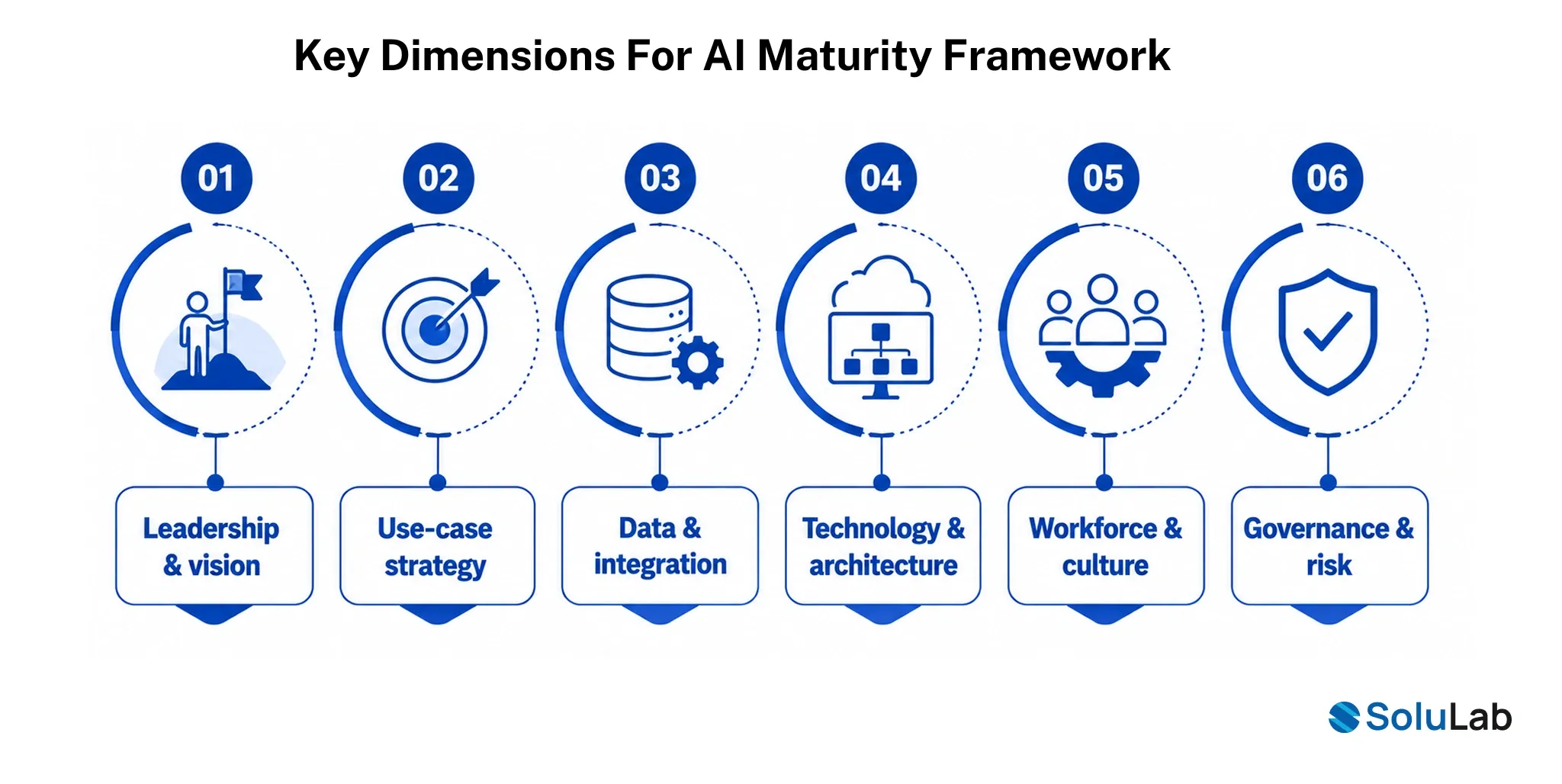
A robust AI maturity framework for 2026 should evaluate maturity across at least six dimensions, which then inform integration decisions.
Key dimensions
- Leadership & vision: Executive understanding of AI’s role and clear sponsorship for AI initiatives.
- Use-case strategy: Prioritized portfolios of AI implementation services mapped to business outcomes.
- Data & integration: Data quality, integration depth, and readiness for enterprise AI integration and custom AI integration.
- Technology & architecture: Cloud platforms, AI tooling, security stack, and integration capabilities.
- Workforce & culture: AI literacy, skills, and willingness to adopt AI-driven workflows.
- Governance & risk: Policies, oversight, and AI security frameworks for generative and agentic AI.
SoluLab’s AI Consulting Services use these dimensions to diagnose readiness and shape phased roadmaps across integration and agent deployments.
How SoluLab Approaches AI Consulting and Integration Using AI Maturity?
SoluLab’s AI consulting and integration approach is grounded in AI maturity best practices from analyst research and real-world delivery.
SoluLab’s maturity-aware approach
- Assessment and strategy
- Evaluate current maturity using structured models.
- Identify high-impact use cases for AI integration services and AI implementation services.
- Pilot design and delivery
- Launch targeted pilots (e.g., generative AI integration services for a content team, LLM integration services for support).
- Keep humans in the loop and define success metrics.
- Integration and hardening
- Extend integrations into CRM, ERP, data platforms, and security systems.
- Implement monitoring, observability, and AI security controls.
- Scale and multi-agent orchestration
- Move successful pilots into enterprise AI integration.
- Introduce agentic AI integration and AI agents integration with clear governance.
By combining AI consulting and integration, SoluLab acts as both an AI integration partner and a strategic advisor, helping enterprises move up the AI maturity curve in a controlled way.
Best Practices for AI Integration Partner Engagement in 2026
Engaging an AI integration company or AI integration partner in 2026 should follow maturity-based best practices.
- Anchor integration around AI maturity.
Use a structured framework to assess readiness and set realistic expectations. - Start with high-impact, feasible use cases.
Avoid trying to “AI everything” at once; focus on where AI can change outcomes quickly. - Design for integration, not isolation.
Ensure all AI solutions connect to core systems and data, instead of becoming new silos. - Embed AI security and governance early.
Use checklists and frameworks to cover access controls, data protection, model oversight, and compliance. - Iterate based on maturity progression.
Revisit your AI maturity framework regularly and adjust integration plans as capabilities grow.
SoluLab’s AI Solutions That Solve Real Business Problems emphasize outcome-first design, integration depth, and long-term support, which align well with these best practices.
Conclusion
In 2026, the importance of an AI maturity framework is that it turns AI from a series of disconnected pilots into a disciplined, enterprise capability. Organizations that invest in AI maturity across leadership, strategy, data, architecture, culture, and governance are the ones that succeed with custom AI integration and enterprise AI integration, making AI agents integration and generative AI part of their operating fabric instead of short-lived experiments.
As a top AI development partner in USA, SoluLab is well positioned to help you build and execute your AI maturity roadmap. If you’re ready to move your organization up the AI maturity curve and design a roadmap for AI integration that actually scales, the next step is to engage SoluLab for AI consulting and integration aligned to your current maturity level and future ambitions.
FAQs
Shipra Garg is a tech-focused content strategist and copywriter specializing in Web3, blockchain, and artificial intelligence. She has worked with startups and enterprise teams to craft high-conversion content that bridges deep tech with business impact. Her work translates complex innovations into clear, credible, and engaging narratives that drive growth and build trust in emerging tech markets.