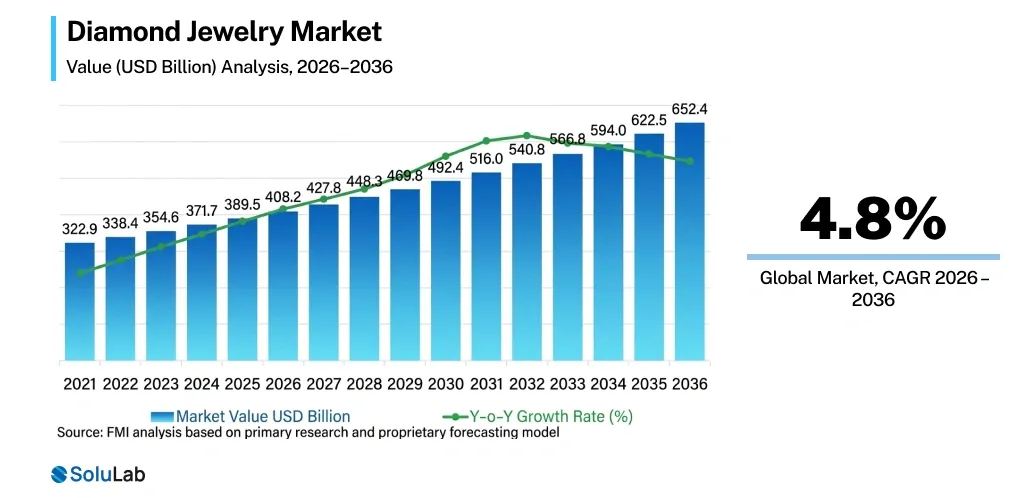
As of Q1 2026, the global diamond jewelry market is expected to reach $408.2 billion, yet it remains one of the most illiquid asset classes. While gold tokenization has already proven the model with over $5.3 billion in on-chain value, diamond tokenization is the next frontier for institutional RWA (Real-World Asset) portfolios.
With MiCA (EU) and the SEC’s 2026 Joint Staff Statement providing the necessary legal guardrails, SoluLab’s asset tokenization development services are transforming static gemstones into programmable financial instruments. By moving beyond simple “digital twins,” we enable fractional ownership and DeFi-collateralization for diamonds. This creates a borderless liquidity layer that rivals traditional precious metal tokenization benchmarks.
Key Takeaways
- Diamond tokenization reduces liquidity discounts and improves resale value through structured pricing and faster market access
- Tokenized diamonds can generate passive income through lending models while maintaining long-term asset exposure
- Real-time pricing, Proof of Reserve, and cross-chain systems improve trust and capital efficiency for investors
- Multi-asset portfolios combining diamonds, gold, silver, and carbon assets are shaping institutional strategies in 2026
Solving the $400B Liquidity Trap: The ROI of Diamond Tokenization
The traditional diamond market is valued at $106.76 billion in 2026. It has historically suffered from a 25% to 35% “liquidity discount”. The loss in value an investor takes when trying to sell a physical stone quickly. Precious meta Tokenization eliminates this friction, transforming a static stone into a high-velocity financial asset.
1. Better Price Discovery Through Standardization
One of the biggest issues in digital diamond token investing has always been inconsistent pricing. Even with certifications, valuations can vary widely depending on the buyer, location, and urgency of sale.
- Tokenization addresses this by linking each asset to structured data layers such as certification records, grading details, and market benchmarks.
- When combined with real-time pricing feeds, this reduces subjectivity in valuation.
- In practical terms, improved transparency can recover a meaningful portion of value lost in negotiations.
With some estimates pointing to around 10%–15% better price realization compared to traditional resale scenarios.
2. Transparent Supply Chains Improve Asset Credibility
Traceability has become a serious concern, especially for institutional investors. Questions around sourcing, authenticity, and ethical compliance often impact how assets are priced and whether they are considered investable at all.
- With tokenization, each diamond can carry a verifiable audit trail from origin to ownership, recorded on-chain.
- This creates a clear record of provenance and reduces reliance on manual verification.
- There is also a growing trend toward linking such assets with sustainability layers.
For example, integrating carbon offset data alongside asset records helps align with ESG regulations expectations, which are increasingly influencing capital allocation decisions in 2026.
3. From Idle Assets to Income-Generating Collateral
Traditionally, diamonds are passive assets. They sit in vaults and only generate returns if their value appreciates over time.
- Tokenization introduces a different approach. Once represented as digital assets, diamonds can be used within financial ecosystems, including lending and liquidity pools.
- This opens up the possibility of earning yield without selling the underlying asset.
Depending on platform structure and risk exposure, tokenized diamonds used as collateral may generate approximately 4% to 7% annual returns, while still allowing investors to benefit from long-term price appreciation.
4. Faster Settlement and Capital Efficiency
Selling a physical diamond is rarely quick. The process often involves shipping, inspection, negotiations, and delayed payments. In many cases, this can take weeks to complete.
- Tokenized assets, on the other hand, can be transferred and settled almost instantly on blockchain networks.
- This reduces settlement timelines from 30+ days to near real-time execution.
The impact goes beyond speed. Faster settlement improves overall capital efficiency, allowing investors to reallocate funds quickly across assets instead of waiting for liquidity events to complete.

How Does Diamond Tokenization Work?
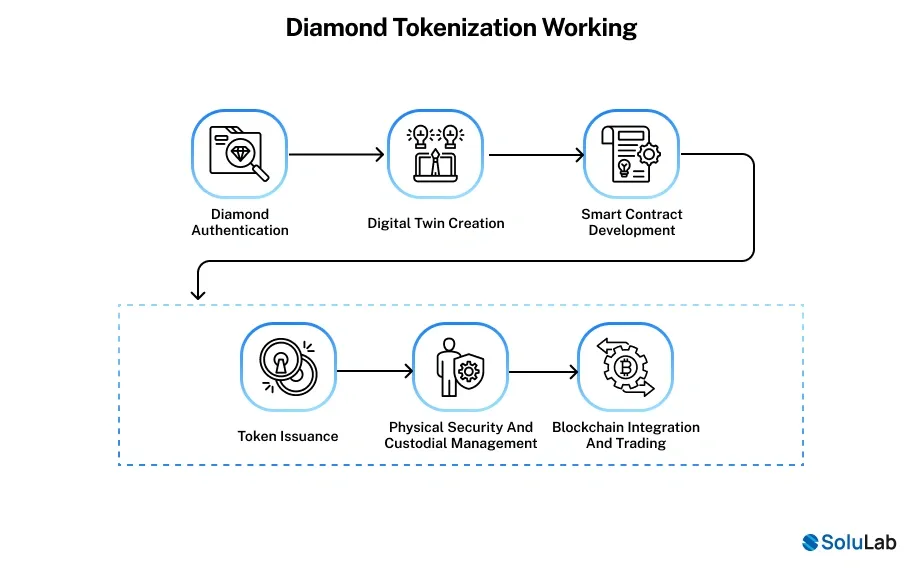
Tokenizing a diamond encompasses more than just affixing a digital identifier to a tangible gemstone. It is a safe, multi-faceted procedure that integrates professional authentication, sophisticated imaging, and blockchain technology to create a reliable digital asset. From physical vaults to digital smart contract development, each phase is engineered to preserve the diamond’s integrity while facilitating ownership, trading, and investment.
Let’s walk through the entire diamond tokenization procedure:
1. Diamond Authentication
The procedure starts with the authentication of the diamond’s validity. Prominent gemological organizations such as GIA (Gemological Institute of America) and IGI (International Gemological Institute) do comprehensive assessments based on the 4Cs—Carat, Cut, Color, and Clarity. In addition to laboratory certification, professionals conduct a physical check to verify the absence of inconsistencies. Each diamond is thereafter allocated a distinct identification number, serving as its digital fingerprint all over the tokenization process.
2. Digital Twin Creation
Upon authentication of the actual diamond, a digital twin is created. This includes:
- 3D scanning of the diamond to create an exact virtual copy.
- Acquiring high-resolution photos and details, including shape, grading data, and origin.
- Documenting all relevant information, including certification and history, inside a secure system.
- Issuing authentication certificates that validate the digital twin’s association with the physical diamond.
- The digital twin assures that each token is explicitly linked to an individual diamond with transparent, verifiable information.
3. Smart Contract Development
The blockchain layer is now implemented. A smart contract is programmed to delineate the behavior of the tokenized asset. This contains:
- Provenance tracking to demonstrate the whole ownership history.
- Protocols for ownership transfer facilitate smooth P2P transactions.
- Security measures that safeguard against fraud or illegal modifications.
- Custodial arrangements specify the location of the physical diamond and its management protocols.
These smart contracts function as the regulatory framework, ensuring that transactions are carried out automatically, clearly, and enforceably.
4. Token Issuance
Upon the implementation of a smart contract, a digital token is generated on the blockchain. The main elements of this phase are:
- Choosing a token standard such as ERC-721 (non-fungible) or ERC-1155 (semi-fungible) according to the investment model.
- Associating the token with its information, including diamond specifications, photos, and certifications.
- Enabling digital signatures for safe traceability.
- Registering the token on NFT marketplace platforms, preparing it for trade or investment.
The token now serves as a digital certificate of ownership for the underlying diamond.
5. Physical Security and Custodial Management
The tokens are exchanged digitally, but the real diamonds are securely stored in insured vaults monitored around the clock. These fortified establishments offer:
- Third-party verification to confirm the existence of the diamond and its correspondence with the token data.
- Asset-backed insurance protects the value of the diamond against theft or damage.
This ensures that your diamond-backed cryptocurrency token is consistently linked to a tangible, safely held item.
6. Blockchain Integration and Trading
The currencies are ultimately implemented on prominent blockchain networks like Ethereum, Polygon, or Solana, contingent upon considerations including scalability, gas costs, and compatibility. Investors may transact these tokens on dedicated markets, and systems may provide fractional ownership, enabling the acquisition of a share in a high-value diamond without requiring a substantial financial outlay.
Thus, diamond tokenization converts a premium asset into a liquid, safe, and accessible investment. It is a harmonious integration of tangible assets and digital advancements, facilitating a more inclusive diamond economy.
Read more: Top RWA Tokenization Questions Answered for Enterprises Ask in 2026
How Blockchain-Based Tokenization Transforms Diamond Investing?
Diamond tokenization is shifting from basic digitization to AI-powered financial infrastructure, where assets are not just stored but actively utilized across liquidity networks.
1. Real-Time Pricing with AI + Oracle Integration
Modern platforms combine AI models with blockchain oracles (Chainlink, Pyth) to continuously update diamond valuations based on 4C data, global demand, and historical trends. This reduces pricing gaps and enables near real-time trading decisions.
2. Verified Ownership with Proof of Reserve (PoR)
Each token is backed by diamonds stored in insured vaults, with Proof of Reserve systems ensuring 24/7 asset verification. This removes reliance on manual audits and increases institutional trust.
3. Cross-Chain Liquidity and Asset Mobility
Using cross-chain protocols (CCIP), diamond tokens can move across Ethereum, Polygon, and Solana. This allows investors to access broader liquidity pools and integrate with DeFi ecosystems.
Use case: Billiton Diamond & Ctrl Alt
The project was initiated in February 2026, supported by Ripple’s institutional-grade custody and the XRP Ledger (XRPL). Here are the three key points of their initiative:DeFi Integration & Yield Generation: The platform pioneered the use of diamonds as high-quality collateral. By tokenizing these physical assets, they allowed institutional and retail investors to lock their tokens into DeFi lending pools, generating a 4%-6
Read Also: Tokenized US Treasury Platform Development
The Perks of Investing in Tokenized Diamonds
Diamonds have long been considered a store of value, but most people cannot afford them due to their high price, complex pricing, and storage problems. Currently, diamond investment is entering the contemporary age through blockchain-enabled tokenization.
Here are some standout benefits of diamond tokenization:
- Facilitates Micro-Investment in Luxury Assets
Tokenization enables investment in micro-shares of high-value diamonds, allowing individuals to incrementally accumulate wealth in luxury goods, much like purchasing fractional shares of blue-chip stocks.
- Integrated Liquidity Pools for Instant Liquidation
Certain platforms include integrated liquidity pools that facilitate immediate buybacks or peer-to-peer transactions, allowing you to liquidate your tokens at your discretion without awaiting a buyer.
- Real-Time Asset Valuation and Pricing Data Streams
Blockchain oracles and sophisticated connections enable tokenized diamonds to be connected to real-time market data, providing dynamic values rather than obsolete evaluations.
- Verification of Carbon Offsetting and Ethical Sourcing
As environmental and ethical concerns escalate, blockchain facilitates the certification of ethically sourced diamonds, enabling eco-conscious investors to match their portfolios with their principles.
- Facilitated Collateralization for Decentralized Finance Loans
Upon tokenization, diamonds may serve as collateral for cryptocurrency loans or DeFi lending platforms, facilitating liquidity without the necessity of liquidating the physical asset, an impossibility under conventional diamond ownership.
- Potential of Gamification and Collectibles
NFTs and diamond tokens provide gamified experiences, diamond-backed collectibles, and branded luxury experiences associated with ownership, adding an emotional and engaging dimension to investing.
- Effortless Inheritance and Digital Bestowing
Diamond tokens provide seamless transfer to heirs, cross-border gifting, and division among numerous beneficiaries, hence streamlining legacy planning and personal asset transfers.
Tokenization is revolutionizing investment by converting diamonds into programmable, shareable, and tradable digital assets, therefore altering our interaction with value itself.
Read more: Silver Tokenization Platform Development
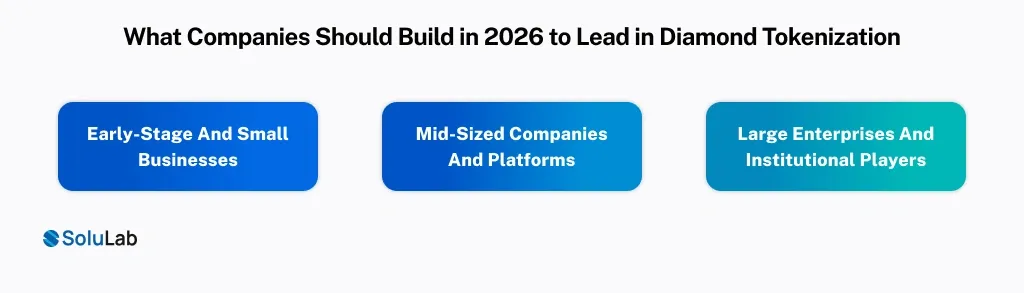
What Companies Should Build in 2026 to Lead in Diamond Tokenization
The shift toward tokenized diamonds is already underway, but the real advantage in 2026 comes from how businesses position themselves within this ecosystem.
Different companies don’t need the same strategy. The right approach depends on scale, capital, and market positioning.
Below is a practical breakdown of what to focus on.
1. Early-Stage and Small Businesses
Smaller players entering tokenization should avoid overbuilding and focus on speed.
What to prioritize:
- Single-asset tokenization (individual certified diamonds)
- Basic smart contract infrastructure (ERC-721 or ERC-1155)
- Third-party custody and insurance integration
- Marketplace listing for liquidity access
This allows faster go-to-market without heavy capital investment, while still offering fractional ownership and digital liquidity.
Goal: Validate demand and build initial investor trust
2. Mid-Sized Companies and Platforms
At this stage, differentiation becomes important. Just tokenizing diamonds is not enough.
What to build:
- AI-assisted pricing engines using market and grading data
- Oracle integrations for real-time valuation
- Proof of Reserve systems for asset verification
- Partial DeFi integration (collateralized lending or liquidity pools)
Investors now expect transparency, pricing consistency, and some level of yield opportunity.
Goal: Move from digital asset access to financial utility
3. Large Enterprises and Institutional Players
For larger companies, the opportunity lies in building ecosystems, not just products.
What to implement:
- Multi-asset tokenization (diamonds, gold, silver, carbon credits)
- Cross-chain infrastructure (Ethereum, Polygon, Solana interoperability)
- Built-in compliance layers aligned with MiCA and global regulations
- Integrated DeFi strategies for yield generation and asset utilization
Institutional capital flows toward platforms that offer liquidity, compliance, and portfolio-level integration.
Goal: Create a unified digital asset platform, not just a tokenization service.
Conclusion
As the investment structure is evolving in 2026, tokenized diamonds are emerging as a compelling asset class. Their ability to combine the timeless value of diamonds with the leading-edge potential of blockchain solutions makes them an attractive option for investors seeking liquidity, transparency, and diversification.
- As the market continues to grow, it’s clear that tokenized diamonds will play a pivotal role in the future of digital investment portfolios.
- At SoluLab, a top asset tokenization development company, we specialize in providing custom solutions that empower businesses to capitalize on the growing tokenization trend.
- From smart contract creation and blockchain integration to secure platforms for trading tokenized assets, SoluLab provides tailored solutions that align with your unique business goals.
Whether you’re a jeweler, investor, or startup aiming to launch a diamond-backed token, SoluLab delivers the technical expertise and strategic guidance to bring your vision to life. Let’s connect!
FAQs
Deepika is a content writer who blends storytelling with strategic thinking. She explores topics across digital innovation, emerging tech, and the evolving blockchain industry. She enjoys breaking down complex ideas into simple, engaging narratives in the growing global markets.