
Stablecoin adoption in Europe is entering a new phase.
With the implementation of MiCA Regulation for stablecoins, launching a euro backed or cross border stablecoin is no longer an experimental blockchain initiative. It is a regulated financial product initiative.
That shift fundamentally changes how stablecoin development must be approached.
Under MiCA, architecture determines compliance. Minting logic, reserve management, issuer control, and auditability are no longer design choices. They are regulatory obligations.
For enterprises exploring stablecoin platform development in Europe, the real challenge is not deploying a token; it is building a MiCA ready stablecoin platform that satisfies regulators, scales operationally, and supports cross border payments.
Key Takeaways
- Compliance-First Architecture: Move from simple tokens to regulated money systems where compliance is baked into the code.
- 1:1 Fiat Reserve Backing: Guarantee value with segregated, 1-to-1 fiat reserves for every E-Money Token issued.
- EU-Wide Passporting: Scale effortlessly across 27 EU member states with a single MiCA-compliant license.
- Hybrid Data Logic: On-chain transparency for balances; off-chain security for sensitive KYC and risk data.
What Is a MiCA Stablecoin?
A MiCA stablecoin is a digital asset issued under the European Union Markets in Crypto Assets regulation framework.
In most cases, fiat backed stablecoins in the EU qualify as e-money tokens.
Under MiCA Regulation for stablecoins, these tokens must:
- Be backed one-to-one by a single fiat currency
- Be redeemable at par value at all times
- Be issued by a licensed entity
- Maintain segregated reserves
- Operate under full issuer control
This means MiCA compliant stablecoins function as regulated electronic money in tokenized form. They are not governance-driven crypto assets. They are supervised monetary instruments. Understanding this distinction is essential before starting enterprise stablecoin development.
How MiCA Regulation for Stablecoins Changes Stablecoin Platform Development?
Before MiCA, stablecoin projects often separated technology from compliance.
Onboarding was handled by wallets.
Sanctions screening was pushed to exchanges.
Reserve disclosures were periodic and external.
The token contract itself remained largely autonomous.
That model no longer works in Europe.
MiCA for stablecoins removes the distance between issuance and accountability. The issuer is no longer indirectly responsible. The issuer is directly accountable for how the system behaves at all times.
That includes the ability to guarantee redemption on demand, halt issuance immediately if required, freeze circulation under lawful instruction, and demonstrate that token supply mirrors segregated reserves.
These are not operational conveniences. They are statutory expectations under MiCA Regulation for stablecoins.
This fundamentally changes AI powered stablecoin development.
Instead of building a token first and layering compliance around it, enterprises must design a compliance-controlled system where minting, burning, and reporting are tightly governed by an issuer-controlled infrastructure.
- When redemption fails, it is not a technical incident.
- When reserve reconciliation lags, it is not an operational glitch.
Under MiCA, those are compliance breaches.
That is why enterprise stablecoin development in Europe must center around a structured compliance control plane supported by auditable reserve integration and controlled smart contract execution.
In this regulatory environment, architecture is not separate from compliance.
Architecture is compliance.
Once you understand what a MiCA-compliant stablecoin is, the next question becomes practical.

What actually needs to be built?
Enterprise stablecoin development under MiCA is not about launching a token quickly. It is about engineering a regulated money system that behaves predictably under supervision.
That system must include several tightly integrated components.
- First, a compliance control infrastructure.
The issuer must be able to manage onboarding, sanctions screening, transaction monitoring, and jurisdiction rules in a controlled environment. These controls cannot live at the edge of the system. They must sit at the center. - Second, a structured mint and redeem framework.
Euro backed stablecoin development requires fiat-first logic. Tokens cannot be minted before cleared funds are confirmed in segregated accounts. Redemption must trigger coordinated burn and settlement flows without delay. - Third, reserve segregation and reconciliation systems.
MiCA-compliant stablecoins must maintain one-to-one backing with legally isolated reserve accounts. This requires continuous reconciliation pipelines between banking systems and token supply data. - Finally, reporting and audit infrastructure.
Stablecoin adoption in Europe is accelerating because regulators now expect structured transparency. Issuers must generate supply reports, reserve attestations, and compliance logs in formats suitable for supervisory review.
When these layers operate together, stablecoin platform development moves from experimentation to regulated execution.
White Label Stablecoin Platform vs Custom Stablecoin Development
Enterprises evaluating stablecoin ecosystem development typically face an early strategic choice.
Should they adopt a white label stablecoin platform, or pursue custom stablecoin development?
A white label stablecoin platform can reduce time to market. It often includes pre-built token contracts, compliance modules, and reserve tracking tools. For fintechs entering the market quickly, this approach can provide a structured starting point.
However, MiCA Regulation for stablecoins places full accountability on the issuer. Even when using a white label model, the licensed entity remains responsible for redemption guarantees, reserve integrity, and regulatory reporting.
This is where custom stablecoin development becomes attractive.
With a custom approach, enterprises can design:
- Issuer-controlled mint and burn workflows
- Tailored compliance rule engines
- Dedicated reserve management structures
- Cross-border stablecoin platform capabilities
- Upgrade logic aligned with regulatory expectations
Banks and institutional issuers launching a euro-based institutional stablecoin often prefer custom development because it aligns with internal risk and governance standards.
The right approach depends on licensing status, scale ambitions, and operational maturity. Under MiCA, speed matters. Structural correctness matters more.
MiCA Ready Stablecoin Platform Architecture for EU Compliant Stablecoin Development
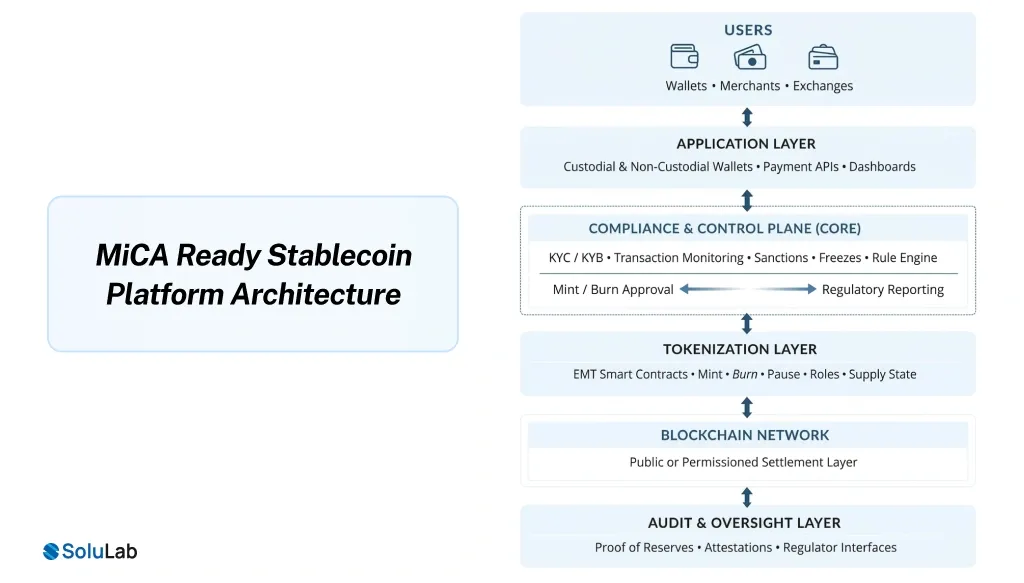
A MiCA-ready stablecoin platform is not simply a smart contract deployed on a blockchain. It is a layered financial system where blockchain acts as a controlled execution layer.
At a high level, enterprise stablecoin platform development under MiCA includes five coordinated layers.
The application layer provides user interfaces, institutional dashboards, and partner APIs. This layer enables access but does not control issuance.
The compliance and control layer forms the operational core. It manages onboarding, sanctions screening, mint approvals, redemption authorization, account freezes, and jurisdiction-specific rules. Under MiCA for stablecoins, this layer must remain fully issuer-controlled.
The token execution layer handles balances, minting, burning, and role management. Smart contracts should remain intentionally minimal, reflecting state changes rather than encoding complex policy decisions.
The reserve integration layer connects segregated fiat accounts, payment rails, and liquidity management systems. For Euro-backed stablecoin development, this layer ensures continuous alignment between token supply and bank balances.
Finally, the audit and reporting layer aggregates system data into regulator-ready disclosures and proof of reserve statements.
When designed correctly, these layers ensure that a MiCA-compliant stablecoin behaves like regulated digital money rather than autonomous crypto infrastructure.
What Should Go On-Chain and What Should Stay Off-Chain in a MiCA Compliant Stablecoin Platform
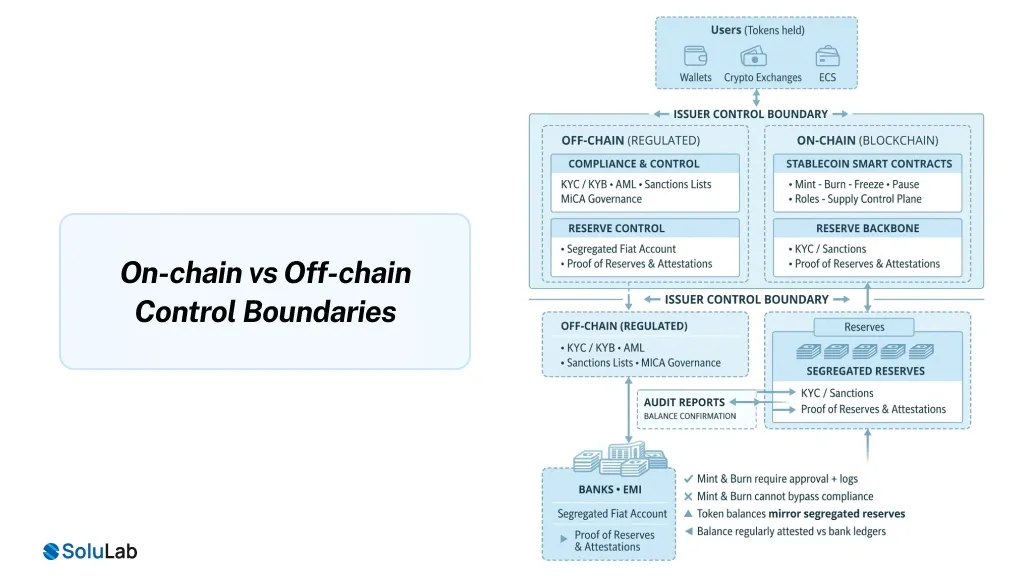
One of the most common mistakes in stablecoin platform development is putting too much logic on chain. In crypto native systems, complexity inside the contract is often viewed as innovation. Under MiCA Regulation for stablecoins, excessive on-chain logic becomes a risk.
A MiCA-compliant stablecoin must clearly separate execution from decision-making.
On-chain components should be limited to elements that require global consistency and tamper evidence:
- Token balances
- Total supply
- Mint and burn execution
- Role-based permissions
- Emergency pause capability
These elements answer a simple question. What exists and who controls it.
Everything else belongs off-chain.
Identity data, sanctions decisions, risk scoring, fiat reconciliation, and redemption approvals must operate within regulated infrastructure environments. Placing them on chain introduces data protection challenges and weakens issuer accountability.
For enterprise stablecoin development, this boundary is critical. The blockchain records outcomes. The compliance control plane determines those outcomes.
That separation is what allows a MiCA-ready stablecoin platform to remain flexible, auditable, and regulator-friendly.

Building a Cross-Border Stablecoin Platform Under MiCA
MiCA has made cross-border stablecoin development in Europe structurally possible.
By harmonizing rules across EU member states, MiCA Regulation for stablecoins enables passporting rights for licensed issuers. This means a properly structured euro-backed stablecoin can circulate across multiple jurisdictions within the Union.
However, cross border stablecoin platform design introduces additional complexity.
Issuers must account for:
- Jurisdiction-specific reporting requirements
- Sanctions alignment across regions
- Liquidity coordination across banking partners
- Operational resilience across payment rails
A cross border stablecoin platform cannot treat expansion as a simple token configuration change. Each jurisdiction introduces supervisory expectations that must be reflected in the compliance control infrastructure.
For enterprises, this means building scalable rule engines and adaptable reporting pipelines from the start. Retrofitting cross border logic later is significantly more complex.
When designed correctly, cross border stablecoin platforms can reduce settlement friction, improve liquidity mobility, and support institutional payment innovation across Europe.
Stablecoin Adoption in Europe Is Moving From Experimentation to Infrastructure
Stablecoin adoption in Europe is no longer speculative.
The clarity provided by MiCA has shifted the conversation from whether stablecoins should exist to how they should be structured.
Financial institutions, fintechs, and payment providers are increasingly exploring euro-based institutional stablecoin models to improve settlement efficiency, treasury operations, and cross border payments.
Several forces are driving this momentum:
- Regulatory certainty under MiCA
- Demand for faster settlement rails
- Increasing institutional comfort with tokenized money
- Competitive pressure in digital payments
However, adoption will not reward experimentation alone. It will reward disciplined enterprise stablecoin development aligned with EU-compliant stablecoin development standards.
Organizations that approach stablecoin platform development as regulated infrastructure rather than crypto innovation will be better positioned for long term viability.
In Europe, stablecoin growth is now a compliance-led evolution.
How to Choose the Right Stablecoin Development Company in Europe?
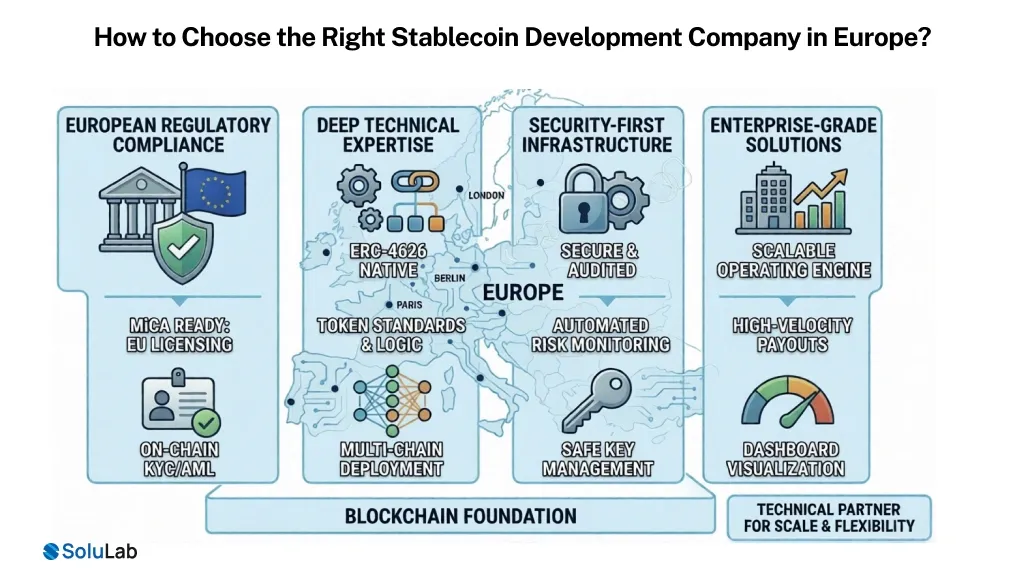
Choosing a stablecoin development company under MiCA is not just a technical decision. It is a regulatory and risk decision.
Enterprise stablecoin development in Europe requires a partner who understands both blockchain engineering and financial supervision standards. A vendor that only builds token contracts is not enough.
When evaluating a stablecoin development company, enterprises should assess three core capabilities.
First, regulatory architecture expertise.
The partner must understand MiCA Regulation for stablecoins, EMT classification requirements, reserve segregation expectations, and redemption obligations. Stablecoin platform development under MiCA begins with compliance design, not coding.
Second, banking and payment integration capability.
EU-compliant stablecoin payment platform development requires integration with segregated reserve accounts, SEPA payment rails, liquidity management systems, and cross border settlement mechanisms. Without this experience, euro backed stablecoin development remains theoretical.
Third, enterprise grade engineering maturity.
Custom stablecoin development must support controlled upgradeability, emergency intervention logic, detailed audit trails, and resilient system architecture.
Under MiCA, mistakes made during development often surface during supervisory review. Choosing the right stablecoin development company reduces redesign costs and regulatory friction later.
Why Enterprises Choose SoluLab for MiCA Ready Stablecoin Platform Development?
Launching a MiCA compliant stablecoin requires alignment between legal obligations and technical execution.
SoluLab supports fintechs, banks, and payment providers in building MiCA ready stablecoin platforms that meet regulatory expectations while remaining scalable and secure.
Rather than treating compliance as an overlay, SoluLab approaches enterprise stablecoin development as a systems engineering challenge rooted in issuer accountability.
SoluLab capabilities include:
- Custom stablecoin development aligned with EMT requirements
- White label stablecoin platform customization for regulated issuers
- Euro backed stablecoin development with segregated reserve architecture
- Cross border stablecoin platform engineering
- Compliance control infrastructure integration
- Secure and upgradeable smart contract frameworks
By combining blockchain expertise with institutional financial systems understanding, SoluLab even enables EU-compliant asset-backed stablecoin development that moves from concept to production without compromising regulatory readiness.
For organizations serious about stablecoin adoption in Europe, disciplined execution makes the difference.

Conclusion: Enterprise Stablecoin Development Under MiCA Is an Architecture Decision
MiCA Regulation for stablecoins does not eliminate innovation. It channels it.
In Europe, launching a stablecoin now requires more than token deployment. It requires structured architecture that ensures redemption integrity, reserve transparency, issuer control, and supervisory readiness.
Whether pursuing a white label stablecoin platform or custom stablecoin development, enterprises must approach stablecoin platform development as regulated infrastructure.
Stablecoin adoption in Europe will favor platforms that behave predictably under oversight and scale responsibly across borders.
Under MiCA, compliance is not an external layer.
It is embedded in how the system is built.
FAQs
A specialized stablecoin development company reduces compliance risk and helps avoid costly redesign after supervisory review.
Shipra Garg is a tech-focused content strategist and copywriter specializing in Web3, blockchain, and artificial intelligence. She has worked with startups and enterprise teams to craft high-conversion content that bridges deep tech with business impact. Her work translates complex innovations into clear, credible, and engaging narratives that drive growth and build trust in emerging tech markets.