Key Takeaways
- Dubai provides unparalleled legal certainty through specialized frameworks that attract institutional investors seeking secure digital asset environments globally.
- Leading enterprises utilize programmable compliance and smart contracts to eliminate manual overhead while ensuring seamless 24/7 cross-border settlements.
- Success depends on connecting tokenized offerings with secondary trading desks to prevent stagnant assets and ensure continuous capital.
2026 is the year when real-world asset (RWA) tokenization is a capital strategy, not a side innovation. And if you look closely at where this shift is happening fastest, Dubai stands out.
We can clearly see that the market is projected to reach $307.3 million by 2030, growing at a CAGR of 29.8% from 2025.
But why and how? Because it’s not just about technology here. It’s about a system that actually supports it. Clear regulations, strong investor confidence, and access to global capital have turned Dubai into a practical launchpad for the RWA tokenization business.
But one question comes up every time: what does it really cost to get started, and more importantly, does it pay off? The hidden costs and the strategic decisions enterprises are making to build profitable tokenization platforms in Dubai today.
Why is Dubai the Ultimate Launchpad for Your Asset Tokenization Venture?
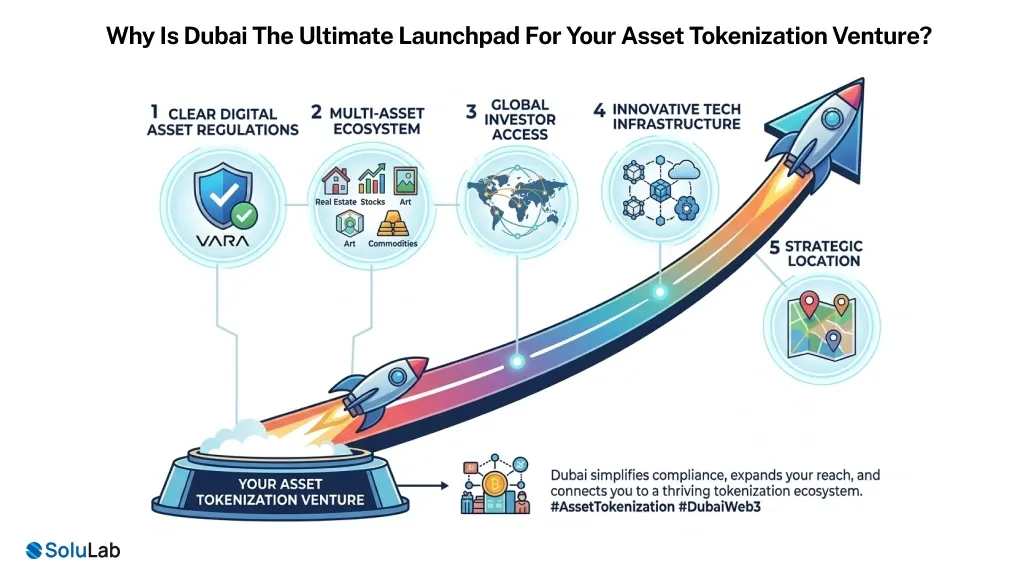
Dubai didn’t just “allow” RWA tokenization. It designed an ecosystem around it. UAE tokenization regulations never restrict the legal development; you can see that clearly in the numbers below:
- In February 2026, the “Kensington Waters” property listing sold out in just 1 minute and 58 seconds, demonstrating massive investor appetite.
- Secondary trading for real estate tokens went live on February 20, 2026, allowing investors to trade property stakes with a ±15% price range based on current valuations.
- Large enterprises and the BFSI (Banking, Financial Services, and Insurance) sector are projected to hold a 52% and 26% market share, respectively, by late 2026.
But numbers are not just enough; we need proper reasons, a method, and a tokenization development partner, too.
1. Regulatory clarity that actually works
Authorities like the Virtual Assets Regulatory Authority and Abu Dhabi Global Market have created frameworks specifically for digital assets.
Instead of forcing tokenized assets into outdated financial rules, they’ve built guidelines that reflect how blockchain actually works.
What does this mean for you? You spend less time interpreting regulations and more time building your business.
2. Tax efficiency that protects margins
Dubai’s tax structure is one of the biggest advantages:
- 0% personal income tax
- Competitive corporate tax
- No capital gains tax in most cases
For tokenized assets generating yield, this directly improves investor returns.
3. A capital hub with global reach
Dubai connects Europe, Asia, and the Middle East. That’s not just geography, it’s liquidity.
Institutional investors, family offices, and crypto-native funds are already active here. Launching in Dubai means you’re closer to the capital from day one.
So the real question isn’t “why Dubai?” but “why not launch where the capital already is?”
The Cost of Compliance: Understanding VARA and ADGM Regulatory Fees for Asset Tokenization
Compliance is not optional here. It’s your entry ticket into institutional markets. Those who can auto-update regulations according to VARA stand out and gain higher profits in asset tokenization.
1. Core regulatory costs
VARA (Dubai Mainland):
- Initial application: AED 40,000 – AED 100,000
- Annual supervision: AED 80,000 – AED 200,000
- Capital requirement: AED 500,000 – AED 4,000,000
ADGM (Free Zone):
- Application: $15,000 – $25,000
- Annual fees: ~$10,000+
- Capital: Case-based (risk dependent)
For most RWA platforms, Category 1 issuance under VARA typically sits at the higher end of the application range.
2. What are you really paying for?
- Legal clarity
- Investor trust
- Institutional access
- Long-term scalability
Think of it this way: compliance is not a cost center, it’s a revenue enabler.
3. Smart ways companies reduce compliance burn
Instead of building everything internally, companies are optimizing:
- Third-party KYC/AML providers
Saves $80,000–$120,000 annually - Test-Adapt-Scale (TAS) licenses
Reduces capital requirements by up to 50% during the early stages - Shared compliance infrastructure
Avoids hiring full in-house compliance teams early
The shift is clear. Companies are buying compliance efficiency instead of building it.
Read more – Tokenization Regulation Ecosystem
How Much Does High-Tier Tokenization Asset Development Cost in the Current UAE Market?
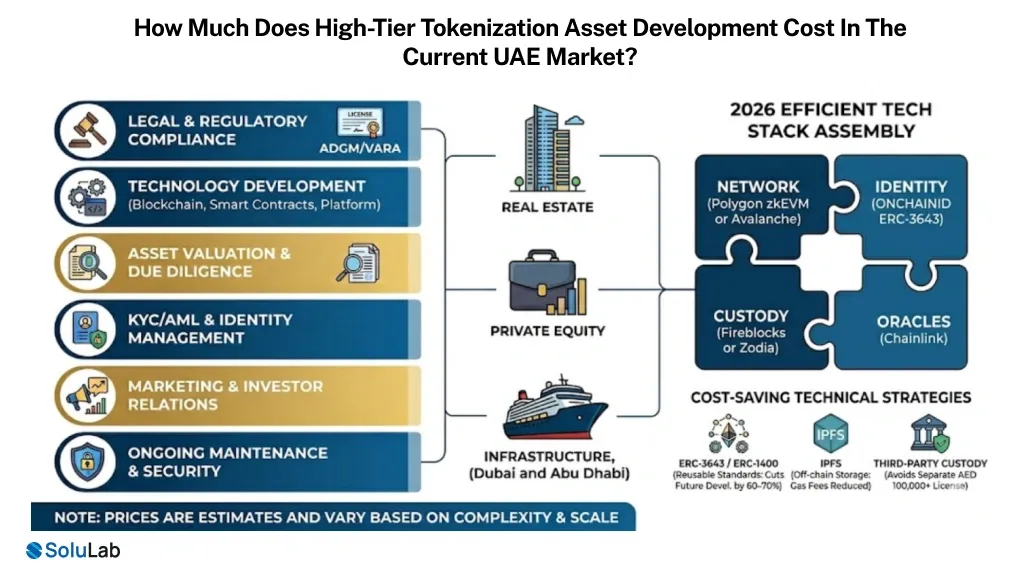
This is where most of the actual investment goes. You might plan the asset tokenization development in your budget, but sometimes the new features attract you, and the budget increases. But it’s not about increasing or decreasing; you should also check the benefits.
1. MVP / White-label platforms (Fast entry)
- Cost: $25,000 – $50,000
- Timeline: 14 days
Best suited for:
- Concept validation
- Early fundraising
- Pilot asset launches
You get basic dashboards, smart contracts, and investor onboarding tools.
But here’s the catch: MVPs don’t scale well without upgrades.
2. Custom enterprise platforms (Long-term ROI)
- Cost: $100,000 – $250,000+
- Timeline: 8-12 weeks
These platforms include:
- Multi-asset tokenization
- Automated yield distribution
- Secondary market integrations
- MPC-based custody systems
This is where serious players invest.
Because in tokenization, UX and automation matter more than just blockchain presence.
3. The 2026 “efficient tech stack” approach
Leading tokenization companies are not reinventing infrastructure. They are assembling it smartly:
- Network: Polygon zkEVM or Avalanche
- Identity: ONCHAINID (ERC-3643)
- Custody: Fireblocks or Zodia
- Oracles: Chainlink
This modular approach reduces costs and speeds up deployment.
4. Cost-saving technical strategies
- Reusable smart contract standards (ERC-3643 / ERC-1400)
Cuts future development costs by 60–70% - Off-chain storage (IPFS)
Reduces gas fees significantly - Third-party custody integration
Avoids separate licensing costs of AED 100,000+
In short, companies are no longer building everything. They are integrating what already works.
What are the Hidden Costs of Corporate Services and Office Setup for Tokenization Firms in Dubai?
This is where many budgets go off track. However, with an efficient tokenization development company, these hidden but compulsory costs can be reduced.
1. Company formation and structuring
- Trade license: AED 15,000 – AED 50,000
- Legal structuring (SPVs, contracts): $20,000 – $80,000
Using an ADGM SPV is common because it creates a clean legal bridge between physical assets and tokens.
2. Office and operational setup
- Co-working / flexi desk: AED 10,000 – AED 25,000 annually
- Physical office (if required): AED 50,000+
Some free zones allow virtual setups, reducing early costs.
3. Banking and payment rails
- Corporate bank account setup
- Fiat on-ramps (AED/USD integration)
Without easy fiat onboarding, you lose a large portion of potential investors.
4. Marketing and liquidity creation
Here’s the part most founders underestimate.
Building the platform is only half the job.
- Investor acquisition campaigns
- Exchange partnerships
- Market-making / liquidity support
This is where the “Liquidity Mirage” happens.
5. Final ROI Checklist for Enterprises
Before launching, serious players are validating a few things:
- Early smart contract audits (firms like CertiK or Hacken)
- Clear SPV structure for asset ownership
- Fiat-to-crypto onboarding pathways
- Built-in liquidity mechanisms
If these are missing, scaling becomes difficult later.
Conclusion
Starting an RWA tokenization business in Dubai is not a low-cost experiment. It’s a calculated investment into a regulated, high-growth financial ecosystem.
Between compliance, technology, and operational setup, most enterprises spend anywhere between $30,000 and $60,000+ to get started. Larger players often go beyond that. With SoluLab as your tokenization platform development services partner, you can gain more features at a lower cost.
We know, Dubai offers something few other markets can:
- Regulatory certainty
- Global investor access
- Tax-efficient returns
- Faster go-to-market cycles
The real advantage isn’t just launching a tokenized asset platform. It’s building one in an environment where liquidity, trust, and scalability already exist.
So the better question is, can you afford to build here? It’s can you afford not to? Contact us now and discuss the latest tokenization features and stand out in the global market.
FAQs
Deepika is a content writer who blends storytelling with strategic thinking. She explores topics across digital innovation, emerging tech, and the evolving blockchain industry. She enjoys breaking down complex ideas into simple, engaging narratives in the growing global markets.