Talk to an Expert

Conversational AI Consulting Services

Conversational AI consulting decides what to build before anyone builds it. SoluLab's conversational AI consultants assess feasibility, choose between platform and custom, design the conversation and the escalation path, specify the architecture, and set the evaluation and compliance guardrails your chat, voice, or messaging assistant has to pass.

  • Build-vs-Buy Recommendation in 10 Days
  • Conversation Design, Not Just Prompts
  • EU AI Act Article 50 Ready
See Case Studies (opens in a new tab)
Forbes
CoinDesk
Bloomberg
TechCrunch

When Does Conversational AI Consulting Actually Make Sense?

Conversational AI consulting is the strategy and design phase of a chat, voice, or messaging AI project. It assumes you already understand how conversational AI works and now need to decide what to do about it. A conversational AI consultant maps intents, sets containment and escalation targets, selects the model and platform, specifies integrations, and defines how the system will be tested and governed before development starts.

You need it in three situations:

01

You have not built one yet.

The expensive mistake is rarely the model. It is the first use case. Most teams open with general customer support, the hardest possible surface, instead of a narrow high-volume flow like order status or password reset.

02

You built one and it stalled.

The pilot looked good in a demo, then hit real traffic. That is almost never a model problem. It is a knowledge, integration, or intent-coverage problem.

03

You are buying, not building.

You have vendor quotes and no way to judge them. Consulting here means a technical evaluation, a total-cost model, and an exit plan.

What Conversational AI Consulting Services Does SoluLab Offer?

As the conversational specialism inside SoluLab's wider AI consulting practice, we scope, design, and de-risk conversational systems before a line of production code gets written.

Conversational AI Strategy

Conversational AI Strategy

Use-case scoring by volume, risk, and data readiness. Target metrics agreed up front: containment rate, escalation rate, average handle time, CSAT floor. If we cannot name the metric, we do not recommend the use case.

Use-Case Identification

Use-Case Identification

We rank every candidate flow on ticket volume, answer stability, integration cost, and blast radius if it gets something wrong, then tell you which three to start with and which twelve to defer.

Build-vs-Buy Assessment

Build-vs-Buy Assessment

Platform, framework, or custom, with the three-year total-cost model behind the recommendation and an exit plan for whichever you pick.

Conversation Design Services

Conversation Design Services

Intent taxonomy, dialogue flows, tone and persona rules, error and fallback handling, and the escalation script. This is the workstream most vendors skip, and it decides whether users trust the bot after their first bad answer.

Knowledge & Retrieval Audit

Knowledge & Retrieval Audit

We test whether your documentation is actually answerable before anyone picks a model, because that single factor decides whether RAG application development will hold up under real traffic. Most stalled assistants fail here, not at the model layer.

Solution Architecture

Solution Architecture

Orchestration, retrieval, memory, tool calling, and the AI integration work needed to reach your CRM, ticketing, and order systems, all specified against your actual stack rather than a reference diagram.

Evaluation & Guardrail Design

Evaluation & Guardrail Design

A graded golden set, automated regression runs, hallucination and refusal policies, PII handling, and the human-review loop.

AI Security & Adversarial Review

AI Security & Adversarial Review

Prompt-injection testing, data-exfiltration paths through tool calls, role-based access boundaries, and what the assistant must never be able to say or do.

Compliance & Governance Review

Compliance & Governance Review

Article 50 disclosure scored against our EU AI Act compliance checklist, GDPR lawful basis and retention, plus HIPAA or PCI DSS where the conversation touches that data.

Voice & IVR Modernization Consulting

Voice & IVR Modernization Consulting

Barge-in, latency budgets, ASR accuracy targets, and call-deflection modelling for the voice-activated AI applications that carry your inbound call volume.

Platform & Vendor Evaluation

Platform & Vendor Evaluation

Structured scoring of Intercom Fin, Ada, Sierra, Decagon, Amazon Lex, Google Dialogflow CX, and Microsoft Copilot Studio against your requirements. SoluLab is not a reseller for any of them.

Rescue Audits

Rescue Audits

Diagnosis and a prioritized fix list for an assistant that passed its demo and failed on real traffic, or architecture governance while your own team builds. Consulting without the delivery lock-in.

CTA Background

Stop Guessing Whether Your Bot Will Work

Most conversational AI budgets get committed before anyone has tested whether the knowledge base can answer the questions. Two weeks of assessment costs less than one wasted quarter.

Book Free Consultation

What Types of Conversational AI Are There?

Conversational AI splits into five levels by autonomy: scripted flows, retrieval assistants, transactional assistants, multi-step agents, and multi-agent systems. Most buyers ask for level 4 and need level 2. Picking the level is the first decision in any consulting engagement, because it sets the cost, the risk, and the compliance burden.

Level 1

Scripted flow

Fixed decision tree, buttons and menus, no language model

Autonomy None
Typical build Platform flow builder
Right when Under 20 stable intents, zero tolerance for a wrong answer
The trap Users hit "the bot can't help" within two turns
Level 2

Retrieval assistant

Answers from your documents and cites the source

Autonomy Reads only
Typical build RAG over a vector store, hybrid retrieval, re-ranker
Right when Support deflection, policy and product questions
The trap The knowledge base was written for skimmers, not retrieval
Level 3

Transactional assistant

Reads and writes: checks an order, reschedules, files a claim

Autonomy Acts within fixed tools
Typical build Tool calling with approval gates and idempotency
Right when The answer alone doesn't resolve the ticket
The trap No rollback path when a write goes wrong
Level 4

Multi-step agent

Plans across several steps and chains tools to reach a goal

Autonomy Chooses its own path
Typical build Orchestrated agent loop with step limits and audit trail
Right when Genuinely variable workflows, not variable phrasing
The trap Non-determinism you cannot regression-test
Level 5

Multi-agent system

Specialised agents coordinated by an orchestrator

Autonomy Distributed
Typical build Agent framework plus a supervisor
Right when Cross-department workflows at scale. See UpdateIA below
The trap Debugging cost grows faster than capability

Conversational AI Systems We Design

Six system patterns cover almost every conversational AI engagement we scope, from read-only support assistants through to multi-agent enterprise platforms. Which pattern fits is usually settled in week two, once we know your intent mix and how many systems the assistant actually has to reach.

Customer Support Assistants

Customer Support Assistants

Grounded retrieval over your documentation and ticket history, with an escalation path that carries full context to a human agent.

Internal Employee Copilots

Internal Employee Copilots

HR, IT, and policy assistants that answer from internal sources under role-based access control. Most of these ship as an AI copilot embedded in the tools employees already use, so nobody sees data they could not open directly.

Voice Assistants & AI Call Deflection

Voice Assistants & AI Call Deflection

Speech-first systems with latency budgets, barge-in handling, and honest containment targets by intent type.

Transactional & Agentic Assistants

Transactional & Agentic Assistants

Assistants that act rather than answer: check an order, reschedule a booking, file a claim, with approval gates and idempotency on every write. Past a certain complexity, these stop being assistants and become a question of AI agent development instead.

Multilingual & Multi-Channel Deployments

Multilingual & Multi-Channel Deployments

One intent layer serving web, app, WhatsApp, and the agent desktop, so you are not maintaining four divergent bots.

Enterprise Knowledge Assistants

Enterprise Knowledge Assistants

Retrieval across scattered systems with citation of the source document, which is what turns an answer into something a compliance team will accept. Enterprise-wide rollouts sit with our enterprise AI chatbot practice.

Real-World Conversational AI Work

Three conversational AI engagements SoluLab has delivered and published, with the metrics exactly as they appear on each case study. Two are enterprise agent platforms; the third is a customer-facing banking assistant, which is the closest analogue to a typical support deployment.

UpdateIA Case Study

UpdateIA

Autonomous AI Agents Across Enterprise Workflows

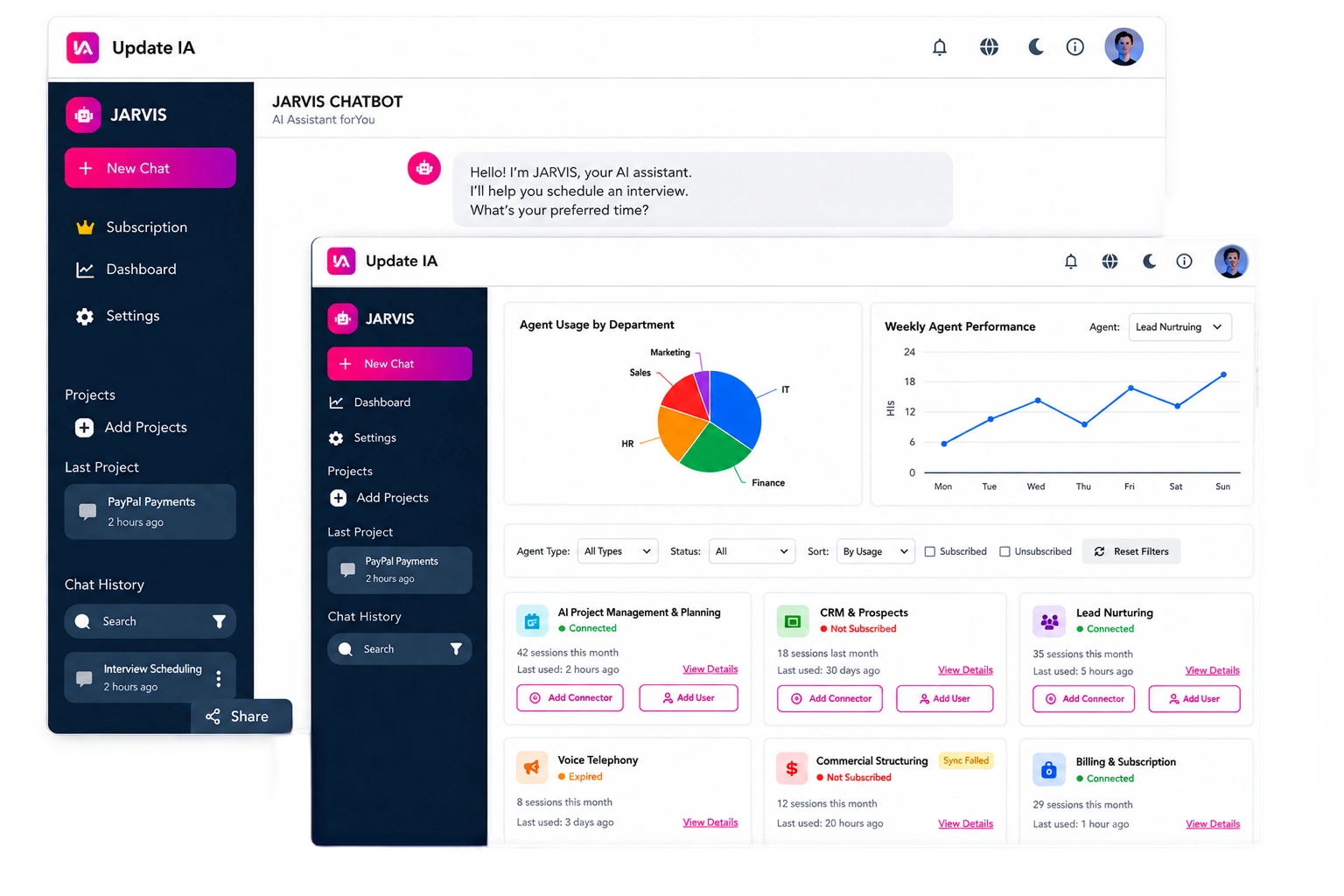
The client wanted one AI ecosystem spanning HR, CRM, Finance, Legal, and operations instead of disconnected tools. SoluLab built a multi-agent platform of 14+ autonomous agents orchestrated through Jarvis, coordinating communication across departments and systems.

  • 14+ Autonomous Agents Orchestrated
  • 5 Business Functions Unified
  • Real-Time Cross-Department Decisioning
View Case Study →
Digital Financial Platform Copilot

Digital Financial Platform

AI Support Copilot Grounded in Internal Documentation

A support team handling high ticket volume across fragmented CRM data needed grounded, consistent answers. SoluLab built a RAG copilot retrieving from internal documentation and connected systems, cutting average handle time.

  • Reduced Average Handle Time
  • Grounded Retrieval With Source Citation
  • Unified Answers Across Fragmented Systems
View Case Study →
Aman Bank Conversational Assistant

Aman Bank

Conversational Banking Assistant

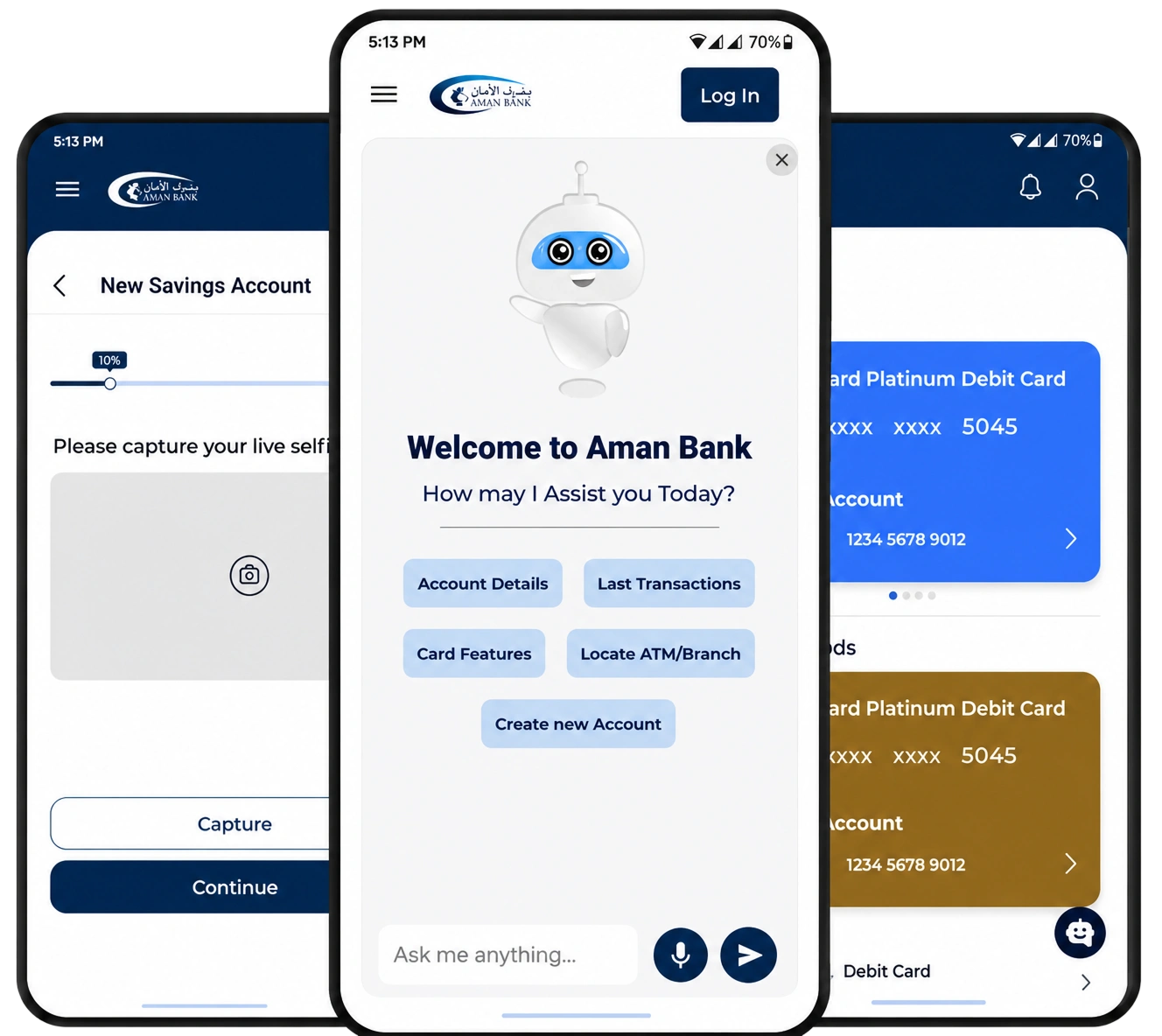
Aman Bank's existing mobile app had a lengthy, manual onboarding process and support limited to business hours. SoluLab designed AI-powered chatbot and voice assistant conversations to close both gaps.

  • 30% increase in positive customer feedback
  • 40% reduction in average response times
  • 50% reduction in human agent workload
  • 60% reduction in onboarding time
View case study →

Which Channels Can Your Conversational AI Assistant Run On?

One intent layer, many surfaces. The intent taxonomy and retrieval layer stay shared; what changes per channel is the interaction budget, and that is what most rollouts get wrong.

Channel
What changes
Design constraint
Web chat
Richest surface. Cards, carousels, file upload
Users expect a visible human-handoff button
Mobile in-app
Authenticated session, so the assistant knows who it is talking to
Screen real estate; keep answers short and actionable
WhatsApp Business
Template-message rules and 24-hour session windows
Business-initiated messages need pre-approved templates
Apple Messages for Business
Native list pickers, Apple Pay
Brand registration and Apple's review process add lead time
RCS
Rich cards on Android without an app install
Carrier and device support still uneven
SMS
Universal reach, no rich formatting
160-character discipline, and TCPA consent for outbound
Facebook Messenger
Consumer-familiar, good for retail
Meta policy windows on proactive messaging
Slack / Microsoft Teams
Internal assistants where employees already work
Role-based access control matters more than tone
Voice and IVR
No visual fallback, so recovery has to be conversational
Latency budget under roughly one second, plus barge-in handling
Email
Asynchronous, long-form, tolerant of slower responses
Threading and quoting break naive context windows
Agent desktop (assist mode)
The assistant drafts, a human sends
Highest-trust starting point, and the fastest path to a measurable win

How does a conversational AI consulting engagement work?

A SoluLab conversational AI consulting engagement runs two to six weeks and ends in a written go or no-go, not a proposal. Here is what happens in each week, and what lands on your desk at the end of it.
Why Do Most Conversational AI Projects Stall After the Pilot?

Four failure modes account for most of what we are asked to rescue. Naming them up front is cheaper than discovering them in month four.

01

The knowledge base is not answerable

Your documentation was written for humans who skim. Retrieval needs atomic, self-contained chunks with clear headings. A knowledge audit belongs before any model decision.

03

Integrations were treated as phase two

A bot that can answer but cannot act ("where is my order" with no order API) frustrates users faster than no bot at all. Integration scope belongs in week one.

02

Nobody defined containment honestly

"80% deflection" is a vendor metric. Containment counts sessions closed without a human. Deflection often counts sessions where the user gave up. Measure resolution and abandonment separately.

04

There is no regression test

Someone edits a prompt to fix one complaint and silently breaks forty other answers. Without a graded golden set you cannot ship changes with confidence, so eventually you stop shipping.

Should you buy a conversational AI platform or build custom?

This is the question every conversational AI consulting engagement starts with, so here is the answer we give, free. The comparison below is the same one we walk clients through in week two, before anyone has committed to a licence or a sprint.

Buy a platform

Build custom

Buy a platform

Standard support deflection, FAQ, order status

Typical fit
Build custom

Domain-specific reasoning, proprietary workflows, regulated data

Buy a platform

4–8 weeks

Time to first production flow
Build custom

10–16 weeks

Buy a platform

Per-resolution or per-seat pricing

Year-one cost driver
Build custom

Engineering time, then inference

Buy a platform

Rises with volume, sometimes steeply

Cost at scale
Build custom

Flatter; inference cost per conversation falls as models get cheaper

Buy a platform

Limited to what the vendor exposes

Control over retrieval and prompts
Build custom

Full

Buy a platform

Vendor-dependent

Data residency and PII control
Build custom

Yours

Buy a platform

High. Intents, flows, and analytics live in their schema

Lock-in risk
Build custom

Low, if you keep the intent layer portable

Buy a platform

Teams with unusual workflows or strict residency rules

Who should not choose this
Build custom

Teams under 8 weeks of runway or with no ML-capable engineer

Build a Compliance-Backed Conversational AI Programme

Enterprise conversational AI now carries real regulatory weight. EU AI Act Article 50 has applied to customer-facing assistants since 2 August 2026, and conversation transcripts are personal data under GDPR from the first turn onward. We design disclosure, retention, and PII redaction into the conversation itself and score the result against our EU AI Act compliance checklist.

EU Region Icon

EU AI Act Article 50

EU Region Icon

GDPR Transcript Handling

US Region Icon

HIPAA-Scoped Conversations

Global Region Icon

PCI DSS Scope Control

US Region Icon

CCPA / CPRA

US Region Icon

TCPA for Outbound Voice

UAE Region Icon

UAE & GCC Data Residency

UK Region Icon

UK ICO Guidance

Global Region Icon

SOC 2 Alignment

How much does conversational AI consulting cost?

Consulting is scoped separately from build, and the AI development cost for the build itself is quoted once scope is fixed. These are SoluLab's typical bands for the consulting phase.

1–2 weeks

Feasibility / build-vs-buy assessment

$6,000 – $12,000
What you get

Written recommendation, three-year cost model, risk list

6–10 weeks

Design plus a scoped proof of concept

$35,000 – $60,000
What you get

The above, plus one working flow in your environment

2–3 weeks

Rescue audit of an existing assistant

$8,000 – $15,000
What you get

Diagnosis, prioritized fix list, revised metric targets

CTA Background

Get Your Conversational AI Readiness Assessment

We review your knowledge base, intent coverage, integration surface, and compliance posture, then tell you whether you are ready to build. Used by teams in the US, UK, UAE, and APAC.

Book a Slot

Conversational AI Consulting Across Industries

Conversational AI consulting looks different in a hospital than it does in a telecom billing queue, because the intent mix, the regulatory surface, and the cost of a wrong answer all shift. These are the sectors where SoluLab has shipped conversational and agentic systems.

Why Choose SoluLab as Your Conversational AI Consulting Company?

Most conversational AI consulting companies also resell a platform, which quietly shapes the recommendation you end up with. Six reasons SoluLab's advice is worth what you pay for it.

Vendor Neutral

Vendor-Neutral by Design

We are not a reseller for Intercom, Ada, Sierra, Decagon, or any other platform. The recommendation follows your cost model, not a partner margin.

We Will Tell You Not to Build

We Will Tell You Not to Build

Roughly a third of our consulting engagements conclude that buying beats building. A no-go report is a cheaper outcome than a failed pilot.

Evaluation

Evaluation Before Code

The graded golden set gets written during design, not after the first incident. It is why prompt changes stay shippable in month twelve.

Conversation Design

Conversation Design, Not Just Prompt Engineering

Intent taxonomy, tone rules, fallback handling, and escalation scripting as a real workstream. Most vendors treat this as a footnote.

Compliance

EU AI Act Article 50 Built In

AI disclosure is designed into the conversation and the technical documentation, not bolted on as a footer line after launch.

AI-Native Delivery Team

AI-Native Delivery Team

250+ engineers and 1,500+ projects since 2014, working across LLM orchestration, RAG, and agentic systems, not a chatbot-only shop.

Meet Your Conversational AI Architect

Rajat Lala

"The projects that fail aren't the ones with weak language models. They're the ones where nobody designed what happens when the conversation goes off-script."

Rajat Lala · Co-Founder and CEO, SoluLab · View full profile
Testimonials

What Our Clients Say About Us

Our biggest concern was reliability. We couldn't introduce an AI assistant into a customer-facing workflow without understanding how it would handle inaccurate responses, missing information, or requests it wasn't designed to answer. SoluLab helped us define guardrails, escalation paths, and evaluation criteria before we moved into full development. That consulting work gave us much more confidence in the architecture we eventually built.

Daniel Foster

Daniel Foster

Director of Digital Products, Nexora Systems

We initially approached conversational AI as a standalone product, but SoluLab helped us see that its real value depended on how well it connected with our existing systems. Their team mapped the integrations with our CRM, knowledge base, and internal workflows before recommending an implementation approach. That saved us from building an impressive-looking assistant that couldn't actually complete useful tasks.

Priya Shah

Priya Shah

Head of Technology, VertexOne Solutions

The most valuable part of working with SoluLab was that they challenged our assumptions. We came in thinking we needed a highly complex AI assistant, but after reviewing our users, data, and workflows, they recommended a more focused approach for the first phase. It reduced the initial scope, shortened our path to launch, and gave us a much stronger foundation to expand from.

Ethan Reynolds

Ethan Reynolds

Co-Founder & CEO, ClarityBridge

We knew we wanted to introduce conversational AI, but we had too many potential use cases and no clear way to prioritize them. SoluLab helped us look beyond the idea of simply adding a chatbot and identify where conversational AI could actually reduce friction in the customer journey. The consulting process gave us a clear roadmap, including what to build first, what could wait, and how we should measure success.

Melissa Grant

Melissa Grant

VP of Customer Experience, ConnectSphere

FAQ

Helpful resource to grow your business

A conversational AI consultant decides what gets built before development starts: scoring use cases, choosing between platform and custom, designing intents and dialogue flows, specifying architecture and integrations, and defining how the assistant will be evaluated and governed once live.

Consulting decides the what and why; chatbot development services build it. A consulting engagement ends with a recommendation, an architecture, and a roadmap. Development ends with running software. SoluLab does both, and a meaningful share of consulting engagements conclude that buying a platform beats building.

Two to six weeks for most engagements. A standalone build-vs-buy assessment can close in ten working days. Full strategy and design including a graded evaluation set and a scoped proof of concept runs six to ten weeks, depending on how many systems it touches.

SoluLab's typical bands: $6,000 to $12,000 for a feasibility and build-vs-buy assessment, $18,000 to $35,000 for full strategy and design, and $35,000 to $60,000 when a scoped proof of concept is included. Build cost is quoted separately once scope is fixed.

Buy when the use case is standard support deflection with no data-residency constraint. Build when the conversation must reason over proprietary logic, when residency or auditability rules out a vendor, or when volume makes per-resolution pricing more expensive than owning the stack. Hybrid is common.

It depends entirely on intent mix, so treat any single benchmark with suspicion. What matters is measuring containment, escalation, and abandonment as three separate figures. A vendor quoting one blended "deflection" percentage is usually counting users who gave up as a success.

You need answerable content, not necessarily a lot of it. Transcripts, ticket exports, product documentation, and policy pages are the usual inputs. A week-one knowledge audit tells you whether retrieval will work against your existing material or whether it needs restructuring first.

If your assistant interacts with people in the EU, Article 50 applies from 2 August 2026 and requires that users be told they are dealing with an AI system unless it is obvious. It applies regardless of where your company is based, and to systems already running, not just new ones.

Conversation design covers intent taxonomy, dialogue flows, tone and persona rules, error handling, and escalation scripting. Yes, you need it. It decides whether users trust the assistant after its first wrong answer, and it is the workstream most often skipped.

You own everything produced in the engagement: documents, designs, prompts, evaluation sets, and any code. For custom builds you own the repository and fine-tuned artifacts. Third-party model and platform licences stay with their vendors, and we flag every such dependency in the architecture document.

Yes. Rescue audits are a common engagement. We review the knowledge base, retrieval configuration, intent coverage, escalation path, and metrics, then return a diagnosis and a prioritized fix list. Most stalled assistants have a content or integration problem, not a model one.

On the buy side, we assess Intercom Fin, Ada, Sierra, Decagon, Amazon Lex, Google Dialogflow CX, and Microsoft Copilot Studio against your requirements. SoluLab is not a reseller for any of them, which is the point. The recommendation follows your cost model, not a partner margin.

Articles

Latest Insights from Experts