Key Takeaways
- The problem: Businesses struggle to deliver fast, intuitive user experiences as traditional apps rely heavily on manual input, increasing friction, drop-offs, and limiting accessibility across diverse user segments.
- The solution: Voice-activated AI apps enable real-time, conversational interactions, reducing user effort, improving engagement, and streamlining workflows through speech recognition, NLP, and intelligent response systems.
- How SoluLab helps: SoluLab, an AI-native company, integrates AI directly into development workflows, enabling faster delivery, optimized costs, and scalable voice solutions tailored for enterprise-grade performance and real-world use cases.
Businesses are struggling to keep users engaged as traditional apps require too much time, effort, and attention. Customers now expect faster, hands-free, and more intuitive interactions, but most applications still rely on outdated input methods that slow down user journeys and reduce retention.
However, voice-activated AI development is changing that by enabling real-time, conversational interactions that feel natural and efficient.
By integrating advanced speech recognition, AI models, and contextual intelligence, companies can build smarter applications that simplify user actions while improving engagement, accessibility, and operational efficiency across multiple touchpoints in 2026.
What is Voice-Activated AI App Development?
Voice-activated AI app development involves building applications that can understand, process, and respond to human speech using artificial intelligence.
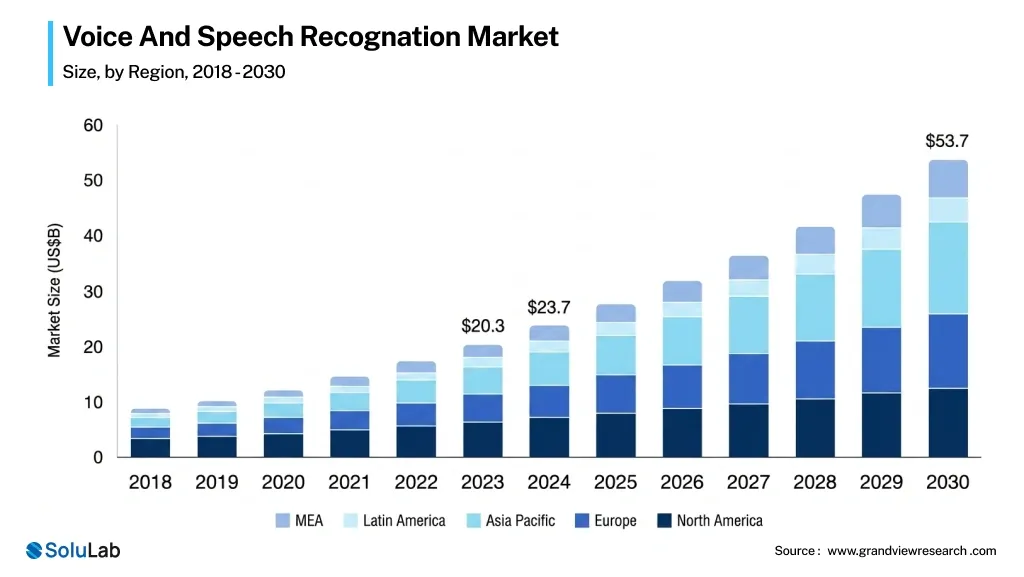
It combines speech recognition, natural language processing, and speech synthesis to enable real-time, conversational interactions across devices, improving user experience, accessibility, and task efficiency. The global voice and speech recognition is expected to reach USD 53.67 billion by 2030, growing at a CAGR of 14.6% from 2024 to 2030.
How Voice AI Apps Work:
- Voice Input Capture (microphone, devices): Captures user speech through microphones and connected devices
- Speech-to-Text (STT engines): Converts spoken language into structured, machine-readable text
- Natural Language Processing (intent recognition): Interprets intent, context, and meaning from user input
- Decision Engine (logic or LLM-based response): Processes input and determines appropriate system response
- Text-to-Speech (TTS output generation): Converts responses into natural-sounding speech output
Key Reasons Behind the Growth of Voice-Activated Apps
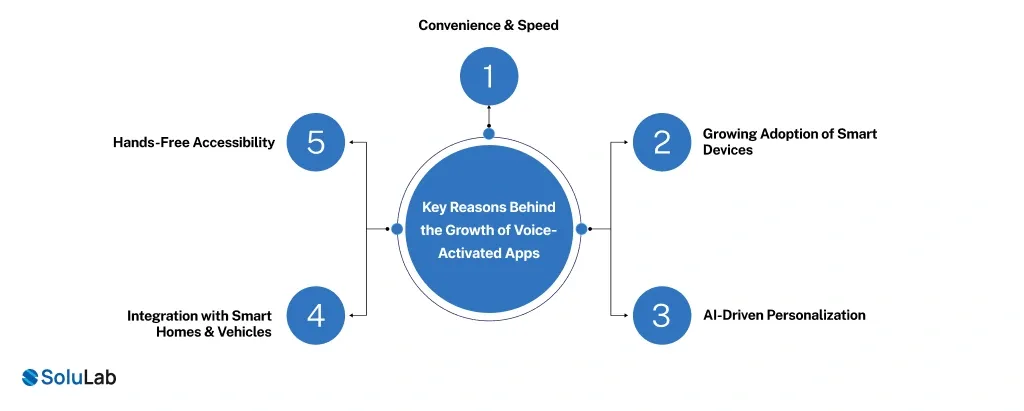
Voice-enabled applications are gaining traction as users demand faster, intuitive, and hands-free digital experiences, driven by advancements in AI, device ecosystems, and real-time interaction capabilities.
- Convenience & Speed: Voice interfaces reduce navigation steps and enable instant task execution, allowing users to complete actions faster compared to traditional touch-based applications, improving overall efficiency and user satisfaction.
- Growing Adoption of Smart Devices: Increasing usage of smartphones, wearables, and IoT devices has accelerated voice integration, creating a connected ecosystem where users expect seamless voice interaction across multiple platforms and environments.
- AI-Driven Personalization: Advanced AI models analyze user behavior, preferences, and context to deliver personalized voice responses, enhancing engagement and making interactions more relevant, adaptive, and user-centric over time.
- Integration with Smart Homes & Vehicles: Voice AI is becoming central to controlling smart home devices and in-car systems, enabling unified control experiences and improving convenience, safety, and automation in everyday environments.
- Hands-Free Accessibility: Voice-enabled apps enhance accessibility for users with physical limitations or multitasking needs, allowing interaction without screens or manual input, making digital services more inclusive and widely usable.
Read More: Advanced AI Voice Agent Development
Step-by-Step Development Process of Voice AI Applications
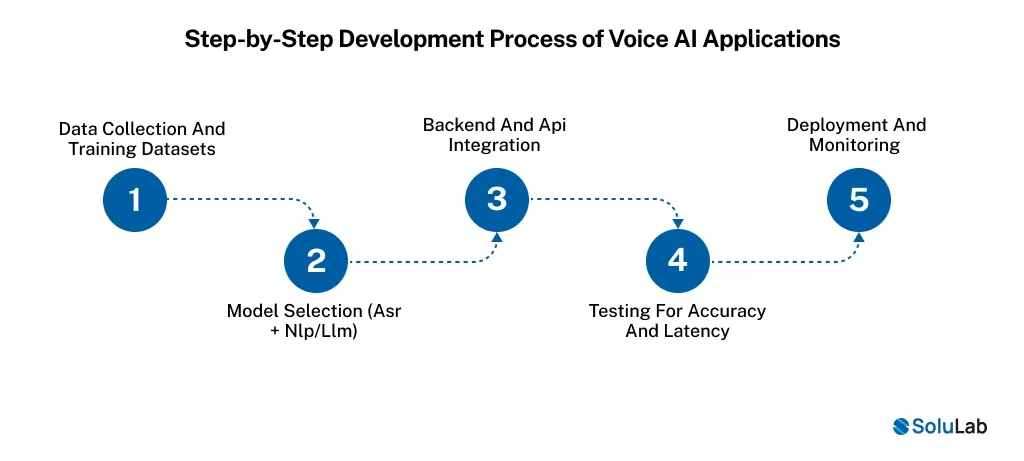
Clearly defining user intent and mapping conversational AI flows ensures voice interactions feel natural, efficient, and aligned with real-world user behavior, improving adoption and overall user experience across applications.
1. Data Collection And Training Datasets
High-quality, diverse datasets improve speech recognition accuracy and intent understanding, enabling voice systems to handle different accents, languages, and contextual variations effectively in real-time environments.
2. Model Selection (ASR + NLP/LLM)
Choosing the right combination of speech recognition and language models directly impacts response accuracy, contextual understanding, and scalability, especially for complex conversational and enterprise-level applications.
3. Backend And API Integration
AI integration with backend systems, databases, and third-party APIs allows voice apps to execute actions, fetch real-time data, and deliver dynamic responses beyond basic conversational capabilities.
4. Testing For Accuracy And Latency
Rigorous testing ensures the system responds quickly and accurately under different conditions, including noisy environments, varied speech patterns, and high user loads, maintaining consistent performance.
5. Deployment And Monitoring
Continuous monitoring of performance, usage patterns, and errors helps optimize models, reduce latency, and improve user satisfaction while ensuring the system scales efficiently with growing demand.
Core Technologies Behind Voice AI
Voice AI agents rely on multiple interconnected technologies that enable machines to understand, process, and respond to human speech in real time, ensuring seamless and intelligent conversational user experiences.
- Automatic Speech Recognition (ASR): Converts spoken language into text by analyzing audio signals, enabling voice-enabled applications to accurately capture user commands across diverse accents, environments, and speech patterns.
- Natural Language Processing (NLP): Interprets user intent, context, and meaning from transcribed text, allowing systems to understand conversational nuances and deliver relevant, context-aware responses in real-time interactions.
- Large Language Models (LLMs): Generate intelligent, human-like responses by processing contextual inputs, enabling advanced conversational capabilities, dialogue handling, and improved personalization across voice-driven applications.
- Text-to-Speech (TTS) systems: Transform system-generated text into natural-sounding speech, enhancing user experience by delivering clear, expressive, and human-like voice responses across various devices and platforms.
- Edge AI for low-latency processing: Processes voice data locally on devices instead of cloud servers, reducing latency, improving response speed, and ensuring reliable performance in real-time, bandwidth-constrained environments.
Voice AI App Development vs Traditional Apps
This comparison highlights how voice recognition app development is transforming user interaction models, making applications more natural, efficient, and aligned with real-time user expectations.
| Factor | Voice AI Apps | Traditional Apps |
| Input Method | Users interact using natural voice commands | Users rely on touch, typing, and navigation |
| User Experience | Conversational, hands-free, and intuitive interactions | Structured, screen-based, and navigation-heavy interfaces |
| Speed of Interaction | Faster task completion through direct voice commands | Slower due to multiple clicks and steps |
| Accessibility | Highly accessible for elderly and disabled users | Limited accessibility without assistive features |
| Data Processing | Handles unstructured voice inputs and real-time interpretation | Processes structured inputs like forms and clicks |
| Personalization | Context-aware responses using AI and user behavior | Limited personalization based on predefined logic |
| Scalability | Scales with AI models and cloud-based voice systems | Scales with backend infrastructure and APIs |
| Examples | Alexa voice shopping, Google Assistant queries | Mobile banking apps, eCommerce apps |
Use Cases Across Industries
Voice-enabled applications are transforming how users interact across industries, enabling faster, hands-free, and intelligent experiences powered by AI-driven speech recognition, natural language understanding, and real-time response systems.
- Healthcare: Voice assistants improve patient interactions by enabling appointment scheduling, symptom tracking, and clinical documentation through speech inputs, helping providers build AI applications that reduce administrative workload and improve care delivery efficiency.
- Finance: Voice-enabled banking allows users to check balances, initiate transactions, and receive financial insights securely, while institutions adopt smart voice app development to enhance customer experience, automate support, and enable faster, frictionless service access.
- Retail: Voice commerce enables users to search products, place orders, and track deliveries using conversational interfaces, helping businesses deploy custom AI solutions that improve engagement, personalize shopping experiences, and increase conversion rates.
- Smart Homes: Voice-controlled systems manage lighting, security, and appliances through simple commands, allowing users to automate daily routines while companies create scalable voice ecosystems that enhance convenience, energy efficiency, and device integration.
Future Trends in Voice AI
Voice AI is rapidly evolving with advancements in real-time processing, contextual understanding, and multimodal capabilities, enabling more natural, intelligent, and responsive interactions across consumer and enterprise AI applications.
- Voice + LLM integration (conversational intelligence): Voice systems are increasingly powered by large language models, enabling deeper contextual understanding, dynamic conversations, and human-like responses, improving accuracy and user engagement across complex, multi-turn interactions.
- Emotion-aware voice systems: Advanced voice AI can now detect tone, sentiment, and emotional cues, allowing applications to respond empathetically, personalize interactions, and enhance user experience in customer support, healthcare, and conversational interfaces.
- Edge-based voice processing: Processing voice data on edge devices reduces latency, enhances privacy, and enables real-time responses without relying heavily on cloud infrastructure, making voice AI more efficient and scalable in distributed environments.
- Multimodal AI (voice + vision): Combining voice with visual inputs enables richer interactions, where systems can understand spoken commands alongside images or video, unlocking advanced use cases in smart devices, automation, and immersive user experiences.

Conclusion
Voice technology is becoming a core interface for modern applications, enabling faster, more intuitive user interactions across industries. Businesses adopting AI voice agents for business are improving efficiency, engagement, and accessibility at scale.
From personalized experiences to real-time responses, Smart Voice Apps are redefining how users interact with digital platforms. Integrating an advanced AI voice assistant into your ecosystem can streamline operations while enhancing customer satisfaction.
As demand grows, building scalable and voice solutions will be a key competitive advantage. SoluLab, an AI development company in USA, can help your business build custom voice AI solutions. Get in touch with us today.
FAQs
Neha is a curious content writer with a knack for breaking down complex technologies into meaningful, reader-friendly insights. With experience in blockchain, digital assets, and enterprise tech, she focuses on creating content that informs, connects, and supports strategic decision-making.