Key Takeaways
- Carbon markets used to run on volume, not trust. Static credits, shaky verification, and systems that didn’t talk to each other opened the door to double-counting and greenwashing, and enterprises noticed.
- That’s changed. By 2026, a carbon credit behaves more like a live data feed than a certificate sitting in a drawer. Credits with dMRV backing and CCP alignment pull premium prices, and institutions are lining up for them.
- Tokenization is what makes this possible: real-time verification, automatic retirement, a full paper trail from issuance to burn. Carbon stops being an abstraction and becomes something you can trace, audit, and trade.
The carbon market barely resembles what it looked like a few years back. Volume used to be the whole game, and speculative offsets filled the gaps. Not anymore. Blockchain technology services have pulled the market toward something else entirely: high-integrity, verifiable, regulation-aligned assets.
In 2025 alone, the voluntary carbon market crossed $1.04 billion in spending. Not because more credits hit the market. Buyers simply started paying up for the ones they could actually trust. Credits backed by strong methodologies, ARR (Afforestation, Reforestation, and Revegetation) among them, now trade well above the low-integrity stuff.
Modern platforms are building in:
- dMRV systems (Digital Monitoring, Reporting, and Verification) powered by IoT and satellite data
- Smart contracts that enforce compliance and automate retirement
- Institutional-grade token standards for regulated trading environments
If your enterprise hasn’t started on carbon credit tokenization yet, now’s the moment. The top of this market won’t wait around.

Carbon Credit Tokenization 2.0: Unlocking Secondary Market Liquidity
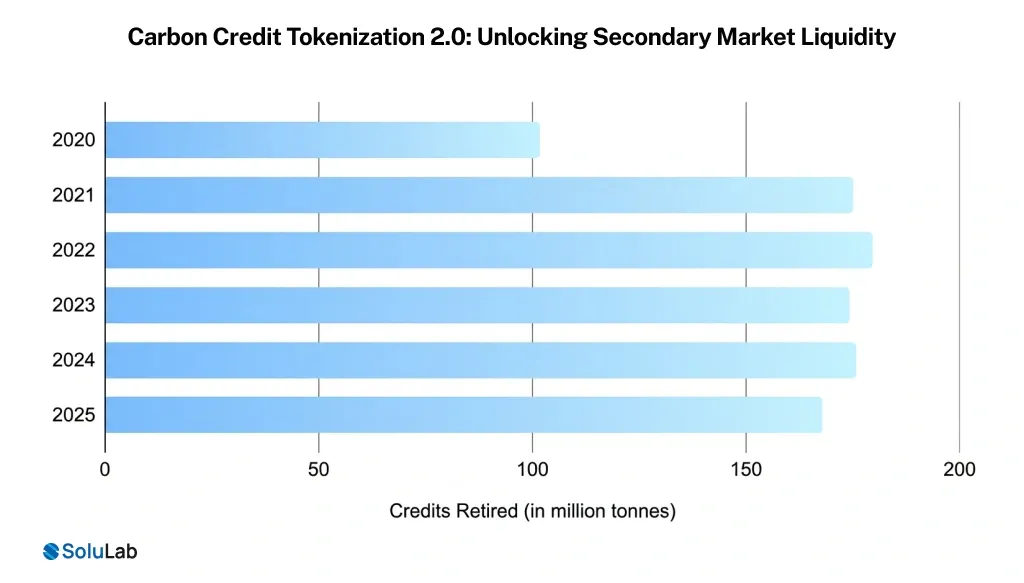
For years, carbon markets ran on one metric: volume. More credits, more trading, more activity, and, in theory, more climate impact.
That model didn’t hold up.
By 2025, buyers started backing off. Demand hadn’t vanished, trust had just become the real bottleneck. Enterprises figured out, some the hard way, that one credit is not the same as another.
One idea now runs the 2026 market: quality gets priced in, and infrastructure is what decides quality. High-Integrity credits (those with a “CCP” tag from the ICVCM) are now trading at a 79% accuracy premium compared to legacy credits.
Read more – Crypto Exchange with Tokenization Features
Carbon Credits Are No Longer Static-They Are Dynamic Data Assets
For a long time, a carbon credit meant one thing: “1 ton of CO₂ offset.”
That definition is too basic [REDACTED] 2026.
Today it behaves more like a living data asset. Its value hinges on:
- Continuous verification
- Source transparency
- Real-time environmental data
- Third-party ratings
Platforms like Sylvera and BeZero now move pricing directly. Credits with strong ratings and digital verification trade at 2x to 3x premiums. The old paper-based credits? Losing relevance fast.
This is exactly where tokenization solutions start to matter.
Rather than lock credits away as static certificates, modern systems:
- Attach live data feeds to each credit
- Track ownership and lifecycle on-chain
- Update credibility based on verification inputs
So the question isn’t “How many credits do we have?” anymore.
It’s “How reliable and traceable are these credits, over time?”
What is the Role of Banks in Carbon Credit Tokenization?
Banks used to just finance projects. Now they’re becoming the custodians, and the liquidity engines, of the tokenized carbon market.
1. Carbon-Backed Lending Is Becoming Real
In 2026, tokenized carbon credits are being used as collateral.
- Banks accept credits rated BBB+ and above
- High-quality credits are treated as low-risk green assets
This allows enterprises to:
- Turn sustainability initiatives into usable liquidity
- Put carbon assets to work inside financial strategies
2. Programmable Green Bonds Are Changing Financing
Banks are also rolling out tokenized green bonds, tied directly to carbon performance.
Here’s how it works:
- A project (like reforestation) is tokenized
- Its performance is tracked through dMRV
- Bond returns adjust based on actual carbon capture
Better performance = better returns
Climate impact and financial outcome, tied together directly.
3. Faster, Safer Settlements with Digital Money
Settlement infrastructure is also evolving.
In 2026, transactions are happening through:
- Bank-issued digital assets (like JPM Coin)
- Central Bank Digital Currencies (CBDCs)
This enables atomic settlement:
- Carbon credits and payments are exchanged instantly
- No settlement delays
- No counterparty risk
Read more: Top RWA Tokenization Questions Answered for Enterprises Ask in 2026
Top 5 Use Cases of Carbon Credit Tokenization Across Multiple Industries
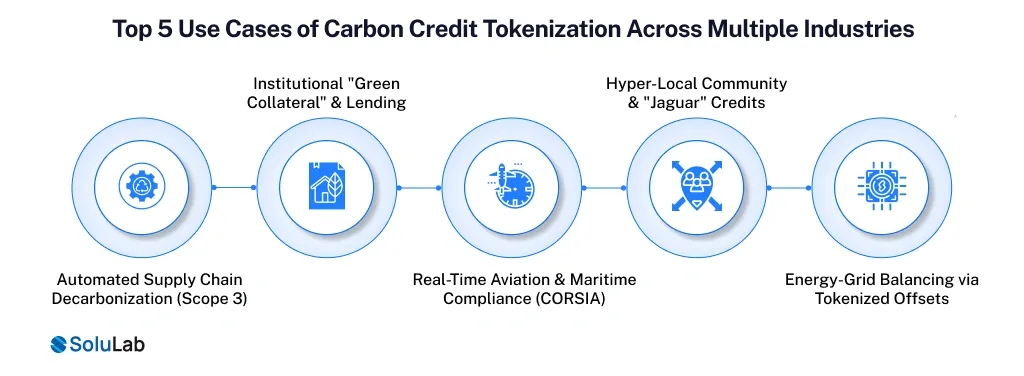
1. Automated Supply Chain Decarbonization (Scope 3)
Scope 3 emissions, the indirect supply chain kind, used to be nearly impossible to track or offset with any accuracy. In 2026, enterprises are turning to Smart Settlement to automate carbon neutral logistics.
- How it Works: Smart contracts trigger an automatic purchase, and “retirement,” of carbon tokens the second a shipping container’s IoT sensor confirms a completed delivery.
- Industry Adoption: Maersk and Amazon (2025-2026) have started folding tokenized fuel-offsetting credits into their logistics APIs.
- Key Benefit: Zero reporting lag. No more annual emissions math, companies offset in real time and satisfy 2026 EU CSRD (Corporate Sustainability Reporting Directive) requirements as they go.
2. Institutional “Green Collateral” & Lending
Banks now treat tokenized carbon credits with high-integrity, CCP-labeled ratings as a genuinely liquid asset class.
- How it Works: Banks take high-grade carbon tokens, verified through satellite dMRV, as collateral on sustainability-linked loans. Drop the token’s quality rating, and the loan’s interest rate adjusts itself, automatically, through the smart contract.
- Industry Adoption: Banco do Brasil and BNDES, in Brazil, launched regulated carbon exchanges in early 2026, opening carbon-backed financing to agricultural producers.
- Key Benefit: Capital Efficiency. Enterprises can put their “banked” carbon credits to work, securing lower-interest financing for future green CAPEX.
3. Real-Time Aviation & Maritime Compliance (CORSIA)
2026 CORSIA Phase I is now fully in effect, and airlines have to offset every emission above 85% of 2019 levels. Traditional registries just can’t keep pace with the high-frequency trading that demands.
- How it Works: The IATA Aviation Carbon Exchange (ACE) runs blockchain-integrated settlement, clearing CORSIA-eligible tokens in seconds instead of weeks.
- Industry Adoption: Airbus and major carriers buy “Digital Twins” of Direct Air Capture (DAC) credits through platforms like Carbonmark, locking in permanent, verifiable removal that meets strict international aviation standards.
- Key Benefit: Regulatory Safeguard. Automated settlement wipes out counterparty risk, so airlines never fall “out of compliance” over paperwork delays.
4. Hyper-Local Community & “Jaguar” Credits
“Social-Carbon” tokens have surged in 2026. They bundle environmental impact together with local economic data, poverty reduction figures, biodiversity metrics, that kind of thing.
- How it Works: With “Jaguar Credits” in Ecuador or Amazonian tokens in Brazil, buyers can trace, on-chain, exactly which local community the funds reached.
- Industry Adoption: Moss and KlimaDAO have scaled fractionalized reforestation tokens to the point where even mid-sized European retailers can fund specific, 100-acre plots of the Amazon, fully transparently.
- Key Benefit: Brand Authenticity. A “Digital Proof of Impact” map, shared straight with customers, cuts down on “greenwashing” accusations.
5. Energy-Grid Balancing via Tokenized Offsets
The Shift: Data centers and heavy industry now lean on tokenized credits to manage renewable grid volatility.
- How it Works: A data center’s renewable supply dips, low solar output, say, and an AI agent automatically buys and retires high-frequency carbon tokens to hold “Net Zero minute” status.
- Industry Adoption: Microsoft and Google, in 2026, use “24/7 Carbon-Free Energy” tokens that match hourly consumption against hourly carbon removal data from projects like 1PointFive’s STRATOS facility.
- Key Benefit: Precision Offsetting. Ditch the “annual average,” match hourly instead, and you get about as much climate integrity as this market currently offers.
Read more: A Guide to Asset Tokenization
Tokenized Carbon Credits: A New Asset Class for Climate Action
Tokenized carbon credits represent verified greenhouse gas reductions, recorded on the blockchain. One token, one metric ton of carbon dioxide, avoided or pulled straight out of the atmosphere.
- These credits get created by bridging existing registry credits into crypto tokens, with rigorous verification behind each one to protect its environmental integrity.
- For organizations, that’s a blockchain-based tool for offsetting residual emissions and hitting sustainability goals. Individuals get something too: a way to compensate for their own carbon footprint.
- Trading these tokens brings liquidity, transparency, and standardization to a market that’s long been plagued by fragmented trading and inconsistent data.
On blockchain platforms, tokenized credits turn into a fluid digital asset class, and transactions just work, no friction. Corporations, governments, individuals: all of them get equal footing to treat carbon as an investable commodity.
Launching an Impactful Carbon Credit Tokenization Project
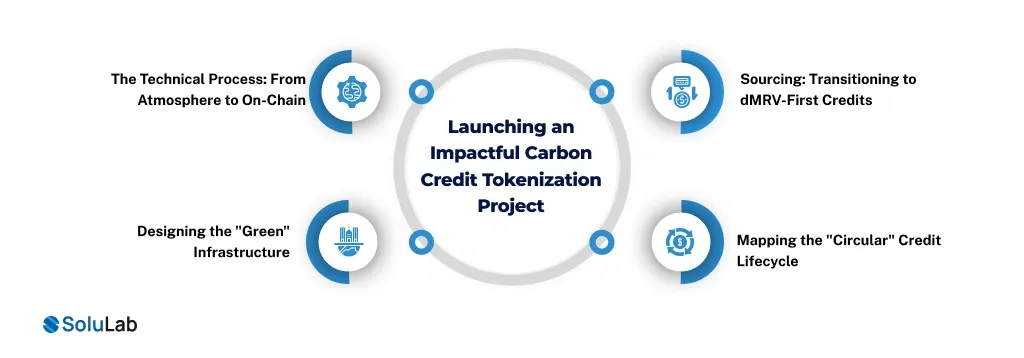
Capturing the enterprise market means moving past simple “minting.” Interoperability and dynamic verification are what matter now.
1. Sourcing: Transitioning to dMRV-First Credits
In 2026, “credible” means digitally verifiable.
- The Tech: Skip the manual field audits. Source credits from projects running dMRV (Digital Monitoring, Reporting, and Verification), think LiDAR-equipped drones over reforestation sites, or IoT sensors bolted onto Direct Air Capture (DAC) facilities.
- The 2026 Standard: Look for the ICVCM’s CCP label. Think of it as the “AAA” rating of the carbon world, proof the project clears 2026’s tough additionality and permanence bar.
2. Mapping the “Circular” Credit Lifecycle
Forget linear. The lifecycle now runs as a continuous loop of data.
- Ingestion: IoT data is sent to a decentralized oracle (like Chainlink).
- Validation: The data is cross-referenced against AI-satellite imagery (e.g., Google Earth Engine).
- Tokenization: Only after validation does the smart contract mint the token.
- Retirement: A user “burns” a token to claim an offset, and a Soulbound Token (SBT) or Non-Transferable Certificate gets issued right after, permanent, immutable proof for their 2026 tax and ESG filings.
3. Designing the “Green” Infrastructure
Your choice of blockchain is now a marketing point.
- Layer 2 Sustainability: Most 2026 enterprises pick Ethereum Layer 2s, Polygon, Arbitrum, Base, or carbon-neutral chains like Celo. High throughput, barely any energy footprint.
- Token Standards: Move past ERC-20. ERC-1155 handles semi-fungible tokens, where different batches carry different vintage years, and the InterWork Alliance (IWA) Carbon Token Standard covers cross-chain compatibility.
4. The Technical Process: From Atmosphere to On-Chain
The engineering behind these projects, in 2026, follows a specialized “Bridge & Mirror” architecture:
- The Bridge (Registry Integration): Set up a secure API connection to major registries like Verra or Gold Standard. Once a credit gets “locked” in the physical registry, a “Digital Twin” mints on your platform, and that’s what keeps you out of the “Double-Counting” trap that plagued earlier markets.
- The Oracle Layer: Bring in Environmental Oracles for a live feed on the project’s health. A forest catches fire, satellite picks it up, and the smart contract can “freeze” or “devalue” the associated tokens on the spot.
- The Liquidity Engine: Deploy Automated Market Makers (AMMs), and enterprises can trade carbon tokens around the clock with no broker in the loop. These pools, in 2026, usually pair with stablecoins like USDC or EURC for instant settlement.
Read more: What Makes Germany a Natural Fit for Carbon Credit Tokenization?
Future-Proofing: Use Cases for 2026 and Beyond
1. Precision Offsetting for AI & Data Centers
AI energy consumption is peaking in 2026, and data centers have become the biggest buyers, by far.
- Mechanism: Offer Hourly Matching. A data center can then buy tokens tied to carbon removal happening at the exact hour it runs high-intensity LLM training sessions.
2. The “Green” Dividend: Tokenized Yield
- Mechanism: Some reforestation tokens now pay “Growth Yield.” Trees mature, they sequester more carbon, and the token’s underlying value, or the count you hold, climbs right along with it: a “dividend” for investors willing to play the long game.
Checklist for 2026 Launch Success
- Regulatory Layer: Build ZKP (Zero-Knowledge Proof) privacy into your smart contracts. Companies can then prove to regulators they hit their carbon goals without exposing sensitive trade secrets buried in supply chain volumes.
- Audit Protocol: Run “Continuous Auditing,” with your smart contracts reviewed by AI-driven security firms like OpenZeppelin, checking that no vulnerabilities sit in the retirement
- User Interface: Your marketplace needs to feel like a Bloomberg Terminal, not a crypto exchange. Enterprises want API-first access, so their ERP systems (SAP/Oracle) can buy credits automatically

Conclusion
Carbon credit tokenization isn’t a nice-to-have anymore. It’s a scalable, transparent, data-driven answer to a genuinely hard problem. Turn environmental impact into high-integrity digital assets, and enterprises get automated compliance plus fresh liquidity, both at once.
SoluLab works as a premier carbon credit tokenization development company, closing the distance between climate action and blockchain innovation. Here’s what we bring:
- Custom dMRV Integration: Connecting real-time satellite and IoT data to your tokens for maximum integrity.
- Institutional Frameworks: Developing smart contracts that align with 2026 CCP standards and EU CSRD regulations.
- DeFi Connectivity: Plugging your credits directly into decentralized finance for round-the-clock liquidity.
Partner with SoluLab, and we’ll architect the end-to-end technical work that turns your sustainability goals into verifiable, planetary-scale impact. Contact us today to launch your tokenized carbon future.
FAQs
Chain choice decides the footprint of everything built on top of it. For a ranked comparison of the lowest-energy networks, see our guide to the best green and eco-friendly cryptocurrencies.
Deepika is a content writer who blends storytelling with strategic thinking. She explores topics across digital innovation, emerging tech, and the evolving blockchain industry. She enjoys breaking down complex ideas into simple, engaging narratives in the growing global markets.