Key Takeaways
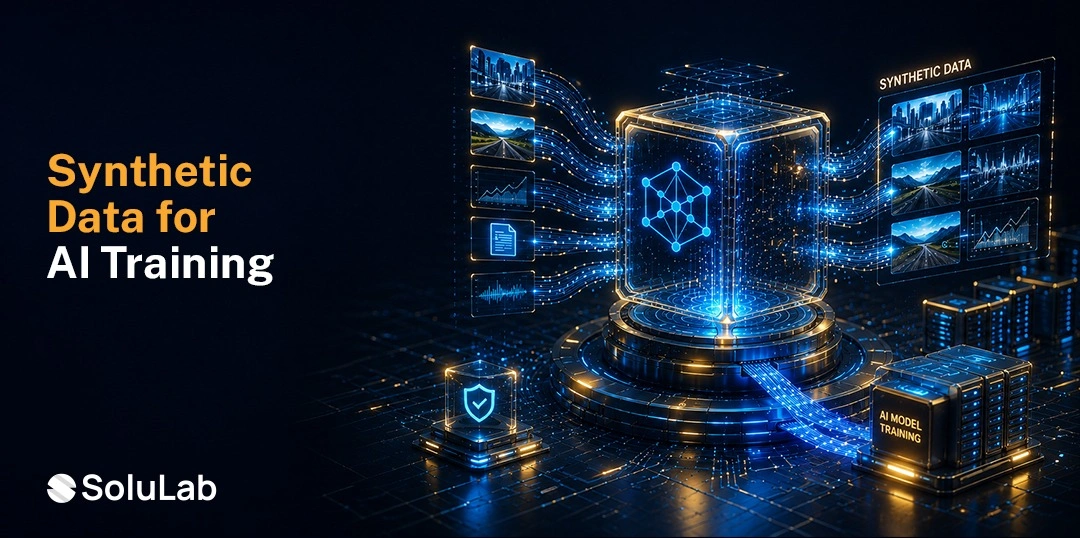
- Synthetic data for AI training is artificially generated information built to mimic real-world data without exposing actual records.
- It solves three concrete problems: scarce data, privacy law, and the sheer cost of labeling by hand.
- Used carelessly, especially in recursive loops, synthetic data causes model collapse. This is a documented failure mode, not a theoretical one.
- The safest approach blends synthetic and real data, with a validation gate before any synthetic batch touches a training run.
- Teams that treat synthetic data validation as a one-time checkbox get burned. The ones who treat it as an ongoing process don’t.
Feed a model enough of its own output, and it starts to forget what real data even looks like. That’s not a warning from a research paper nobody reads. It’s happening now, it’s measurable, and it has a name: model collapse.
Synthetic data for AI training went from a niche workaround to a default setting in AI model training pipelines in under four years. The reasons are practical, not trendy. Real data is expensive to label. It’s slow to collect. And a good chunk of it is legally off-limits the moment it touches personal or medical information. Synthetic data sidesteps all three problems at once, which is exactly why so many teams reached for it without asking what they were trading away.
Here’s the honest version of that trade-off: how synthetic data generation actually works, where it earns its place, where it quietly wrecks a model, and how to build a validation process that catches the damage before it ships.
What Is Synthetic Data, Exactly?
Synthetic data is information created by algorithms, simulations, or generative models rather than pulled from a real event. Built well, it keeps the statistical patterns and correlations of a real dataset intact, without a single record that traces back to an actual person, transaction, or patient.
It’s a stunt double. Looks and behaves like the real thing in every way that matters for training, but nothing bad happens if it leaks.
Three Reasons Teams Reach for It
- Scarcity. Equipment failures, fraud cases, rare diseases. These don’t happen often enough in real datasets to train a model that generalizes.
- Privacy law. GDPR and HIPAA restrict how personal or medical data gets used, sometimes even inside the company that collected it.
- Cost and speed. Hand-labeling a few million real images takes months and a real budget. Generating them synthetically takes hours.
Gartner put synthetic data at just 1% of all AI training data in 2021. By the end of 2024, that number was projected to cross 60%, a shift that outran most data teams’ governance processes. Gartner has also predicted synthetic data will overtake real data in model training by 2030, with the market behind it growing from roughly $351 million in 2023 to over $2.3 billion by decade’s end.
How Synthetic Data Generation Actually Works
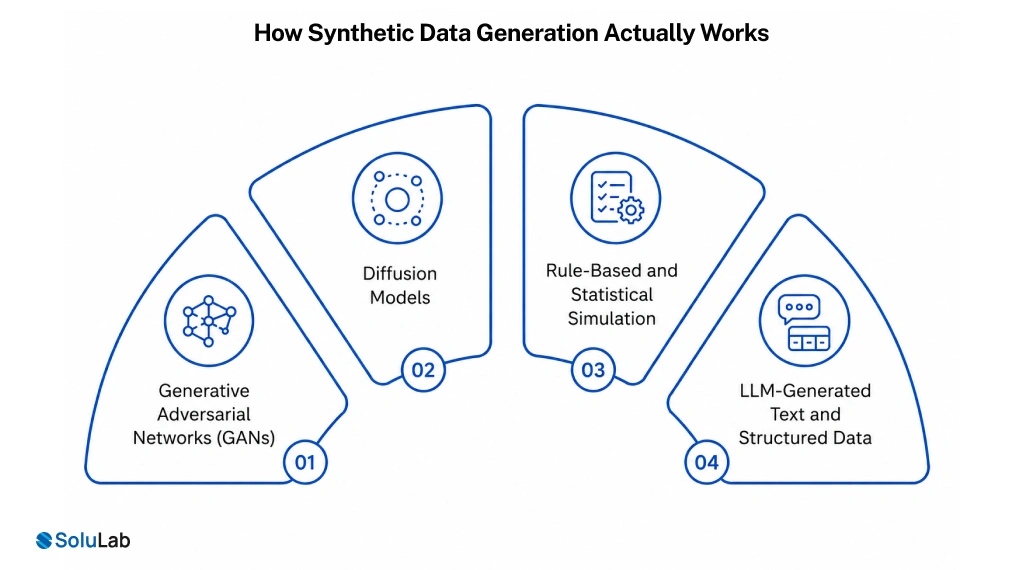
There’s no single method here, and picking the wrong one is a common reason a synthetic dataset underperforms.
1. Generative Adversarial Networks (GANs)
Two neural networks compete. One generates fake samples, the other tries to catch them. After thousands of rounds, the generator gets good enough to fool its opponent consistently. GANs work well for images and tabular data, though they can be genuinely painful to train stably.
2. Diffusion Models
Start with noise, then refine it step by step into something coherent, guided by patterns learned from real data. Diffusion now powers most modern image and audio synthesis, and it tends to produce more diverse output than older GAN approaches.
3. Rule-Based and Statistical Simulation
No neural network here. Just known statistical rules (distributions, correlations, business logic) encoded directly. Less flexible, sure. But far more interpretable, which matters in finance and healthcare, where “the model just decided” isn’t an answer regulators accept.
4. LLM-Generated Text and Structured Data
Large language models can generate synthetic conversations, documents, or structured records to fine-tune smaller models. Microsoft trained Phi-4 on hundreds of billions of synthetic tokens instead of relying purely on scraped web text. That approach is becoming the norm as fresh, high-quality public text runs low.
This overlaps with data augmentation techniques, though the two aren’t the same thing. Augmentation reshapes existing real samples, rotating an image, paraphrasing a sentence. Synthetic generation builds entirely new samples from nothing. Most production pipelines use both, one after the other, as part of a broader machine learning development workflow.
Where Synthetic Data Genuinely Helps?
Not every use case benefits the same amount. The strongest results show up where real data is too sensitive, too rare, or too expensive to gather at scale.
Healthcare and MedTech
Patient records sit near the top of any list of tightly regulated data. Synthetic patient cohorts let research and product teams test diagnostic models and simulate rare conditions without a real medical record ever entering the pipeline. SoluLab’s GenAI in MedTech case study shows exactly this pattern in practice: synthetic and augmented clinical data cutting model validation time while the underlying patient data stays untouched.
Financial Services and Fraud Detection
Fraud is rare by definition. That’s the whole problem. Real fraud datasets are small and lopsided, so synthetic fraud scenarios give a model thousands of variations of a pattern it might otherwise see a handful of times a year. Teams building this out often pair synthetic scenarios with real transaction data inside an AI-based fraud detection pipeline rather than relying on either data source alone.
Autonomous Systems and Robotics
Simulated environments generate driving scenarios and sensor readings that would be dangerous or flat-out unethical to capture for real: a child darting into the street, black ice on a bridge at night.
Software Testing and QA
Synthetic user data lets teams load-test applications without exposing real customer information, which folds directly into privacy-preserving training data practices more broadly.
Deloitte surveyed roughly 2,770 director-to-C-suite leaders for its State of Generative AI in the Enterprise research and found that 75% of organizations were increasing their technology investment in data management specifically because of generative AI initiatives. That’s a company betting on data strategy, not just model architecture, and it’s the right bet.
The Hidden Risk: Model Collapse
Here’s where synthetic data stops being a shortcut and starts being a liability.
Model collapse happens when a model trains, generation after generation, on data produced by earlier versions of itself, or by other AI systems, instead of on fresh real-world data. A 2024 study in Nature by Shumailov and colleagues showed that recursive training on AI-generated data causes steady, measurable degradation. Rare events disappear first. After five to ten generations, outputs converge toward a narrow, repetitive average. The diversity that made the original data useful just isn’t there anymore.
Zoom out from one company to the whole internet, and the problem compounds fast. Company A trains on synthetic data and publishes its model’s outputs. Company B scrapes those outputs to build its own training set. Now both models inherit the same degradation. A meaningful share of current web text is already AI-generated, and that share keeps climbing. Accidental recursive contamination isn’t an edge case anymore. It’s a background risk in almost every pipeline touching public data.
What Actually Triggers Collapse
- Replacing real data with synthetic data instead of supplementing it.
- Training exclusively on one generative model’s outputs, with no diversity checks.
- Feeding a model’s own outputs back into its next training round, unfiltered.
- Skipping validation against a real-data benchmark before each cycle.
The fix isn’t “stop using synthetic data.” It’s simpler than that: never let synthetic data fully replace your real-data anchor, and check every batch against that anchor before it’s used.
Synthetic vs Real Training Data: When Each One Wins
Neither wins outright. The right mix depends on what you’re building and what you actually have access to.
| Factor | Real Data Wins | Synthetic Data Wins |
| Data availability | Abundant, well-labeled data exists | Data is rare, sensitive, or expensive to collect |
| Regulatory exposure | Low-risk data categories | Personal, medical, or financial data under strict law |
| Ground-truth accuracy | Model needs exact real-world nuance | Edge cases need volume more than perfection |
| Bias risk | Real data is already reasonably balanced | Historical data is skewed and needs rebalancing |
| Budget and timeline | Time and budget allow proper collection | Speed matters more than perfect fidelity |
Synthetic vs real training data isn’t really an either-or in production. Most mature pipelines run both: real data as ground truth, synthetic data filling statistical gaps, expanding rare classes, or standing in wherever privacy law draws a hard line.
Building a Synthetic Data Validation Process
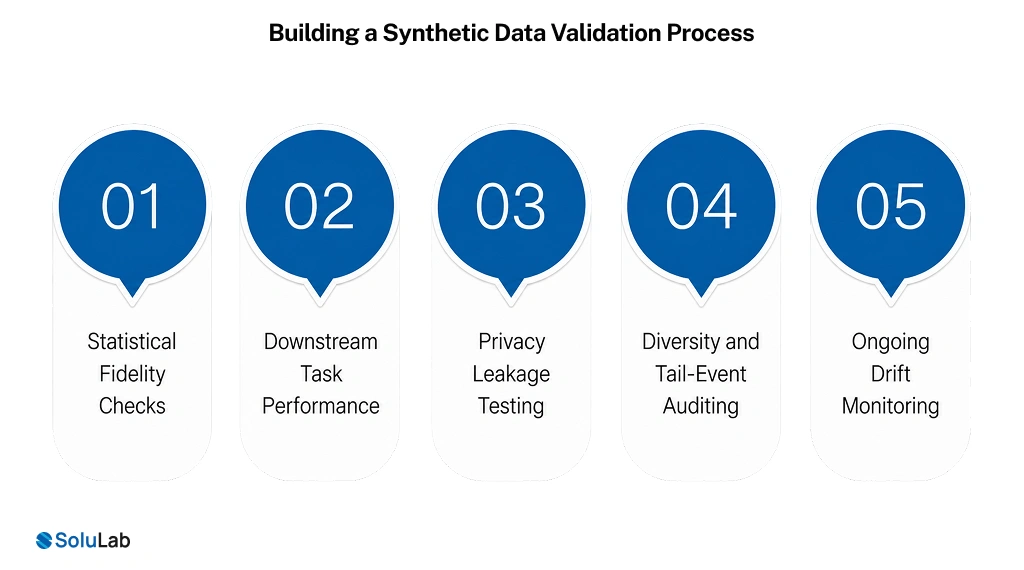
This is the step most teams skip. It’s also the one that decides whether a synthetic dataset helps a model or quietly poisons it.
1. Statistical Fidelity Checks
Compare distributions, correlations, and variance between the synthetic dataset and the real one it’s modeled on. Big deviations are a warning sign. Don’t file them away for “later.”
2. Downstream Task Performance
Train two versions of the same model: one on real data only, one with synthetic data blended in. Compare both against a held-out real-world test set. If the synthetic version doesn’t hold its own, it hasn’t earned a place in the pipeline.
3. Privacy Leakage Testing
Run membership-inference tests to confirm the synthetic data hasn’t quietly reproduced identifiable patterns from the source. Wherever privacy-preserving training data is a compliance requirement rather than a nice-to-have, this step isn’t optional.
4. Diversity and Tail-Event Auditing
Check specifically for rare classes and edge cases. If a synthetic dataset smooths those out to look “cleaner,” it just undid the one reason synthetic data was worth generating in the first place.
5. Ongoing Drift Monitoring
Validation isn’t a one-time gate. Re-check synthetic batches periodically, especially after the generative model producing them gets retrained.
Teams without this expertise in-house often bring in outside data science consulting support to build the validation layer, not just the generation pipeline. Get the generation right and skip validation, and model collapse sneaks in months after launch, once everyone’s stopped watching.
Explainability and Trust in Synthetic-Trained Models
A model trained partly on synthetic data invites a fair question from stakeholders: can we still explain why it decides what it decides? This is where what is explainable AI stops being an academic phrase and starts mattering operationally. Tools like SHAP values, LIME, and attention visualization trace a model’s decision back to which features, real or synthetic, actually drove the outcome.
This matters more in regulated sectors. A lending model or diagnostic tool trained on a mix of real and synthetic records needs to prove to auditors that the synthetic slice didn’t smuggle in hidden bias or an untraceable decision path. Build explainability into the architecture from day one. Bolting it on after an audit request is the expensive way to learn this lesson.
Conclusion
Synthetic data for AI training earns its place when real data is too scarce, too sensitive, or too slow to collect at the volume a model needs. It turns into a liability the moment it replaces real data outright, gets fed back into itself across generations, or skips validation on its way into a pipeline. Teams getting real value from it treat synthetic data as one ingredient, measured and checked, never left to run on its own.
Getting that mix right takes the kind of machine learning development discipline that catches drift before it compounds, which is exactly the work SoluLab does with product and engineering teams every week.
If you’re deciding whether synthetic data belongs in your training pipeline, or you’ve already shipped a model and can’t explain an unexpected accuracy drop, SoluLab is an AI development company built to figure out what’s actually happening under the hood and fix it before it forces a full retrain.
FAQs
Neha is a curious content writer with a knack for breaking down complex technologies into meaningful, reader-friendly insights. With experience in blockchain, digital assets, and enterprise tech, she focuses on creating content that informs, connects, and supports strategic decision-making.