Key Takeaways
- The appropriate AI development firm is not only addressing business issues but also developing models and demonstrating flashy technology.
- Domain expertise matters. Experienced partners are able to know workflow, regulations, and real-life constraints.
- Never accept empty promises; demand evidence of work case studies, live demos, or even quantifiable results.
- Compliance, data privacy, and security must not be compromised, particularly with sensitive or regulated data.
- Effective communication and transparency allow the collaboration process to become easier, quicker, and reduce the number of project delays to be reduced.
- An effective AI collaborator is long-term so that you can scale, sustain, and continue to develop your AI solution as your business expands.
Ever wondered why some businesses successfully scale with AI while others burn budgets and still struggle with poor results? The difference often isn’t the idea—it’s the AI development company they choose to execute it.
78% of companies have already deployed AI in at least one business area, showing that choosing the right partner is no longer optional—but strategic. But choosing the wrong partner can lead to delayed timelines, weak models, security risks, and solutions that look good in demos but fail in real-world use.
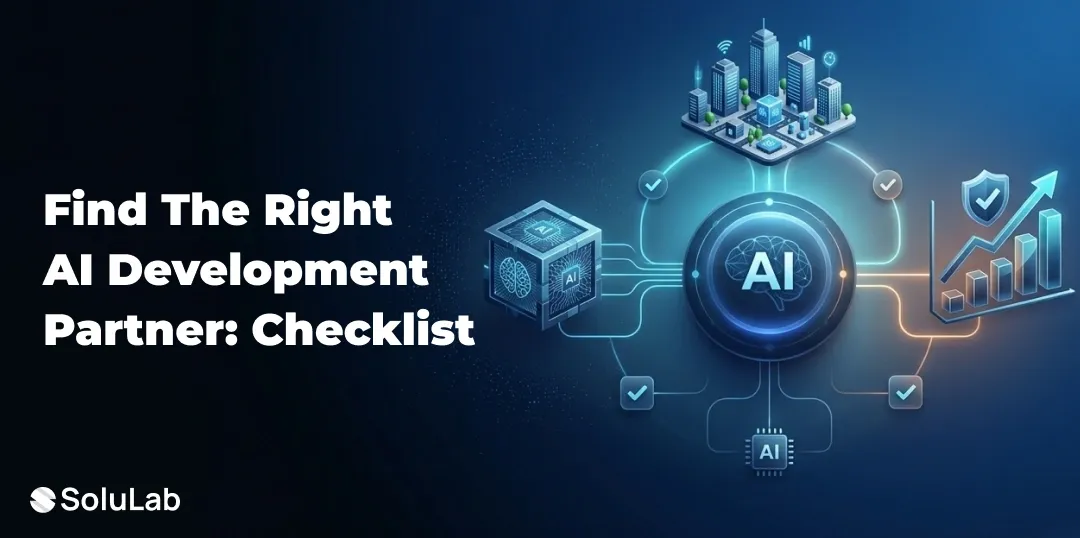
That’s why selecting the right AI development company needs a structured approach. This checklist will help you evaluate AI partners based on real capabilities, domain expertise, security standards, and communication practices.
By the end, you’ll know exactly what to look for, what to question, and how to choose an AI partner that aligns with your business goals and delivers long-term value.
Why Choosing the Right AI Development Company Matters?
The selection of the appropriate AI development company is not merely a question of a vendor but determines whether your AI project will be successful, will represent actual value, and will grow with your business objectives, or will turn out to be an expensive failure. Here are a few reasons you should hire the right AI development company:
1. Strategic alignment to business goals: An effective AI-led development partner knows in and out of your business goals and aligns the AI solution to achievable business outcomes, rather than high-glamour technology. This makes certain that your investment is truly a growth driver and that it is a solution to real problems.
2. Knowledge and Technical Depth: The development of AI requires experts working in machine learning, data engineering, NLP, and other areas. The right firm will come with a team of experienced staff capable of developing quality, scalable systems that will add lasting value.
3. Scalability and Future-Ready Solutions: AI does not exist as a single construction, but is a developing concept. A trustworthy partner will build systems to scale with your business, respond to data needs, and ensure performance is maintained over time.
4. Reduced risks and increased ROI: Making the right decisions minimizes risks such as project delays, budget wastage, or under-performance. An established AI firm will reduce the overall expenses in the long term and will maximize your revenue.
5. Communication, Support, and Trust: Open communication, constant support, and ethics are essential. A good partner will ensure you stay updated, secure your information, and provide after-deployment support to make your AI remain useful.
How to Choose the Right AI Development Company?
Selecting the appropriate AI app development firm is not a purely technological choice, but a business one. The right match gets AI to match your objectives, schedules, and budgets, as well as long-term expansion agendas.
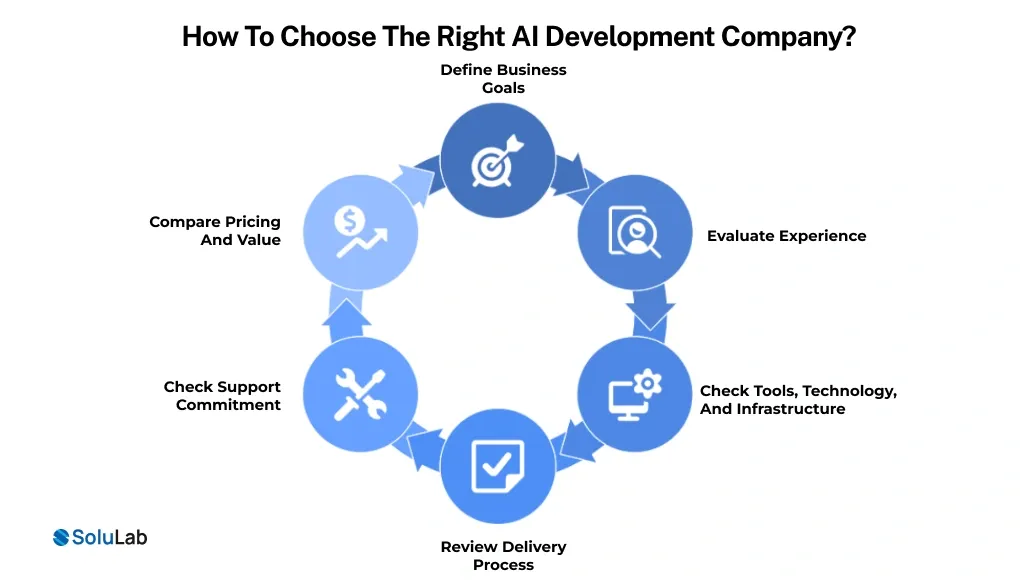
1. Define Business Goals
Start with clarity. Be clear about what you want AI technology to do, what you expect it to do, what success criteria and timelines to use. This assists you in filtering companies that have an interest in business making, rather than constructing complicated models.
2. Evaluate Experience
Look beyond portfolios. Test whether the company has practical experience within your industry, related use cases, and regulatory conditions. Experience leads to fewer risks, accelerated development, and practical, scalable AI solutions.
3. Check Tools, Technology, and Infrastructure.
Evaluate their AI structures, cloud-based offerings, information flows, and security measures. The current, scalable AI technology stack will also guarantee improved performance, compliance, and scalability as your AI solution evolves.
4. Review Delivery Process
Know the way they handle projects, from discovery to deployment. The presence of transparency can be ensured by a structured process, which is characterized by clear milestones, regular updates, testing phases, and feedback loops, and prevents costly delays or scopes creep.
5. Check Support Commitment
AI models should be constantly controlled and refined. Make sure that the firm provides after-deployment services, model training, performance optimization, and prompt resolution of any issues to ensure that your AI system is stable and current.
6. Compare Pricing and Value
Don’t choose purely on cost. Compare pricing frameworks with the supplied value, experience, scalability, and post-sale assistance. The least expensive choice usually results in increased expenditures in the future because of rework or lack of performance.

Industry-Specific AI Solutions for Business-Centric Outcomes
The right AI software development agency does not just create models, but it resolves actual business issues. Through the integration of AI into daily operations, it assists businesses in many industries in automating repetitive operations, enhancing precision, and expanding expeditiously without increasing the number of hands-on activities.
1. Healthcare
AI in healthcare can be used to automate the scheduling of appointments, updating medical records, and handling claims. As an example, chatbots respond to patient requests, whereas AI systems detect anomalies in reports, lessening the workload on the administration, allowing doctors and other staff to pay more attention to patients.
2. Banking & Finance
AI in banking facilitates KYC verification, detection of fraud, and monitoring of transactions. Machine learning models can scan thousands of transactions in real time instead of manual checks, and eliminate repetitive compliance tasks as well as enhance accuracy in risk assessment.
3. Retail & E-commerce
AI in retail is used to combine inventory and sales systems and automates the process of demand prediction, price optimization, and customer support. As an example, AI forecasts the need to purchase stocks, and chatbots answer questions regarding orders, which saves teams hours of follow-ups.
4. Manufacturing
AI in manufacturing assists in automating quality inspections, predictive maintenance, and supply planning. AI models and sensors identify the problems in machines in their early stages, eliminating the redundant processes of manual inspection and avoiding expensive downtime in a production line.
5. Logistics & Supply Chain
AI in logistics optimizes the route scheduling, the shipment, and the demand. Rather than decisions on routes being made manually, AI systems propose quicker and cheaper routes and automate status reporting, reducing the time spent by operations teams in repetitive coordination actions.
Privacy, Data Security Capabilities, and Compliance.
With AI-based systems, high-level data security, privacy, and compliance are not a choice. They safeguard sensitive data, establish trust in users, and make sure that your business is up to rigorous regulatory standards.
- Handling and Security Practices: This includes data handling as it relates to the collection of data, data storage, data processing, and data deletion. Some best practices are safe cloud maintenance, authorization, frequent security testing, and explicit policies to avoid spillage, abuse, and unauthenticated access.
- Compliance Knowledge: Good compliance knowledge implies knowing such laws as GDPR, HIPAA, and the DPDP Act in India. The right team is proactive and maps requirements, documents the processes, and updates the systems as regulations change- minimizing legal and operational risks.
Read More: Build HIPAA-Compliant AI Health Platforms
Evaluate Their Costing Structure
| Costing Aspect | What to Evaluate? | Why It Matters? |
|---|---|---|
| Pricing Model | Fixed price, hourly, milestone-based, or subscription | Helps you predict total spend and choose a model that matches project uncertainty and delivery timelines |
| Scope Clarity | What’s included vs excluded in the quoted cost | Prevents scope creep and unexpected add-on charges during development |
| Hidden Costs | Licensing, cloud usage, APIs, third-party tools, maintenance | Avoids budget overruns that appear after deployment |
| Scalability Costs | Cost impact as users, data, or features grow | Ensures the solution remains affordable as your business scales |
| Post-Launch Support | Support, updates, compliance changes, and bug fixes | Reduces long-term operational risk and unexpected future expenses |
| Payment Milestones | Clear deliverables tied to payments | Protects cash flow and ensures accountability at each project stage |
Read more: AI Development Cost
Mistakes You Should Avoid When You Hire an AI Development Company!
Outsourcing to an AI development firm has the potential to break or make your product. Hiring AI developers who can actually help your business grow in the long term.
- Optimizing on the cheapest: The cheapest vendor will reduce the quality of the code, resulting in low scalability and undisclosed costs in the future. Developing AI requires robust engineering, data skills, and testing – reducing costs in the initial phase will tend to fluctuate with time in repairing, rewriting, and maintaining it.
- Selecting a Non-Experienced Partner for Your Domain: AI is not universal. The inexperienced team might not know how to work, what is required of them to comply, or what constraints are real and alive in the business, and thus their models may look good on the screen but fail when applied in the business.
- Purchasing a False Hope on No Evidence: Be wary of the sellers who claim unrealistic accuracy, schedules, or fully automated AI. Always request case studies, live demos, or references. When the results cannot be justified by data or previous works, it is a red flag.
- Failing to Take into Security and Compliance: Data security, privacy, and compliance are serious issues that can put your business in grave legal and financial challenges if disregarded. Be sure that the company adheres to safe developmental practices, data handling, and pertinent regulations since the establishment of the company, and not as an additional factor.
- No Communication Practices Checked: When there is poor communication, it creates delays, misunderstandings, and an incorrect alignment of expectations. Unless reporting lines, feedback, and escalation are clarified at the beginning, teamwork will be agonized, and project schedules may go off track.

Conclusion
The process of selecting the appropriate AI development company is not about pursuing large claims and complicated technologies but rather about getting a partner that will genuinely grasp your business.
The right enterprise development company will not be in a hurry to make decisions. It is important to remember that AI is effective when constructed wisely. Smart choice in the present will bring value to your investment in AI long after the launch.
SoluLab, an AI development company in the USA, can help you integrate AI into your existing workflows. Book a free discovery call today!
FAQs
Tanmay is focused on building brand authority through narrative-driven marketing. With 19+ years in tech branding, he has positioned SoluLab as a thought leader in the Blockchain and AI sectors. He regularly shares insights on AI-driven brand storytelling and content strategy. He is open to connecting with startups and enterprise teams to help them overcome their challenges.