Key Takeaways
- AI products inspired by Muse Spark focus on combining multimodal intelligence, reasoning, and action, moving beyond basic automation to systems that can understand context, generate outputs, and execute tasks seamlessly.
- Building similar AI products requires integrating advanced models with real-time data pipelines and scalable infrastructure to replicate the responsiveness and adaptability seen in Muse Spark-like systems.
- A strong emphasis on AI-first UX is essential, where interactions feel conversational and intuitive, reflecting how Muse Spark enables natural, human-like engagement across different input formats.
- To successfully develop AI products inspired by Muse Spark, businesses often rely on expert AI app development services or hire AI developers who understand complex, production-level AI systems.
AI product development has moved far beyond basic chatbots and automation tools. Today, companies are building systems that can understand context, generate content, and take actions. Meta’s Muse Spark is a strong example of this shift, combining multimodal intelligence, reasoning, and task execution into a single experience.
It reflects how modern AI development solutions are expected to behave, not just responding to users but actively assisting and adapting. For businesses, this creates a clear opportunity to rethink how products are designed and delivered.
According to Forbes, AI is projected to contribute $15.7 trillion to the global economy by 2030, making AI product development one of the most valuable long-term investments for businesses.
Building AI products inspired by Muse Spark means focusing on scalable architecture, strong data foundations, and user experiences that evolve continuously with real-world usage and feedback.
What Is Muse Spark?
Muse Spark is Meta’s latest AI model and the first major release from its Superintelligence Labs, built as a step toward what the company calls personal superintelligence.
At its core, Muse Spark is a multimodal AI system, which means it can understand and process different types of inputs like text, images, and even real-world context at the same time.
But what makes it different from traditional AI tools is how it thinks and acts.
Instead of just answering questions, Muse Spark is designed to:
- Reason through complex problems across multiple steps
- Generate real outputs like dashboards, mini-games, or UI components from simple prompts
- Use multiple AI agents simultaneously to improve decision-making (what Meta calls “contemplating mode”)
- Interact with real-world scenarios, like analyzing images, suggesting products, or interpreting health data
Why AI Product Development Is Exploding in 2026?
AI product development is increasing in 2026 as businesses move beyond experimentation and start building intelligent, scalable systems that directly impact revenue, efficiency, and customer experience.
1. AI adoption across SaaS, fintech, healthcare, and Web3
Industries are embedding AI into core products, from predictive analytics in fintech to diagnostics in healthcare and personalization in SaaS, making AI a foundational layer rather than an optional feature.
2. Rising demand for intelligent automation
Companies are replacing repetitive workflows with AI-driven systems that can learn, adapt, and make decisions, reducing operational costs while improving speed, accuracy, and overall business efficiency.
3. Enterprises investing heavily in AI Automation
To stay competitive, enterprises are partnering with specialized providers offering AI app development services, enabling faster deployment, access to expert talent, and scalable infrastructure for production-ready AI products.
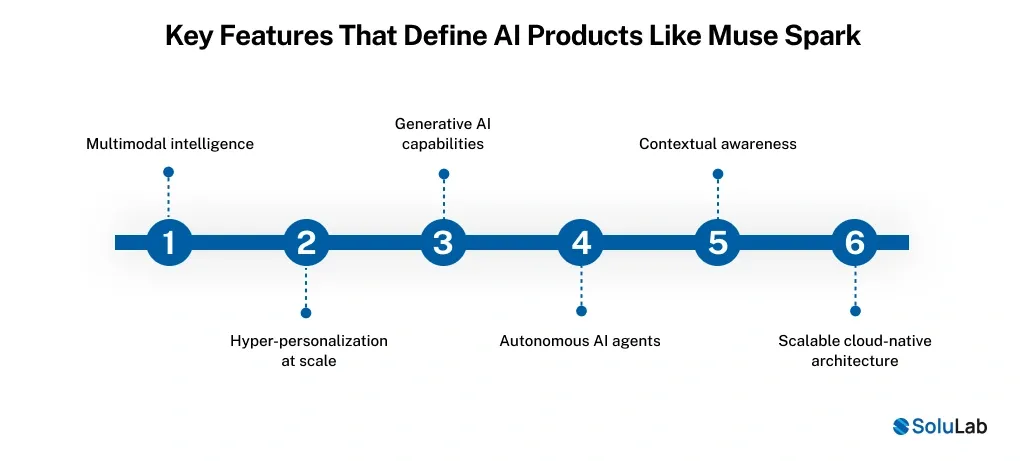
Key Features That Define AI Products Like Muse Spark
AI products are evolving beyond simple automation into intelligent, adaptive systems. Inspired by Meta’s advancements, businesses are now building smarter solutions that can think, create, and act in real time.
- Multimodal intelligence: AI products like Muse Spark combine text, images, voice, and video understanding, enabling richer interactions and deeper context awareness that drive more accurate outputs and user experiences.
- Hyper-personalization at scale: AI continuously learns from user behavior and preferences, delivering tailored experiences, recommendations, and outputs that evolve without requiring manual intervention or static rule-based systems.
- Generative AI capabilities: Modern AI systems can create content, designs, code, and workflows on demand, transforming user prompts into actionable outputs and significantly reducing manual effort across creative and operational tasks.
- Autonomous AI agents: AI products like Muse Spark leverage multiple agents that can independently plan, execute, and optimize tasks, enabling complex workflows to run with minimal human involvement.
- Contextual awareness: These systems understand user intent, historical interactions, and real-world signals, allowing them to deliver more relevant and meaningful responses instead of generic outputs.
- Scalable cloud-native architecture: Built on distributed systems and APIs, AI-driven product development like Muse Spark ensures high performance, flexibility, and the ability to handle large-scale data and user demands efficiently.
Step-by-Step Process to Build AI Products Like Muse & Spark
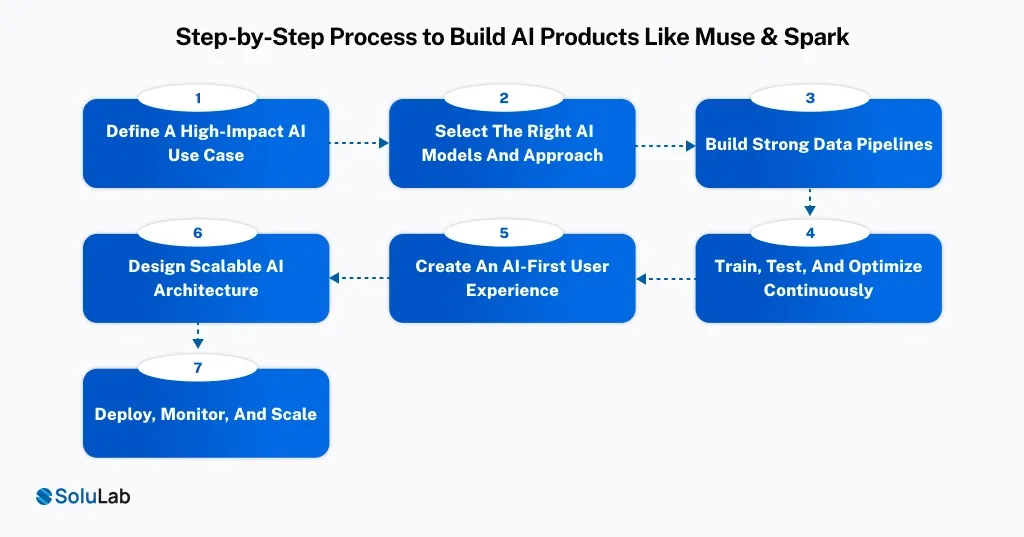
Building AI products like Muse Spark requires more than integrating models. It demands a clear strategy, scalable architecture, and continuous learning systems that evolve with user behavior and real-world data inputs.
Step 1. Define a High-Impact AI Use Case
Start with a clear problem worth solving, not just technology experimentation. Focus on areas where AI can automate decisions, enhance personalization, or improve efficiency, ensuring the product delivers measurable business and user value from day one.
Step 2. Select the Right AI Models and Approach
Choose models based on your use case, whether large language models, multimodal systems, or autonomous agents. The right combination ensures better performance, scalability, and adaptability, especially when building complex, real-time AI-driven products.
Step 3. Build Strong Data Pipelines
AI systems rely heavily on high-quality data. Set up pipelines for collecting, cleaning, and processing structured and unstructured data, ensuring your models receive accurate inputs and continuously improve through real-time feedback and learning loops.
Step 4. Design Scalable AI Architecture
Use cloud-native infrastructure, APIs, and microservices to ensure flexibility and performance. A scalable backend allows your AI product to handle increasing user loads, real-time processing, and seamless integration with third-party tools and systems.
Step 5. Create an AI-First User Experience
Design interfaces that feel natural, whether through chat, voice, or visual interaction. Focus on reducing friction between user intent and AI output, making the experience intuitive, responsive, and aligned with how people naturally communicate.
Step 6. Train, Test, and Optimize Continuously
AI products are never truly finished. Regularly evaluate model performance, reduce errors, and refine outputs using user feedback and testing frameworks, ensuring the system becomes smarter, more reliable, and more aligned with user expectations over time.
Step 7. Deploy, Monitor, and Scale
After launch, monitor performance, usage patterns, and system behavior closely. Use analytics and observability tools to identify improvements, scale infrastructure, and ensure your AI product remains stable, efficient, and competitive in an evolving market.
Tech Stack Required for AI Product like Meta’s Muse Spark
Building AI products like Meta’s Muse Spark requires a modern, scalable tech stack that supports multimodal intelligence, real-time processing, and continuous learning across complex, data-driven environments.
| Layer | Technologies | Role in AI Product |
| AI/ML Frameworks | PyTorch, TensorFlow | Used to build, train, and deploy machine learning and deep learning models efficiently at scale |
| LLMs & Multimodal Models | GPT-based models, diffusion models | Power natural language understanding, content generation, and multimodal capabilities like image and video processing |
| AI Orchestration | LangChain, LlamaIndex | Manage workflows, connect models with data sources, and enable complex reasoning across multiple AI components |
| Backend Development | Python, Node.js | Handle APIs, business logic, and communication between AI models and frontend systems |
| Frontend Development | React, Next.js | Build intuitive, responsive interfaces for seamless human-AI interaction and real-time user experiences |
| Cloud Infrastructure | AWS, Google Cloud, Azure | Provide scalable compute power, storage, and GPU resources required for training and deploying AI models |
| Data Engineering | Apache Kafka, Spark | Enable real-time data streaming, processing, and pipeline management for continuous AI learning |
| Vector Databases | Pinecone, Weaviate | Store embeddings and enable fast semantic search, improving contextual understanding in AI systems |
| DevOps & Deployment | Docker, Kubernetes | Ensure smooth deployment, scaling, and monitoring of AI applications in production environments |
Applications Of Meta Muse Spark
Applications of Meta Muse Spark are expanding, enabling businesses and creators to build intelligent, multimodal experiences that go beyond automation, combining creativity, real-time reasoning, and personalized user engagement at scale.
- Marketing and Advertising: AI-driven campaign generation: Muse Spark enables hyper-personalized ads, real-time audience targeting, and automated creative optimization, helping brands improve engagement, conversion rates, and overall marketing performance with minimal manual intervention.
- Product Recommendations: Context-aware personalization: It analyzes user behavior, preferences, and real-time signals to deliver highly relevant product suggestions, improving customer experience, boosting retention, and increasing revenue across eCommerce and digital platforms.
- Creative Writing: Intelligent content generation: Muse Spark assists in writing blogs, scripts, and storytelling by understanding tone, context, and intent, enabling faster, high-quality content creation while maintaining originality and audience relevance.
- Design and Art: Multimodal creative generation: It can create visuals, UI concepts, and digital artwork from simple prompts, helping designers accelerate workflows, explore ideas quickly, and produce high-quality creative outputs efficiently.
- Content Creation: From ideation to publishing, Muse Spark supports video scripts, social posts, and multimedia content, enabling creators and businesses to scale content production without compromising quality or consistency.
Read more: Launch an AI-Powered Super App
Cost of Building AI Products Like Meta’s Muse & Spark
Building AI products like Meta’s Muse & Spark requires careful budgeting across development stages, as costs vary based on complexity, scalability, data requirements, and the level of intelligence and automation involved.
| Stage | Estimated Cost | What You Get |
| MVP | $25K–$30K | A functional AI prototype with core features like basic model integration, limited datasets, and a simple UI to validate the idea and test market fit quickly. |
| Mid-Scale Product | $40K–$50K | More refined AI system with improved models, better UI/UX, scalable backend, and integration of features like personalization, analytics, and partial automation capabilities. |
| Enterprise-Grade Solution | $50K+ | Fully scalable, production-ready AI platform with advanced models, multimodal capabilities, real-time processing, high security, and robust infrastructure to support large-scale users and complex workflows. |
Future Trends in AI Product Development
AI product development is moving fast, shifting from simple automation to intelligent, adaptive systems that learn, act, and personalize experiences in real time across industries and digital ecosystems.
- Autonomous AI agents: AI systems now operate independently, making decisions, executing workflows, and improving over time, powering AI-powered products like Muse Spark that move beyond assistance into fully autonomous execution.
- Hyper-personalization: Advanced models analyze behavior, preferences, and context in real time to deliver tailored experiences, enabling AI products like Muse Spark to provide deeply customized interactions at scale.
- AI + Web3 convergence: Decentralized infrastructure combined with AI gets secure, transparent, and user-owned data ecosystems, driving AI-driven product development like Muse Spark for trustless and intelligent digital platforms.
- Edge AI and real-time processing: AI models deployed on edge devices enable faster decisions with minimal latency, making custom AI product development more efficient for real-time applications like IoT, healthcare, and autonomous systems.

Conclusion
Building AI products inspired by Meta’s Muse Spark requires more than adopting advanced models. It demands a clear use case, scalable architecture, quality data, and continuous learning systems that evolve with user behavior.
Businesses that focus on real-time intelligence, personalization, and seamless user experiences will gain a strong competitive edge. The shift toward autonomous and multimodal AI is already redefining how products are built and used.
The key is to move early, experiment fast, and scale wisely. If you’re planning to build such solutions, SoluLab, an AI development company, can help your business turn ideas into production-ready AI products.
FAQs
Neha is a curious content writer with a knack for breaking down complex technologies into meaningful, reader-friendly insights. With experience in blockchain, digital assets, and enterprise tech, she focuses on creating content that informs, connects, and supports strategic decision-making.