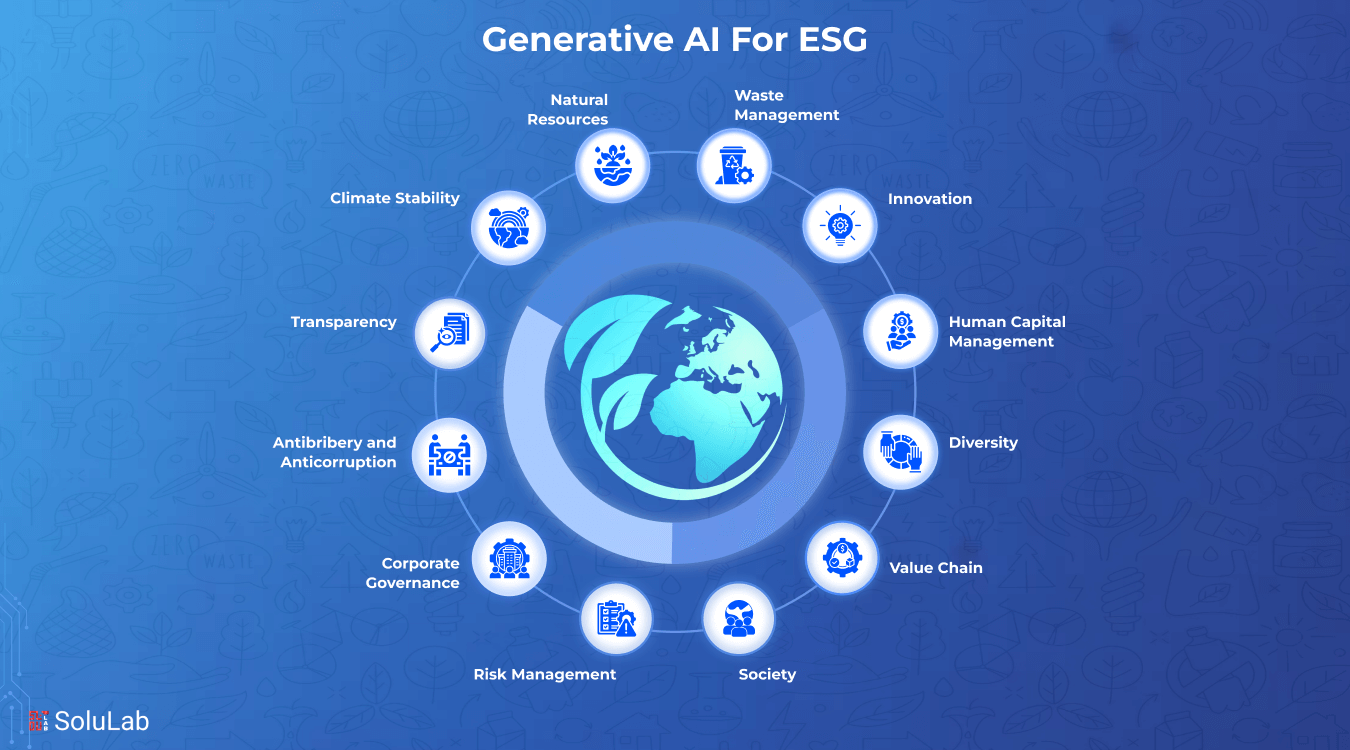
Environmental, social, and governance (ESG) factors now shape how companies talk about value and impact. Climate pledges, fair labor, board oversight: investors and regulators want proof, not promises, and they want it backed by data anyone can check. The hard part? Most ESG data arrives as a mess of spreadsheets, PDFs, and emails that nobody has time to untangle. That’s the gap generative AI in ESG is starting to close.
Sustainability reports, climate risk scenarios, supplier ethics checks. Work like this used to eat weeks of analyst time, and generative AI can now take a first pass at all of it. One McKinsey’s 2024 study indicates that 78% of firms have used AI in at least one business function, up from 72% earlier in the year. That jump tells you something. AI is becoming a practical way to get sharper ESG insight and run the program with less manual grind.
The tools are getting cheaper and better tuned for ESG work, so the companies that start early get a head start that’s hard to catch. Below, we walk through where generative AI is changing ESG strategy, reporting, and innovation across industries.
How Generative AI Aligns with ESG Goals?
“Sustainable.” “Responsible.” Until there’s action behind them, those words read like marketing. And building a credible Environmental, Social, and Governance (ESG) plan is genuinely hard. You usually have too much data, too little clarity, and standards that keep moving under your feet. This is exactly where ESG and AI fit together well.
Tools such as generative AI chatbots make ESG reporting simpler, give decision-makers better information, and pull stakeholders into the conversation. The result is ESG goals you can actually reach, measure, and show to others. Compliance gets lighter, and there’s more room left for new ideas and change before a regulator forces it. Here’s how it works in practice:
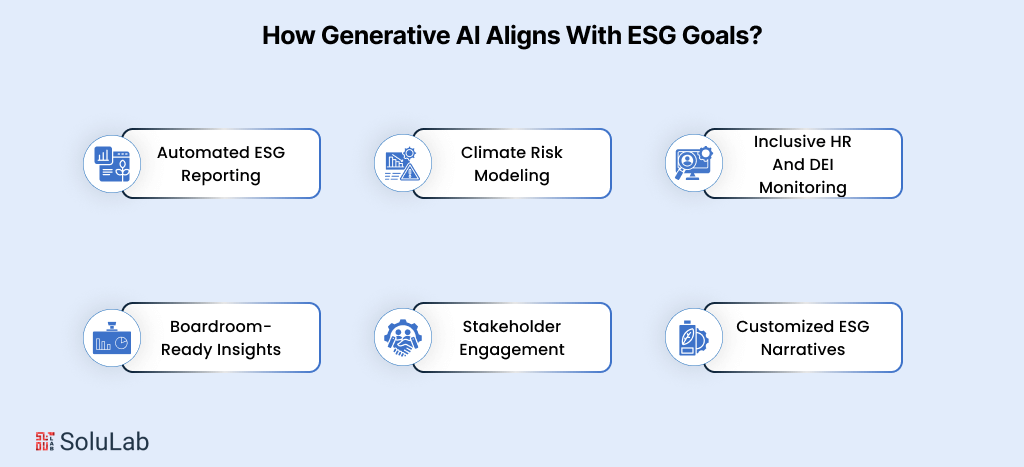
- Automated Environmental, Social, and Governance Reporting: Generative AI can pull data from energy logs, HR systems, supplier records, and more, then assemble accurate reports that are ready for GRI, SASB, or CSRD. That’s weeks of copy-and-paste work your team doesn’t have to do.
- Climate Risk Modeling: Artificial intelligence models recreate environmental scenarios so a company can see how climate risks might hit its assets, operations, and investments over the long run. Decisions get made earlier, and with better information.
- Ethical Supply Chain Mapping: Feed it supplier data, contracts, and shipping records, and generative AI can spot unethical practices, trace carbon footprints, and back up a cleaner, more open procurement process.
- Inclusive HR and DEI Monitoring: Using anonymised employee input and simulations of equity-focused policies, generative AI shows HR teams where diversity, equality, and inclusion efforts fall short. Then it suggests fixes that don’t favor one group over another.
- Stakeholder Engagement: With generative AI chatbots or other automated systems, a company can hold two-way conversations about ESG goals with shareholders, employees, and local communities. At scale. And the feedback it collects is something you can act on.
- Personalized ESG Narratives: Sustainability page or investor deck, it doesn’t matter. Generative AI can write ESG stories in plain language that reflect what the company values and what it has achieved, and still stay inside compliance lines.
Generative AI for Environmental Sustainability
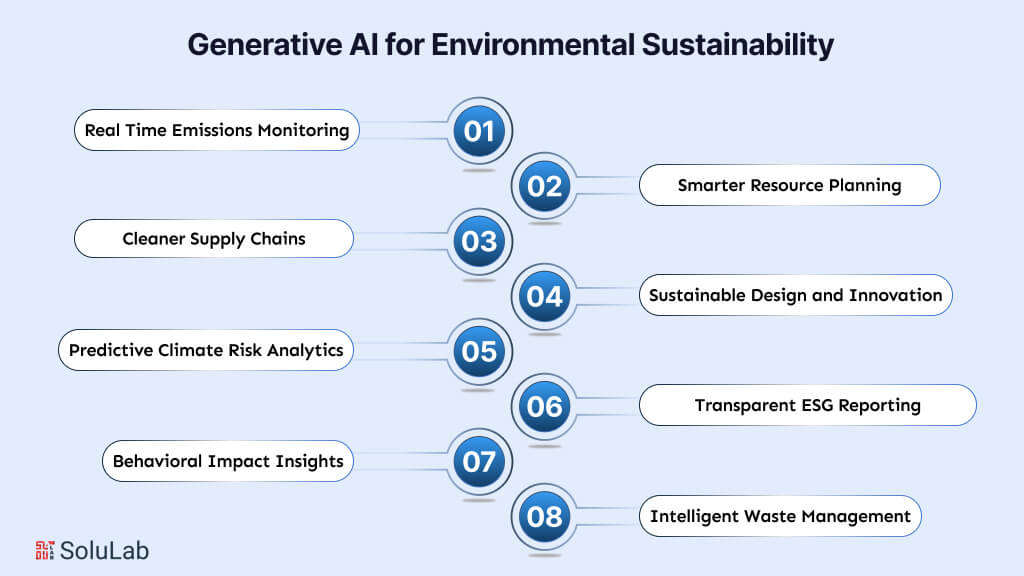
Everywhere you look, companies are being pushed to run cleaner operations. Measuring environmental impact, though, is messy. The datasets are complex, the regulations keep shifting, and decisions have to be quick and right at the same time. Generative AI is making a quiet but real difference here.
Number crunching is only part of it. The bigger win is that teams can picture long-term sustainability outcomes, see environmental risks coming, and make climate-smart calls without drowning in spreadsheets.
1. Real-Time Emissions Monitoring: Generative AI tools can churn through large volumes of industrial data and pinpoint carbon emission hotspots as they happen. So you fix the footprint where it’s worst, and you fix it fast.
2. Smarter Resource Planning: With an AI assistant, teams can test different production models or supply chain tweaks and see which ones save energy or water. All of that happens before anyone spends money changing things on the ground.
3. Sustainable Design and Innovation: Product teams can ask generative AI for greener materials or more efficient designs based on past performance data. Less waste, right from the first sketch.
4. Predictive Climate Risk Analytics: Floods, droughts, heatwaves. AI models simulate these scenarios so a business can prepare in advance and keep disruption to a minimum.
5. Transparent ESG Reporting: How can AI help with ESG? It takes environmental data scattered across the business and turns it into clear, structured, audit-ready reports that line up with GRI, SASB, or CSRD. No weeks of manual work.
6. Behavioral Impact Insights: AI can measure how customers or employees actually react to sustainability initiatives. That real behavioral data tells you which campaigns or green practices to adjust.
7. Intelligent Waste Management: Factory scrap or office trash, AI can track and forecast waste volumes, boost recycling, and cut reliance on landfill by catching inefficiencies early.
Social Impact of Generative AI in ESG Strategies
In most ESG conversations, the “Social” piece gets less airtime than the environmental one. It shouldn’t. This is about how a company treats people, backs its communities, and makes decisions that are fair and inclusive.
Here, generative AI is changing things quietly, mostly by helping organizations understand their own workforce better. It doesn’t replace the human touch. It amplifies it, so social goals become easier to reach, easier to measure, and more in tune with what people really need.
- Better Employee Feedback Loops: Top AI development companies can use generative AI tools to work through employee surveys, chat logs, and HR reports, surfacing morale problems, inclusion gaps, or workplace issues nobody has named yet. HR sees the pattern, not just one complaint at a time.
- Smarter Hiring with Fewer Biases: AI can screen resumes and applications on skills alone, which cuts down unconscious bias and opens the door to a more diverse, inclusive hiring process.
- Empathetic, Scalable Support: Most businesses can’t keep pace with customer concerns in real time. That’s where generative AI for customer service earns its place: it answers the routine questions instantly and hands the complex or emotional ones to a person.
- Stronger Community Engagement: Public reaction to a new policy, or general sentiment about a brand, AI can gather it and make sense of it at scale. Companies can then respond with more thought and act in line with what the public actually cares about.
- Improved Transparency in Impact Reporting: Generative AI for sustainability has a social side too. It helps write reports and updates that are easier to read, more inclusive in tone, and focused on what employees, communities, and customers care about most.
The Use of Ethical AI in ESG
Ethical AI is simple to describe. Respect people, protect their data, and don’t bake old biases into new systems. In ESG, trust and accountability are the whole game, so getting this right changes outcomes.
For example, say a company uses AI to analyze workplace diversity or watch supplier behavior. The system has to be trained on fair, inclusive data. And the company has to be upfront about what data it collects, how that data gets used, and who can see it.
Plenty of organizations now rely on generative AI for ESG data collection and reporting, pulling emissions figures, community impact metrics, and everything in between from different departments. Doing it ethically asks more of you than accurate numbers. You also have to make sure the data isn’t stripped of context or used in a way that misleads. In practice, that’s the foundation every piece of ESG work sits on.
Real-World Applications of Gen AI in ESG Reporting and Compliance
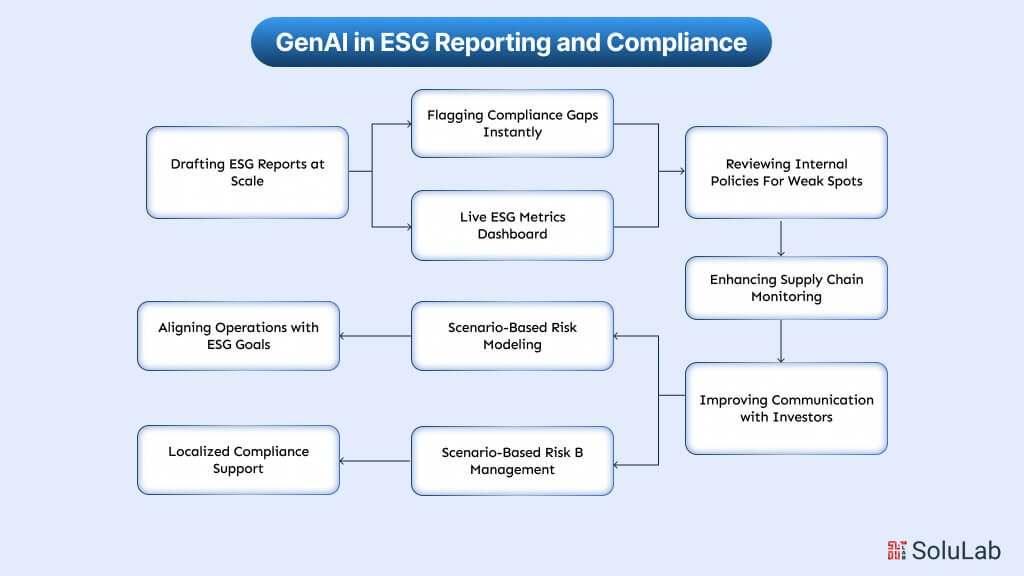
If you take ESG standards seriously, accurate and on-time reporting isn’t optional anymore. Generative AI isn’t a shortcut here. Think of it as a sharp assistant that does the heavy lifting: combing through scattered datasets, spotting patterns, and drafting reports that match global standards. Speed is nice, but the real payoff is compliance that’s smarter, clearer, and a step ahead instead of a step behind.
Here’s where generative AI is already making ESG reporting easier and more reliable:
1. Drafting ESG Reports at Scale: AI turns raw data into well-organized reports that follow regulations and frameworks like GRI or SASB. Faster, and the quality holds.
2. Flagging Compliance Gaps Instantly: It reads documents, metrics, even vendor data, and flags inconsistencies or compliance gaps well before the auditors show up.
3. Live ESG Metrics Dashboards: Some companies run AI-powered dashboards that refresh ESG indicators in real time. Leadership sees progress as it happens and can move quickly.
4. Reviewing Internal Policies for Weak Spots: AI tools check current ESG policies against changing global standards and point out sections that are outdated or missing pieces.
5. Enhancing Supply Chain Monitoring: With generative AI for data analysis and modeling, companies can gauge sustainability risk across tangled supply chains, covering everything from emissions to labor practices.
6. Improving Communication with Investors: AI can produce ESG updates for each stakeholder group, turning dense data into visual summaries or short briefs depending on who’s reading.
7. Scenario-Based Risk Modeling: What happens to operations if regulations or climate policies change? AI simulations answer that, which means better planning, not just box-ticking.
8. Aligning Operations with ESG Goals: In day-to-day business, AI turns ESG ambitions into concrete moves, like better transport routes or new ways to save energy. These are the real-world generative AI sustainability use cases that produce results you can measure.
9. Localized Compliance Support: Generative AI can rework ESG documentation into legally accurate formats for different countries, closing language and regulatory gaps with precision.
10. Turning Feedback into Strategy: Employee surveys, customer reviews, public sentiment. AI reads all of it and feeds the useful insights back into ESG narratives and decisions.
The Future of ESG with Generative AI Integration
ESG is moving from a regulatory checkbox to a core business priority, and that’s changing how companies handle data, strategy, and communication. Technology, generative AI in particular, is slowly working its way into that shift. The question isn’t “if” businesses will use AI for ESG anymore. It’s how.
The interesting part is where this goes next. AI won’t stop at simpler reporting; it will start shaping better decisions. The future of genAI in ESG isn’t about replacing people. It’s about handing them better tools so they can lead with purpose and precision.
A few things we expect to see over the next several years:
- Custom ESG Reports: Generic summaries give way to ESG insights written for each audience, whether that’s the board, customers, or regulators.
- Clearer ESG Goals, Backed by Real Data: AI helps organizations set targets they can actually hit and track, especially environmental ones like emissions or water use.
- Predictive Social Impact Modeling: Picture testing how a policy change would land with employees, local communities, or your brand’s reputation, before you roll it out. AI makes that realistic.
- Smarter Decision Support Tools: AI-driven dashboards will let leadership see risks, follow progress, and make ESG calls faster and with more confidence.
- More Responsive Sustainability Planning: Climate conditions change, and sustainability plans have to change with them, quickly. AI runs the simulations, lays out the trade-offs, and helps teams plan around them.
- The Role of a Trusted Tech Partner: As the tools get more advanced, more companies will turn to a generative AI development company for more than software. They’ll want advice on using AI responsibly and sustainably.

Conclusion
ESG is fast becoming one of the main lenses through which businesses are run and judged. Generative AI gives companies a new way to meet that bar. Automation is the easy part. The harder, more valuable part is building systems that are smarter, fairer, and quicker to respond, systems that match the values a company says it holds.
At SoluLab, we don’t just build and walk away. We stay on as long-term partners, helping organizations shape their ESG journey with the right technology. As a trusted Generative AI development company, we’ve worked with clients like Amanbank in Libya, one of the country’s most established banks, with over 18 years of experience, 35% market share, and a capital base of 300 million Libyan Dinars.
Thinking about how generative AI could fit into your ESG strategy? Or looking for a team that gets both the technical and the ethical side of the build? Let’s talk.
FAQs
Chain choice decides the footprint of everything built on top of it. For a ranked comparison of the lowest-energy networks, see our guide to the best green and eco-friendly cryptocurrencies.
Shipra Garg is a tech-focused content strategist and copywriter specializing in Web3, blockchain, and artificial intelligence. She has worked with startups and enterprise teams to craft high-conversion content that bridges deep tech with business impact. Her work translates complex innovations into clear, credible, and engaging narratives that drive growth and build trust in emerging tech markets.