
Key Takeaways
- A custom blockchain from scratch gives a business full control over consensus rules, governance, tokenomics, and compliance, something shared or forked networks can’t offer.
- The architecture rests on four layers: network, consensus, data, and application. Each layer’s design choices directly affect throughput, cost, and security.
- Realistic budgets for a production-grade chain typically range from $45,000 for a lean permissioned network to $250,000 or more for a full public Layer 1.
- Picking the wrong consensus mechanism, or skipping third-party audits, is the most common reason custom blockchain projects stall or need a rebuild.
- An experienced development partner usually cuts timelines by 30-40%, because the architecture, tooling, and audit process don’t have to be figured out from zero.
Building a blockchain from the ground up is a serious engineering commitment, not a weekend project. You’re designing consensus rules, data structures, and governance before a single transaction runs. Enterprise interest keeps climbing anyway.
The Blockchain market size is projected to grow USD 67.4 billion by 2026, at a Compound Annual Growth Rate (CAGR) of 68.4%.
Deloitte’s Global Blockchain Survey found that 55% of senior executives now rank blockchain among their top five strategic priorities, up from 43% two years earlier.
This guide walks through the architecture, technology choices, build process, real costs, and the factors that decide whether a custom blockchain from scratch actually reaches production, or stalls at the proof-of-concept stage like so many do.

What Is a Custom Blockchain, and Why Build One From Scratch
A custom blockchain is a distributed ledger designed and coded around one organization’s own rules for consensus, data structure, permissions, and governance, rather than adopted from an existing public network or template. Custom blockchain development matters most when a business’s requirements don’t fit what Ethereum, Solana, or a generic fork can offer out of the box.
When Off-the-Shelf Platforms Fall Short
Forking an existing chain is faster. But it inherits that chain’s limitations too: fixed consensus rules, shared validator economics, governance you don’t control. Businesses turn to building a custom blockchain when they need:
- Regulatory-specific data handling, for example, healthcare records, financial settlement, or government identity systems.
- Transaction throughput or latency targets a public chain can’t guarantee at a reasonable cost.
- Proprietary tokenomics or incentive models tied to a specific business model.
- Full ownership of validator selection, upgrade paths, and network governance.
Where Custom Chains Actually Get Used
Supply chain traceability, cross-border payment rails, tokenized real-world assets, healthcare data exchange, and loyalty networks are where build-your-own blockchain projects show up most. Each of these has a compliance or performance need that a generic chain simply wasn’t built to handle.
Understanding Blockchain Architecture: The Core Layers
Every functioning chain, regardless of use case, is built from the same four architectural blockchain layers. Get this blockchain architecture right early, because redesigning it later is painful and expensive.
The Four Layers, Briefly
- The network layer handles peer-to-peer communication, node discovery, and how transactions and blocks propagate across participants.
- The consensus layer sets the rules nodes use to agree on the state of the ledger. Proof of Work, Proof of Stake, PBFT-style protocols, or hybrid models all live here.
- The data layer covers block structure, the ledger’s storage model, and how state gets committed and queried.
- The application layer is what people actually touch: smart contracts, APIs, and integrated interfaces.
Why These Layer Decisions Compound
A choice made in the consensus layer, say, validator count or finality time, directly constrains what’s possible at the application layer later on. Teams that skip formal architecture documentation before writing code tend to hit scaling walls six to twelve months in, right when real transaction volume finally arrives.
Choosing the Right Technology Stack and Blockchain Platforms
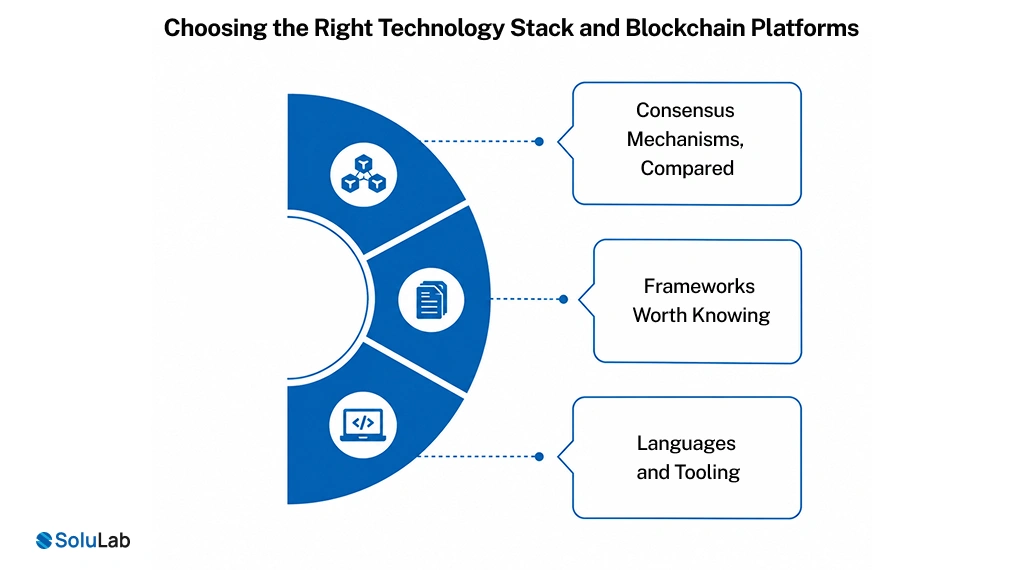
Consensus Mechanisms, Compared
- Proof of Work (PoW) is the most battle-tested against Sybil attacks, but it’s energy-intensive and slow. Rarely the right call for a new enterprise chain today.
- Proof of Stake (PoS) offers faster finality and lower energy cost, and it’s now the default for most public and consortium chains.
- PBFT and its variants work well for permissioned networks that need fast finality with a known, fixed validator set.
- Delegated Proof of Stake (DPoS) trades some decentralization for higher throughput through a smaller, elected validator set.
Frameworks Worth Knowing
Hyperledger Fabric and Besu suit permissioned enterprise networks. Cosmos SDK and Polkadot’s Substrate are common bases for sovereign, interoperable chains.
Ethereum-compatible stacks, built with tools like Geth or op-stack derivatives, suit teams that want EVM compatibility from day one. Picking among these blockchain platforms comes down to whether interoperability, raw throughput, or regulatory control matters most for your case. There’s no single “best” answer here, whatever a sales deck might tell you.
Languages and Tooling
Go and Rust dominate core protocol development, mostly for performance and memory safety. Solidity or Vyper handle EVM-compatible smart contracts. Node.js or Go typically power the surrounding APIs and node infrastructure.
Step-by-Step Process to Build a Custom Blockchain from Scratch
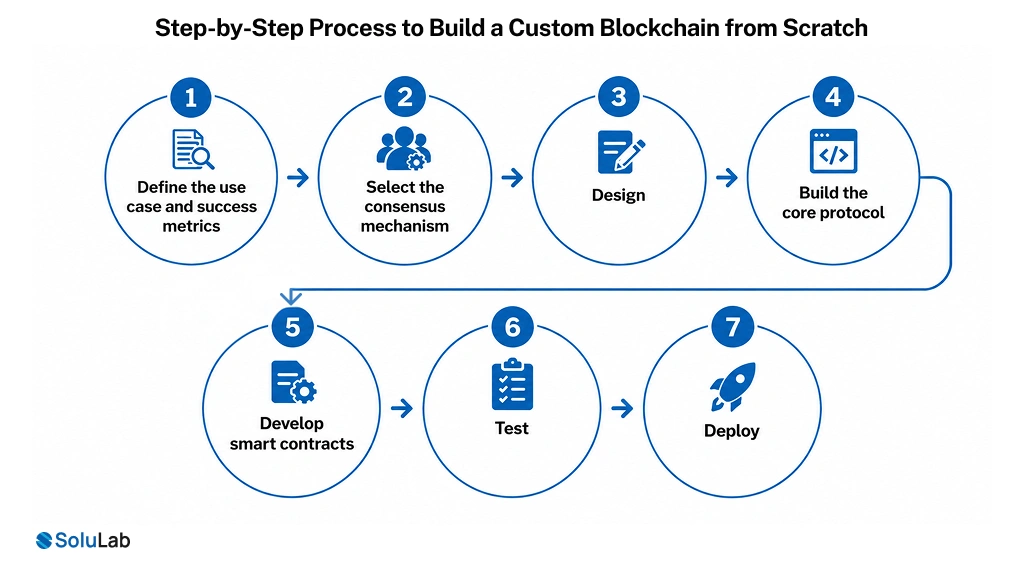
Building a blockchain from scratch follows a fairly consistent sequence across projects, even when the specifics differ wildly.
- Define the use case and success metrics: Throughput, transaction cost ceiling, participant count, compliance requirements, documented before a line of code gets written.
- Select the consensus mechanism: Select the consensus mechanism and network type, whether public, private, permissioned, or hybrid, based on who actually needs to validate transactions.
- Design: Design the data model and block structure, including how state is stored, indexed, and pruned over time.
- Build the core protocol: Build the core protocol and node software: the chain logic, peer networking, and validator rules.
- Develop smart contracts: Develop smart contracts and the application layer, covering business logic, token standards, and integration APIs.
- Test: Test on a private testnet under simulated real load and adversarial conditions before any public exposure.
- Deploy: Deploy to mainnet with observability tooling already in place, not bolted on afterward as an afterthought.
Custom Blockchain Development Cost: What Actually Drives the Budget
Custom blockchain development cost is usually the first question every stakeholder asks, and “it depends on scope” is the honest answer. The ranges get predictable once requirements are locked in, though.
What Moves the Price
- Consensus complexity. A simple PBFT-based permissioned chain costs far less to build and audit than a novel PoS design with custom validator economics.
- Team composition. Protocol engineers, smart contract developers, DevOps, and QA specialists all bill differently, and a real project needs all four.
- Audit scope. A full third-party security audit of core protocol code adds real cost, but it’s standard practice for anything handling actual value. Gartner has repeatedly flagged inadequate security testing as a leading cause of blockchain project failure in enterprise pilots.
- Integration requirements. Connecting the chain to existing ERPs, payment rails, or identity systems extends both timeline and budget, sometimes significantly.
Rough Budget Bands
A lean permissioned network for internal enterprise use typically runs $45,000 to $90,000. A public-facing Layer 1 or Layer 2 with custom tokenomics, full audits, and multi-chain interoperability commonly lands between $150,000 and $250,000 or more. Take these as directional, not as a quote. Your actual custom blockchain development cost depends entirely on the architecture decisions made earlier in the process.
Key Success Factors for Custom Blockchain Development
Grand View Research estimates the global blockchain technology market will keep expanding at a compound annual growth rate above 80% through the end of the decade, which means competition for engineering talent and infrastructure isn’t easing up any time soon. Whether individual projects succeed usually comes down to a short list of things.
What Separates Shipped Projects from Stalled Ones
- A clear governance model, defined upfront: who can propose upgrades, how disputes get resolved, how validators get added or removed.
- Realistic throughput targets, designed against actual expected transaction volume rather than aspirational numbers.
- Security built in from day one, not treated as a final checklist item before launch.
- Interoperability planning. Even permissioned chains eventually need to talk to other systems, and retrofitting bridges later gets expensive fast.
- A team or partner with real production deployments behind them. Theoretical blockchain knowledge and shipped-network experience are not the same thing, and it shows.
Common Challenges, and How to Get Ahead of Them
Scalability Bottlenecks
Chains designed without sharding, rollup strategies, or layer-2 offloading in mind tend to hit throughput ceilings once real usage arrives. Planning for horizontal scaling at the architecture stage, even if you don’t implement it on day one, avoids a costly rebuild down the line.
Regulatory Uncertainty
Rules around digital assets, data residency, and cross-border settlement vary by jurisdiction and keep shifting. Building compliance hooks, such as KYC/AML integration points and data localization options, into the architecture early is far cheaper than retrofitting them post-launch.
Validator and Governance Disputes
Permissioned networks with multiple corporate participants often stall on governance disagreements more than technical ones. A documented governance charter, agreed on before development starts, heads off most of these disputes before they turn into six-month delays.
How to Choose the Right Blockchain Development Partner?
What to Actually Evaluate:
- Track record with production chains, not just proof-of-concept demos that never shipped.
- In-house security expertise or verified third-party audit partnerships.
- Transparent, milestone-based pricing instead of open-ended hourly billing.
- A real post-launch support model covering node monitoring, upgrade management, and incident response.
- Domain experience that actually matches your use case, whether that’s payments, supply chain, tokenization, or identity.
Businesses evaluating blockchain app development services for enterprises should treat the vendor conversation like a technical interview, not a sales call. Ask for architecture diagrams, past audit reports, and references from live deployments before any budget gets committed. A capable custom blockchain development partner will also tell you, plainly, when an existing platform is the better fit and a from-scratch build isn’t worth it.

Conclusion
A custom blockchain built from scratch gives a business full control over consensus, governance, and data handling. But it demands real architectural discipline, security investment, and honest budgeting from day one.
Skipping any of the four core layers, or rushing the audit stage, is where most projects lose time and money. If you’re weighing whether to build a from-scratch chain, extend an existing framework, or explore other options entirely, SoluLab, a blockchain development company in the USA with deep blockchain engineering experience, can help your business assess the right path, architect the system, and take it from design through mainnet deployment.
FAQs
Neha is a curious content writer with a knack for breaking down complex technologies into meaningful, reader-friendly insights. With experience in blockchain, digital assets, and enterprise tech, she focuses on creating content that informs, connects, and supports strategic decision-making.