Key Takeaways
- Blockchain gives medical supply chains a single, tamper-proof record shared across manufacturers, distributors, pharmacies, and regulators.
- The clearest wins are pharmaceutical track-and-trace, medical equipment lifecycle tracking, and prescription/controlled-substance monitoring.
- DSCSA and EU FMD compliance are pushing adoption from pilot to production, but interoperability and legacy integration remain the real cost centers.
- Start narrow: one product category, one corridor, and standards-based data (GS1/EPCIS) before scaling to the full network.
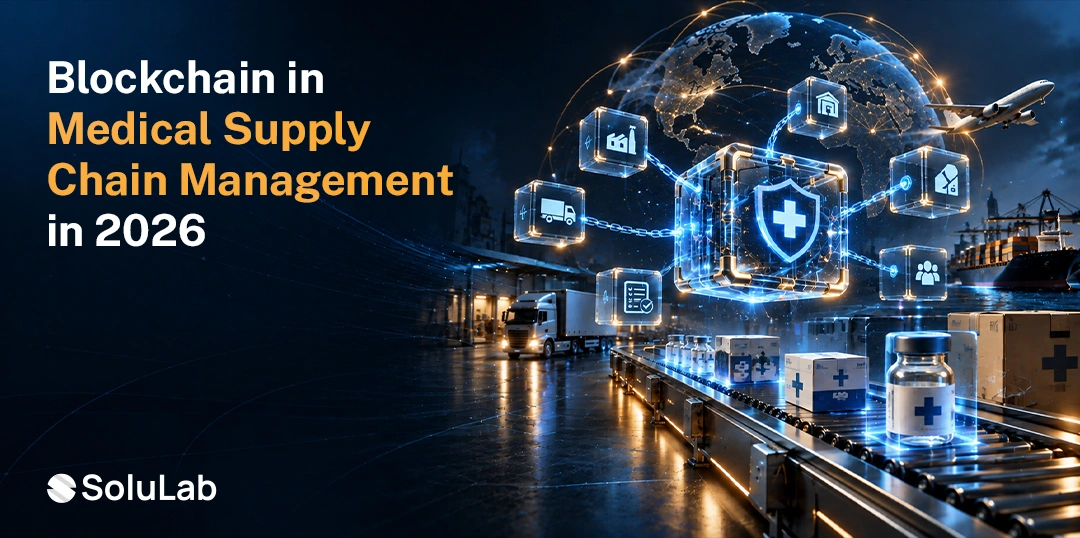
A single batch of counterfeit insulin or a mislabeled surgical implant can move through five hands before anyone notices something is wrong. Blockchain in medical supply chain management fixes that blind spot by giving every party, from the manufacturer to the pharmacy counter, a shared, tamper-proof record of where a drug or device has been and who touched it. The result is faster recalls, cleaner audits, and a much harder target for counterfeiters.
This guide walks through why the problem is getting worse, how blockchain in pharmaceutical supply chain projects actually works for medicines and medical equipment, the use cases that are already live, and a practical way to scope an MVP if you’re building one for enterprise or government stakeholders.\

Where Medical Supply Chains Are Breaking Down
Most pharmaceutical and medical equipment supply chains still run on a patchwork of spreadsheets, PDFs, and disconnected ERP systems. A distributor’s record of a shipment rarely matches the manufacturer’s batch data or the pharmacy’s intake log, and reconciling the three after the fact is slow, manual, and easy to falsify.
- That gap is exactly where counterfeit and diverted drugs get in, and it’s the single biggest argument for blockchain counterfeit drug prevention. Analysts estimate the global counterfeit drug trade at somewhere between $200 billion and $432 billion a year, and the losses aren’t just financial.
- Statista’s analysis of the same data (via the Pacific Research Institute) puts the drag on innovation at roughly 13 new drugs that never make it to market annually because counterfeit revenue erodes the returns that fund R&D.
- Medical equipment has its own version of the problem. Recalled devices, expired stock, and grey-market imports move through the same fragmented paperwork, which is part of why hospitals and health systems still struggle to answer a simple question fast: which units of a recalled device are sitting in which facility right now.
What Is Blockchain in Medical Supply Chain Management?
Blockchain in medical supply chain management is the use of a shared, distributed ledger to record every transaction, custody change, and status update for a drug or medical device as it moves from manufacturer to end consumer. Once a record is written, it can’t be edited or deleted, only appended to, which means every stakeholder is looking at the same version of the truth.
For a project like this, three components matter more than the buzzwords around them.
1. Distributed Ledger, Not a Public Cryptocurrency Chain
Enterprise pharma platforms rarely run on public chains like Ethereum mainnet. They use permissioned frameworks such as Hyperledger Fabric or Quorum, where only verified participants (manufacturers, licensed distributors, regulators, pharmacies) can write to the ledger. That keeps sensitive commercial and patient data out of public view while preserving the tamper-resistance that makes blockchain useful here in the first place.
2. Smart Contracts for Automated Compliance
A smart contract can automatically flag a shipment that has sat outside its approved temperature range, block a transfer if a distributor’s license has lapsed, or trigger a compliance report the moment a batch crosses a state or national border. This is where a lot of the manual compliance work disappears.
3. Serialization and GS1 Standards
Blockchain doesn’t replace GS1 barcoding, RFID, or IoT sensors; it sits on top of them. Each unit gets a unique serial number under the DSCSA or GS1 EPCIS standard, and the blockchain becomes the immutable audit trail that ties every scan of that serial number to a timestamped, verified event.
Getting this architecture right from day one is where most blockchain consulting services earn their keep, since a poorly scoped permission model or data schema is expensive to unwind once a platform is live with real distribution partners on it.
How Blockchain Tracks Medicines and Equipment From Factory to Pharmacy
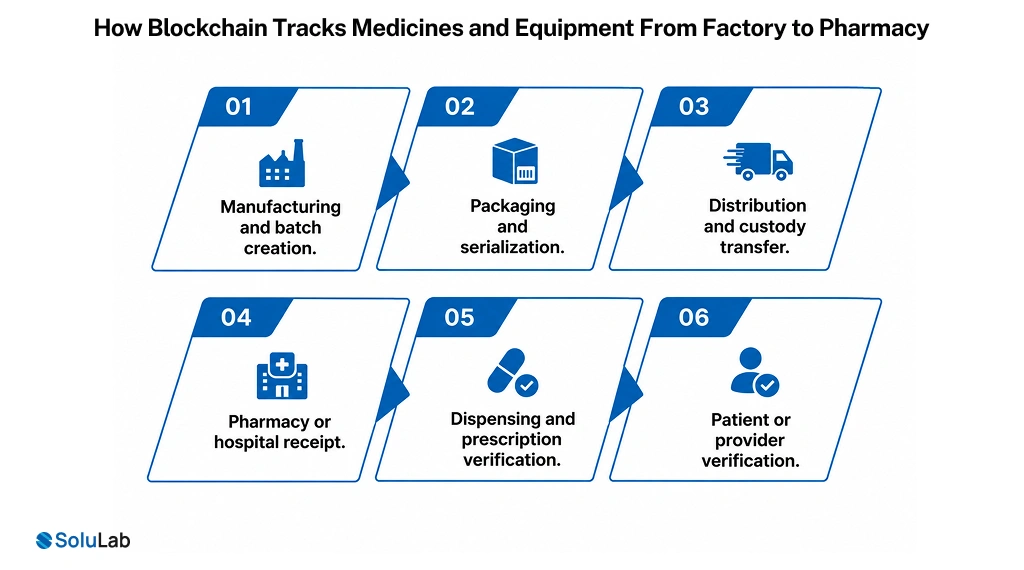
Here’s what the flow looks like in a working blockchain for pharma supply chain deployment, step by step. Most of it depends on blockchain IoT medical logistics working together instead of as separate systems.
- Manufacturing and batch creation. Each drug batch or equipment unit gets a unique digital identity (serial number, batch ID, expiry date, manufacturing site) written to the ledger the moment it’s produced.
- Packaging and serialization. A QR code or RFID tag links the physical unit to its blockchain record, so any scan in the field pulls the full history instantly.
- Distribution and custody transfer. Every handoff, from manufacturer to wholesaler to regional distributor, is logged with a timestamp, GPS location, and the identity of the receiving party. IoT sensors add temperature and humidity data for cold-chain products.
- Pharmacy or hospital receipt. The receiving pharmacy scans the unit and the system cross-checks it against the manufacturer’s original record before it’s accepted into inventory. A mismatch (wrong batch, expired stock, broken chain of custody) is flagged before the product ever reaches a shelf.
- Dispensing and prescription verification. For controlled substances, the dispensing event itself gets logged, tying a specific unit to a specific, verified prescription. This is where prescription control and anti-diversion controls live.
- Patient or provider verification. Some deployments let the end consumer scan the package to confirm authenticity before use, which is a strong deterrent for counterfeiters targeting the last mile.
Core Use Cases in Pharma, Pharmacy, and MedTech
The blockchain use cases in pharmaceutical supply chain projects differ depending on what’s moving through the chain.
Pharmaceutical Track-and-Trace
This is the most mature use case and the one regulators are actively pushing. Blockchain drug traceability directly targets the counterfeit problem described earlier by making it computationally hard to introduce a fake unit into a chain of verified, sequential custody records.
Medical Equipment Lifecycle Tracking
Beyond drugs, blockchain medical device tracking applies the same ledger model to high-value equipment (imaging machines, surgical instruments, implants) through manufacturing, sterilization, ownership transfers, and maintenance history. When a recall hits, a hospital network can locate every affected unit in minutes instead of days.
Prescription and Controlled-Substance Monitoring
Blockchain-backed prescription drug monitoring programs give regulators and pharmacies a real-time, cross-institution view of who’s dispensing controlled substances and how often, which is far harder to game than today’s siloed state-level databases.
Cold-Chain Monitoring for Temperature-Sensitive Medicines
Blockchain cold chain monitoring pharma deployments write continuous temperature and humidity readings straight to the ledger, which matters most for vaccines, biologics, and specialty drugs. Blockchain vaccine supply chain tracking is a good example: a cold-chain breach becomes provable and traceable to the exact leg of the journey where it happened, rather than a guess made after the fact.
These use cases sit inside a broader shift already underway across blockchain in healthcare, where the same distributed-ledger principles are being applied to clinical trials, electronic health records, and claims processing alongside supply chain traceability.
Adoption in this space isn’t theoretical anymore. Gartner’s research on blockchain combined with IoT found pharmaceuticals had one of the highest adoption rates of any industry, largely because pharma’s business model, physically moving regulated goods across many hands, maps directly onto what blockchain and IoT do well together.
Gartner has also documented the PharmaLedger Association, a blockchain-enabled ecosystem bringing together 12 global pharmaceutical companies and 18 public and private entities to solve exactly this class of problem at industry scale.
Regulatory Compliance and Why Enterprises Are Moving Now
Regulation is the biggest single driver here. The U.S. Drug Supply Chain Security Act (DSCSA) requires full electronic, interoperable traceability for prescription drugs, and the EU’s Falsified Medicines Directive imposes similar serialization and verification requirements across member states.
- Blockchain pharma compliance (HIPAA/GDPR/DSCSA) has to account for all three at once whenever patient-linked dispensing data crosses into a US or EU jurisdiction, since HIPAA and GDPR govern how that data is stored and shared even on a permissioned ledger.
- Neither DSCSA nor the FMD mandates blockchain specifically, but supply chain blockchain is one of the few architectures that can meet the interoperability requirement without forcing every manufacturer, distributor, and pharmacy onto the same proprietary system.
- That urgency shows up in the data. Deloitte’s Global Life Sciences Outlook found only 20% of biopharma companies rated themselves as digitally mature, a wide gap between where the industry needs to be on traceability and where it actually is.
- Deloitte’s own 2025 life sciences predictions go further, describing blockchain-enabled track-and-trace, from manufacturing all the way to the patient and prescribing clinician, as no longer a pilot concept but an operating reality companies are building toward now.
- For enterprises and government agencies scoping a platform, this is also the moment procurement teams want to see a working MVP rather than a whitepaper. Regulators increasingly expect vendors to demonstrate interoperability with existing GS1/EPCIS systems, not replace them wholesale.
What Manufacturers, Distributors, Retailers, and Pharmacies Each Gain
The benefits of blockchain in medical supply chain projects land differently depending on where a stakeholder sits in the chain:
- Manufacturers cut the cost and time of recalls, since affected batches are identified instantly instead of through manual paper trails.
- Distributors reduce disputes over shipment discrepancies, because both parties are reading from the same immutable record.
- Retailers and hospitals catch counterfeit or expired stock at receiving, before it reaches a patient, rather than after an incident.
- Pharmacies get automated, auditable proof of controlled-substance handling, which shortens regulatory inspections and reduces liability exposure.
- Patients gain the ability to verify a medicine’s authenticity directly, which matters most in markets where counterfeit penetration is highest.
In one deployment we’ve been close to, documented in this blockchain for pharma case study, a pharmaceutical manufacturer built a Hyperledger Fabric-based track-and-trace platform with GS1 EPCIS serialization, QR codes, and warehouse system integration.
It improved drug traceability by 91%, cut counterfeit detection time by 73%, and sped up regulatory reporting by 48%. Numbers like that are the real argument for building this properly, not the technology itself.
Where Blockchain Projects Actually Struggle
None of this is a plug-and-play fix, and it’s worth being honest about the trade-offs before you commit budget.
Interoperability is the hardest problem. A platform that only talks to itself is useless in a supply chain with dozens of independent manufacturers and distributors, so getting competing companies to join the same permissioned network takes as much business negotiation as engineering.
Legacy ERP integration is the second big cost driver; most manufacturers are running systems that were never built to expose real-time data to an external ledger, and that integration work often outweighs the blockchain build itself. Whoever builds this, whether an in-house team or an outside blockchain development company, needs real experience wiring legacy pharma ERPs into a ledger, not just writing smart contracts.
Data privacy also needs careful handling, since patient-linked dispensing records sit close to protected health information even on a permissioned chain. And realistically, smaller distributors and independent pharmacies may need incentives or subsidized onboarding to justify the operational change, or adoption stalls at the edges of the network no matter how solid the core platform is.
Building Your MVP: A Practical Roadmap
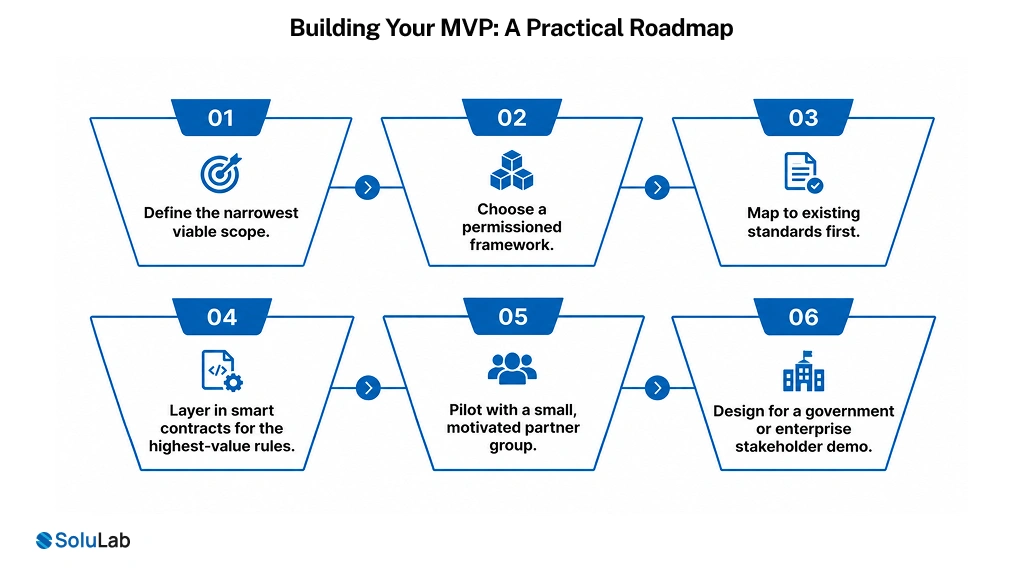
If you’re an enterprise or government stakeholder scoping a pilot, here’s a sequence that gets you to a demonstrable MVP without over-building on day one.
- Define the narrowest viable scope. Pick one product category (a single drug class or one equipment type) and one corridor (manufacturer to a limited set of distributors and pharmacies) rather than modeling the entire national supply chain at once.
- Choose a permissioned framework. Hyperledger Fabric and Quorum are the two most common choices for pharma-grade deployments because of their access-control models and enterprise support ecosystems. Some vendors offer this as blockchain as a service, which shortens setup time but limits how much you can customize the permission model later.
- Map to existing standards first. Build against GS1 EPCIS and DSCSA data formats rather than inventing a proprietary schema, since this is what makes the platform interoperable with partners who haven’t adopted blockchain yet.
- Layer in smart contracts for the highest-value rules. Start with temperature-breach alerts and license-expiry checks. These are easy to demonstrate to stakeholders and hard to dispute the value of.
- Pilot with a small, motivated partner group. A regional distributor and two or three pharmacies are enough to prove the traceability loop end to end before scaling.
- Design for a government or enterprise stakeholder demo. If the platform needs to be presented to regulators or enterprise procurement, build the dashboard view early. Decision-makers need to see the chain-of-custody trail visually, not just query an API.
Our engineers do this kind of build regularly through blockchain supply chain development work, and the pattern above is close to how we’d structure a first phase for a pharmaceutical traceability platform bound for enterprise and government review.
Conclusion
Building a platform like this for enterprise or government review takes more than a serialization layer bolted onto an existing ERP. If you’re scoping an MVP for pharmaceutical traceability, prescription control, or medical equipment tracking.
SoluLab’s blockchain development company can walk through the architecture with you and outline a realistic build timeline before you commit to a full engagement.
Book a free discovery call to review your specific compliance requirements and see what a working pilot could look like in the next 90 days.
FAQs
Shipra Garg is a tech-focused content strategist and copywriter specializing in Web3, blockchain, and artificial intelligence. She has worked with startups and enterprise teams to craft high-conversion content that bridges deep tech with business impact. Her work translates complex innovations into clear, credible, and engaging narratives that drive growth and build trust in emerging tech markets.