
Key Takeaways
- Blockchain in marketing solves a trust problem first, a technology problem second. It gives brands, publishers, and customers a shared record of what actually happened, one nobody can quietly edit later.
- The clearest wins right now sit in ad verification, loyalty programs, influencer proof, and product authenticity. Not flashy consumer tokens.
- Toyota, Nestlé, and Unilever have all run real, measurable blockchain marketing pilots. None of them started with the technology. They started with a trust gap that was costing them money.
- Blockchain technology in marketing isn’t a replacement for your CDP or CRM. Think of it as a verification layer bolted alongside them, not instead of them.
Somewhere between $63 billion and $172 billion gets stolen from advertisers every year through fraud, bots, and fake impressions, depending on which research firm’s model you trust. Even the conservative end of that range is bigger than the GDP of most countries. That number, not a CMO wanting to sound cutting-edge, is the actual reason blockchain in marketing exists as a category.
Marketing has always run on trust that’s hard to verify. Did that ad actually run? Did a real person see it, or a bot farm? Is this influencer’s audience real, or bought in bulk from a click farm somewhere?
For decades, the answer was simple: trust the vendor’s report and hope it’s accurate. Blockchain development flips that arrangement. Every party in a transaction, an ad buy, a loyalty point, a supply chain step, gets the same unchangeable record. Nobody gets to quietly edit history after the fact.
This isn’t another piece hyping NFTs as marketing’s future. It’s a straight look at how the technology works in a marketing context, ten use cases already running in production today, where it genuinely earns its keep, where it’s overkill, and what Toyota, Nestlé, and Unilever actually learned by trying it for real.
How Blockchain Technology Works for Marketing?
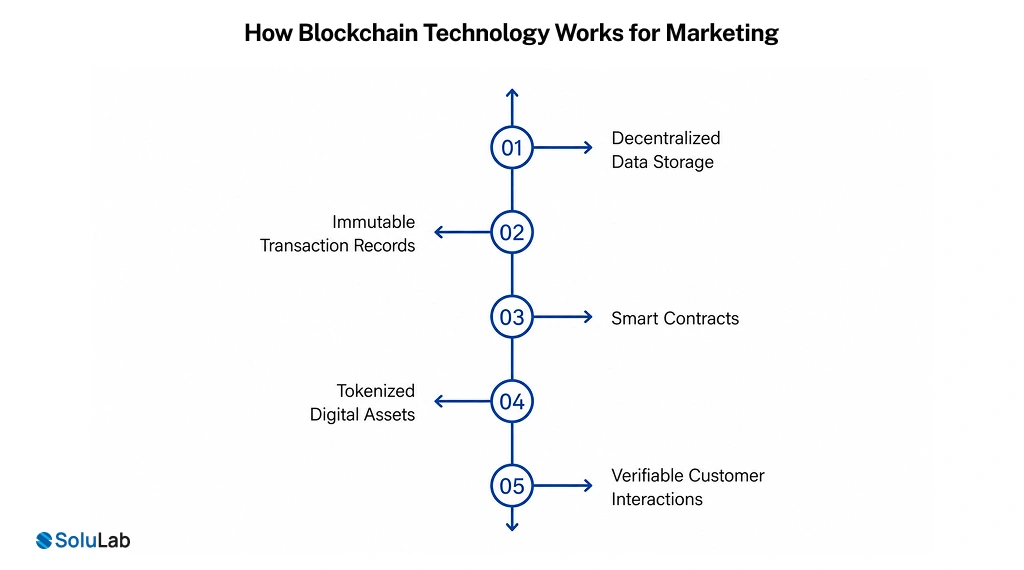
Strip away the jargon, and blockchain technology does five specific jobs a marketer should care about. Not fifty. Five.
1. Decentralized Data Storage
Instead of one company holding the master record of, say, ad delivery data, that record spreads across multiple parties. No single player can quietly rewrite history to make their own numbers look better.
2. Immutable Transaction Records
Once something’s written to the chain, it stays put. An ad impression, a loyalty point earned, a product’s origin claim: logged once, it can’t be edited without every party in the network noticing immediately.
3. Smart Contracts
Self-executing agreements that fire automatically once conditions are met. Pay a publisher only when a verified human impression is confirmed, for instance, with zero manual invoice reconciliation involved.
4. Tokenized Digital Assets
Loyalty points, collectibles, even ownership stakes in a piece of content can live as tokens: unique, tradable, and traceable straight back to whoever holds them.
5. Verifiable Customer Interactions
Did the customer actually watch the video? Actually redeem the coupon? That gets logged in a way any party can check, not just self-reported by whichever platform happened to run the campaign.

How Can Businesses Implement Blockchain in Marketing?
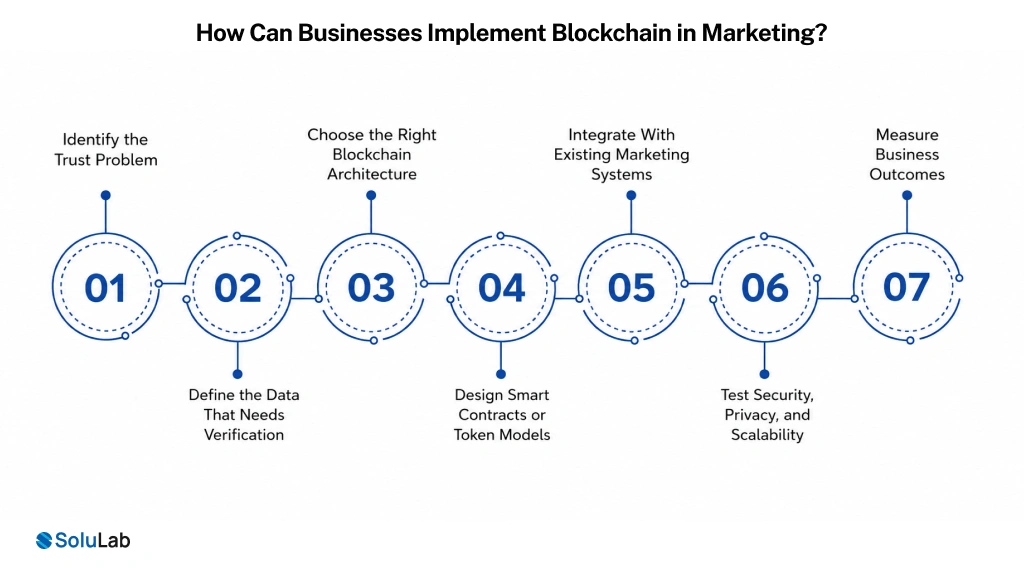
Businesses can implement blockchain in marketing by starting with clear use cases, connecting blockchain to existing systems, protecting customer data, and measuring whether it improves trust, transparency, or campaign performance.
Step 1: Identify the Trust Problem
Before touching any tooling, name the specific thing nobody currently trusts.
- Ad delivery or spend verification
- Influencer audience authenticity
- Product origin or authenticity claims
Step 2: Define the Data That Needs Verification
Not every data point needs a blockchain, and treating it that way is how projects balloon in cost for no reason.
- Transaction and payment records
- Customer consent and identity data
- Supply chain or product origin data
Step 3: Choose the Right Blockchain Architecture
Public, private, and consortium chains solve genuinely different problems. Get this wrong early, and it’s expensive to unwind.
- Public chain for open, consumer-facing verification
- Private chain for internal, sensitive data
- Consortium chain for multi-brand collaboration
Step 4: Design Smart Contracts or Token Models
This is where the “if this happens, then that happens” logic actually gets built out.
- Define payout or reward trigger conditions
- Decide what gets tokenized, if anything at all
- Set clear rules for token transfer or redemption
Step 5: Integrate With Existing Marketing Systems
A blockchain layer that doesn’t talk to your CDP, CRM, or ad platform is just an expensive side project nobody uses after month two.
- Connect to existing customer data platform
- Sync with ad verification or DSP tools
- Map data flow into current dashboards
Step 6: Test Security, Privacy, and Scalability
Before a single real customer or ad dollar touches this system, stress-test it properly.
- Run penetration and security audits
- Confirm compliance with data privacy law
- Load-test for peak campaign volume
Step 7: Measure Business Outcomes
Blockchain for its own sake isn’t a KPI anyone’s CFO will accept. Tie it to something they actually care about.
- Track fraud reduction in ad spend
- Measure loyalty program engagement lift
- Compare reconciliation time before and after
10 Blockchain-Powered Marketing Use Cases in
This is where the theory turns into something you can actually point to and say “that’s working.”
- Digital Advertising Verification – confirming an ad ran, on the site it claims, to a real human, before anyone pays the invoice.
- Ad Fraud Prevention – catching bot traffic and fake impressions in real time through a shared, tamper-proof ledger across the ad supply chain.
- Customer Loyalty Programs – points that live on-chain, transferable and redeemable across partner brands with no single point of failure.
- Token-Based Rewards – tying specific customer actions to tradable or redeemable tokens instead of a static points balance.
- Digital Collectibles and NFTs – limited-run branded assets giving collectors provable scarcity and a real ownership trail.
- Influencer Marketing Verification – checking an influencer’s engagement and audience are real before anyone signs a contract.
- Customer Data Management – a verifiable, permissioned record of exactly what data a customer has shared, and with whom.
- Product and Brand Authenticity – a shopper scans a code and sees a product’s actual origin instead of a claim printed on a label.
- Decentralized Identity – one verified identity a customer controls, shared selectively instead of re-verified on every single platform.
- Transparent Marketing Attribution – a shared, auditable record of which touchpoint actually drove a conversion, agreed on by everyone in the chain, not just the platform that wants credit.
Blockchain vs Traditional Marketing Technology
This isn’t blockchain replacing your MarTech stack. It’s blockchain plugging a specific hole traditional tools were never built to close.
| Factor | Traditional MarTech | Blockchain-Based Marketing |
| Data ownership | Centralized, controlled by one vendor | Distributed across multiple parties |
| Record tampering | Possible, often undetectable | Effectively impossible once written |
| Ad verification | Self-reported by ad platforms | Independently verifiable by all parties |
| Payment triggers | Manual invoicing and reconciliation | Automated via smart contracts |
| Setup complexity | Lower, familiar tooling | Higher, newer skill sets required |
| Best fit | Day-to-day campaign execution | Trust-sensitive transactions and claims |
The part most teams miss: you don’t rip out your MarTech stack for this. You bolt a verification layer onto the exact spots that keep generating disputes, and leave the rest alone.
Real-World Examples of Blockchain in Marketing
Case studies age fast in this space. Worth being specific about what actually happened rather than what a press release implied at the time.
1. Toyota
Through the Toyota Blockchain Lab, launched in 2019, Toyota tested blockchain across four areas: customer identity verification, a vehicle “digital passport” tracking ownership, mileage, and repair history, supply chain traceability for parts, and tokenized ownership records for leasing.
The identity piece is the one that matters most for marketing. Instead of a customer re-verifying themselves for every single Toyota service, one verified identity travels with them, permissioned and shareable on their own terms.
2. Nestlé
Nestlé joined IBM’s Food Trust platform as a founding member in 2017 to test blockchain for food traceability. It first used the technology to track Mousline instant mashed potatoes through Carrefour stores in France, then expanded it to Zoégas coffee, where Rainforest Alliance certification data was added to the blockchain.
The traceability piece is what matters most for marketing. Instead of simply telling customers that a product is sustainably sourced, Nestlé can let them scan a QR code and verify where the product came from and how it moved through the supply chain. This turns a sustainability claim into something shoppers can actually check.
3. Unilever
Unilever partnered with IBM to bring blockchain into digital ad buying, trying to fix a reconciliation mess in a media supply chain where third parties can pocket a big chunk of ad spend before it ever reaches a publisher.
The pilot reported “zero leakage,” meaning Unilever could reconcile 100% of its media investment against actual delivery, and IBM estimated the process saved two to three percentage points in cost. Unilever later joined the wider JICWEBS industry pilot alongside Nestlé, McDonald’s, and Virgin Media to push the same fix industry-wide instead of keeping it proprietary.
Notice the pattern. Nobody here started by asking “how do we use blockchain?” They started with a specific, expensive trust problem and found blockchain was the tool that actually closed it.
Benefits and Challenges of Blockchain in Marketing
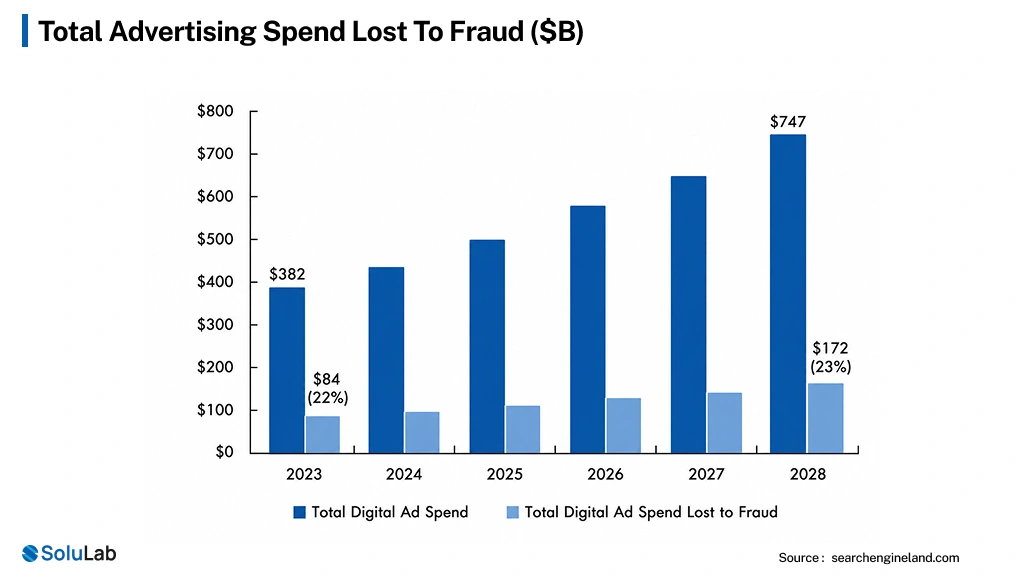
The benefits of blockchain in marketing are real. So are the friction points, and a strategy that only talks about one of these isn’t a strategy.
The Upside
- Verifiable ad spend cuts into fraud losses that Statista and Juniper Research project could hit $172 billion globally by 2028, up from an estimated $88 billion in 2023.
- Smart contracts remove manual reconciliation entirely, which is exactly what Unilever’s pilot targeted and solved.
- Tokenized loyalty programs boost portability and give customers an actual reason to stay engaged across a brand’s ecosystem instead of just one app.
The Challenges of Blockchain in Marketing
- Integration complexity with legacy MarTech stacks that were never designed for distributed ledgers.
- A shortage of in-house skill sets, since blockchain development still sits outside most marketing teams’ core competency.
- Regulatory uncertainty, especially anywhere tokens or crypto-adjacent rewards brush up against financial regulation.
- Consumer confusion. Most shoppers don’t care how the trust got established. They just care that it exists.
Deloitte’s Global Blockchain Survey found that 80% of surveyed executives expect their industries to see new revenue streams from blockchain, digital assets, or cryptocurrency.
But the same research keeps flagging legacy system integration and unclear regulation as the two biggest barriers to scaling past a pilot. That gap between belief and execution is exactly where most projects quietly stall out.
How Can SoluLab Help With Blockchain in Marketing?
SoluLab starts by scoping the actual trust problem- fraud, attribution, loyalty, authenticity- before recommending any architecture at all, then handles the smart contract development, integration, and validation work needed to connect it to your existing marketing systems.
As a blockchain development company with hands-on experience delivering web3 marketing services, SoluLab has also paired blockchain projects with AI and blockchain integrations, where verification data feeds directly into predictive attribution models. That gives marketing teams both the trust layer and the analytics to actually act on it.
Conclusion
Blockchain for marketing isn’t a trend chasing relevance. It’s a direct response to a trust deficit that’s been quietly draining ad budgets and eroding customer confidence for well over a decade now.
The brands getting real value from it- Toyota, Nestlé, Unilever- didn’t start with the technology. They started with one specific, expensive problem and worked backward to whatever solved it.
If your team is weighing whether blockchain belongs in your next marketing initiative, or you’re trying to fix ad fraud, fragmented loyalty programs, or authenticity claims customers no longer take at face value, SoluLab, a blockchain development company built specifically for this kind of work, can help you figure out where it actually fits and build it without the guesswork.
FAQs
Neha is a curious content writer with a knack for breaking down complex technologies into meaningful, reader-friendly insights. With experience in blockchain, digital assets, and enterprise tech, she focuses on creating content that informs, connects, and supports strategic decision-making.