
Key Takeaways
- A single smart contract audit only captures risk at one point in time; blockchain security threats evolve continuously after deployment.
- Node and validator compromises, RPC endpoint abuse, and privileged key exposure now account for a growing share of losses, not just contract bugs.
- Security as a Service (SECaaS) shifts blockchain protection from a one-time checklist to always-on monitoring, detection, and response.
- Cross-chain bridges and Layer 1/Layer 2 environments each carry distinct attack surfaces that need dedicated coverage.
- Enterprises evaluating blockchain infrastructure development should budget for ongoing security operations, not just a pre-launch audit.
Blockchain security has outgrown the audit-and-launch model. A smart contract audit checks the code at one point; attackers probe the infrastructure every hour after that. In 2025, blockchain-related security incidents pushed stolen crypto assets past $3.4 billion, with a single exchange breach accounting for nearly half of that figure, according to Chainalysis.
The global blockchain security market size is projected to grow from USD 7.6 billion in 2026 to USD 31.3 billion by 2033.
For teams running validators, RPC infrastructure, and cross-chain bridges, the gap between one-time checks and constant threats is exactly where blockchain security-as-a-service fits, and why more enterprises are budgeting for it as a standing line item rather than a launch expense.
What Is Security as a Service (SECaaS) for Blockchain?
Security as a Service (SECaaS) is a subscription-based model where a specialized provider continuously monitors, detects, and responds to threats across an organization’s infrastructure, rather than performing a fixed-scope, one-time engagement. Applied to blockchain technology, it extends that model to nodes, validators, RPC endpoints, smart contracts, wallets, and cross-chain connections.
Unlike a traditional smart contract audit, which reviews code before deployment and produces a report, blockchain security as a service operates after deployment too. It watches transaction patterns, validator behavior, and privileged access in real time, and it responds when something looks wrong a compromised key, an anomalous transfer, or a validator going offline unexpectedly.
For a business decision-maker, the distinction matters commercially. An audit is a project with a start and end date. SECaaS is an operating capability, similar to how a company treats network monitoring or fraud detection in traditional finance; it does not stop the day the product ships.
Why Blockchain Infrastructure Security Demands a New Approach in 2026
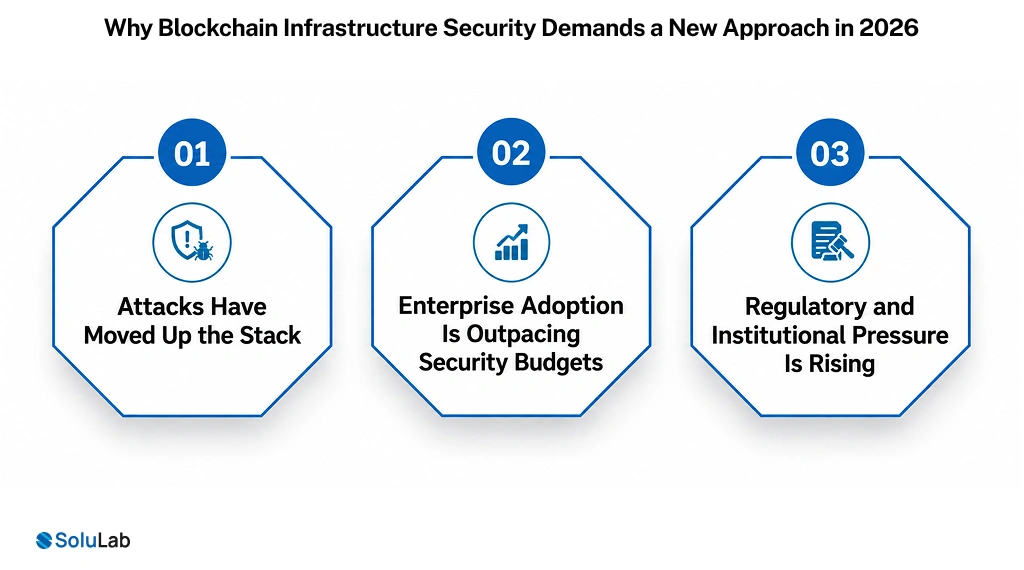
The threat model for blockchain has changed faster than most security programs have. Three shifts explain why static, point-in-time reviews are no longer sufficient for blockchain infrastructure security.
1. Attacks Have Moved Up the Stack
Early exploits concentrated on smart contract logic. Today, a large share of losses trace back to infrastructure-level failures: compromised private keys, exposed RPC endpoints, and social-engineered access to validator operations. CertiK’s 2025 incident data puts the average loss per security incident at $5.32 million, up 66.6% year over year — a signal that attackers are finding higher-value, harder-to-audit targets outside the contract layer itself.
2. Enterprise Adoption Is Outpacing Security Budgets
Deloitte’s research on enterprise Web3 adoption found that 87% of surveyed businesses are likely to invest in a blockchain solution within the next 12 months. Fast adoption without a matching increase in continuous blockchain security tools coverage is exactly the gap attackers look for new integrations, new bridges, and new custody arrangements all expand the attack surface before security operations catch up.
3. Regulatory and Institutional Pressure Is Rising
As institutional capital moves into digital assets, boards and compliance teams increasingly expect the same operational security rigor applied to systems as to traditional financial infrastructure: audit logs, incident response plans, and demonstrable monitoring, not just a one-time report filed away after launch.
The Blockchain Attack Surface: Where Enterprises Are Most Exposed
A useful way to reason about attack surface is to map it by layer, since each layer needs different controls.
1. Where Risk Concentrates
- Node and validator security — misconfigured nodes, outdated client software, or unprotected validator keys can let an attacker disrupt consensus or steal staked assets.
- RPC security — public or poorly authenticated RPC endpoints are a common entry point for reconnaissance and abuse, especially on infrastructure spun up quickly during a product launch.
- Smart contract monitoring — even audited contracts can behave unexpectedly under live conditions, upgrade paths, or interactions with unaudited third-party contracts.
- Cross-chain security — bridges that move assets between chains have repeatedly been the site of the largest single losses in the industry, because they concentrate value and trust assumptions in one component.
- Privileged access security — admin keys, multisig signers, and deployment credentials are frequently the weakest link, since they sit outside the contract code an audit typically reviews.
Core Components of a Blockchain Security as a Service Platform
A mature blockchain security architecture delivered as a service typically includes the following functions, working together rather than as separate point tools.
1. What a Complete SECaaS Stack Covers
- On-chain monitoring — continuous observation of wallet activity, contract calls, and transaction flows to flag deviations from normal patterns.
- Blockchain threat detection — correlating on-chain signals with off-chain telemetry (infrastructure logs, access events) to catch attacks earlier than either source alone would.
- Blockchain incident response — a defined, tested playbook for freezing exposure, rotating keys, and coordinating with exchanges or validators when a breach is confirmed.
- Layer 1 Layer 2 security — coverage tuned to the specific consensus mechanism and rollup or sidechain architecture in use, since a Layer 2’s security assumptions differ from its underlying Layer 1.
- Privileged access governance — enforced multisig policies, hardware key requirements, and time-locked admin actions to reduce the blast radius of a single compromised credential.
Blockchain SECaaS vs. Smart Contract Audit: What’s the Difference?
This is one of the most common points of confusion for teams budgeting security spend, so it is worth stating plainly.
A smart contract audit vs security as a service comparison comes down to timing and scope. An audit is a static, one-time code review conducted before or shortly after deployment. It is essential it catches logic errors, reentrancy bugs, and access-control mistakes before they reach production.
But it cannot see how the contract behaves once it is live, interacting with real users, real liquidity, and unpredictable market conditions.
SECaaS picks up where the audit stops. It does not replace the audit; it extends protection into the operational phase, covering the infrastructure around the contract nodes, keys, RPC access, and transaction behavior that no code review can evaluate in advance. Enterprises with mature security programs typically budget for both: an audit before launch, and ongoing SECaaS coverage for as long as the system runs.
The Business Case for Continuous Blockchain Security
Framing this as a cost center misses the point. Continuous coverage changes the economics of a breach.
Immunefi’s 2025 data shows fund-recovery rates falling sharply: just 0.4% of Q1 2025 stolen funds were recovered, compared with 21.2% in Q1 2024. That decline reflects, in part, how much faster stolen assets move once they leave a compromised system. Detection speed is now one of the few variables a security team can still control; recovery after the fact is increasingly unreliable.
For an enterprise weighing enterprise blockchain security services against the cost of a breach, the calculation is straightforward: the average blockchain security incident cost $5.32 million in 2025. A subscription-based SECaaS engagement is a fraction of that, spread predictably across a budget cycle instead of arriving as a single catastrophic loss.
How to Choose a Security as a Service Provider for Blockchain?
Not every security as a service provider teams find in a search will cover the same ground. A few questions help separate a genuine continuous-security partner from a repackaged audit shop.
Questions to Ask Before Signing
- Does the provider monitor infrastructure (nodes, RPC, keys) in addition to contract code, or only the contract layer?
- What is the documented mean time to detect and respond to an incident, and is that response plan tested rather than theoretical?
- Does coverage extend across the specific chains, Layer 2s, and bridges the business actually uses, or is it generic across “blockchain” as a category?
- Is there a named technical point of contact, or does support route through a generic ticketing queue during an active incident?
- How does the engagement scale as the business adds new contracts, chains, or integrations over time?
Providers offering security consulting services alongside SECaaS tend to be better positioned to advise on architecture changes, not just flag problems after they occur.
Building Security Into Your Blockchain Infrastructure Development Roadmap
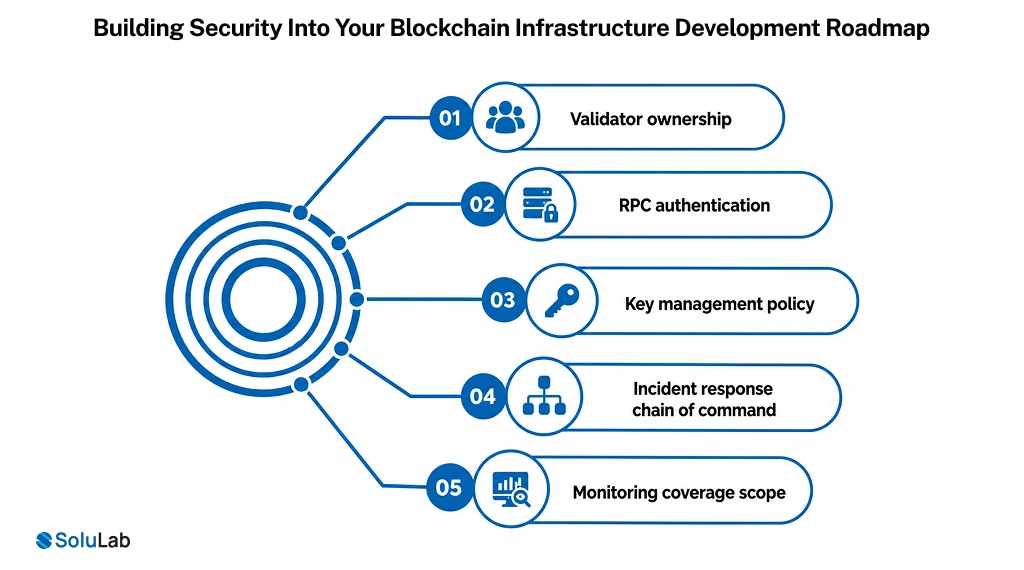
Security works best when it is planned alongside infrastructure development, not bolted on after an incident. Treat SECaaS as part of your architecture roadmap from day one, before mainnet launch.
- Validator ownership — decide who monitors validator health and uptime before the first block is produced, not after a slashing event.
- RPC authentication — define how RPC endpoints are authenticated and rate-limited as part of the initial blockchain risk detection plan, not as a patch later.
- Key management policy — set multisig thresholds, signer roles, and hardware-key requirements for every privileged action before deployment.
- Incident response chain of command — name who gets alerted, who can freeze funds, and who talks to exchanges or validators during a live incident.
- Monitoring coverage scope — confirm SECaaS coverage extends to every chain, Layer 2, and bridge in the architecture, not just the primary contract.

Conclusion
Blockchain infrastructure security in 2026 is an operational discipline, not a one-time deliverable. Audits still matter, but they answer a narrower question than most enterprises assume: they confirm code correctness at a point in time, not ongoing safety across nodes, keys, RPC access, and cross-chain connections.
Security as a Service closes that gap by keeping monitoring, detection, and response running for as long as the system is live.
SoluLab, a blockchain development company with hands-on experience building and securing production-grade infrastructure, helps businesses design and operate SECaaS coverage that matches their actual architecture, not a generic template.
If your team is planning a new deployment or reassessing security on an existing one, it’s worth having that conversation before an incident forces it.
FAQs
Neha is a curious content writer with a knack for breaking down complex technologies into meaningful, reader-friendly insights. With experience in blockchain, digital assets, and enterprise tech, she focuses on creating content that informs, connects, and supports strategic decision-making.