Enterprise AI spending is projected to reach $2.52 trillion, yet a significant percentage of AI initiatives never progress beyond experimentation. The reason is simple: organizations often invest in development before validating whether AI can deliver measurable business outcomes.
While companies such as JPMorgan Chase use AI for risk analysis and fraud detection, and modern agent-based platforms report workflow reductions of up to 80%, these results come after rigorous validation, not blind implementation.
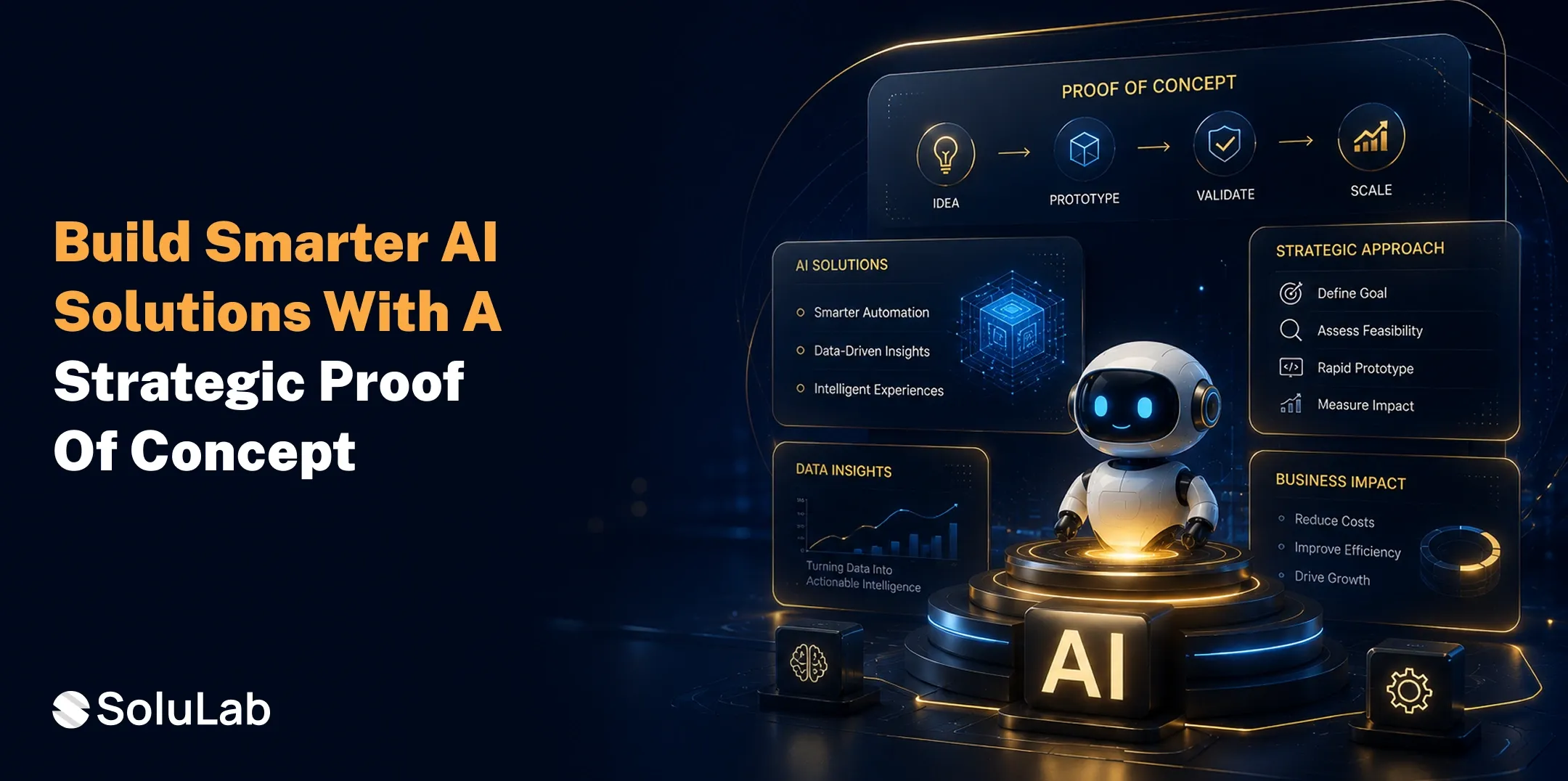
This is where AI Proof of Concept Development becomes essential. An AI PoC helps businesses evaluate
- technical feasibility,
- data readiness,
- integration requirements,
- compliance considerations, and
- potential ROI
before committing to larger investments. Instead of relying on assumptions, organizations gain evidence to determine whether an AI integration deserves further development, budget allocation, and deployment planning.
Key Takeaways
- An AI Proof of Concept (PoC) validates feasibility before significant development investments.
- Most AI failures stem from poor data readiness, unclear KPIs, and weak integration planning rather than model limitations.
- A structured 4-week PoC can uncover technical, operational, and compliance risks early.
- Enterprises should use measurable success criteria such as cost savings, cycle-time reduction, accuracy, and ROI.
- PoCs, MVPs, and Pilots serve different purposes and should not be treated interchangeably.
- Multi-agent AI architectures are increasingly replacing traditional chatbot-based implementations for complex workflows.
- Industries including finance, real estate, manufacturing, and asset tokenization are actively using AI PoCs to validate high-impact use cases.
- A successful PoC provides leadership with evidence-based Go/No-Go decisions for future investments.Tokenizing Luxury Hotels in the Maldives at an institutional level.
Why Is AI Proof of Concept Development Becoming Essential in 2026?
The AI trends are no longer driven by experimentation alone. Organizations are now focused on measurable business outcomes.
Several market indicators support this trend:
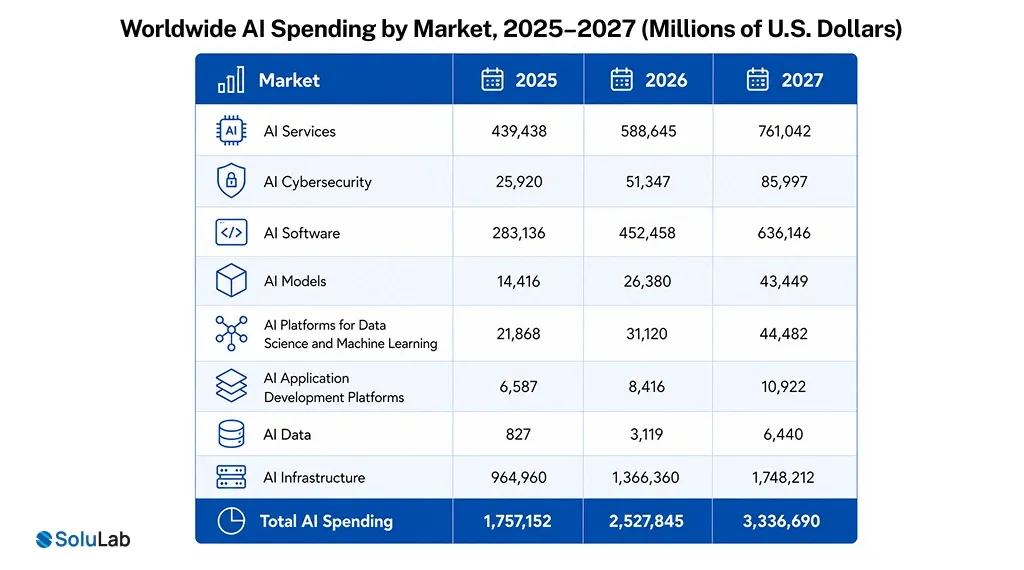
- Gartner report says that global enterprise AI spending is projected to reach $2.52 trillion, growing approximately 44% year-over-year.
- More than 80% of enterprises have moved beyond testing and are actively deploying generative AI applications or APIs within business operations.
- Advanced multi-agent systems are helping organizations reduce manual workloads by up to 80% while completing tasks nearly three times faster than traditional automation approaches.
- Around 80% to 90% of enterprise data remains unstructured, creating a significant challenge for AI deployment and validation.
This is exactly why Proof of Concept AI Development has become a standard first step. Leaders need evidence before committing to larger implementation budgets.
Without validation, AI projects often become a “budget black hole.”
When Should Businesses Invest in an AI Proof of Concept (PoC)?
Not every AI initiative requires a PoC. However, an AI Proof of Concept (PoC) becomes highly valuable when uncertainty exists around feasibility, performance, compliance, or ROI.
A PoC Makes Sense When:
- The use case is new
If your organization has never applied AI to a similar problem, validation is necessary before committing resources.
- Data quality is unknown
Many AI projects collapse because datasets contain inconsistencies, missing records, or poorly structured information.
- Performance thresholds matter
Healthcare, finance, insurance, and compliance applications often require specific accuracy levels before deployment.
- Integration challenges exist
Legacy ERPs, CRMs, and internal databases can create technical blockers that only surface during implementation.
- Leadership needs evidence
Budget approvals usually require measurable proof that the opportunity justifies investment.
A PoC May Be Unnecessary When:
- Similar AI systems already exist internally.
- The problem can be solved using conventional automation.
- Technical requirements are already validated.
- Leadership has already approved full implementation regardless of findings.
The biggest mistake? Treating a PoC like a mini production product.
A PoC answers questions. It does not need every feature, dashboard, or integration imaginable.
What Are the Steps to Develop AI PoC Successfully?
The most successful AI PoC Development projects follow a structured four-week validation process.
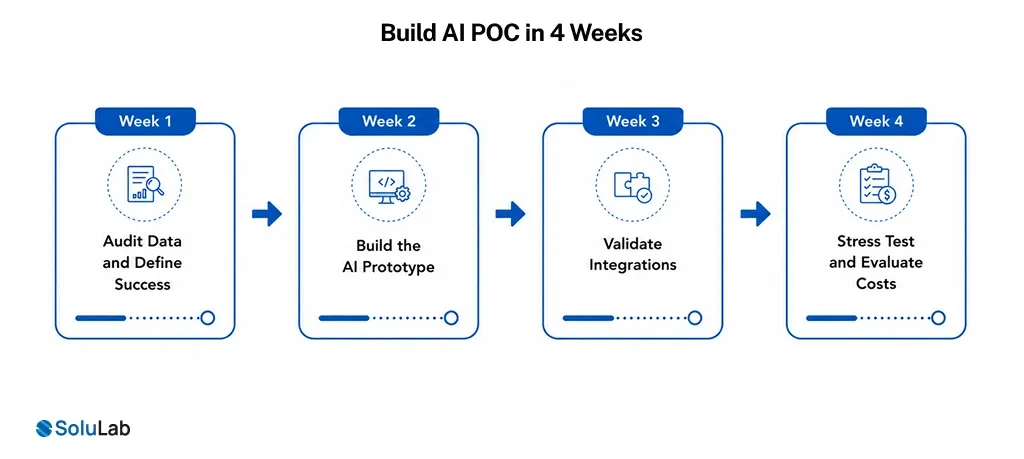
Week 1: Audit Data and Define Success
Before touching models, evaluate the foundation.
Questions to answer:
- Is the data complete?
- Is sensitive information present?
- Are datasets usable for training or retrieval?
- Can performance be measured objectively?
Avoid vague goals like: Improve productivity
Use measurable targets like: Reduce contract review time from 8 days to under 15 minutes while maintaining 94% accuracy.
This stage often determines whether the project proceeds or stops. And honestly, stopping early can save thousands.
Week 2: Build the AI Prototype
This is where AI Prototype Development begins.
Teams typically build:
- Retrieval-Augmented Generation (RAG) systems
- Document intelligence solutions
- AI copilots
- Agent-based workflows
- Predictive analytics models
Popular platforms include:
- Amazon Web Services Bedrock
- Microsoft Azure AI Foundry
- Anthropic Claude models
- Meta Llama models
The goal is simple.
Use actual business data rather than synthetic demo datasets.
Week 3: Validate Integrations
A great AI model means nothing if it cannot communicate with business systems.
Validation should include:
- ERP connections
- CRM integrations
- Internal databases
- Document repositories
- Workflow automation tools
This stage uncovers hidden technical debt before larger investments occur.
Week 4: Stress Test and Evaluate Costs
This is where many projects get exposed.
Teams should intentionally challenge the system using:
- Complex prompts
- Edge-case scenarios
- Multi-step reasoning tasks
- Unexpected user inputs
At the same time, calculate:
- Cost per query
- Infrastructure expenses
- Monitoring costs
- Model maintenance costs
A PoC should produce a clear Go or No-Go decision. Not a “maybe.”
How Does AI Proof of Concept Development Services Validate Enterprise Architecture?
A PoC should validate the architecture that will eventually support production AI deployment.
The following framework helps organizations evaluate readiness.
| Architecture Layer | PoC Validation Focus | Future Production Objective |
|---|---|---|
| Data & Vector Layer | Search accuracy, chunking strategy, ingestion quality | Real-time retrieval and automated data synchronization |
| Model & Agent Layer | Prompt performance, workflow logic, and reasoning quality | LLMOps workflows, model routing, continuous optimization |
| Governance Layer | Access controls, PII masking, guardrails | Compliance monitoring, regional data requirements, audit controls |
A modular architecture prevents expensive rebuilds later. Nobody wants to discover six months later that the foundation cannot support growth.
How Do AI PoC Services Reduce Enterprise Risk?
Risk reduction is one of the biggest reasons enterprises invest in AI Proof of Concept Solutions.
Data Privacy Validation
Organizations need to verify that confidential information remains protected throughout processing.
This becomes especially important for:
- Healthcare
- Financial services
- Insurance
- Government applications
Compliance Readiness
A PoC can evaluate requirements related to:
- GDPR
- MiCA
- Regional data residency laws
- Internal governance policies
Vendor Flexibility
Many organizations worry about being locked into a single provider. Modern architectures often use:
- Semantic Kernel
- LangChain
- Custom middleware
This allows businesses to switch models when pricing, performance, or capabilities change.
Hallucination Detection
Large language models can produce incorrect outputs with surprising confidence. A PoC helps identify:
- Factual inaccuracies
- Retrieval failures
- Workflow breakdowns
- Agent coordination issues
Finding these issues early is dramatically cheaper than fixing them after deployment.
What Is the Difference Between AI Proof of Concept, MVP, and Pilot?
One of the biggest reasons AI projects go off track is simple: stakeholders use PoC, MVP, and Pilot as if they mean the same thing.
They don’t.
Each stage answers a different business question and requires a different level of investment, technical effort, and organizational commitment.
Skipping stages or choosing the wrong one often leads to wasted budgets, unrealistic expectations, and months of unnecessary rework.
1. AI Proof of Concept (PoC): Can This Actually Work?
An AI Proof of Concept (PoC) focuses on technical feasibility.
The objective is not to build a complete product. The goal is to validate whether AI can solve a specific business problem using real company data and existing systems.
A PoC typically includes:
- Data readiness assessment
- Small-scale model implementation
- RAG or AI agent validation
- Integration feasibility checks
- Performance and accuracy testing
- Compliance and security validation
Questions a PoC answers:
- Can the model achieve the required accuracy?
- Is our data suitable for AI?
- Will integration with existing systems be possible?
- Are there regulatory or governance challenges?
Typical AI PoC Development Cost
The cost depends on complexity, integrations, and data quality.
- Basic AI PoC: $10,000 to $25,000
- Mid-level enterprise PoC: $25,000 to $60,000
- Advanced multi-agent or industry-specific PoC: $60,000 to $150,000+
Enterprise Recommendation
If there is uncertainty around data quality, compliance requirements, or model performance, start with a PoC.
Do not jump directly into development because everyone is excited about AI. That’s how budgets disappear faster than free pizza at a startup meetup.
2. AI MVP: Will Users Find Value in It?
Once feasibility is proven, the next question becomes:
Will employees, customers, or partners actually use the solution?
This is where an AI MVP development approach comes in.
An MVP introduces real users into the equation while keeping functionality intentionally limited.
Typical MVP components include:
- User dashboards
- Workflow automation
- Authentication systems
- Core AI functionality
- Basic reporting
- Initial integrations
Questions an MVP answers:
- Does the solution solve a real problem?
- Are users adopting it?
- Is it improving operational efficiency?
- Does it create measurable business value?
Typical AI MVP Development Cost
- Simple AI MVP: $25,000 to $75,000
- Enterprise AI MVP: $75,000 to $250,000
- Multi-agent AI platforms: $250,000 to $500,000+
Companies like OpenAI, Notion, and Jasper all launched with focused product experiences before expanding functionality. They validated user value first instead of building every possible feature.
Enterprise Recommendation
Move to an MVP only after the PoC proves the technology works.
Many organizations make the mistake of treating an MVP as a validation exercise. By that stage, significant money is already committed.
3. AI Pilot: Can This Survive Real Business Operations?
A pilot is the final checkpoint before broader deployment.
At this stage, technical feasibility and user value have already been validated.
The focus shifts to operational performance.
A pilot typically includes:
- Production data pipelines
- Monitoring systems
- Security controls
- Governance policies
- Real-world workloads
- Department-wide testing
Questions a pilot answers:
- Can the system handle actual business volume?
- Will it remain accurate under load?
- Can support teams manage it effectively?
- Are compliance requirements fully satisfied?
Typical AI Pilot Cost
- Small department pilot: $50,000 to $150,000
- Enterprise pilot: $150,000 to $500,000
- Highly regulated industries: $500,000+
Large organizations such as JPMorgan Chase, Morgan Stanley, and Siemens frequently run controlled pilot programs before broader AI rollouts. This helps them validate operational readiness without exposing the entire organization to unnecessary risk.
Enterprise Recommendation
A pilot should never be the first step.
If your AI initiative has not yet proven feasibility or business value, running a pilot is like stress-testing a car before confirming the engine works.
How Should Founders and Enterprises Choose the Right Starting Point?
Use a PoC when:
- You are testing a completely new AI use case.
- Data quality is uncertain.
- AI accuracy requirements are strict.
- Leadership needs evidence before allocating larger budgets.
- Compliance risks need validation.
Use an MVP when:
- The AI model already works.
- User adoption is the next challenge.
- Product-market fit needs validation.
- Core workflows are defined.
Use a Pilot when:
- Multiple users are actively using the system.
- Governance frameworks are established.
- Infrastructure is production-ready.
- Deployment decisions are approaching.
A Practical Budgeting Framework
For most enterprises, a realistic progression looks like this:
| Stage | Primary Goal | Typical Timeline | Estimated Cost Range |
| AI Proof of Concept (PoC) | Validate technical feasibility, data readiness, and performance benchmarks before larger investments. | 4 to 8 weeks | $10,000 to $150,000 |
| AI MVP Development | Validate business value, user adoption, and workflow effectiveness with a functional product. | 2 to 6 months | $25,000 to $500,000+ |
| AI Pilot Program | Test operational readiness, security controls, governance requirements, and production workloads. | 2 to 4 months | $50,000 to $500,000+ |
| Full Production Deployment | Roll out the AI solution across departments, customers, or enterprise-wide operations. | 3 to 12+ months | $100,000 to several million dollars, depending on infrastructure, integrations, user volume, and AI workloads. |
The smartest organizations treat these stages as investment checkpoints rather than development milestones. Each stage should provide enough evidence to justify the next round of spending.
That approach prevents teams from building expensive AI systems nobody uses, which, unfortunately, is still one of the most common outcomes in enterprise AI today.
How Are Enterprises Using AI PoC Development Company Expertise?
The most successful AI proof of concepts are not built around generic chatbots or public demos. Enterprises are increasingly validating AI against real operational challenges where accuracy, compliance, and measurable business outcomes matter.
Before committing hundreds of thousands of dollars to production deployment, organizations use AI PoC Development Services to test technical feasibility, integration complexity, regulatory requirements, and expected ROI.
Here are two real-world examples that demonstrate how enterprise AI PoCs evolve into business-critical solutions.
Real Estate Tokenization and Compliance Automation
The Challenge
Real estate transactions often involve multiple stakeholders, manual compliance checks, lengthy onboarding procedures, and fragmented documentation. These inefficiencies create delays that directly impact liquidity and operational costs.
Before investing in a full-scale platform, organizations need to validate whether AI can automate compliance workflows while maintaining regulatory standards.
The AI PoC Approach
A real estate tokenization platform developed by SoluLab began as a validation initiative focused on:
- AI-driven investor onboarding
- Automated KYC and AML verification
- Property document analysis
- Regulatory compliance checks
- Smart contract validation
- Asset fractionalization workflows
The proof of concept tested whether AI could accurately process property documents, verify investor eligibility, and reduce manual compliance efforts.
What Was Validated?
The PoC evaluated:
- Document extraction accuracy
- Compliance decision automation
- Property valuation support workflows
- Investor verification speed
- Integration with blockchain-based ownership records
Using frameworks such as:
- ERC-3643 security token standards
- Solana Token Extensions
- AI-powered compliance engines
the platform demonstrated how digital asset transactions could move from days of manual review toward near real-time processing.
Enterprise Takeaway
For enterprises exploring asset tokenization, a PoC should validate compliance automation first.
The biggest risk is rarely the blockchain layer.
It is usually regulatory workflows and document verification processes that create bottlenecks.
Hyperledger-Based Procurement and Contract Automation
The Challenge
Global procurement and supply chain operations involve thousands of transactions across suppliers, logistics providers, financial institutions, and compliance teams.
Traditional systems often struggle with:
- Manual contract verification
- Payment reconciliation delays
- Supply chain visibility gaps
- Cross-border compliance requirements
Before deployment, enterprises need proof that automation can operate reliably under strict governance controls.
The AI and Blockchain PoC Approach
Using Hyperledger Fabric, SoluLab designed proof of concept environments that combined:
- Smart contract automation
- Procurement workflow management
- Compliance verification
- Transaction monitoring
- Supply chain intelligence
Unlike public blockchain networks, Hyperledger enables permissioned access where only authorized participants can view specific transaction data.
What Was Validated?
The PoC focused on:
Contract Automation
- Purchase order verification
- Vendor agreement validation
- Automated milestone tracking
Supply Chain Visibility
- Logistics event monitoring
- Shipment verification
- Inventory movement tracking
Payment Processing
- Smart contract-triggered settlements
- Automated escrow mechanisms
- Cross-border transaction workflows
Governance Controls
- Role-based access management
- Audit trail generation
- Compliance reporting
Organizations operating within highly regulated industries, including healthcare and multinational supply chains, commonly use these validation exercises before scaling deployment.
Enterprise Takeaway
For procurement and supply chain applications, the biggest value often comes from validating business workflows rather than validating blockchain technology itself.
The technology is usually the easy part.
Getting contracts, suppliers, finance teams, and compliance stakeholders aligned is where the real challenge begins.
Why Choose an AI Development Company for AI Proof of Concept Development?
Building a PoC internally sounds straightforward.
In reality, many teams underestimate data preparation, architecture design, and validation requirements.
An experienced AI PoC development company like SoluLab can help by:
- Defining realistic success metrics
- Assessing data readiness
- Designing retrieval and agent architectures
- Evaluating compliance requirements
- Measuring commercial viability
- Planning MVP and production roadmaps
The result is faster validation and fewer expensive surprises.
For organizations exploring custom AI development, this often becomes the difference between a successful launch and another abandoned experiment.
Conclusion
The purpose of AI Proof of Concept Development is not to impress stakeholders with a chatbot demo. Its purpose is to generate evidence.
A successful PoC validates technical feasibility, data readiness, operational impact, compliance requirements, and commercial viability before larger investments occur.
Whether you are evaluating document intelligence, AI agents, underwriting automation, customer support systems, or tokenization workflows, a structured PoC helps answer the questions that matter most.
Can it work with your data? Can it meet your performance requirements?
Can it justify the investment? If the answer is yes, you move forward with confidence. If not, you save months of effort and a significant budget. Either outcome is a win.
FAQs
Deepika is a content writer who blends storytelling with strategic thinking. She explores topics across digital innovation, emerging tech, and the evolving blockchain industry. She enjoys breaking down complex ideas into simple, engaging narratives in the growing global markets.