Key Takeaways
- Agentic AI helps retailers reduce stockouts through predictive inventory forecasting and autonomous replenishment.
- Retail merchandising becomes faster and more efficient with real-time AI-driven decision-making.
- AI-powered inventory optimization improves product availability and customer satisfaction across retail channels. Retailers can increase profit margins by minimizing overstocking, waste, and operational inefficiencies.
- Agentic AI enables smarter demand forecasting using real-time customer and sales data.
- AI-driven merchandising supports omnichannel retail operations with synchronized inventory management.
Retailers today face constant challenges with inventory shortages, overstocking, and changing customer demand. Traditional merchandising systems often struggle to react to market behavior, leading to lost sales.
However, with AI agent development solutions, retail merchandising is changing by combining autonomous AI agents, predictive analytics, and inventory. Retailers can automate merchandising decisions, reduce stockouts, and improve product availability.
Modern AI-powered retail merchandising systems also help businesses optimize inventory turnover and reduce waste. In fact, according to Gartner, 70% of large organizations will adopt AI-based forecasting for demand prediction by 2030.
Why Retailers Should Invest in Agentic AI Merchandising Systems?
Retailers are increasingly adopting agentic AI merchandising systems to improve inventory accuracy, automate decision-making, reduce stockouts, and deliver personalized shopping experiences while maximizing operational efficiency and profitability. The global AI in retail market is expected to reach USD 40.74 billion by 2030, growing at a CAGR of 23.0%.
- Inaccurate demand forecasting: Traditional merchandising systems struggle to predict changing consumer demand patterns, leading to stock imbalances, lost sales opportunities, and excess inventory management challenges.
- Delayed inventory replenishment: Manual restocking processes slow inventory movement, causing frequent stockouts and reducing customer satisfaction across both physical stores and digital retail channels.
- Limited real-time visibility: Retailers often lack unified inventory visibility across warehouses, stores, and eCommerce platforms, limiting faster operational decisions and accurate stock allocation.
- High inventory carrying costs: Overstocked products increase warehousing expenses, inventory waste, and markdown losses, negatively impacting overall retail profitability and operational efficiency.
- Slow merchandising decisions: Legacy retail systems depend heavily on manual analysis, delaying pricing adjustments, assortment planning, and promotional strategies in rapidly changing market conditions.
- Poor customer experience: Product unavailability and inaccurate stock information frustrate customers, reducing brand loyalty and increasing cart abandonment rates in competitive retail environments.
- Inefficient supply chain coordination: Disconnected supply chain systems create communication gaps between suppliers, warehouses, and retail stores, slowing replenishment and inventory optimization processes.
- Lack of personalized merchandising: Traditional merchandising systems fail to deliver personalized product recommendations and localized inventory planning based on customer preferences and buying behavior.

How Agentic AI for Retail Merchandising Works?
Agentic AI for businesses is transforming retail operations by enabling autonomous inventory decisions, predictive demand planning, and intelligent stock optimization across stores, warehouses, and digital channels using AI-powered retail merchandising systems.
- Real-time inventory monitoring across channels: AI continuously tracks inventory movement across online platforms, physical stores, and warehouses, helping retailers prevent stock discrepancies and maintain accurate product availability.
- AI-driven demand forecasting: AI analyzes historical sales, customer behavior, seasonal trends, and external market signals to forecast product demand and improve inventory planning accuracy.
Read more- AI for Demand Forecasting
- Autonomous replenishment and stock allocation: AI systems automatically trigger replenishment decisions and optimize stock distribution across retail locations, reducing stockouts, overstocking, and unnecessary inventory holding costs.
- Integration with POS systems: AI-powered retail merchandising integrates with retail technology ecosystems, enabling synchronized data sharing, faster operational decisions, and end-to-end inventory visibility.
Why Retailers Struggle With Stockouts and Margin Losses?
Retailers often struggle with inventory inefficiencies, delayed decision-making, and unpredictable customer demand, making retail merchandising with agentic AI frameworks essential for improving operational accuracy, reducing stockouts, and protecting profit margins.
- Inaccurate demand forecasting: Traditional forecasting models fail to capture real-time buying behavior, causing retailers to understock high-demand products or overstock slow-moving inventory across multiple retail channels.
- Manual merchandising and delayed replenishment cycles: Human-dependent inventory planning slows replenishment decisions, creating supply gaps, delayed shelf restocking, and missed sales opportunities during peak shopping periods.
- Overstocking and dead inventory issues: Poor inventory visibility leads retailers to over-purchase products, increasing warehouse costs, unsold inventory accumulation, markdown losses, and reduced overall profitability margins.
- Fragmented supply chain visibility: Disconnected retail systems limit real-time inventory tracking, making it difficult for businesses to coordinate suppliers, warehouses, stores, and logistics operations efficiently using agentic AI for retail operations.
- Pricing and seasonal demand fluctuations: Rapid changes in consumer preferences, promotions, and seasonal demand make pricing and inventory optimization difficult without intelligent AI-driven merchandising systems.
How Agentic AI Reduces Stockouts in Retail Merchandising?
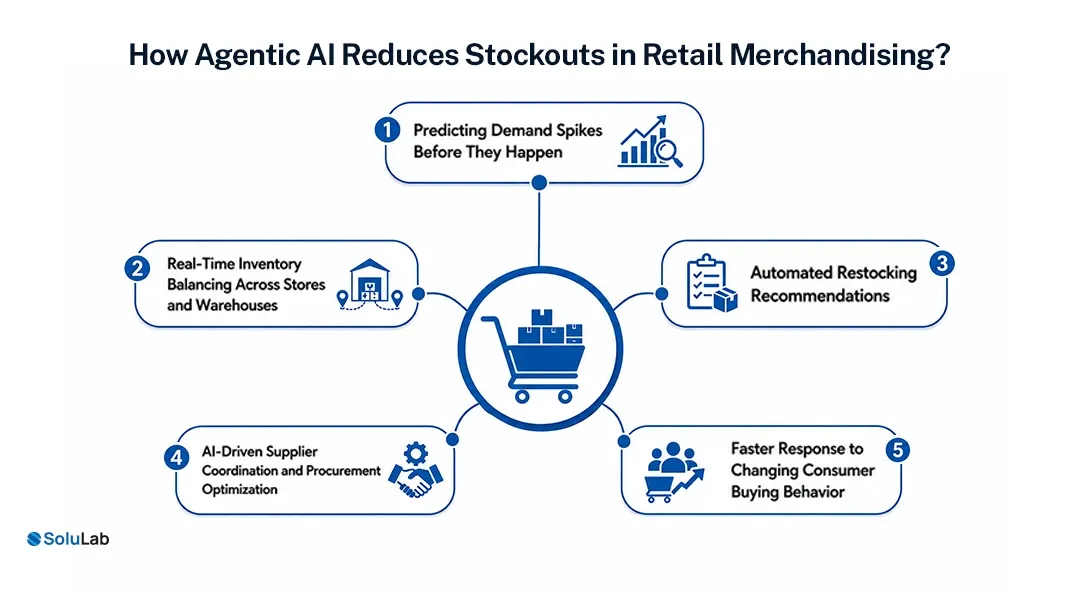
AI development solutions are helping retailers reduce stockouts by improving inventory visibility, predicting demand fluctuations, automating replenishment workflows, and enabling faster merchandising decisions across complex omnichannel retail ecosystems.
1. Predicting Demand Spikes Before They Happen
Agentic AI analyzes seasonal trends, promotions, weather patterns, and customer behavior to forecast sudden demand surges, helping retailers prevent inventory shortages before they impact sales.
2. Real-Time Inventory Balancing Across Stores and Warehouses
AI systems continuously monitor stock availability across retail locations and warehouses, automatically redistributing inventory to maintain optimal product availability and reduce fulfillment delays.
3. Automated Restocking Recommendations
AI-powered platforms generate intelligent replenishment suggestions using real-time sales data, inventory movement, and predictive analytics, improving operational efficiency while minimizing manual inventory planning efforts.
4. AI-Driven Supplier Coordination and Procurement Optimization
Agentic AI improves supplier communication, procurement scheduling, and delivery forecasting, helping retailers maintain stable inventory flow while reducing disruptions in supply chain operations.
5. Faster Response to Changing Consumer Buying Behavior
Retailers using AI-driven shelf optimization can quickly adapt merchandising strategies based on changing customer preferences, purchasing patterns, and regional demand fluctuations across multiple retail channels.
How to Implement Agentic AI in Retail Organisations?
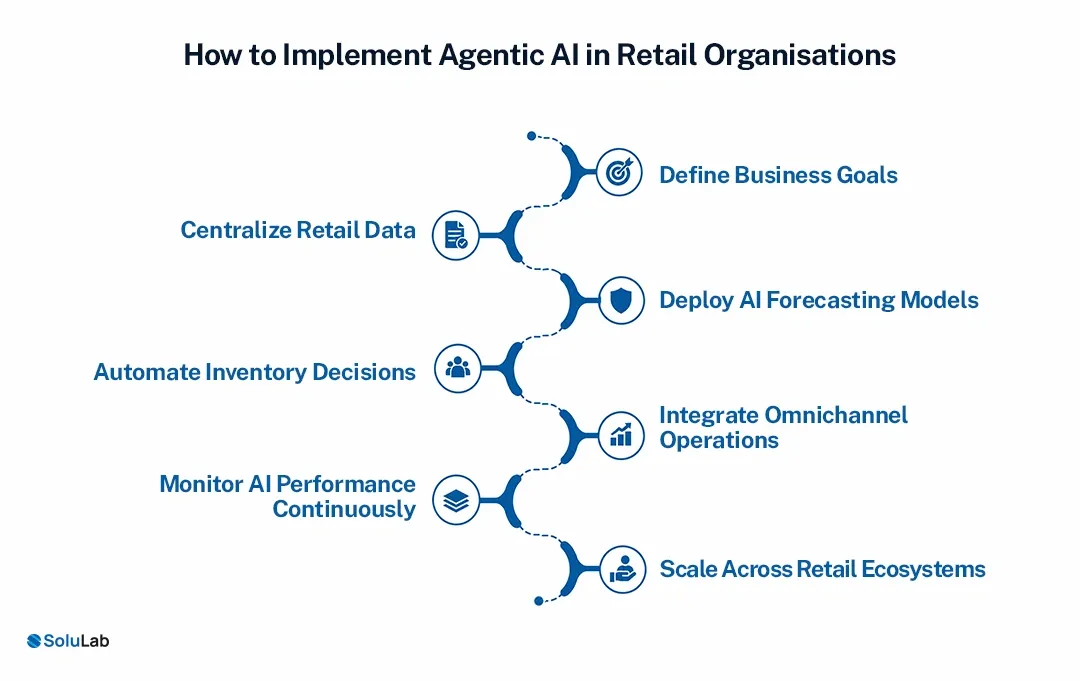
Retail organizations are adopting AI native approach to automate merchandising decisions, improve inventory accuracy, reduce stockouts, and create data-driven retail operations that respond intelligently to changing customer demand patterns.
Step 1. Define Business Goals
Identify specific retail challenges like stockouts, overstocking, pricing inefficiencies, or poor demand forecasting. Clear business objectives help organizations implement agentic AI systems aligned with operational priorities and measurable retail performance outcomes.
Step 2. Centralize Retail Data
Integrate inventory, POS, supply chain, customer behavior, and sales data into a unified system. High-quality centralized data enables agentic AI models to generate accurate insights and autonomous merchandising decisions.
Step 3. Deploy AI Forecasting Models
Implement predictive AI models that analyze historical trends, seasonal patterns, and consumer demand fluctuations. These systems help retailers forecast inventory requirements and optimize stock allocation across multiple locations.
Step 4. Automate Inventory Decisions
Enable AI agents to autonomously manage replenishment recommendations, stock balancing, and procurement workflows. Automated decision-making reduces manual intervention while improving inventory availability and operational responsiveness.
Step 5. Integrate Omnichannel Operations
Connect AI systems across online stores, warehouses, and physical retail outlets. Omnichannel AI integration allows agentic AI to synchronize inventory visibility and maintain consistent customer experiences across all shopping channels.
Step 6. Monitor AI Performance Continuously
Track AI-driven merchandising decisions using KPIs like stock availability, inventory turnover, sales growth, and margin improvements. Continuous monitoring helps retailers refine models and improve long-term operational accuracy.
Step 7. Scale Across Retail Ecosystems
After successful pilot implementation, expand agentic AI capabilities across departments, regions, and supply chain networks. Scalable AI infrastructure enables retailers to achieve enterprise-wide merchandising automation and efficiency improvements.
Benefits of Agentic AI for Retail Merchandising
Agentic AI is transforming retail merchandising by improving inventory accuracy, automating merchandising decisions, enhancing operational efficiency, and helping retailers deliver better shopping experiences while maximizing profitability across channels.
- Improved customer satisfaction: AI-driven inventory forecasting ensures popular products remain consistently available, reducing stockouts and improving customer trust, loyalty, and overall shopping experiences across retail platforms.
- Faster merchandising decisions: Autonomous AI agents analyze sales trends, customer behavior, and inventory data instantly, enabling retailers to make faster merchandising and replenishment decisions with minimal human effort.
- Enhanced operational efficiency across retail channels: Generative AI in the retail industry improves coordination between warehouses, stores, and e-commerce platforms, streamlining supply chain operations and reducing delays across omnichannel retail ecosystems.
- Better inventory turnover: Agentic AI optimizes stock allocation and demand forecasting, helping retailers reduce excess inventory, minimize unsold products, and improve overall inventory turnover rates efficiently.
Real-World Use Cases of Agentic AI in Retail Merchandising
Agentic AI is changing retail merchandising by helping businesses automate inventory decisions, predict customer demand, optimize stock allocation, and improve operational efficiency across physical stores and digital commerce channels. Some of the popular AI use cases include:
1. Grocery and Supermarket Inventory Optimization
Agentic AI monitors real-time inventory levels, predicts demand fluctuations, and automates replenishment processes, helping supermarkets reduce food waste, avoid stock shortages, and improve product availability across locations.
2. Fashion Retail Demand Prediction
Fashion retailers use agentic AI to analyze seasonal buying patterns, social trends, and customer preferences, enabling accurate demand forecasting and reducing overstocking or unsold inventory risks.
3. Electronics and Omnichannel Retail Merchandising
AI-powered merchandising systems synchronize inventory across physical stores, e-commerce platforms, and warehouses, ensuring accurate stock visibility and seamless customer experiences across multiple retail channels.
4. E-commerce Stock Management Automation
Agentic AI automates stock monitoring, warehouse allocation, and order fulfillment processes, helping e-commerce businesses manage inventory efficiently while minimizing delayed deliveries and stockout-related revenue losses.
5. Seasonal and Promotional Inventory Planning
Retailers use agentic AI to forecast promotional demand spikes, optimize product allocation, and prevent inventory shortages during seasonal sales events, festive campaigns, and high-traffic shopping periods.
Future of Agentic AI for Retail Merchandising
Agentic AI is reshaping the future of retail merchandising by enabling autonomous operations, intelligent inventory management, personalized shopping experiences, and predictive retail ecosystems driven by continuous real-time learning capabilities.
- Autonomous retail ecosystems: AI agents independently manage inventory, pricing, merchandising, and replenishment decisions, reducing manual intervention while improving operational efficiency across physical stores, warehouses, and digital retail platforms.
- Hyper-personalized shopping experiences: Agentic AI analyzes customer behavior, purchase history, and preferences to deliver tailored product recommendations, personalized promotions, and highly relevant shopping experiences in real time.
- AI-powered smart stores and cashierless retail: Smart retail environments use computer vision, sensors, and autonomous AI systems to automate checkout processes, optimize shelf management, and enhance in-store customer convenience.
- Predictive supply chain orchestration: AI-driven forecasting systems predict inventory demand fluctuations, supplier delays, and market trends, helping retailers optimize procurement, logistics, and multi-location inventory distribution efficiently.
- Self-learning merchandising systems: Advanced AI merchandising systems continuously learn from customer interactions, sales performance, and operational data to improve decision-making accuracy and adapt strategies automatically over time.
How SoluLab Can Help With Agentic AI for Retail Merchandising?
SoluLab helps retailers build merchandising ecosystems using an AI native approach, enabling faster inventory decisions, autonomous retail operations, improved forecasting accuracy, and scalable AI-driven retail optimization strategies.
- AI Demand Forecasting Solutions
- Autonomous Inventory Management Systems
- AI-Powered Merchandising Automation
- Predictive Supply Chain
- Retail Analytics Dashboard Development
- Multi-Channel Inventory Synchronization
- AI Agent Development for Retail Operations
- Smart Replenishment and Stock Allocation Systems
- Retail ERP and POS AI Integrations
- Omnichannel Retail AI Platforms
For example, ShopSmart improved RetailPro’s operations using Gen AI. From real-time inventory tracking to hyper-personalized marketing, AI solutions improved sales conversions, reduced operational costs, and boosted customer retention.
With centralized data and automated workflows, RetailPro saw faster decision-making, lower inventory holding costs, and a data-driven retail experience across 500+ stores.

Conclusion
Agentic AI is improving retail merchandising by helping businesses reduce stockouts, improve inventory visibility, automate replenishment, and increase profit margins through decision-making.
With real-time analytics, predictive forecasting, and autonomous AI agents, retailers can respond faster to changing customer demands while minimizing waste and operational inefficiencies.
Businesses looking to modernize retail operations and build scalable AI-powered merchandising solutions can partner with SoluLab, an AI development company in USA, that can help transform retail workflows with advanced AI solutions.
FAQs
Neha is a curious content writer with a knack for breaking down complex technologies into meaningful, reader-friendly insights. With experience in blockchain, digital assets, and enterprise tech, she focuses on creating content that informs, connects, and supports strategic decision-making.